Showing posts with label teachers pay teachers. Show all posts

Sunday, January 05, 2025

New Jersey Drones ... never forget

As 2024 came to a close, the skies over New Jersey seemed to be cluttered with unexplained drones. Stories of these UFO drones filled social and mainstream media for a few weeks. News Nation hit the story hard, but other 24-hour news networks covered the story at length, too. 

What's stunning about most of the footage is the "blobsquatch" nature of it: digitally zoomed, out of focus. This is nearly always the case: it's always easier to attach mystery to blurry images; in-focus images are easily identified as non-mysterious things.

Some of the flying lights might well have been ... drones. Drones are not new; flying them at night is allowed. But some of the "drone panic" footage was clearly video of commercial aircraft taking off or landing at night. If I were trying to claim these lights were absolutely not airplanes, I wouldn't just say, "those are definitely not planes" (as they do in the News Nation special report). I would shoot nighttime take-offs and landings of commercial aircraft from a distance and document how my UAP footage was so vastly different.

But there's more going on here, and in the attention economy that the media exists in now, the New Jersey drones represented a potential ratings bonanza. The incentive structure3 demands fanning the flames and strictly prohibits debunking the phenomenon.

Crooked Media's podcast, "What A Day" ran an occasional series called "How We Got Here." That series has been discontinued, but its final episode was devoted to the 2024 New Jersey drone panic: "The New Jersey Drones Mass Delusion, Explained."

The well-researched episode includes references War of the Worlds, Havana Syndrome, evil clowns, and the Salem witch trials. Hosts Max Fisher and Erin Ryan have answers. And I have questions.

It's 2025, and podcasts are a thing. A big thing, and getting bigger. I've done many question sets for film and video presentations. This is my first question set for a podcast. I don't think it will be my last.


[The "What a Day" podcast series is given an "Explicit" rating. This episode merits a TV-14 rating at worst. It is safe for school.]

I added the "never forget" tag to the title because the typical pattern with these phenomena is that they fade quickly from public memory once something newer/shinier comes along. Those who absorb the lessons of the New Jersey Drone Panic of 2024 will find themselves less panicked when the next mass delusion arises. 

I hope News Nation leaves their purely speculative conspiracy specials up for us to review for years to come. They're great examples of what it looks like when a media outlet manufactures a panic out of nothing. Military bases, check. Alien intelligence at work, check. "They" don't wasn't us to know, an absolute must! The "shoot 'em down" ethos is straight out of science fiction/American militarism Hollywood storyboards. Given that many of the "UFO drones" are commercial aircraft, do we want to imagine how that instinct would play out?

Friday, May 06, 2022

Tangled Up With You

A theoretical physicist walks into a bar. Specifically, Jim Al-Khalili walks into a recreation of a in 1920s speakeasy where a prohibition-era band is performing. It's a scene from The Secrets of Quantum Physics, episode 1: "Einstein's Nightmare" in which quantum entanglement is the theme. While Al-Khalili lists a few details to chronicle the zeitgeist while enjoying a beverage from his table, the club's chanteuse croons lamentingly of a love she cannot leave.

But careful observers quickly realize this is no ordinary torch song. It's infused with subtle physics cues. I appreciate the production team going the extra mile to create a gem that might be lost on many viewers. So after watching the episode, I hit the Internet to track down the details. 

Enjoy the fruits of my post-viewing web quest:


I found lyrics to Nick Goodman's ditty online. They had a few errors, so here's my corrected accounting. 

You got a heart but there's no way of knowing

Can see where you are but can't see where you are going

And I'm stuck here still

I'm tangled up with you

I know I deserve you

I know you're my savior

But when I observe you

You change your behavior

So I'm stuck here still

I'm tangled up with you

This whole world can be...

So uncertain

But you can bet that I'll still be hurting

When you say our wedding vows to somebody else

Well I've seen some things

I've been around

But darling there ain’t a finer thing that I've found

I'll always be so tangled up with you

I'll always be so tangled up with you

Eliza's Uncertainty - Voice: Eliza Shea, Bass: Misha Mullov-Abbado, Clarinet: Anthony Friend, Trombone: Vij Prakash, Guitar/Composition: Nick Goodwin


And I did manage to craft a question set for The Secrets of Quantum Physics. Episode 1, "Einstein's Nightmare," gets us up to speed on quantum entanglement ("spooky action at a distance"). Episode 2, "Let There Be Life," takes us into the nascent world of quantum biology. Many people might not even know quantum biology is a thing.

Tuesday, July 20, 2021

One document format to rule them all

When the pandemic hit and schools closed down, I was knocked on my backside pretty hard in many ways.

One thing I found I needed to do—and quickly—was to convert my student curriculum documents into Google Docs format so that I could deploy them in Google Classroom. I had virtually no experience in Google Docs or Google Classroom. And I was facing four preps: Physics, AP Physics 1, AP Physics 2, and Conceptual Physics. A considerable mountain of work loomed.

I'm confident that my colleagues handled the transition better than I did. But I did my best. I transformed many of my documents (Apple Keynote files/PDFs) originally intended for printing and photocopying to Google Docs format for use in distance learning. I leveraged features that made the documents both student and teacher friendly. 

When school morphed again into "hybrid" (which will likely go down in history as the worst model of instruction ever implemented), the Google Docs fell a bit short. Certain elements that made the Google Docs useful for distance learning made them difficult to use for in-person instruction. I could use the old PDFs in-person and the new Google Docs for distance, but multiplying that load by four preps made that unpalatable.

A few modifications made the Google Docs versatile enough to be used successfully for both in-person and distance learning. I refer to these as Print-Friendly Google Docs. One file to rule them all. Precious to me!

In the summer of 2020, I whirled Dervishly to convert my Lessons of Phyz products from PDFs to Google Docs because if I needed Google Docs for remote teaching, so would everyone else. This summer, I am working feverishly to transform those Google Docs to Print-Friendly Google Docs because who knows what's next?

Breakthrough: Ideas that Changed the World, How Earth Made Us, Our Planet, One Strange Rock, and Pandemic are done. Everything else remains in progress or in the queue. 

And at long last, I finished a new product! First real, new item since Pandemic [Netflix series] in March, 2020. I branched out into chemistry with Jim Al-Khalili's BBC series, Chemistry: A Volatile History. I'll probably work on David Pogue's chemistry NOVAs next. This item is the first to be offered as a Google Drive digital download. No PDFs; no Zips. I foresee all my new products being posted to TpT that way.

Digital document evolution. I do not foresee an end to that.

Saturday, March 20, 2021

RT;DL Physics in the Fountain of Fizz

The Diet Coke Mentos geyser made a big splash in popular media before social media was a big thing. I was keen to incorporate it into my curriculum, but needed a content-based hook. Mythbusters (among others) focused on the chemistry of the spectacle. That was entirely cromulent: it's the engine that drives the demonstration. 

But I teach physics. And there's plenty of physics to exploit. Between the beginning and end of the eruption, some quantity of mass is ejected. Mass flow rate? Check. The fizz emerges from the bottle with some speed and reaches some altitude above the launch point. Energy conservation? Check. Determination of muzzle speed from maximum height? Check. Total energy dissipation approximation? Check. Power approximation? Check.

My school is a 1960s-era low-slung, sprawling campus. Determining the maximum height of the eruption is non-trivial. Most buildings top out at about three meters. We do have an accessible tall (~6 m) wall made of cinder blocks as part of our gymnasium. So that's what we settled on.

Initial mass is measured. Video is captured. Final mass is measured. The video is analyzed. Calculations are made.

Physics in the Fountain of Fizz [Virtual Demonstration] on Teachers Pay Teachers

Wednesday, March 10, 2021

RT;DL Introductory Wave Activities

At this point, I think we all have our own favorite PhET sims. You might be able to start a fight among physics teachers by proclaiming your favorite is the best PhET sim of them all. But honestly, what's not to love about John Travoltage? 

Actually, I think Wave Interference is my favorite. (Energy Skate Park fans are now unfollowing me on Twitter.)

When we get to wave optics, we use the light module to develop interference pattern mathematics. As we begin the study of mechanical waves, we explore representations in the water wave and sound modules.

Water Waves in an Electric Sink at Teachers Pay Teachers
Students begin with examining a pulse with the sim's various view modes. Then it's on to continuous wave trains while varying frequency and amplitude.

High Quiet Low Loud at Teachers Pay Teachers
Originally developed for use with Pasco's Waveport DataStudio software, this activity has been redesigned around Wave Interference's sound module. This time, the manipulation of amplitude and frequency is accompanied with audio feedback. The sim's "Particle View" feature shows that matter doesn't move much even as a wave propagates across greater distances. Diving deeper, we notice that our sound waves appear to be moving through a solid in the sim.

I couple these with The Mechanical Universe - Episode 18: Waves and Paul Hewitt's Conceptual Physics Alive! Vibrations and Sound I and Vibrations and Sound II to round out much of the introduction to waves.

In any case, I'm sure there's even more to PhET's Wave Interference than I am leveraging. So much groovy wavy goodness!

Sunday, March 07, 2021

RT;DL Magnetic Electricity

The immediate follow-up to the Electric Magnetism activity is the Magnetic Electricity activity. As one might expect, Electric Magnetism explored the ability to produce magnetic fields using electric currents. Magnetic Electricity moves on to using magnetic fields to produce electric currents, with an emphasis on "moves".

Induced current and turning motors into generators are at play in this one.

Student Document (Google Docs)
Observations HTML Export | Movie (link embedded in Student Document)
Answer Key (Google Docs)

Media links are included in the student document. The HTML export is preferred. The movie export is available for use on devices that struggle with the HTML export.

Saturday, March 06, 2021

RT;DL Electric Magnetism

With Ørsted's Discovery, we established that electric currents are surrounded by magnetic fields. In this activity, we extend that to the design of electromagnets and motors. In our traditional, In-Person Learning electricity and magnetism sequence, we would have used our Genecon hand-crank generators to power electric circuits. In short, we would have been familiar with their utility as generators. Here we turn the tables so that the Genecons become motors.

This one is also a bit fiddly in class: St. Louis motors are great, but students will discover all the ways they can go wrong. I don't think that's a bad thing, but there is frustration in the room. You lose that in the RT;DL version. You lose a lot in most RT;DL activities.

But it's a nice sequence of observations, building on Ørsted's Discovery and setting up the next activity: Magnetic Electricity.

Electric Magnetism [Virtual Lab Experiment] at Teachers Pay Teachers includes

Student Document (Google Docs)

Observations (HTML Export | Movie Export linked in Student Document)

Answer Key (Google Docs)

Media links are included in the student document. The HTML export is preferred. The movie export is available for use on devices that struggle with the HTML export.

Enjoy my lack of professional production sets, lighting, and technique. These are all shot in my classroom using classroom apparatus and lighting options, and shot on my iPhone 8. Presentations are created in Apple Keynote and exported as HTML and exported as a movie.

One More Thing: I just noticed this delightful bit of apparatus available from Arbor Scientific. Simple and effective for working out the right-hand rule for the magnetic force on a current-carrying wire.

Monday, March 01, 2021

RT;DL Ørsted's Discovery

This activity explores the magnetic field around a current-carrying wire: Ørsted's Discovery. It's a bit fiddly when we do it in the classroom. The compasses can be thrown off by steel spines and/or leg plates in the tables. To be honest, I've seen compass behavior I cannot explain in my classroom. Perhaps strange things happen to our compasses while they're stored during the off-season. They are stored in proximity to bar magnets.

In any case, I got passably reasonable behavior from my compasses as I recorded the videos for the RT;DL observations of this activity.

Because I was recording the observations on behalf of the students, I provided them to the students in a disorganized way. Students would need to match the randomly sequenced observations with the called-for observations in the activity instructions. It's RT;DL ... you do what you can.

The HTML reports are preferred; the movie exports are provided for users whose devices struggle with the HTML exports. Links to all media are embedded in the student document. 

Apologies for any clumsiness that comes through in the videos. The physical geometry required for recording these events is awkward, and I really didn't invest much time in rehearsal. I was happy to get decent light on my subjects.

Ørsted's Discovery Part B (3D) - Movie Export


Ørsted's Discovery [Virtual Lab Experiment] at Teachers Pay Teachers
Student Document (Google Docs copy link)
Observations (HTML and YouTube)
Answer Key (Google Docs)

Friday, February 26, 2021

RT;DL Seeing Magnetic Fields

This activity shows a magnetic field projectual being used to reveal the magnetic field around various configurations of bar magnets. As with all RT;DLs, this activity began as an in-class lab and has been retooled for online delivery. 

Seeing Magnetic Field - Movie Export

Student Document (Google Docs file)
Observations and Mysteries - HTML Export (this link is in the gdoc, too)
Observations and Mysteries - Movie Export (for devices that cannot run the HTML export—this link is in the gdoc, too)
Answer Key (Google Docs file)

I will confess that I find watching iron filings slowly align with magnetic fields on a large screen to be calmingly satisfying. I suppose it's my ASMR.


Thursday, February 11, 2021

RT;DL Van de Graaff Demonstrations

What may turn out to be the most shocking (yeah, that didn't take long) aspect of my Van de Graaff demonstration sequence is how I could possibly have left your favorite VDG demo out. What was I thinking? By all means, let me have it in the comments—don't hold back.

Charging Ahead - Movie Export

If you can forgive me, I selfishly included all of my favorites. And they're not so bad. My favorites are ones I can mine for good physics that I believe my students can gather and grasp. 

Mop Head, Pie Tins vs. Styrofoam Bowls, Bubble Brigade (soap bubbles), Bad Hair Day, Green Wig, and I Blew My Top. Again, light me up in the comments for omitting the cool VDG demo you do.

There is also an explanation of how the generator works.

Student Document - Google Docs file
Answer Key - Google Docs file
Observations - HTML Export (linked to in the student document)
Observations - Movie Export (for devices that struggle with the HTML export)

Sunday, February 07, 2021

RT;DL Electroscopia

Here is the second qualitative electrostatics lab redesigned and video clip enhanced for use in Distance Learning. The first was "A Pithy Matter" shown in a separate post.

For "Electroscopia," we swap out the pith balls for a can-form electroscope. These were sold with cardboard inserts with angle markings to make them more electrometer-ish. In practice, removing the insert allowed students working on opposite sides of the electroscope to see the pointer without obstruction. 

The activity works through a series of observations involving charge typing, induction, and the differences between conductors and insulators. It closes with some questions students should be able to answer with the benefit of evidence. 

There are appearances of the Fun Fly Stick, a latex balloon, and my head in this activity. Not to be missed!

Here's a taste.


Electroscopia at Teachers Pay Teachers includes:
Student Document (Google Docs)
Observations (HTML export, preferred—linked to in the student document)
Observations (Movie export for devices that struggle with the HTML export)
Mystery Objects and Mystery Charges Observations (link embedded in the Answer Key)
Answer Key (Google Docs)

In practice, students "ask for help" to summon the instructor to their breakout room. Once there, students request an Object or a Charge and identify their room number. The instructor shares their screen while showing the appropriate clip, then leaves the breakout room as students interpret the observations.

Saturday, February 06, 2021

RT;DL A Pithy Matter

Sure, there's some kind of force involved in the rubbed plastic/pith ball interactions. But do we really need to consider it a whole new force? Isn't it just some form of gravity or magnetism? Let's experiment.

This qualitative exploration of electrostatics features: electrostatic attraction and repulsion, a triboelectric sequence (but we don't use the T-word here), an electrophorus (with pronunciation guidance), and two rounds of Pith Ball Ping Pong. What's not to like?

Let me just add that nothing—nothing—turned my most jaded, been-there-done-that high school seniors into elementary students more than this activity. When the pith balls started flying, their giddy glee was an involuntary reaction that expressed itself before they could so much as attempt to stifle it.

A Pithy Matter at Teachers Pay Teachers includes:

Student Document (print-friendly Google Docs)

A Pithy Matter - Observations (HTML export as linked within the GoogleDocs document). This is a sequence of video clips showing interactions between cloth-rubbed plastic and pith balls, with special appearances by an electrophorus (ft. slow-motion electrophorus ping). Here's the movie export of the observations for use on devices that struggle with the HTML export—link also included in gdoc).

A Pithy Matter - Special Observations (HTML export for use by the instructor). They will seem silly to experts with content knowledge, but they are actually critical for the purpose of this activity.

This activity was designed for use with video conferencing (e.g., Zoom). Students need to check in with the instructor to see the "Special Observations". It's a redesign of what was an in-class lab. I consider it a mark of success that I am able to use the same lab quiz (ported to Socrative for online use, of course) to assess student performance on the activity. 

The roughest edge for students in this activity is recognizing that the brick is far and away the "most gravitational" object in the apparatus and how it can be used in this lab. The instructions make an attempt to steer, but still... Once they get past that, most groups catch on to the value of the bar magnet. Most; not all. 

To the best of my knowledge, this activity is not duplicated or even simulated elsewhere in teh interwebz. No Pivots; no PhETs. I will be corrected in the comments if I am mistaken.

In Distance Learning, I'm everyone's lab partner in addition to being the instructor.

Wednesday, November 18, 2020

RT;DL Things That Go Bump!

Which involves more force: stopping or bouncing? Let's demonstrate.


I inherited a stop/bounce dart when I arrived at my school in 1986. You arrange the dart as a pendulum and swing it into a wood block. Back in those days, you ran the unadorned nail point into the block for the stop, and attached a rubber stopped to the nail point for the bounce.

Since then, the advent of "happy" and "sad" balls improved this demo. And happy/sad pendula/mallets have been commercially available (help me out with a link if you know one).

Arrange the dart so that it barely knocks over the block using the happy ball on the tip. Then switch to the sad ball and allow for predictions and arguments. Then proceed with the reveal.

Sunday, October 25, 2020

RT;DL Thermoscope

I was reluctant to post this since thermal physics has been so thoroughly abandoned by NGSS (HSPS) and AP Physics. And also because the apparatus that I use appears to be unavailable. And the ones I was able to get most recently are a bit fiddly to use.

But what the heck? Physics teachers teach across a spectrum and not everyone is beholden to NGSS and AP. And physics teachers are a resourceful bunch: There may be other ways to do this without the exact apparatus I'm using here.

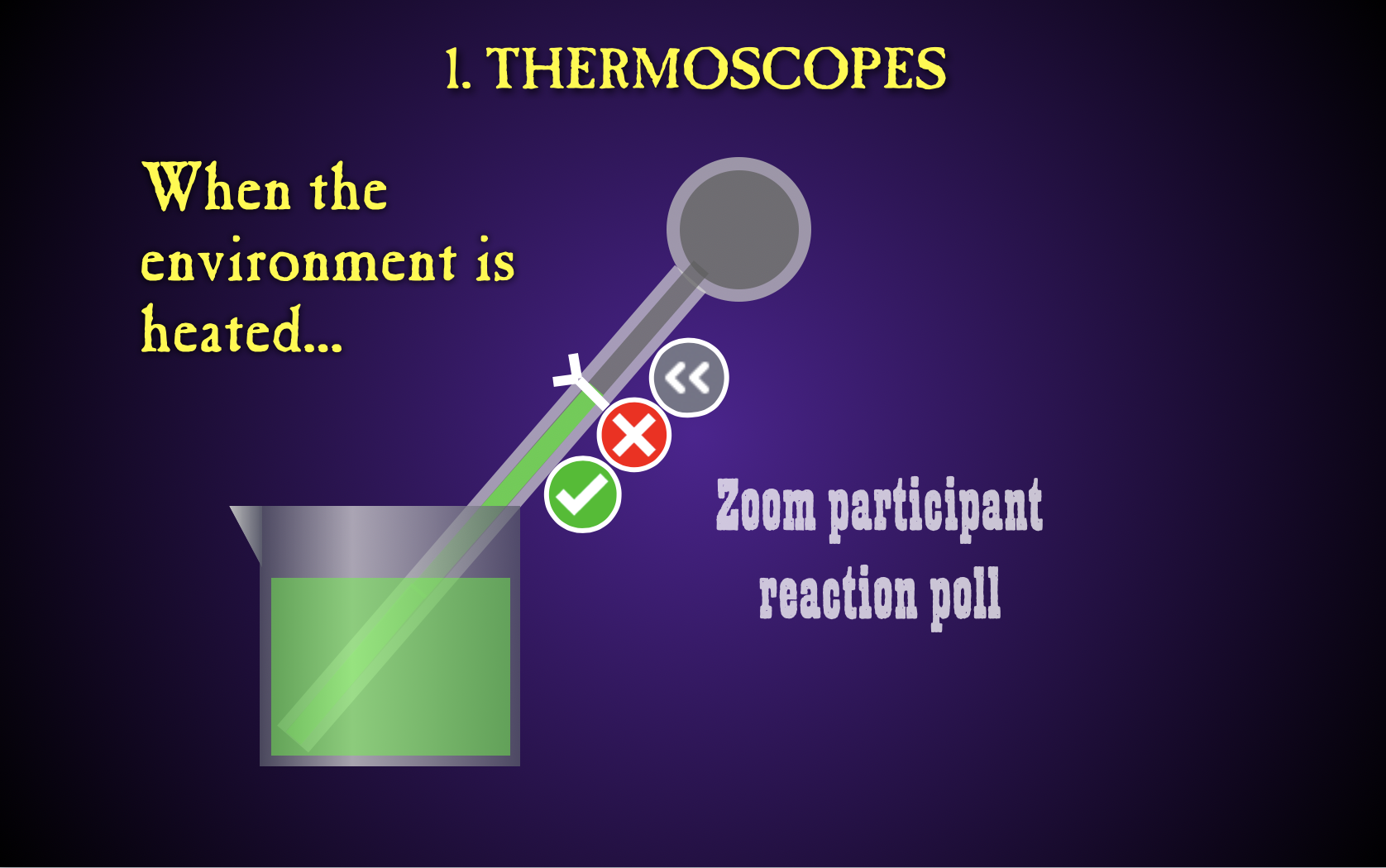
The demonstration revolves around what I've been told is a Galilean thermoscope. A narrow-throated Florence flask is used here, as is a beaker, some food coloring, a twist-tie, a blow drier, a hot plate, and some water.

I like it enough to continue using in in my AP Physics 2 unit on thermal physics which is a pre-cursor to the unit on thermodynamics.

An instant Zoom poll using participant reactions is once again included.

Thermoscope [Virtual Demonstration] at Teachers Pay Teachers

If you have a clever workaround to get past the dearth of what were once sold by Sargent-Welch as "air bulb thermometers," let me know in the comments.

Saturday, October 10, 2020

RT;DL The Tower of Bottle

In the pre-blog, pre-social media days of the mid-1990s, when the World Wide Web was Alien-birthing from nothing (1994) to everything (1995), I was involved with the Southern California Alliance of Mentors for Physics Instruction and its Southern California Area Modern Physics Institute. Yes, two SCAMPIs in one. John Jewett (Cal Poly Pomona) and Roger Nanes (CSU Fullerton) outdid themselves on the acronyms!

Somebody at the California Department of Education liked what SCAMPI was doing, and wanted to get four Northern California teachers involved. I was chosen/selected to be one of them. Jessica Downing, then the Science Department at Esparto High School (now IB coordinator at Inderkum/Natomas) was selected as well. She and I conducted SCAMPI workshops throughout Northern California during those years.

I got this demo idea from her.

The gist is to show that the molecules in a jar of hot water are moving faster than the molecules in a jar of cold water. Just add food color and wait a minute. 

But while we're here, let's add some value. Lay a playing card on top of the hot water and flip the bottle over. The card stays in place and the water doesn't spill. 

Set the bottle mouth down on the cold bottle and remove the card. The result is surprising.

Then re-insert the (a) card and flip the configuration over so that the cold water's on the top. Remove the card. And it's a different outcome.

Last, a few questions of balance or imbalance. If you were nervous that I wouldn't shoehorn a Zoom participant reaction poll in, ease your worried mind.

The Tower of Bottle [Virtual Demonstration] at Teachers Pay Teachers

Single-shot video of the complete demo

Enjoy!

Thursday, October 08, 2020

RT;DL Blowout—Newton's Laws Edition

My use of Pasco's Lenz's Law demonstrator as a blowgun to explore the equations of motion is discussed in a previous post. That's an activity I don't do in my regular Physics class, because number puzzles aren't a priority there.

In this activity, I introduce the blowgun to Physics, do a quick speed determination, and then detail how Newton's laws of motion apply to the various portions of the Hero's Marker's Journey.

How are Newton's third, first, and second laws relevant to when the marker (bullet) was in the tube (barrel)? Between the barrel and the box? When caught by the catch box?

I do this after all three laws have been taught in class. It's a nice review.

For example, when the marker is in the tube, Newton's third law is relevant in that the air pushes the marker forward while the marker pushes the air backward. 

Newton's first law is relevant in that the marker at rest would have remained at rest, but was acted on by an unbalanced, external force applied by the air. 

And Newton's second law tells us the acceleration of the marker will be proportional to the force that the air applies and inversely proportional to the mass of the marker. 

In the end, we ponder how to make a faster-moving bullet based on Newton's laws. I can't blow any harder. So we modify the bullet. 

Is this demonstration activity really just an excuse to do another blowgun activity in class? I mean... what are you even talking about right now? That's ridiculous! Why would you even suggest such a thing?

It really is a nice review of Newton's laws. 

Blowout Newton [Virtual Demonstration] at Teachers Pay Teachers

Here's the accompanying HTML presentation. As always, the presentation was designed to accompany to the student document rather than to stand on its own.

Monday, October 05, 2020

RT;DL The Newtonian Shot

I'm embarrassed to confess that I don't remember the name of the physics teacher who shared this demo at the January 1986 MSTA Meeting in Lansing. I do recall driving past many cars that had slid into the ditch on the road from Ann Arbor that morning. It was windy and icy. And cold.

But the demo stayed with me, and I worked it into my curriculum early on. It was my first Show & Tell at an NCNAAPT Meeting (Spring 1992, American River College, IIRC). 

I think it's a great demo for the Newton's Law unit. There have been times when securing toy dart guns was a challenge. They can last for many cycles, but they were built as inexpensive toys, not precision science apparatus. Here's one I found online in 2025; use your search engine/AI skills as needed.

I wrote a post about this demo previously, when I recorded some nice high-speed video of it. It includes a few more specifics.

The Newtonian Shot at TPT (Students document, Answer Key, link to presentation)

HTML Preso: Demo - The Newtonian Shot (including convenient Zoom participant reaction instant poll)

As ever, my presos are designed to support my storytelling and do not stand on their own terribly well. (Like a backup band with no lead singer.) And you can see I use aluminum support rods to help with the simultaneous launch. I launch the darts from ceiling-level down to my countertop so students can see the landing point. I protect my concrete countertop with a wood plank.

Monday, September 28, 2020

RT;DL Cannonball - Ball dropped from moving ship

Another classic demo that can elicit excellent classroom discussion. A cannonball is dropped from the mast of a moving boat. Where will the ball land? This nicely confronts our inner Aristotle.

In my version, the premise is laid out, the landing point options are described, and students are asked to produce arguments supporting three of the five possible landing sites: one that they believe, and two they could convince others of (as good attorneys).

A straw poll is conducted (now with Zoom participant reactions), then students are asked to defend their various positions. After the classroom discussion/debate, a final vote is taken. 

I warn them to vote carefully. "Physics is a democracy, and whichever outcome gets the most votes will  be correct. The universe will accede to our wishes. Please vote responsibly!" [Update: at some point Zoom made participant reactions ephemeral, so they lost their value as an instant polling tool.]

Then we see the actual outcome. First in my animation; eventually in the classic Project Physics footage from 1968. In face-to-face instruction, I also carry it out using a discontinued Pasco product (Ballistic Cart Accessory with Ball Drop Attachment). So sad to see that combo go.

Lastly, I ask students how the demo could be altered so that the ball would land at the other locations that were offered in the premise. The 1968 footage shows one such modification. I leave it to students to think of the others.

Cannonball [Virtual Demonstration] free resource at Teachers Pay Teachers

Includes
Student document (Google Docs file on Google Drive)
Presentation link embedded in student document
Answer key

The HTML export from Apple Keynote had a few wee quirks this time. Mostly in that while most of the splash sounds are muted, the audio from the 1968 video (muted in my preso) comes through loud and clear in the export.

Here's the HTML presentation: Cannonball. It's intended for use with the TPT student document.

Further discussion in the comments.

Sunday, September 27, 2020

RT;DL The Clever Dumbbell - Tension & Inertia Demo

A classic and popular demo. I do it in Conceptual Physics, Physics, and AP Physics 1. And I use a 5-lb dumbbell and kite/packaging cotton string. For years, I used a cast-iron dumbbell. But I broke floor tiles on occasion, and there was that one time the wheel-like nature of the dumbbell ends allowed it to roll onto a student's open ... toes. So I found rubberized hexagonal-end dumbbells. And I use a cardboard catch-box with scrap paper to protect the tiles.

After posing the initial question: Which string will break when the bottom string is pulled, I have them work through some leading questions.

Instead of having students predict which string will break, I have them request a string for me to break. Once they understand this paradigm shift, they request the bottom string. And I oblige. Eventually I break the top string, too. This can be navigated in the preso, alone. But I prefer to do the demo in my empty classroom because I can.

The efficacy of this demo lies in the dependence of the outcome on the presenter's technique. If it were a 50-50 coin flip each time, the demo would not have any pedagogical value. Some ponderables are offered post-demo, too.

As is a continuing theme in my RT;DLs, the student sheet is a Google Doc and the preso is an Apple Keynote preso, exported to HTML. These exports work delightfully on computers. Less well on tablets or phones. 

This one takes a bit of practice to navigate. 

Things shown in images but not in words: strings break when they are stretched beyond their limit by tension greater than the sting can withstand. A rapid pull stretches the bottom string through its limit before the dumbbell moves very much, thus keeping the top string from being stretched. A slow pull allows the top string to be at greater tension than the bottom string, allowing it to reach its limit before the bottom string does.


Includes
Student document (Google Docs file on Google Drive)
Observations presentation (linked to on student document)
Answer key

Saturday, September 26, 2020

RT;DL Blowout: A tour through the equations of motion

Near the close of the last century, I wrote an article for The Physics Teacher extolling the unadvertised virtues of Pasco's Lenz's Law Demonstration tube. 

Sure, you could use it to demonstrate Lenz's law, but that fine aluminum tube seemed pricey, so I was keen to justify the expense. You can tap it with a mallet (or on the ground) while holding it at various places to produce different notes. The Q of aluminum is great for this. You can stand it up on its end in your classroom to demonstrate unstable equilibrium. 

But for my notion of classroom theatrics, the best unintended use for the tube was as a blowgun. 

For this RT;DL I prepared a tour through the equations of motion with the blowgun acting as my vehicle. it is very much up to the task. I do this in my AP Physics 1 course only. Regular Physics students don't really need the exercise in number puzzles that the equations of motion afford. The year's too short.

In any case, I blow a marker pen through the tube and arrange two photogates near the muzzle to help determine the exit speed. It's over 60 mph!

Once the exit speed is determined, we figure out the acceleration of the marker while it was in the tube. Over 20 g's.

We also figure out how long it took the marker to exit the tube once its motion began. Then we investigate where the marker was when it was at the half way point (in time) along its journey through the tube.

The preso is enhanced with photos and high-speed videos. And an instructive(?) blooper at the end.

Blowout Kinematics [Virtual Demonstration] at TPT

Here's the accompanying HTML presentation: Blowout Kinematics. It's intended for use with the TPT student document.

Exploratorium friends, Don Rathjen and Paul Doherty, turned the blowgun idea into a nice Snack: Marshmallow Puff Tube.