Showing posts with label forces. Show all posts

Sunday, July 24, 2022

Is a tape measure a constant force spring?

I recently came across a video of tape measures "racing" along a board of wood as they retract. Who doesn't love extending the tape as far as you can and recklessly letting it fly in? It obviously accelerates dramatically. Like any physics-minded person I got to wondering if the force is constant. How might we assess?

I'm home for the summer, a summer I desperately needed, and away from some of my usual tools. No probeware. No students to help. First I put a small bucket with a handle on a food scale from our kitchen. I extended the tape measure and used it to pull up on the scale. The force was somewhat constant, but not as steady as I would like. A force probe would have been handy to average many data points and see the force graphically.

Perhaps it would be simpler to measure acceleration, rather than measuring force directly. We could replicate the original video. But what about friction? I've also noticed that tape measures sometimes stick when used in this position. What if we pulled a cart of known mass and analyzed the video? The toy cars at my disposal were all too light—or had too much friction—to provide a motion that was slow enough and consistent enough to satisfyingly measure with the tools on hand.

But there it was staring me in the face: the air hockey table. I put the tape measure on its side, so that the weight of the extended tape doesn't cause it to rub as much against the tape (tape retracts more smoothly). Lego base plate floats beautifully on table. A few Lego bricks are placed on one end of the plate to hold the hook of the tape measure during retraction.  

Thursday, October 08, 2020

RT;DL Blowout—Newton's Laws Edition

My use of Pasco's Lenz's Law demonstrator as a blowgun to explore the equations of motion is discussed in a previous post. That's an activity I don't do in my regular Physics class, because number puzzles aren't a priority there.

In this activity, I introduce the blowgun to Physics, do a quick speed determination, and then detail how Newton's laws of motion apply to the various portions of the Hero's Marker's Journey.

How are Newton's third, first, and second laws relevant to when the marker (bullet) was in the tube (barrel)? Between the barrel and the box? When caught by the catch box?

I do this after all three laws have been taught in class. It's a nice review.

For example, when the marker is in the tube, Newton's third law is relevant in that the air pushes the marker forward while the marker pushes the air backward. 

Newton's first law is relevant in that the marker at rest would have remained at rest, but was acted on by an unbalanced, external force applied by the air. 

And Newton's second law tells us the acceleration of the marker will be proportional to the force that the air applies and inversely proportional to the mass of the marker. 

In the end, we ponder how to make a faster-moving bullet based on Newton's laws. I can't blow any harder. So we modify the bullet. 

Is this demonstration activity really just an excuse to do another blowgun activity in class? I mean... what are you even talking about right now? That's ridiculous! Why would you even suggest such a thing?

It really is a nice review of Newton's laws. 

Blowout Newton [Virtual Demonstration] at Teachers Pay Teachers

Here's the accompanying HTML presentation. As always, the presentation was designed to accompany to the student document rather than to stand on its own.

Monday, October 05, 2020

RT;DL The Newtonian Shot

I'm embarrassed to confess that I don't remember the name of the physics teacher who shared this demo at the January 1986 MSTA Meeting in Lansing. I do recall driving past many cars that had slid into the ditch on the road from Ann Arbor that morning. It was windy and icy. And cold.

But the demo stayed with me, and I worked it into my curriculum early on. It was my first Show & Tell at an NCNAAPT Meeting (Spring 1992, American River College, IIRC). 

I think it's a great demo for the Newton's Law unit. There have been times when securing toy dart guns was a challenge. They can last for many cycles, but they were built as inexpensive toys, not precision science apparatus. Here's one I found online in 2025; use your search engine/AI skills as needed.

I wrote a post about this demo previously, when I recorded some nice high-speed video of it. It includes a few more specifics.

The Newtonian Shot at TPT (Students document, Answer Key, link to presentation)

HTML Preso: Demo - The Newtonian Shot (including convenient Zoom participant reaction instant poll)

As ever, my presos are designed to support my storytelling and do not stand on their own terribly well. (Like a backup band with no lead singer.) And you can see I use aluminum support rods to help with the simultaneous launch. I launch the darts from ceiling-level down to my countertop so students can see the landing point. I protect my concrete countertop with a wood plank.

Monday, September 28, 2020

RT;DL Cannonball - Ball dropped from moving ship

Another classic demo that can elicit excellent classroom discussion. A cannonball is dropped from the mast of a moving boat. Where will the ball land? This nicely confronts our inner Aristotle.

In my version, the premise is laid out, the landing point options are described, and students are asked to produce arguments supporting three of the five possible landing sites: one that they believe, and two they could convince others of (as good attorneys).

A straw poll is conducted (now with Zoom participant reactions), then students are asked to defend their various positions. After the classroom discussion/debate, a final vote is taken. 

I warn them to vote carefully. "Physics is a democracy, and whichever outcome gets the most votes will  be correct. The universe will accede to our wishes. Please vote responsibly!" [Update: at some point Zoom made participant reactions ephemeral, so they lost their value as an instant polling tool.]

Then we see the actual outcome. First in my animation; eventually in the classic Project Physics footage from 1968. In face-to-face instruction, I also carry it out using a discontinued Pasco product (Ballistic Cart Accessory with Ball Drop Attachment). So sad to see that combo go.

Lastly, I ask students how the demo could be altered so that the ball would land at the other locations that were offered in the premise. The 1968 footage shows one such modification. I leave it to students to think of the others.

Cannonball [Virtual Demonstration] free resource at Teachers Pay Teachers

Includes
Student document (Google Docs file on Google Drive)
Presentation link embedded in student document
Answer key

The HTML export from Apple Keynote had a few wee quirks this time. Mostly in that while most of the splash sounds are muted, the audio from the 1968 video (muted in my preso) comes through loud and clear in the export.

Here's the HTML presentation: Cannonball. It's intended for use with the TPT student document.

Further discussion in the comments.

Sunday, September 27, 2020

RT;DL The Clever Dumbbell - Tension & Inertia Demo

A classic and popular demo. I do it in Conceptual Physics, Physics, and AP Physics 1. And I use a 5-lb dumbbell and kite/packaging cotton string. For years, I used a cast-iron dumbbell. But I broke floor tiles on occasion, and there was that one time the wheel-like nature of the dumbbell ends allowed it to roll onto a student's open ... toes. So I found rubberized hexagonal-end dumbbells. And I use a cardboard catch-box with scrap paper to protect the tiles.

After posing the initial question: Which string will break when the bottom string is pulled, I have them work through some leading questions.

Instead of having students predict which string will break, I have them request a string for me to break. Once they understand this paradigm shift, they request the bottom string. And I oblige. Eventually I break the top string, too. This can be navigated in the preso, alone. But I prefer to do the demo in my empty classroom because I can.

The efficacy of this demo lies in the dependence of the outcome on the presenter's technique. If it were a 50-50 coin flip each time, the demo would not have any pedagogical value. Some ponderables are offered post-demo, too.

As is a continuing theme in my RT;DLs, the student sheet is a Google Doc and the preso is an Apple Keynote preso, exported to HTML. These exports work delightfully on computers. Less well on tablets or phones. 

This one takes a bit of practice to navigate. 

Things shown in images but not in words: strings break when they are stretched beyond their limit by tension greater than the sting can withstand. A rapid pull stretches the bottom string through its limit before the dumbbell moves very much, thus keeping the top string from being stretched. A slow pull allows the top string to be at greater tension than the bottom string, allowing it to reach its limit before the bottom string does.


Includes
Student document (Google Docs file on Google Drive)
Observations presentation (linked to on student document)
Answer key

Monday, October 07, 2019

Doggies on a waxed floor


Where will you use it: inertia, friction, centripetal force? I don't think students will mind if you use it for all of those.

Can you stretch it into conservation laws? Of course you can! Low stopping force requires longer stopping time. Impulse/momentum: check. That wee force will need to act across a large distance to change the kinetic energy of those goggies! Work-energy: check.

Want to take it a step further? How did those doggos get up to speed to begin with? Hmmm...

And fear not: it all ends well.


Hat tip to Wendy A. (Rio Phyz ’88). Old physics teacher flex? Why, yes!

Wednesday, September 25, 2019

The Forces Playlist of Phyz

The Forces Playlist of Phyz
SONGARTISTYEAR
Carry That WeightThe Beatles1969
First PushDeVotcKa2005
Force of Nature (Bonus Track)Lenka2008
Force TenRush1987
Forces ... Darling (Featuring Earl Zinger)Koop2006
FrictionImagine Dragons2014
FrictionMorcheeba1998
FrictionShame2018
FrictionTauk2014
FrictionTelevision1977
The Girl With the Weight of the World in Her HandsIndigo Girls1990
Grace In GravityThe Story1991
GravityAgainst The Current2015
GravityDaughtry2018
GravityJesse Cook2005
GravityJohn Mayer2006
GravityA Perfect Circle2003
GravitySara Bareilles2008
GravityWith Confidence2017
Gravity (feat. JMR)Jai Wolf2016
Gravity (Stripped)Wage War2017
Please Push No MoreGary Numan1980
PullBlind Melon1996
PullMicrowave2019
Pull ShapesThe Pipettes2007
Pulling Mussels (From The Shell)Squeeze1980
PushMatchbox Twenty1996
PushSarah McLachlan2003
Push on for the DawnCorinne Bailey Rae2016
Stop Draggin' My Heart AroundTom Petty & The Heartbreakers1981
Tension Is A Passing NoteSixpence None The Richer2002
WeightlessAdam French2017
WeightlessBlondfire2004
WeightlessBrina Eno and Daniel Lanois1989
WeightlessChris Burkich2016
WeightlessCity And Colour2011
WeightlessThird Eye Blind2016
WeightlessWashed Out2013
Weightless3112011
Weightless (feat. Shungudzo)Hayden James2019

Friday, January 25, 2019

Spring demo set-up

I joke with my classes that the last class of the day gets the best version of me. At least today it only took one period for me to get this worked out.

My AP Physics C are studying simple harmonic motion and the most common type is a block attached to a spring on a horizontal friction less surface. Surprisingly our book does not touch upon springs in series and parallel. Students did a quick activity using PhET's Hooke's Law simulation the other day, leading them to the equations to find the equivalent spring constant if series and parallel pendulums. We ran out of time that day to show it to them live so I set it up for the next day.

I had two identical springs of spring constant 20 N/m +10% that I hung from a horizontal support attached to two large ring stands. I used a pegboard hook to link the two springs when working in parallel which made it easier to hang one mass from it. For the first class of the day I hung a 500 gram mass from a single spring, then the two springs in series and then in parallel so the class could see the difference. The series elongation was very easy to see the difference but the parallel elongation was harder for those in the back. So I added to it between classes.

I used bright post-its and labeled the natural length of one spring, where it stretched to in parallel and in series. I taped a measuring tape in line with the top of the spring so if I wanted to, I could do calculations. It made for a much better visual for the students.

After the fact I realized I wanted to add a marker for the natural length for the two in series since the new length is much larger than twice the stretch of the single spring because of the additional length of the second spring. If I had enough springs of the same spring constant I would want to have all three setups up at the same time. Add that one to the wishlist I guess.

Sunday, December 17, 2017

An inclination for serendipity

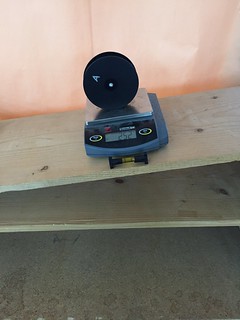
When I show the Honda Cog ad (flavors of equilibrium, energy transformations), there is always strong skepticism regarding the wheels that roll uphill. So I am always ready to go with the demonstration illustrated in this previous post.

Sometimes I leave the wheel resting comfortably on the inclined plane. That very same inclined plane is also home to my electronic balance.

UntitledSo why not another Physics Mashup?

First, students should be able to explain why the wheel holds fast on the incline before I spill the beans. Or in this case, ball bearings.

Next, I tare the scale and rest the "hill-hugger" atop the scale. A reading is observed.

Finally, students should correctly predict what will happen to the scale reading when the incline is re-leveled. Assure them the wheel will remain atop the scale.

It's not so novel it will shatter the Earth. But it's nice to milk some mileage out apparatus just otherwise lying around.

The answer can be seen via the comments. I leave the solution to the reader.

Friday, November 03, 2017

Simple demo big gains

I have noticed a big difference in student comprehension when the problems become real to them. Simple visuals can have a big impact on the students "getting it." I can't count the number of times I've tossed a tennis ball around to make a point. Somehow holding the tennis ball at different heights or just tossing it up to catch it again can lead to "Oooh now I see what's happening!" So I have several simple demos that help students visualize their problems, a block or two hanging from the ceiling with spring scales, a stuffed toy in a bucket, etc. 
When we studied springs I found a Pasco spring demo set with five springs all of the same length but different spring constants. The first stage was to hang a 20 g mass from the red spring and see it barely settle above the table. I asked students what would happen if I were to hang a 500 g mass then from the green (which they assumed was identical). They were surprised at its shorter elongation and when I asked why they all said "it has a larger spring constant."

For the next stage I set up two large ring stands with another bar clamped horizontally between them. I dramatically assure students it is level with the springs hanging at their relaxed length. Then I hang a 500 g mass from each and they can see the slight differences in elongation. Then the 500 g masses are switched out for 1 kg and the difference between them becomes more pronounced (left). Applying this to Hooke's Law they could all calculate the spring constant for each spring. But this made it way more interesting than five given forces and elongation lengths to calculate the spring constant from a word problem. 
When my AP Physics C class started center of mass, many could calculate the center of mass with equations but had a hard time visualizing what that actually meant. A common problem involves materials of different densities stuck together, for example a piece of aluminum and a piece of iron. To make a real life version I found a piece of Styrofoam that was the same thickness as a piece of scrap wood. I drilled three holes in the wood, stuck three dowels into the holes and stuck the dowels into the Styrofoam. I wrapped the whole thing in paper to make it appear uniform but I did tell students it was made of two different materials. I showed it to students and asked what information they would need to solve for the center of mass. Of course I play with them a bit and after each response I say, "Ok, now you can solve it right?" to which they predictably respond, "No, we need XYZ too!" Eventually, I give them the dimensions of the whole thing and let them solve for it. The dimensions are listed on the paper below (the "total mass" includes the paper in case they ask).

They are not surprised that the center of mass is closer to the wood side but they are surprised that for this particular arrangement it's actually on the wood. It's a simple practice problem but once they're done I can balance the piece on my hand at (almost) the exact position they predicted, about 5 cm in from the wood side. Students that struggle with this homework problem were successful with this in-class practice problem. 
Another simple one my colleague Jessie Chen shared with me can be done by every student in your class on the cheap. Like less than $1 cheap. Most dollar stores sell packs of cards for $1, or even a double pack if you're lucky. Each student will need one plastic playing card (or index card) folded at a right angle along the length of the card. Place it on the corner of the table with one corner hanging off the edge of the table. Place two pennies on the card so that one is on the portion on the table and one is on the portion hanging off the table. You can use a pen or pencil to press on the card so that when it moves it pivots around that point. Flick the vertical part of the card on the side that is hanging off the table. This causes the card to move so that it is no longer supporting the penny hanging off the table and it will fall straight down due to gravity. On the other side the vertical portion of the card will push forward, applying a horizontal velocity to the penny and making it shoot off the table in a half a parabola shape. You can hear (and see) the two pennies hitting the ground at the same time. Many of us have a fancy machine that demos this for us, sometimes called a "Drop/shot" or a Newton's Second Law machine, and those work great, don't get me wrong. But to be able to hand these to my students and have them try it, nothing can be better than that! 


Thursday, June 29, 2017

A summertime fidget spinner I can endorse

If you aren't plugged into Derek Muller's Veritasium YouTube channel, it's time to correct that oversight.

His latest exploration involves hydrodynamic levitation. It's a phenomenon very different from the Coanda effect-based airstream levitation. And it constitutes a summertime fidget spinner I can wholeheartedly endorse!

Hydrodynamic Levitation


Muller is, of course, armed with high-speed videography. He recently added schlieren photography to his arsenal. I'm delighted to support him on Patreon; the guy does great stuff that's always fun to watch.

Friday, February 03, 2017

Brainiac clips

Every year, for as long as I can remember, I've shown a clip from the British show Brainiac that makes a giant pendulum mirroring the in-class bowling ball demo. My downloaded copy is grainy and pixelated so I decided to try and find a better version. I downloaded one Brainiac episode (Season 1, episode 3) with the intention of editing it down to the 4 minutes or so that I wanted. I ended up watching the whole 40 minute episode and editing out six clips to use in my classroom. Not too shabby for some fun TV time.

Conservation of Energy and a giant pendulum:
Well explained and stands alone well.

Oil Slip & Slide:
Even really slippery surfaces have a coefficient of friction that slows down moving objects. You could have students estimate it using the values given in the clip.

LN2 filled water bottle:
Quick example of pressure, boiling and of course liguid nitrogen.

Does a duck's quack echo?
Sometimes students just won't believe you unless they see it for themselves. Or in this case hear it. 


Don't microwave a CD:
#ThingsThatShouldGoWithoutSaying

Playground G forces:
Brainiacs (the volunteers and staff that put on the science of the show) try to get the most G forces possible out of a playground merry-go-round. You could get more but they are limited by human power.

Iron in cereal:
This is an easy demo to do in the classroom but it does take some prep, the right cereal, etc. This is a super short clip that demonstrates it if you don't have the time.

Now I want to watch more of it. Besides the energy pendulum the only other clip I have seen prior to this was another all time favorite, "The Electric Fence." It is pretty much all the things you wish you could do in your classroom but couldn't:


Update: For an exhaustive video demo lesson on the Brainiacs: Electric Fence clip, see this old Blog of Phyz post:

Electric Fence Redux

Saturday, December 03, 2016

Roll the dice

Studying the Law of Universal Gravitation can be heavy (ba dum tss) for students. Each year my students push through the long equations and we go without a lab for about a week. That's pretty unusual in my classes and they can feel the change. If a student asks why we aren't doing a lab I usually reply, "Well I can't haul Jupiter in here to measure it so ...."

Practice problems were always difficult for students, more about living by the Order of Operations (PEMDAS) then actually understanding the problem. Some would take one look at that period of revolution equation and say "No, nuh uh, not gonna make me. Nope."

I tried to make them fun by creating word problems. It wasn't just calculating the Force of Gravity between you and Jupiter, "Let's compare that to the Force of Gravity between you and the doctor that delivered you! Jupiter's gravity doesn't affect you and astrology is bunk!" But still going through problems together wasn't engaging students.

Your birth Mass (kg)Jupiter & Doctor (kg)closest distance (m)Universal Gravitational ConstantForce of Gravity (N)
41.90E+275880000000006.67E-111.47E-06
41000.16.67E-112.67E-06
A few years ago I had an idea to make our practice calculations into a dice game. One di has problems to solve and the other different planets. There are actually two different planet di so that students can choose. Here is a print ready file, I suggest thicker paper to give it some structure. They take some time to assemble but you can use them for years to come.

The kids loved it. They probably work through more practice problems than they would have if I had just supplied them with certain ones to do and they were very invested in letting chance choose which they would calculate. A new development this year was that they are so used to checking their answers with me while they whiteboard they wanted to know the "answer." That was harder to do as I walked around the room since there were so many variations. I decided to create and project an answer chart in Excel.

Depending on how your school or district is defining "physics" from the NGSS framework you may or may not be finding yourself teaching more Earth & Space Science. We had our own sort of NGSS Draft among Chemistry, Physics and Biology trying to divide up the Earth & Space Science topics. In my district Physics ended up, rightly so I feel, with HS-ESS1-4:

HS-ESS1-4.Use mathematical or computational representations to predict the motion of orbiting objects in the solar system.[Clarification Statement: Emphasis is on Newtonian gravitational laws governing orbital motions, which apply to human-made satellites as well as planets and moons.] [Assessment Boundary: Mathematical representations for the gravitational attraction of bodies and Kepler’s Laws of orbital motions should not deal with more than two bodies, nor involve calculus.]
This goes well with HS-PS2-4 about the Law of Universal Gravitation:

HS-PS2-4.Use mathematical representations of Newton’s Law of Gravitation and Coulomb’s Law to describe and predict the gravitational and electrostatic forces between objects. [Clarification Statement: Emphasis is on both quantitative and conceptual descriptions of gravitational and electric fields.] [Assessment Boundary: Assessment is limited to systems with two objects.]
I'm still working on adding more of Kepler's Laws into the curriculum, there is an outline here on this Disciplinary Core Idea about it.

Sunday, October 16, 2016

Forces Match Graph: The Presidential Election Challenge

Untitled

I developed an activity using force sensors to create a visual representation of Newton's Third Law.

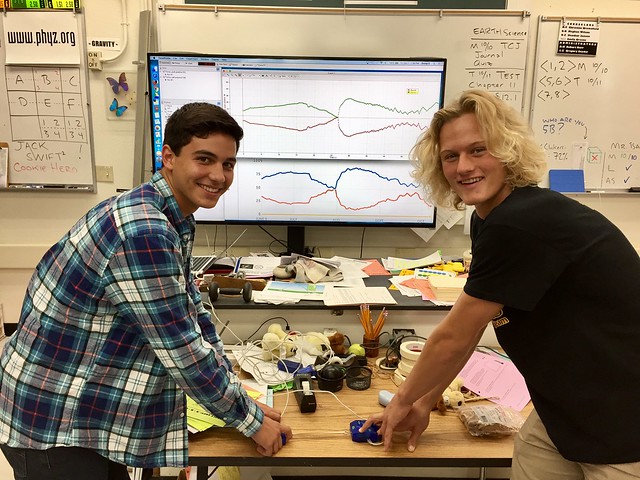
The activity includes a brief exploration of the force sensor, then engages students within lab groups to conduct miniature tug-of-war sessions using the force while the computer records force vs. time data to plot a real-time graph.

The symmetry of the plots revels that whenever one object exerts a force on a second object, the second exerts a force on the first that is equal in magnitude and opposite in direction.

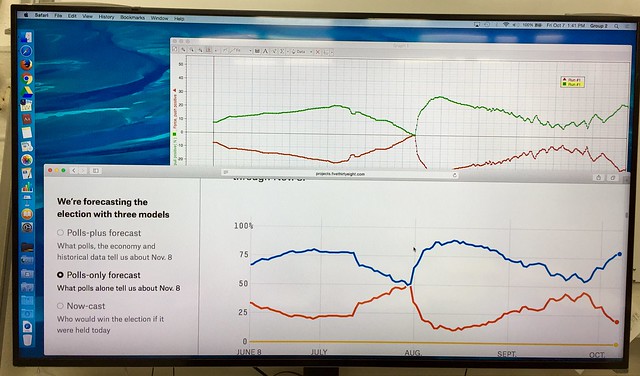
The plot also resembles the "probability of winning" graphs produced by Nate Silver's FiveThirtyEight team.

So I challenged early finishers of the lab to try their hands (literally) at reproducing the Presidential graph using force sensors. I thought the students did a fine job of it.

Untitled

Here's the student sheet for the activity. It's adapted from the one included in the Conceptual Physics lab manual authored by Paul Hewitt and me.

The Force Mirror

Nate Silver's graphs can be found at FiveThirtyEight.

Monday, February 09, 2015

Conservation of momentum: not always your friend

Make of this what you will, gentle readers. But don't doubt the physics! We've got combustion, fluid flow, conservation of momentum / Newton's 3rd law, and an inclined plane.

Firefighters try to extinguish a car fire when suddenly...


And remember: if you're going to set your car alight on the top of a hill, have the courtesy to set the parking brake!

Tuesday, November 04, 2014

Groovy… but I won't show it in class

Except as a springboard to a discussion of "What did they do wrong this time?"

But it is groovy. The world's largest vacuum chamber is used to perform the a variation of age-old physics classic, "penny and feather" free fall experiment.

Brian Cox visits the world's biggest vacuum chamber - Human Universe: Episode 4 Preview - BBC Two


Here's a video clip that I do show in class: A hammer and a feather dropped on the Moon.

Feather & Hammer Drop on Moon


Brian Cox is many kinds of wonderful, but showing free fall in a vacuum chamber using high-speed (slow motion) video, alone, acts to deceive.

A common misconception among physics learners is that gravitational acceleration depends on atmospheric pressure. Things float in space because there's no air in space. There's no reason to think g in the giant vacuum chamber is 9.8 m/s2. All video of free fall in the evacuated chamber is artificially slowed. We never see the vacuum chamber free fall in real time.

The lesson could be interpreted that things fall more slowly in a vacuum. On Earth as it is in Heaven. Or the Moon, at least.

Tuesday, December 24, 2013

Pushing Things Around—A new PhET Activity

Seems like I've been out for a bit. Reconfiguring the Physics curriculum in the transition to NGSS leads to occasional jags of spontaneous development. Not nearly as exciting as that makes it sound. But it keeps me off the blog nonetheless.

Here's something I developed for instruction after Newton's First Law/Inertia and before our full-on Newton's Second Law lab.

It's intended to scaffold some existing knowledge and suggest a = F/m. It uses PhET's "Forces and Motion Basics" sim (not to be confused with the "Forces and Motion" sim—that's a different sim).

Here's the sim:

Forces and Motion: Basics
Click to Run

Here's the sim's page at PhET.

And here's my lab: Pushing Things Around.

I hope to get it set into my own PhET Tech Labs page sometime soon. Patience!

Wednesday, June 12, 2013

Baker Street: El Camino physics teacher honored by AMTA

My friend and fellow San Juan Unified physics teacher, Bob Baker, recently won an award for instructional innovation.

The American Modeling Teachers Association (AMTA) recognized the El Camino High School teacher as winner of its April Apparatus competition.

El Camino teacher earns nod for innovative "street sled" lessons

Design and instructional details are posted at the AMTA's site.

Congratulations, Bob!

Thursday, April 04, 2013

Hewitt-Drew-it! Circular Motion

Paul discusses his father working as a ticket collector in a merry-go-round and ties this to a Burl-Grey problem involving circular motion.

Hewitt-Drew-it! PHYSICS 34.. Circular Motion