Showing posts with label color. Show all posts

Saturday, March 23, 2024

Eclipse Pegboard 3.0

Pegboard 1.0
While driving to Winnemucca for last October's annular eclipse, I stopped by the Lowe's in Idaho Falls to pick up a panel of pegboard. Nothing crazy; just 2" x 4". The holes in the pegboard act as pinholes for for the sunlight. They'll cast "sunball" images any time the Sun is out. They'll cast sun-crescents during partial eclipses. Pegboard 1.0  was great fun at our impromptu remote Nevada rest stop eclipse party.

But I didn't like how uniform it was. Identical holes at identical spacing.

Pegboard 2.0
So I decided that for April 8, I'd dirty things up a bit with some duct tape. I placed some strips across the grid and punched holes. The tape heals itself to some extent, but to different extents on different holes. I also just used some tape to partially cover some holes. There are probably better ways to dis-uniform-ify the panel. Since this is a project intended for partials, I may not need to wait until 2045 to try other techniques.

Pegboard 2.0 varies the apertures of the pinholes. Some remain wide open. Some are completely blocked. Many are partially blocked.

Pegboard 3.0
Why not add a splash of color? I decided colored transparent bingo chips would be the answer. Out here in the frontier of the Mountain West, you can't just get them at a nearby craft store (I tried!). So, Amazon it was.

I'm taping them down with Scotch "Red" (not "Green") crystal clear tape in a deliberately random pattern. Some holes will get no chip, others will get red, orange, yellow, green, blue, or purple chips.

With Pegboard 3.0, we have a variety of apertures and colors.

Pegboard 3.5
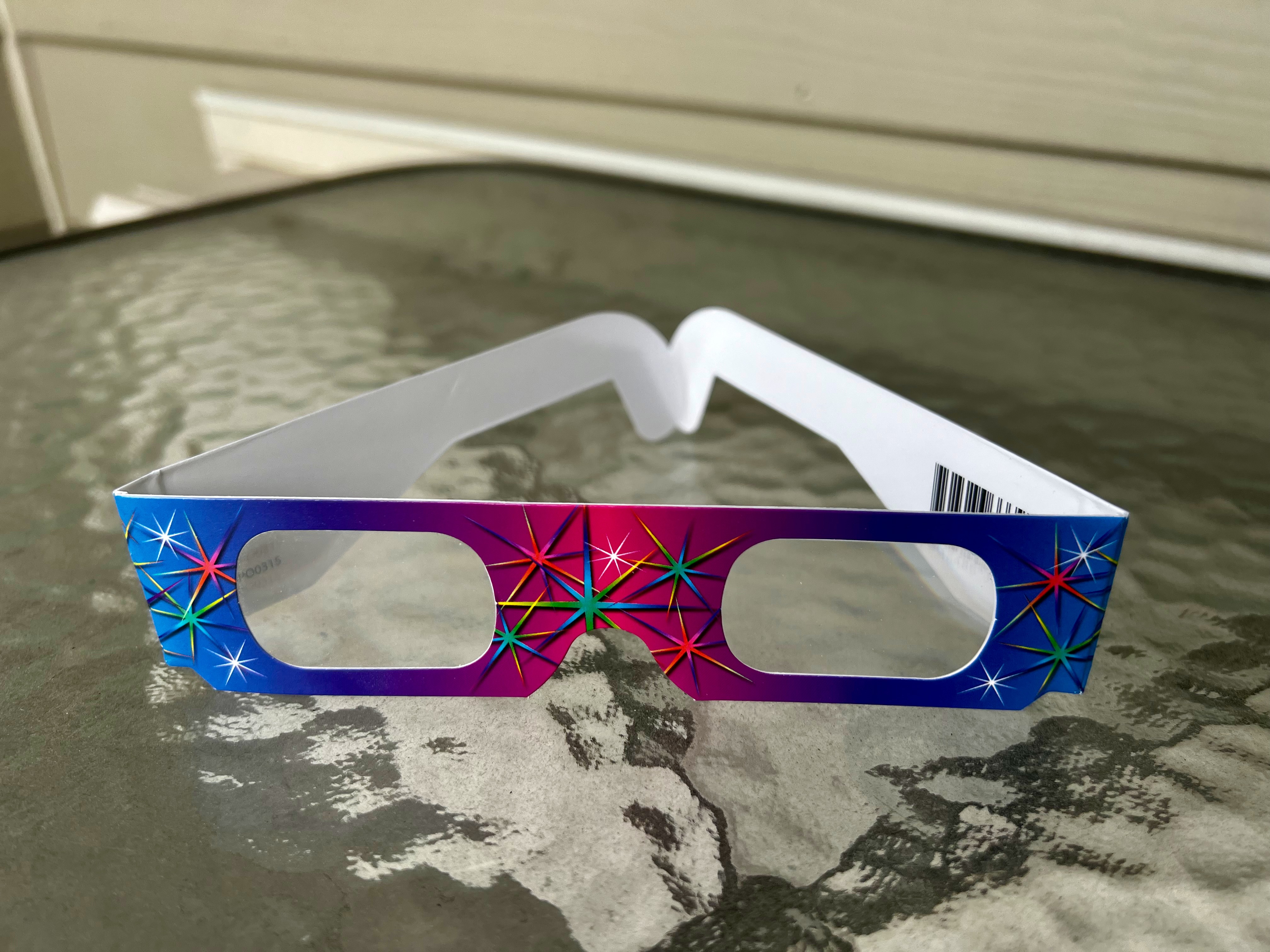
As a physics teacher, I had a few pairs of "rainbow glasses" sitting around. These are cardboard framed glasses with two crossed diffraction gratings for each lens. I cut the lenses up and distributed the film randomly across the board.

Blogger is fairly awful for integrating photos with text. Here's a more complete photo essay/tutorial on preparing pegboard for partials.

Sunday, April 11, 2021

RT;DL Pixel Peeping

Screens. When I was in school, screens were reflective white, flat curtains pulled down from retractible rolls when the teacher was going to show an educational film on the reel projector they shared with the other teachers at the school.

At home, screens were cathode ray tubes in which a spray of electrons, steered by magnetic fields and attenuated by a shadow mask, struck red, green, and blue phosphors. The high-pitched noise given off by the electronics of a CRT TV monitor create physical pain in modern-day students. TV watchers of a certain age somehow tuned that 10 kHz+ whine out.

Today, screens are everywhere, and virtually all are based on light-emitting diodes. But the RGB nature of color imaging remain. That's what this activity is about.

Color mixing and pixel geometry. Surprising enough and instructional enough to be worthwhile.


Pixel Peeping Student Document (Google Docs copy link)

Pixel Peeping Magnifier Observations - HTML export  |  Movie export
(media links are included in the student document)

The PhyzSommelier says this activity pairs nicely with

PhyzLab Springboard - Fun With Colors (Google Docs copy link)


Saturday, April 10, 2021

Saturday, March 20, 2021

The Rainbow Connection—To Physics

Science Friday had a nice segment on rainbows.

The Rainbow Connection—To Physics

Seventeen minutes well-spent. Discussion includes tertiary and quaternary rainbows, why Hawaii is the rainbow capital of the world, and what rainbows might look on other planets (oh, that's a good one!).

Friday, August 09, 2019

The evolution of color vision in tetrachromats

Many of us have a sense of color-mixing among trichromats. There's this classic image of the primary and secondary colors of light achieved by overlapping monochromatic circles of primary colors.

We overlap the red, green, and blue in a triangle to produce magenta (red + blue), cyan (blue + green), yellow (green + red), and white (red + blue + green). We have three distinct cone receptors in our retinas, sensitive to red, green, and blue. So this all makes good sense.

But birds have four cones and can seen into the ultraviolet. Researchers say this gives them an additional dimension of color vision. Imagine red + ultraviolet. You can't: we don't have a name for that mixture, nor can we visualize it. A color mix square would be called for. Actually, that wouldn't work.

Seems the number of possible color-mixing outcomes is 2^n – 1, where n is the number of primary colors. Three primary colors yields 2^3 – 1 = 7 outcomes (R, G, B, M, C, Y, W). Then four primary colors produces 15 outcomes. But the color mixing square can only accommodate 13. How unfortunate. Downright unlucky!

Here's what I got when I tried to populate the cells of a color mixing square. D-oh! Now I'm getting why an extra dimension of color is called for here.

For many more details and implications, check out the Science Friday segment below.


When I say I'm a big fan of SciFri and appreciate the science communication work that host Ira Flatow does, you might suspect a "but" is sure to follow. Who am I to disappoint?

Listen again to the minute from 13:15 to 14:15. I cringed when I heard this over the air the first time through. Ladies, has this ever happened to you? Maybe it was the result of multitasking on Ira's part, but I'm reticent to make excuses for him here. In any case: awkward. The guests maintained composure, so good for them. Still though... I hope I'm never that guy (but I probably have been).

Wednesday, March 13, 2019

All in a Mouse's Night ... Vision

If your curriculum visits light and color, here's a nice tangent worth traveling. Not sharks with fricken lasers, but mice with night vision.
Scientists have figured out how to confer a superpower, like those wielded by the mythical X-Men, at least to mice. Using nanoparticles that convert infrared (IR) light to visible light, researchers have given mice the ability to see in the dark. If the same technique works in humans, it could offer soldiers night vision without the need for goggles and possibly counter ailments that cause patients to gradually lose their sight.
There are important details. Read about them in this article from Science:
Nanoparticles give mice night vision

As a veteran of titling blog posts and lab activities, and as a long-time fan of progressive-era Genesis, "All in a Mouse's Night" quickly came to mind. Trust me, this gift is as much a curse as it is a blessing.

Sunday, April 22, 2018

Structural color in Morpho butterflies

KQED's Deep Look produced a nice piece on the structural color seen in iridescent colors in organisms.

What Gives the Morpho Butterfly Its Magnificent Blue? | Deep Look


And what good is a video clip without some questions to keep gawkers engaged?

YouTube Physics: Magnificent Blue @ TPT

Saturday, April 14, 2018

Resources ... In Color!

You have to have lived many summers to remember when "In Color" was appended to television show titles to distinguish them from humdrum black and white programs. Leslie Neilson spoofed the practice, along with everything relating to 1960s police dramas his Police Squad!.

I added color to my curriculum a few years ago. It began with writing a lab around PhET's "Color Vision" simulation coupled with pocket microscopes. The lab is called "Pixel Peeping" and it's a big eye-opener (!), especially when they look at the phosphors lighting up in yellow.

Next, I wrote an add-on activity called "Fun with Colors!" An interesting exploration of color mixing.

Then I saw this groovy video, and showed it in conjunction with the color activities. Biological pixels!

Science Friday: Where's the Octopus?


Then I saw this wee gem from Steve Mould, and thought to add it, too. How does your brain average red and blue when your green cone is silent?

The Royal Institution: Colour Mixing: The Mystery of Magenta


But I bristle at the notion of just showing a video or asking students to watch a video without having questions attached to ensure mental engagement. Otherwise, it's just watching TV. If it can't be done in class, it makes for great "YouTube homework."

So I put together some questions that could be answered while watching these brief clips.

Chromatophores and Trichromats @ TPT

I had been using an iOS app to mix colors on my iPhone and iPad. But the app ecosystem is lively and active, so old apps die and new apps arise. An app developer named Insight currently offers an iOS app called Color Mixing. It has your standard color addition of primary colors (RGB) as well as color subtraction (CMY). It seems groovy, though I haven't tinkered with it much yet. I'm reluctant to develop an activity around such an app, since it may be gone tomorrow.

If you've got some groovy color stuff that works for you, post about it in the comments.

Sunday, April 08, 2018

Fluorescent Puffin Bills and Tetrachromacy

Serendipity. What a great thing among the scientifically curious.

Ornithologist Jamie Dunning’s serendipity compelled him to shine ultraviolet light on the already decorative bill of a puffin. And he saw something apparently not previously documented in the learned journals.

Birds, those opulent tetrachromats, are apparently up to their colorful shenanigans once again. We humans, humble trichromats that we are, just miss things sometimes. (It’s clearly not just the ability to fly that makes Naomi Hamilton Jealous of the Birds! But I digress.)

Read the story, behold the images, and mention it when you teach about colors and color mixing.

Puffin beaks are fluorescent and we had no idea.