There is no history unless you record it. I used to be much more active in getting candids in class of students conducting lab activities.
But I still like to get some from ExploratoRio. So I get students to snap up what they can during the event. I sifted and sorted, then cobbled together a slide show in the Mac OS Photos application. Set it to a bit of music, then uploaded it to YouTube. Turns out, you have to set the video to "private" when you use copyrighted music. So that's what I do. Here's the link. Fascinated: The ExploratoRio 2018 Slide Show
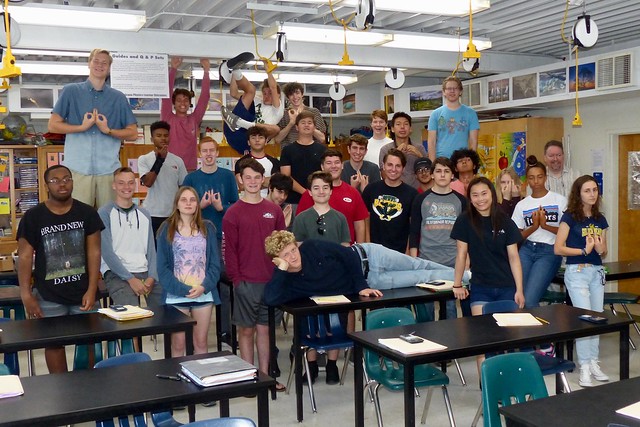
I still break out the camera for Egg Toss and Van de Graaff generator activities. And class portraits on the day of the final exam, immediately following the issuance of the class's PhyzMaster certificates.
Next time your at the Department of Motor Vehicles renewing your driver's license, don't be surprised if you see people in the lobby staring into spinning spirals just before they take their eye test.
Why? It turns out an old favorite illusion, referred to as the "expanding motion effect," can induce increased visual acuity. This illusion is demonstrated in the Exploratorium's "Depth Spinner" Science Snack. It's a perennial favorite among visitors to our ExploratoRio Open House event.
The team discovered that visual acuity—the ability to see fine detail—can be enhanced by an illusion known as the ‘expanding motion aftereffect’. While under its spell, viewers can read letters that are too small for them to read normally.
When participants stare at the center of a spinning pattern that spirals inward for about 30 seconds, shifting their view to a stationary object will induce the illusion that the static object is expanding.
Participants who started with normal visual acuity and saw [inward spinning] spirals ... showed improved visual acuity.
It's as it they were looking through a camera and zooming in on the smallest letters in the eye chart.
It is important that the spiral is spinning inward. Staring at an outward spinning spiral induces a shrinking effect.
Those who saw [outward spinning] spirals ... actually performed worse after exposure to the spirals.
Anyone who's enjoyed this illusion knows the effect is temporary.
But don’t throw out your eyeglasses just yet: the researchers note that the overall boost to visual acuity is small and fleeting.
When broadcast television was something people watched, networks would pitch their "encore presentations with the line, "If you haven't seen it before, it's new to you!"
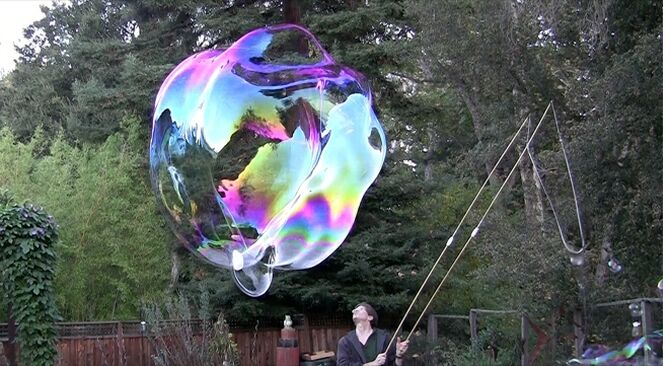
When two students ran me through the paces of their Bubble Suspension build (for our upcoming ExploratoRio2016 on Wednesday, April 13), they left some dry ice behind in my classroom sink.
So it's me, some sublimating dry ice in a sink, and no one else around. Recipe for serendipity if ever there was one.
After dousing the frozen carbon dioxide and blowing the subsequent cloud out of my sink a few times (that never gets old), I found a nearby electrophorus and pressed it into the sublimating mound.
What happened next is best relayed in the form of a video, which drops the action to 1/8th speed at about 20 seconds in.
So unexpected was the sound that I decided a new ExploratoRio Science Snack was in order. The title of "Ice Scream" wrote itself with little help from me.
The details (as much as I know them or foresee them) are in the recipe linked to below.
But when a physics demo is as groovy as this, you can count of someone to figuratively put it on steroids.
I was looking for a video of a vortex cannon blowing out a candle and found this promotional of the Candle Cannon. The suspense builds as the distance is steadily increased.
You can see a slight visual distortion as the vortex reaches the cannon - a nice way to show that the compression of air is denser than the air around it as it refracts the light.
I'm thinking of using the video time stamps to find the speed of the traveling air compression with my students. It looks like it takes 9 seconds from the sound of the diaphragm moving to when the candles get blown out for the last trial of 180 feet. That means the large "puff" of air travels 180 feet in 9 seconds or about 20 feet per second. Comparing that to the trial at 120 feet which took about 6 seconds that speed seems fairly consistent.
"But Mrs. Barnett! Mrs. Barnett! The sound takes some time to get to us (camera)!" Ahh if only they would all think that deeply.
If we assume 340 m/s for the speed of sound, or 1115 ft/ sec, its not offsetting our times that much. And just mentioning that fact that should help to point out that while the vortex cannon is used to model the compression of a sound wave it is not in fact a sound wave that reaches you. It's traveling at ~6% the speed of a sound wave after all. My kids love the air cannon in my classroom so I think they will enjoy this!
I have watched the video several times now and I found myself wondering what would happen if they started the cake much closer .... at some point it should take some of that frosting off the cake, right?
UPDATE: The Candle Cannon has its own website: candlecannon.com, of course.
Sorry for the sudden aggregation binge. I should be working on my genuflection to The College Board (AP Physics 1 and AP Physics 2 syllabi), but my motivation for that exercise is so. very. low.
In the meantime, let's enjoy this confluence of Fibonacci numbers, 3D printing, and stroboscopy, shall we?
"These are 3-D printed sculptures designed to animate when spun under a strobe light. The placement of the appendages is determined by the same method nature uses in pinecones and sunflowers. The rotation speed is synchronized to the strobe so that one flash occurs every time the sculpture turns 137.5º—the golden angle. If you count the number of spirals on any of these sculptures you will find that they are always Fibonacci numbers.
For this video, rather than using a strobe, the camera was set to a very short shutter speed (1/4000 sec) in order to freeze the spinning sculpture."
Here is the conclusion of this year's ExploratoRio time lapse series. We see the 90-minute exhibition and the 60-minute striking of the set. In the end, the classroom has returned to its original state and is ready to go for the next day.
To be a bit different in this year's time lapse, I toured the camera around the room before setting it back on its perch. I also took it outside and into the dark room. A white balance (set to the fluorescent light of the classroom) penalty was exacted.
Earlier, I relearned the lesson that my wide-angle lens is, in fact, a manual focus lens. And easily jarred when the camera is moved, the battery is changed, and the memory card tinkered with. Life goes on.
Here's today's clip. ExploratoRio 2014 had been going for three hours by the time this clip began rolling. So we see things through to the end of the daytime portion.
We had 12 elementary classes come to visit, so that's about 12 x 30 = 360 little ExploratoRions. I hope to see them again as students a few years from now.
The "season" runs from the close of Presidents' ("Ski") Week until ExploratoRio (Open House). Exhibitors bring their exhibits in to show me that they work. Or I show them how to use school equipment to set up their exhibit (so they'll be able to do it on their own on ExploratoRio Eve). We discuss the operation, logistics, physics, perception.
I schedule one or two exhibits after school each day during the season, with the exception of Thursdays and other known blackout days. (Thursdays are out due to district-mandated "collaboration".) The one-on-one time with each set of exhibitors pays dividends on ExploratoRio Eve and Day in terms of operational smoothness and crisis avoidance.
Support staff positions are filling up nicely. Elementary class hosts are bringing in teacher contact information, and I've laid out a visitation schedule. We have three time slots yet unclaimed (two them being 11:30am-12-30pm). There are times when the space we have gets a bit crowded. We want to get as many elementary class students as we can to come in for a visit, but we have school for only a minimum day, so there is a hard time limit. One solution, I suppose, would be moving ExploratoRio off of Open House. But the original vision of ExploratoRio was for it to be the Open House activity.
When ExploratoRio rolls around, I worry about the bubble exhibits. The bubble formulas given in the original recipes were developed in the 1990s, before dishwashing detergents were concentrated and who knows what else.
At last year's High School Share-a-thon (AAPT's national meeting Show & Tell), Chicago-area physics teacher shared a link to a site that seems devoted with keeping up with the latest on soap bubble solutions.
What will be shared at this year's share-a-thon? We'll find out at the 2013 AAPT Summer Meeting in Portland. The share-a-thon is scheduled for Sunday, July 14, 6pm-8pm in the Hilton's Broadway III/IV.
ExploratoRio time lapse sequences. My Canon S3-IS has an intervalometer function which will take up to 100 exposires. I set it to take one shot per minute. Here's what I caught.
SETUP
SETUP + DAYTIME OPERATIONS
If I get any more time lapse footage tonight, I'll post appropriate embed links later.
Rio's Open House is two months away, but our preparations for ExploratoRio 2012 began this week. ExploratoRio is the annual homage to San Francisco's Exploratorium Science Museum that I orchestrate. (You can find more posts on ExploratoRio by clicking the tag off in the column on the right.)
Two of the eight weeks between now and Open House are school vacations, and there is a sequence to this process that requires time. One thought that never strikes my mind when we're setting up on ExploratoRio Eve is, "we should start preparing for this thing LATER next year."
Too many ExploratoRio resources can be accessed via my ExploratoRio Page.
Step 1: The Posting of the Snacks (and Staff Positions, beyond the frame of this pic)
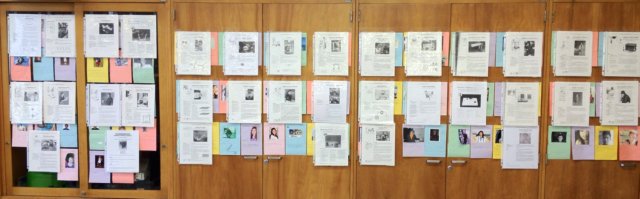
The snacks are taped over the student minibios that grace the back of the room all year. More on those in another post. (If I remember.)
While hosting ExploratoRio, I try to snap a photo or two. That's probably a bad idea, since there are so many mini-crises I should be resolving. And I should spend more time greeting the visiting teachers and chaperones. And I have students who are supposed to be snapping pics all day long. But I can't help myself.
Here is a preliminary set to show for our efforts until the student photos comes in. With any luck, they will have minded shooting details better than I did.
Oh, we did have 14 elementary classes visit from 8:30am-12:30pm. That translates to about 400 students (in addition to my 150). It's not a trivial matter for teachers to coordinate a field trip to come visit us, so it was especially delightful to see so many young investigators throughout the day.
The rooms were rockin' all day. The little ones were impossibly cute and overflowing with unrestrained enthusiasm as they pulled each other over to their favorite exhibits. Their unvarnished expressions of wonder and joy could make you cry.
UPDATE: ExploratoRio evening program has been bumped up. It will run from 6:30pm to 8:00pm.
It seemed so far off when we began preparations six weeks ago, but April 6 is rapidly approaching. That's the date of Open House, so that's the date of ExploratoRio 2011.
Student exhibitors have been building and researching their exhibits. Elementary class hosts have booked every visitation slot on the schedule; we should have young explorers visiting from 8:30am to 12:30pm.
I spent a few hours in the classroom over the weekend to beat back the entropy of of the school year. I was also inspired to develop a new "snack." Over the years I have developed a handful of ExploratoRio Science Snacks for students to choose from, in addition to the Exploratorium Science Snacks published in Square Wheels and the original Exploratorium Science Snackbook.
My new snack is "Wristbandits," inspired by the recent renaming of Sacramento's ARCO Arena to Power Balance Pavilion. Earlier this year, I developed an in-class lesson exposing the pseudo-scientific hoax that the highly-popular wristbands (with or without holograms) represent.
With the onset of ExploratoRio, I thought it would be nice to have an exhibit exposing the methodology of the fraudulent demonstrations used to promote the bracelets. Once I was struck with an appropriate title, it was on.
All I need now is to draft some student exhibitors to present it. In any case, we set up tomorrow after school, clearing the room from 3-5pm and installing the exhibits from 5-6pm. ExploratoRio runs from 7:50am-12:30pm and 7:00pm-8:30pm 6:30pm-8:00pm Wednesday. By 10:00pm 9:00pm Wednesday, it will be as if nothing ever happened: the classroom will be a classroom again, ready for regular use on Thursday morning.