What I always love about Jearl Walker's work is that it looks at the world, sees something peculiar, and says "why is that?" And proceeds to investigate.
We often hear, "Everything happens for a reason." What we should also hear is, "And that reason is physics."
So it is with The Cheerios Effect. Watch and learn.
The Cheerios Effect
There's a whole book filled with this kind of serendipity:
The Flying Circus of Physics by Jearl Walker
I highly recommend it.
Showing posts with label heroes. Show all posts
Showing posts with label heroes. Show all posts
Friday, March 22, 2019


Tuesday, March 12, 2019
One tendril of Dan Burns' vast influence: Kari Byron
I'm just gonna leave this right here, for the benefit of both of you who aren't on the social media.
That's two people made of win right there!
Of course my Montana-sized ego compels me to at least attempt to sourgrapes this awesomeness. Not an easy lift, but here goes:
It's a good thing Kari Byron wasn't one of my students, because if she were, I'd be about 15 years into a forehead tattoo reading "I was Kari Byron's Physics Teacher!" If we're being honest, that would only serve to ostracize me from family, friends, students, and colleagues. And I don't think Ms. Byron would ever speak to me again. So... whew: dodged that bullet!
In any case, I hope Kari will keep us all laughing and thinking, and that Dan will continue to share his pearls wisdom with readers of this blog. The world could always use more people like these two.
This is my high school physics teacher Mr. Burns. I finally signed his year book. Found out he has a viral video with 56M views!https://t.co/w5fgxFatiy pic.twitter.com/HEPjm6TzXX— Kari Byron (@KariByron) March 11, 2019
That's two people made of win right there!
Of course my Montana-sized ego compels me to at least attempt to sourgrapes this awesomeness. Not an easy lift, but here goes:
It's a good thing Kari Byron wasn't one of my students, because if she were, I'd be about 15 years into a forehead tattoo reading "I was Kari Byron's Physics Teacher!" If we're being honest, that would only serve to ostracize me from family, friends, students, and colleagues. And I don't think Ms. Byron would ever speak to me again. So... whew: dodged that bullet!
In any case, I hope Kari will keep us all laughing and thinking, and that Dan will continue to share his pearls wisdom with readers of this blog. The world could always use more people like these two.
Tuesday, June 12, 2018
Cosmos: A Spacetime Odyssey - Video Question Sets
First and most importantly, a third season of Cosmos is in production for a Spring, 2019 release. I believe the appropriate term of art here is "Squee!" My Close, Personal Friend, Neil deGrasse Tyson will once again be hosting. The complete title is Cosmos: Possible Worlds. Cosmos aficionados may refer to it as Cosmos 2019 or Cosmos: PW. I look forward to its addition alongside Cosmos: A Spacetime Odyssey (2014) and Carl Sagan's Cosmos: A Personal Voyage (1980).
In other Cosmos news, I have created video questions sets: student sheets and answer keys to accompany Cosmos: A Spacetime Odyssey. Each of the 13 episodes gets a two-sided sheet of questions that students can answer while the episode plays. Question types vary, but are intended for quick, short responses.
Some video question companions launch into deep, probing questions that take students out of the presentation. Not these. The goal of these questions is to help students maintain focus on the episode while it plays. I leave the deep questions to classroom instructors.
I've added this set to my Teachers Pay Teachers Store: The Lessons of Phyz. My question sets for the now-extinct high school adaptation of The Mechanical Universe are already posted there. Who knows what will be next.

In any case, here's a direct link to the Cosmos set:
Cosmos: A Spacetime Odyssey - Video Question Sets
I have used these sets in my AP Physics 2 course and in my Conceptual Physics course. We watch approximately one episode per unit as part of the ongoing skepticism and critical thinking component of the course curriculum.
In other Cosmos news, I have created video questions sets: student sheets and answer keys to accompany Cosmos: A Spacetime Odyssey. Each of the 13 episodes gets a two-sided sheet of questions that students can answer while the episode plays. Question types vary, but are intended for quick, short responses.
Some video question companions launch into deep, probing questions that take students out of the presentation. Not these. The goal of these questions is to help students maintain focus on the episode while it plays. I leave the deep questions to classroom instructors.
I've added this set to my Teachers Pay Teachers Store: The Lessons of Phyz. My question sets for the now-extinct high school adaptation of The Mechanical Universe are already posted there. Who knows what will be next.

In any case, here's a direct link to the Cosmos set:
Cosmos: A Spacetime Odyssey - Video Question Sets
I have used these sets in my AP Physics 2 course and in my Conceptual Physics course. We watch approximately one episode per unit as part of the ongoing skepticism and critical thinking component of the course curriculum.
Monday, September 18, 2017
Jearl's bottle overfloweth
The ringmaster of the Flying Circus of Physics is at it again. This time, Jearl hops into brewery for a beer. Root beer, that is. A former student taps the top of Jearl's open bottle, and physics ensues. Take a look.
Flying Circus of Physics: Bottle Tap (Episode 3.1)
The Flying Circus of Physics now has a YouTube Channel. I recommend subscribing!
Flying Circus of Physics: Bottle Tap (Episode 3.1)
The Flying Circus of Physics now has a YouTube Channel. I recommend subscribing!
Saturday, August 26, 2017
In Memorium: Paul Doherty
One of my personal mentors was a very down-to-earth Physics celebrity, Dr. Paul Doherty of the Exploratorium. I met Paul within a month of my first year of teaching as part of the New Teacher Institute so he has been a major influence on me. Paul passed after a battle with cancer last week. Despite knowing his time was near, like many I was wrecked at the news. We had all secretly hoped that he would make it to see another solar eclipse but it was not to be. During the eclipse I thought of Paul and the sheer joy he had at experiencing such beauty in science and nature.
Every teacher that has been a part of the Summer Teacher Institute, New Teacher Institute, conference or public outreach at the Exploratorium knew Paul. This was not just because he was a memorable guy, although he certainly was, but because he always tried to get to know everyone. His enthusiasm and curiosity were as infectious as his smile. He seemed to know everything, able to speak on anything related to Physics, and most things in other fields of science. Once while watching the credits of a science documentary I saw "Thanks to Paul Doherty, Science Historical Consultant," and when I asked him about it he said, "Yeah I was just helping them out." He's written books and papers, developed exhibits and more demonstrations and educational activities than you can count. When Paul developed an activity it was hands on, used easy to access materials, and most importantly for teachers, worked every time. He enjoyed playing the whirly, playing with flashlights and was an Iron Science Teacher champion.
Paul made the intricacies of the world easy to understand; he could answer complex questions with a pencil or a telephone cord. He absolutely delighted in every question that was asked of him and he had a few common responses:
He was the smartest man I have ever known and he was perfectly comfortable saying "I don't know." The power in that was palpable. When I asked him a question and he countered with asking me my opinion I no longer felt ashamed at not knowing but excited at the prospect of figuring it out on my own with Paul as a guide. I can say for certain that knowing Paul made me a better teacher because he was an amazing teacher. They say a teacher's influence is hard to measure and I would argue that Paul's reach is truly immeasurable. He helped hundreds of teachers who in turn have each taught or will continue to teach thousands.
Julie Yu of the Exploratorium put together this video of Paul from an interview for the museum. It both warms my heart and saddens me to see Paul speak again. Every response is very quintessential "Paul." I may watch it when I need to remember why I teach, or just when I miss him.
Every teacher that has been a part of the Summer Teacher Institute, New Teacher Institute, conference or public outreach at the Exploratorium knew Paul. This was not just because he was a memorable guy, although he certainly was, but because he always tried to get to know everyone. His enthusiasm and curiosity were as infectious as his smile. He seemed to know everything, able to speak on anything related to Physics, and most things in other fields of science. Once while watching the credits of a science documentary I saw "Thanks to Paul Doherty, Science Historical Consultant," and when I asked him about it he said, "Yeah I was just helping them out." He's written books and papers, developed exhibits and more demonstrations and educational activities than you can count. When Paul developed an activity it was hands on, used easy to access materials, and most importantly for teachers, worked every time. He enjoyed playing the whirly, playing with flashlights and was an Iron Science Teacher champion.
Paul made the intricacies of the world easy to understand; he could answer complex questions with a pencil or a telephone cord. He absolutely delighted in every question that was asked of him and he had a few common responses:
"I don't know, let's try it!"
"Well ... it's more complicated than that."
"What do you think?"
He was the smartest man I have ever known and he was perfectly comfortable saying "I don't know." The power in that was palpable. When I asked him a question and he countered with asking me my opinion I no longer felt ashamed at not knowing but excited at the prospect of figuring it out on my own with Paul as a guide. I can say for certain that knowing Paul made me a better teacher because he was an amazing teacher. They say a teacher's influence is hard to measure and I would argue that Paul's reach is truly immeasurable. He helped hundreds of teachers who in turn have each taught or will continue to teach thousands.
Julie Yu of the Exploratorium put together this video of Paul from an interview for the museum. It both warms my heart and saddens me to see Paul speak again. Every response is very quintessential "Paul." I may watch it when I need to remember why I teach, or just when I miss him.
Paul's family has set up a CaringBridge.org page for sharing stories and thoughts of Paul. If you knew him I encourage you to leave a response. Some of what I wrote about Paul is below:
"...the most important things I learned from you was to keep the wonder, to not be afraid of not knowing to be fascinated with learning and to forever be curious. Over a year ago you wisely responded to a teacher's question with "The best gift for a physics professor is a puzzle they don't don't understand." You encouraged me to delve deeper, gave me permission to have fun and will forever be an inspiration."
May we all teach as Paul did: with enthusiasm, wonder and a true passion for science education.
Sunday, June 25, 2017
In the Skeptic Zone with The Exploratorium's Paul Doherty
And Richard Saunders and Eugenie Scott.
Australian skeptic podcaster, personality, origami artist, and host of The Skeptic Zone Podcast, Richard Saunders crossed the Pacific to visit America. Here in Northern California, he visited Paul Doherty at the Exploratorium and Eugenie Scott at her backyard beehive.
Our friend, Paul Doherty, was literally in his element, and that comes across nicely. Eugenie Scott is noted for her work with the National Center for Science Education, a friend to any teacher hoping to teach the science of evolution or climate change in challenging environments.
Richard Saunders has long been on the front lines of skepticism and critical thinking. My students know him for his ingenious take-down of the Australian distributor of Power Balance bracelets.
All three of these people are heroes and inspirations to me.
In any case, have a listen!
Skeptic Zone, Episode #453 - 25.June.2017
Australian skeptic podcaster, personality, origami artist, and host of The Skeptic Zone Podcast, Richard Saunders crossed the Pacific to visit America. Here in Northern California, he visited Paul Doherty at the Exploratorium and Eugenie Scott at her backyard beehive.
Our friend, Paul Doherty, was literally in his element, and that comes across nicely. Eugenie Scott is noted for her work with the National Center for Science Education, a friend to any teacher hoping to teach the science of evolution or climate change in challenging environments.
Richard Saunders has long been on the front lines of skepticism and critical thinking. My students know him for his ingenious take-down of the Australian distributor of Power Balance bracelets.
All three of these people are heroes and inspirations to me.
In any case, have a listen!
Skeptic Zone, Episode #453 - 25.June.2017
Saturday, July 09, 2016
Failure & Success as seen with Strandbeests
The Exploratorium Museum of San Francisco currently has a large exhibit called Strandbeest: The Dream Machines of Theo Jansen. The exhibit has consisted of several of these large machines on display, daily demonstrations of several machines and special events including an After Dark (adults only night) with Adam Savage of Mythbusters fame.
Savage spent three days making a strandbeest of his own live at the Exploratorium in front of whoever would like to watch. He unveiled his creation at yesterday's After Dark event. I was unable to go (those darn kids) but watched video today.
I was so happy to see Savage admit failure and his own limitations. He had designed his machine wrong at first, adjusted it and it worked but not the way he wanted. Even at his unveiling he admitted it wasn't quite the way he wanted, and then he just hopped up on the machine in a "Well I wonder if..." way. He surprised himself and the audience when the machine worked as he had hoped.
His enthusiasm is contagious and his honest answers to audience questions is very reflective. This is a great video to show students that even their media heroes have failures, and grow through embracing them. He even jokes that he fully expected to see headlines the next day saying he had failed "...and that's okay!" It will make a great addition to an engineering project introduction.
Hearing Savage discussing "The Imposter Complex" that many new and veteran teachers experience is uplifting; "He struggles with it just like I do!"
The Exploratorium has a lot of resources online, links to the demos of the Tinspider walking, and more. I was able to see the machines in passing during the Summer Institute for Teachers and I do hope to get out to the museum this summer and really seeing the machines in detail. If you're in the area I highly recommend it.
Savage spent three days making a strandbeest of his own live at the Exploratorium in front of whoever would like to watch. He unveiled his creation at yesterday's After Dark event. I was unable to go (those darn kids) but watched video today.
I was so happy to see Savage admit failure and his own limitations. He had designed his machine wrong at first, adjusted it and it worked but not the way he wanted. Even at his unveiling he admitted it wasn't quite the way he wanted, and then he just hopped up on the machine in a "Well I wonder if..." way. He surprised himself and the audience when the machine worked as he had hoped.
His enthusiasm is contagious and his honest answers to audience questions is very reflective. This is a great video to show students that even their media heroes have failures, and grow through embracing them. He even jokes that he fully expected to see headlines the next day saying he had failed "...and that's okay!" It will make a great addition to an engineering project introduction.
Hearing Savage discussing "The Imposter Complex" that many new and veteran teachers experience is uplifting; "He struggles with it just like I do!"
The Exploratorium has a lot of resources online, links to the demos of the Tinspider walking, and more. I was able to see the machines in passing during the Summer Institute for Teachers and I do hope to get out to the museum this summer and really seeing the machines in detail. If you're in the area I highly recommend it.
Tuesday, June 07, 2016
When heroism doesn't help
Our instincts as science teachers is to celebrate our rock stars of science. Physics teachers shine a spotlight on Galileo, Einstein, Newton, Faraday among others. We praise their discoveries and praise the advancements they made for our understanding of the universe. We want our students to consider individuals who invented calculus or connected electricity and magnetism as nearly as important as a Kardashian. Hope springs eternal.
We are not going to stop doing this. Nor are my selfies with Neil deGrasse Tyson and Bill Nye coming down any time soon. However,...
It is a rare person for whom math and physics are easy subjects. Those who have achieved great accomplishments in those fields are not necessarily fundamentally different from anyone else. What might set them apart is their response to the challenge. Many see a challenge and choose not to engage. They looked at the daunting obstacles and directed their mortal abilities toward overcoming them. They were not genetically predisposed toward genius. They saw the mystery and believed it could be unraveled.
We are not going to stop doing this. Nor are my selfies with Neil deGrasse Tyson and Bill Nye coming down any time soon. However,...
Researchers found that students perform better in science where they read stories about how famous scientists struggled rather than when they read stories about what those scientists achieved.The story from Shankar Vedantham's "Hidden Brain" ran this morning on Morning Edition and can be found on NPR.org.
It is a rare person for whom math and physics are easy subjects. Those who have achieved great accomplishments in those fields are not necessarily fundamentally different from anyone else. What might set them apart is their response to the challenge. Many see a challenge and choose not to engage. They looked at the daunting obstacles and directed their mortal abilities toward overcoming them. They were not genetically predisposed toward genius. They saw the mystery and believed it could be unraveled.
Monday, May 25, 2015
If you need a moment at the end of the year
The NOVA episode devoted to the work of James "The Amazing" Randi makes a nice coda to any science course.
In the end, skepticism and critical thinking are important elements we hope we instilled during the year and will remain with our students long after the formula for kinetic energy has faded.
The full video is on YouTube here:
NOVA: James Randi's Secrets of the Psychics
An accompanying question sheet to help keep everyone engaged can be found here:
Video Questions for James Randi's Secrets of the Psychics.
More skepticism in the classroom lessons and links can be accessed from my Skepticism in the Classroom page.
In the end, skepticism and critical thinking are important elements we hope we instilled during the year and will remain with our students long after the formula for kinetic energy has faded.
The full video is on YouTube here:
NOVA: James Randi's Secrets of the Psychics
An accompanying question sheet to help keep everyone engaged can be found here:
Video Questions for James Randi's Secrets of the Psychics.
More skepticism in the classroom lessons and links can be accessed from my Skepticism in the Classroom page.
Saturday, August 02, 2014
In good company
Generally speaking, previous AAPT award winners were inducted as the Inaugural Cohort. I was a recipient of their Distinguished Service Citation in 2008. And that's how I came to be included on a list of physics-teaching heavyweights. It's true, I have an ego the size of Montana, but I'm also grounded enough to know I'm dwarfed by the giants on this list.
AAPT's Fellows Announcement Page
A List of the Inaugural Cohort
Friday, May 16, 2014
Hewitt Fest 2014 at Rio Americano

Hewitt, along with his delightful wife Lillian and ever-clever Evan Jones, was kind enough to drop in on my Physics classes today. He regaled the students with tales of the inverse square law, sunballs, college matriculation, and his path to physics.
After the lessons, the lunch time bell rang and my room became Groupie Shot City (or Selfie Central). My post to Facebook was, "An 82 year old textbook author visited my school today. The students mobbed him like he was a rock star."
Here are some images to prove it.
2014 05 Hewitt Fest at Rio Americano
Some readers might recall that Hewitt paid Rio Americano a visit on the last day of school, June, 2011.
Saturday, November 09, 2013
Carl Sagan Day - Neil deGrasse Tyson's new Cosmos
In case you haven't seen this yet. (It got past me somehow.)
Sunday, May 06, 2012
How much would you pay... for the Universe?
Neil deGrasse Tyson asks a fair question.
If you were sentient in the 1960s, you'll want to wipe your tears so they won't drip onto your keyboard.
Sign the petition! (Better slacktivism than nactivism.)
http://penny4nasa.org/Penny4NASA/Home.html
If you were sentient in the 1960s, you'll want to wipe your tears so they won't drip onto your keyboard.
Sign the petition! (Better slacktivism than nactivism.)
http://penny4nasa.org/Penny4NASA/Home.html
Sunday, June 12, 2011
Paul Hewitt visits Rio Americano
The educational value of the last day of school is rightly debated. It's the day after graduation; seniors have been gone for several days. Final exams are over. There is no new material to teach or learn. Options for disciplining misbehavior are limited.
We spend years making our students smart, so they realize that consequences for unauthorized absence or failure to keep to their daily schedule are minimal. The result is that many students do not show up, and the ones who do feel entitled to some degree of off-task behavior. Teachers the foil off-task behavior potential by not offering a task to stray from.
Friday, June 10, however, was the best Last Day of School we ever had in the history of Rio Physics. Conceptual Physics author, Mr. Paul Hewitt came for a visit! In the casual setting of the day, he answered student questions, offered sage advice to students, posed for pictures, and signed autographs (with cartoons to boot).

We were able to visit physics colleague, Mrs. Lucy Jeffries, on her last day at Rio and say "hi" to the principal, Mr. Brian Ginter, and vice-principal, Mrs. Vanessa Adolphson as well.
Hewitt was welcomed by physics students who appreciated his textbook and saw him in action in his Conceptual Physics Alive! videos. I will freely admit bias in this matter, but I cannot imagine the author of any other textbook used on campus being given so enthusiastic a reception had they paid a visit. If I'm wrong, please correct me in the comments. Non-physics students were coming in to get pics and autographs!

Hewitt had a great time at Rio. He found the campus to be beautiful and the students to be delightful.
One student put it best in the caption of the Hewitt "groupie" shot he immediately posted to his Facebook profile. As if to chide those who skipped or slept through Hewitt's visit, he posted his prize pic with the note, "You so jelly I could make you my lunch!"
If you're a student who got a shot with Mr. Hewitt, send it to me and I'll add it to the album linked below.
Hewitt at Rio photos at Flickr.
We spend years making our students smart, so they realize that consequences for unauthorized absence or failure to keep to their daily schedule are minimal. The result is that many students do not show up, and the ones who do feel entitled to some degree of off-task behavior. Teachers the foil off-task behavior potential by not offering a task to stray from.
Friday, June 10, however, was the best Last Day of School we ever had in the history of Rio Physics. Conceptual Physics author, Mr. Paul Hewitt came for a visit! In the casual setting of the day, he answered student questions, offered sage advice to students, posed for pictures, and signed autographs (with cartoons to boot).
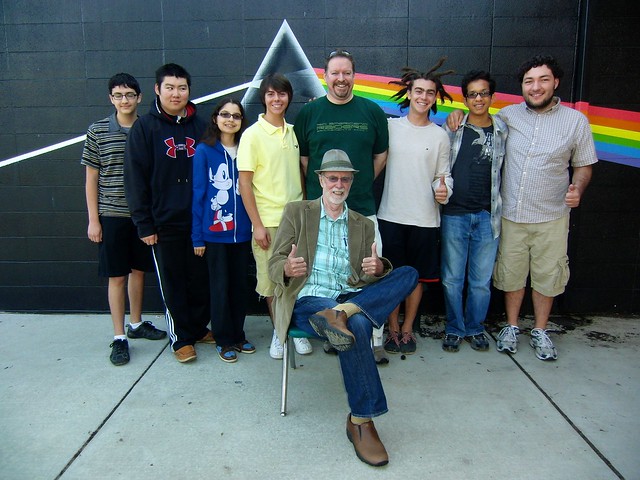
We were able to visit physics colleague, Mrs. Lucy Jeffries, on her last day at Rio and say "hi" to the principal, Mr. Brian Ginter, and vice-principal, Mrs. Vanessa Adolphson as well.
Hewitt was welcomed by physics students who appreciated his textbook and saw him in action in his Conceptual Physics Alive! videos. I will freely admit bias in this matter, but I cannot imagine the author of any other textbook used on campus being given so enthusiastic a reception had they paid a visit. If I'm wrong, please correct me in the comments. Non-physics students were coming in to get pics and autographs!
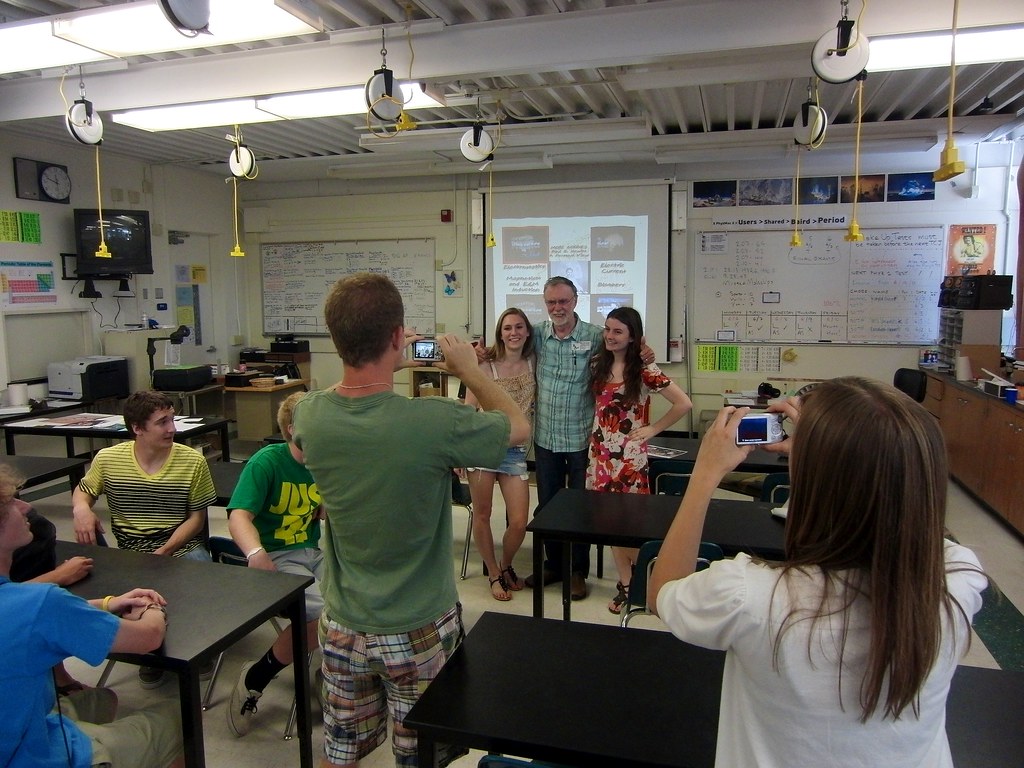
Hewitt had a great time at Rio. He found the campus to be beautiful and the students to be delightful.
One student put it best in the caption of the Hewitt "groupie" shot he immediately posted to his Facebook profile. As if to chide those who skipped or slept through Hewitt's visit, he posted his prize pic with the note, "You so jelly I could make you my lunch!"
If you're a student who got a shot with Mr. Hewitt, send it to me and I'll add it to the album linked below.
Hewitt at Rio photos at Flickr.
Saturday, May 07, 2011
TAM 9 From Outer Space

This is your friendly reminder to get it in gear if you want to go to this year's premiere celebration of science, skepticism, and critical thinking. The Amaz!ng Meeting 2011 (TAM 9) will be held July 14-17 at the South Point Hotel, Casino, and Spa in Las Vegas.
The luminaries scheduled to appear include Bill Nye (The Science Guy), Mythbuster Adam Savage, Neil deGrasse Tyson, Lawrence Krauss, Richard Dawkins, Michael Shermer, Phil Plait, PZ Myers, magicians Penn & Teller and Banachek, Skepics' Guide to the Universe and Skepticality talents, awesome Aussies Karen Stollznow and Richard Saunders, Brit-wit Richard Wiseman, entertainer George Hrab, and many, many, many more.
It's difficult to describe this conference beyond the term, "Amazing." I will say that I've been to TAMs 2, 3, 4, 5, 6, 7, and 8, and that I intend to go as long as
a. they are held and
b. I am alive.
For what it's worth, I do not make that claim regarding any other conference or meeting series that I attend other than TAM.
The attendance for TAM has grown every year (and throughout the Great Recession) because if you're anything like me, you get hooked at your first TAM and never miss another. Best. Addiction. Ever.
The Amaz!ng Meeting 2011: TAM 9 From Outer Space!
Tuesday, February 15, 2011
55,296 and counting

The Bohr, Celsius, and Curie cards got over 3000 views each. Most cards were somewhere in the 2000-range.
Seems they were pretty well received!
Sunday, February 06, 2011
Scientist Valentines

Ironic Sans posted this idea years ago. Scientist valentines. Go look; I'll wait.
The idea is genius, and my mind spun with ideas for more. (The creativity is more of a curse than a blessing, I say with as much false modesty as I can muster. Still though, important errands and tasks languished while I set these ideas to electronic realities.)
I've posted a baker's dozen, and hope to add more. I don't have David Friedman's artistic skills, so mine simply exploit images found via Google Image Search. I did try to find portraits made when the scientist was in his prime, rather than the more more prevalent "venerable sage" renderings. After that, I fiddled and fussed over each valentine in my favorite obsolete graphics program, Canvas. The heart surrounded by a planetary-model atom graphic seemed like a good idea. Then I exported them as JPEGs, imported them in Aperture, added captions, and published the set as a collection on Flickr.
Featured scientists (so far) are Bohr, Celsius, Curie, Darwin, Galileo, Heisenberg, Kelvin, Newton, Ohm, Pauli, Sagan, Tesla, and Volta. For the physics-ly uninitiated, I included a brief explanation of each valentine. There's nothing that helps a joke kill so much as taking the time to explain why it's funny.
As a mark of highest flattery, I used a few specific scientist/slogan combos from the original Ironic Sans post. But I added a bunch of my own. I still have a few in the hopper, and there are countless more to be had, conjured by minds cleverer than my own.
Feel free to print and distribute them to appropriately deserving geeks. And I encourage you to develop the similar ideas that spring to your mind. Or leave your ideas in the comments so others might develop them.
There's still plenty of low-lying fruit here. Aristotle: "My natural place is by your side." Copernicus: "My world revolves around you!" Heinrich Hertz: "You and I are on the same wavelength." Charles Coulomb: "I get a charge out of you." William Gilbert: "You've got a magnetic personality."
Monday, August 09, 2010
Time to ditch those "Scientific Method" posters
I never liked those Scientific Method posters. Or the equivalent lists that occupied Chapter One of so many science textbooks. They seemed too sterile and prescribed, and made science seem like a very clean business carried out by automatons.
So my pulse raced on my first viewing of The Mechanical Universe episode devoted to The Millikan Experiment. The narrative trashes the so-called scientific method. I thought that was fairly bold for a program devoted to science. The Mechanical Universe story laid out the fact that scientists are biased when they enter the lab. They usually know what they're looking for. And so on. It went on to describe how science succeeds despite scientists.
While working on my Master's degree, I found out that the "scientific method" as outlined in posters and schoolbooks was the creation of an education academician. No wonder I didn't care for it!
Carl Sagan suggested we need a Baloney Detection Kit when evaluating scientific claims. Michael Shermer describes, in detail, what such a kit might include. Here it is in video form.
I think a poster form of this Baloney Detection Kit would be a better use of precious science classroom real estate than those tired Scientific Method posters. Even better: a bulletin board where examples of pseudoscience can be added, organized by their most obvious baloney flags. Just a thought.
So my pulse raced on my first viewing of The Mechanical Universe episode devoted to The Millikan Experiment. The narrative trashes the so-called scientific method. I thought that was fairly bold for a program devoted to science. The Mechanical Universe story laid out the fact that scientists are biased when they enter the lab. They usually know what they're looking for. And so on. It went on to describe how science succeeds despite scientists.
While working on my Master's degree, I found out that the "scientific method" as outlined in posters and schoolbooks was the creation of an education academician. No wonder I didn't care for it!
Carl Sagan suggested we need a Baloney Detection Kit when evaluating scientific claims. Michael Shermer describes, in detail, what such a kit might include. Here it is in video form.
I think a poster form of this Baloney Detection Kit would be a better use of precious science classroom real estate than those tired Scientific Method posters. Even better: a bulletin board where examples of pseudoscience can be added, organized by their most obvious baloney flags. Just a thought.
Saturday, February 20, 2010

Wednesday, February 17, 2010
Why does Glenn Beck hate science?
Glenn Beck recently trashed Bill Nye the Science Guy. Nye's crime? Other than being involved in science? An appearance on The Rachel Maddow Show. To make matters worse, Nye spoke truth about snowstorms and global warming. Clearly, Nye was begging to be put on Beck's Enemies List.
While Beck attempted to sell his typical twisted manipulations, Maddow wasn't buying. See for yourself.
While Beck attempted to sell his typical twisted manipulations, Maddow wasn't buying. See for yourself.
Visit msnbc.com for breaking news, world news, and news about the economy
Subscribe to:
Posts (Atom)