Showing posts with label groovy. Show all posts

Saturday, March 23, 2024

Eclipse Pegboard 3.0

Pegboard 1.0
While driving to Winnemucca for last October's annular eclipse, I stopped by the Lowe's in Idaho Falls to pick up a panel of pegboard. Nothing crazy; just 2" x 4". The holes in the pegboard act as pinholes for for the sunlight. They'll cast "sunball" images any time the Sun is out. They'll cast sun-crescents during partial eclipses. Pegboard 1.0  was great fun at our impromptu remote Nevada rest stop eclipse party.

But I didn't like how uniform it was. Identical holes at identical spacing.

Pegboard 2.0
So I decided that for April 8, I'd dirty things up a bit with some duct tape. I placed some strips across the grid and punched holes. The tape heals itself to some extent, but to different extents on different holes. I also just used some tape to partially cover some holes. There are probably better ways to dis-uniform-ify the panel. Since this is a project intended for partials, I may not need to wait until 2045 to try other techniques.

Pegboard 2.0 varies the apertures of the pinholes. Some remain wide open. Some are completely blocked. Many are partially blocked.

Pegboard 3.0
Why not add a splash of color? I decided colored transparent bingo chips would be the answer. Out here in the frontier of the Mountain West, you can't just get them at a nearby craft store (I tried!). So, Amazon it was.

I'm taping them down with Scotch "Red" (not "Green") crystal clear tape in a deliberately random pattern. Some holes will get no chip, others will get red, orange, yellow, green, blue, or purple chips.

With Pegboard 3.0, we have a variety of apertures and colors.

Pegboard 3.5
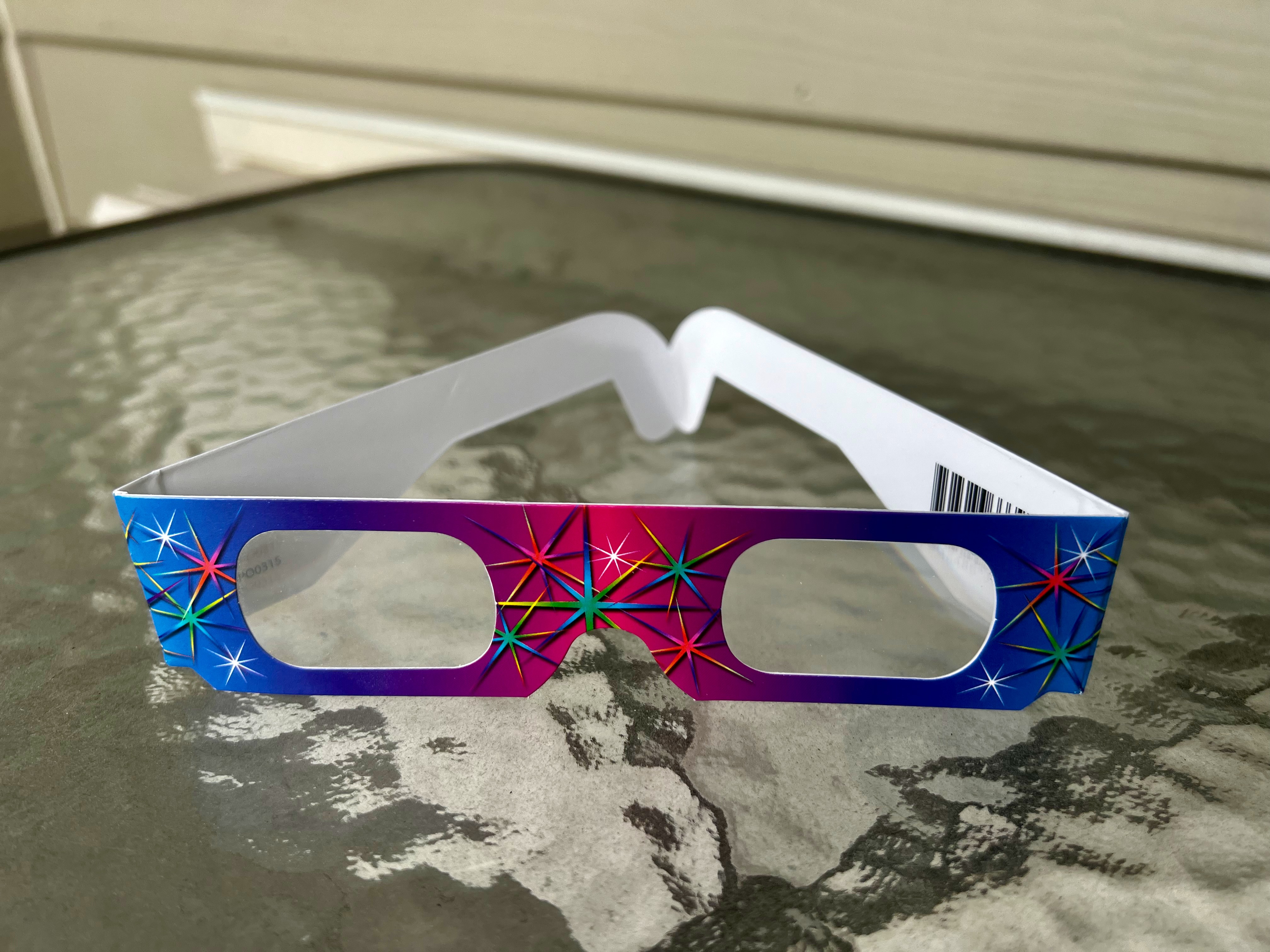
As a physics teacher, I had a few pairs of "rainbow glasses" sitting around. These are cardboard framed glasses with two crossed diffraction gratings for each lens. I cut the lenses up and distributed the film randomly across the board.

Blogger is fairly awful for integrating photos with text. Here's a more complete photo essay/tutorial on preparing pegboard for partials.

Thursday, November 16, 2023

PSSC Film Archive posted on Reddit

In retirement, I find moments of serendipity from time to time. While meandering the Interwebz looking for the source material used in a lesson on electric field lines, I came across a Reddit post by user SchoggiToeff. They compiled a list of films produced for the Physical Sciences Study Committee (PSSC) in the Cold War era that have survived through to the Age of YouTube (and The Internet Archive).

The Physical Science Study Committee (PSSC) Films are a set of 53 films made in the late 1950 early 1960 for US high school physics. The films are also referenced in the Berkeley Physics Course, of which the 2nd book is the well renowned Electricity and Magnetism by Edward M. Purcell.

While dated, the films are still educational and can bring some insight in various physical observations and phenomena. I personally like the Frames of Reference film.

Unfortunately I could not find all of the films, thus the gaps. If you know other ones, please leave a comment. On the Internet Archive one can also find Italian dubbed versions. [u/SchoggiToeff on Reddit r/Physics.]
Impressive work! And a great way to while away an afternoon, checking out these old classics. Clips from many of these were restored and digitized around 1990 and released as Ztek's Physics: Cinema Classics (P:CC). P:CC included clips from a host of other sources, too. It appears that project has gone dormant. I had P:CC on LaserDisc, and then on DVD, when I was still in the classroom.

Here's one of the classic treasures you can find on the Reddit list. A popular favorite among physics instructors of a certain age.

Thursday, March 25, 2021

Polarized Black Hole Image

It's probably irresponsible for me to post this wee package that might deliver more questions than answers. Nevertheless.

Monday, February 11, 2019

The Inverse Leidenfrost Effect at Veritasium

Here at The Blog of Phyz, we're big fans of the Leidenfrost effect. If you search "Leidenfrost" here, you'll see exactly how much we love it. I blame Jearl Walker.

As always, Veritasium's Derek Muller gets us.

Inverse Leidenfrost? What can that possibly be about? Take a look:

The Inverse Leidenfrost Effect

Sunday, February 10, 2019

Physics Fun on Localish

Ray Hall is a California physics professor and a skeptic friend from way back. So yes, he is made of win.

He has also crafted arguably the best account on Instagram: physicsfun. And by "arguably" I mean that you and I might have an argument if you think there's a better Instagram account out there.

As a delightful bonus, physicsfun passed the million follower mark months ago: a reason to be hopeful for the future.

If you don't have an account on Instagram, physicsfun is a reason to get one.

Folks are taking note. ABC's Localish produced a nice segment on Ray and his Instagram.

S1E31 Crazy for Physics on Instagram 

Instagram: physicsfun

Tuesday, July 03, 2018

Cell Phone Airbag Challenge

Videos and pictures of this airbag device have been circling the web the last few days:

While not available for production yet it is getting a lot of publicity, and rightly so. It is an ingenious design that appears to be effective and reusable. It got me thinking about Dan Burns and my Crash Cushion project. Students are asked to design a crash cushion for either a smart cart or a cart with an accelerometer on it to crash into. They are challenged to decrease the impact force as much as possible, something we hope they realize is accomplished by increasing the impact time. 

I want to assign this as an emergency sub assignment for students that can be done theoretically, no cracked screens needed. So I looked to see what other designs might already be out there and found this 2013 parody by Honda:

It is in Japanese and does not have subtitles but the engineering process is still evident in the parody video. The end product is a giant case for your phone which of course makes the phone impractical. I see the Honda version as where my students my start in the process and then the new spring loaded German design as where they might end, with lots of R&D in between.

I plan to start the activity by asking students what is necessary for an automatically deployed air bag for a dropped cell phone. They could work in pairs or groups and discuss the basics of the design criteria for a device that protects the dropped phone from breaking. I expect students to think about drop proof cases they may have seen commercially available that have enforced corners. Once they have made a list of the design needs groups/ pairs could share their individual lists to come up with a whole class list.

After their criteria has been established I would like to show students the original Honda parody video above. The original Honda video has been removed from their YouTube channel but the video is available on a few news sites. Since I can't find one with subtitles I'm not 100% sure its clean for the classroom but its probably safe since it was originally published on the official Honda page. Even on silent students can watch the video and observe his design process; it could be considered an advantage that they have to rely on the visual only and can't regurgitate anything they hear the engineer say. They will probably laugh at the final design but it will serve as a starting point for the next stage.

Before watching the video, or after, students can be given the shorter article about the parody video  that summarizes it and includes stills from the video. Ask students to discuss if the Honda Case N meets all aspects of their design criteria. If their class list was missing something about the phone case being of a practical size they will probably want to add it now. This should lead to a discuss about additional criteria they might want to add.

At this point you can ask students to actually start brainstorming an air bag device on paper. This may include some conjecture and may not hold up to questioning:
"There will be this bag that shoots out here..."
         "How will it shoot out?"
"Ummmm some kind of compressed gas..."
         "Where will that come from?"
"Uhhhh..."

And to an extent that is completely okay. Students aren't going to be able to build a workable model like they do with the Crash Cushions project. This activity is not even necessarily focused on the ideas of impulse either but more on reasonable design criteria

I found this article about the spring loaded German design and made a pdf to share with students. The original video can be shared as well, although it is in German. I plan to ask students what is most important to that design and if it meets all of their design criteria. Students can discuss differences in their design and the German spring loaded design, which of their own design criteria it does not meet, etc.

The viral German spring loaded design is expected to go to Kickstarter soon to crowd fund enough capital to begin production. You could continue the activity with students by asking them which of their own designs they would help crowd fund (before showing them the German design). After they see the German spring loaded design you could ask students if they support it enough to fund it as well, hypothetically of course.

While I plan for this to be a substitute activity it does require the sub to be capable of playing online video clips if your students do not have one-to-one devices like Chromebooks. My subs are not usually capable of operating my projector nor are we a one-to-one school so I don't know how likely I will be to implement this in the next school year. I've summarized everything, including questions I would ask students in this teacher guide for the activity.

I would love to hear any one else's ideas for extending this activity below. 

Sunday, April 08, 2018

Fluorescent Puffin Bills and Tetrachromacy

Serendipity. What a great thing among the scientifically curious.

Ornithologist Jamie Dunning’s serendipity compelled him to shine ultraviolet light on the already decorative bill of a puffin. And he saw something apparently not previously documented in the learned journals.

Birds, those opulent tetrachromats, are apparently up to their colorful shenanigans once again. We humans, humble trichromats that we are, just miss things sometimes. (It’s clearly not just the ability to fly that makes Naomi Hamilton Jealous of the Birds! But I digress.)

Read the story, behold the images, and mention it when you teach about colors and color mixing.

Puffin beaks are fluorescent and we had no idea.

Monday, January 22, 2018

How to cheat on your next eye test

Next time your at the Department of Motor Vehicles renewing your driver's license, don't be surprised if you see people in the lobby staring into spinning spirals just before they take their eye test.

Why? It turns out an old favorite illusion, referred to as the "expanding motion effect," can induce increased visual acuity. This illusion is demonstrated in the Exploratorium's "Depth Spinner" Science Snack. It's a perennial favorite among visitors to our ExploratoRio Open House event.

In any case, researchers at the Universities of Glasgow and York incorporated use of the illusion with eye chart tests.
The team discovered that visual acuity—the ability to see fine detail—can be enhanced by an illusion known as the ‘expanding motion aftereffect’. While under its spell, viewers can read letters that are too small for them to read normally.
When participants stare at the center of a spinning pattern that spirals inward for about 30 seconds, shifting their view to a stationary object will induce the illusion that the static object is expanding.
Participants who started with normal visual acuity and saw [inward spinning] spirals ... showed improved visual acuity.
It's as it they were looking through a camera and zooming in on the smallest letters in the eye chart.

It is important that the spiral is spinning inward. Staring at an outward spinning spiral induces a shrinking effect.
Those who saw [outward spinning] spirals ... actually performed worse after exposure to the spirals.
Anyone who's enjoyed this illusion knows the effect is temporary.
But don’t throw out your eyeglasses just yet: the researchers note that the overall boost to visual acuity is small and fleeting.
I would not have expected this outcome. Hat tip to Richard Wiseman's appearance on Skeptics' Guide to the Universe. The Sun ran an article with the obligatory animated spinner.

Monday, December 04, 2017

Advanced Studies in Artistic Lightning

Watch it big; watch it loud. But mostly, watch it.


Transient from Dustin Farrell (www.dfvc.com) on Vimeo.


And remember, deviations from physical realism serve not as disqualifies, but springboards for discussion here.

Sunday, July 09, 2017

Colored Shadows Tough Problem

I have mentored and coached for the New Teacher Program through the Exploratorium's Teacher Institute for several years now. Many summers I get to work with teachers in their first few years of teaching as they participate in an intensive three week institute. I went through it myself ten years ago and it is a lot of great information and wonderful pedagogy. I learned more in those three weeks than in my entire credential program about teaching science.

It is exciting when a new teacher discovers or comes up with something that is so cool it has be shared. Summer 2016 Ajayi Lawrence was focused on light and took a journey through diffraction, color addition, filters, etc. There were several times that we took red, green and blue LEDs to darker exhibits to experiment. Lots of "Oh that was cool, do that again!" and talking out what we saw, especially when it was contrary to our predictions. (It's good to be wrong sometimes!)

While trying to set up a procedure for his students, Ajayi shone a red LED through the two filters of a pair of 3D glasses. The red light passed through the red filter and was almost completely blocked from the blue-ish filter, as expected. The blue light was blocked by the red filter and shone through the blue-ish filter. The green light was blocked by the red and shone through the blue-ish filter. (Now you seen why I say it was "blue-ish.")

Later we took the same pair of glasses to the Colored Shadows exhibit (which can be recreated in your classroom using this Science Snack) and snapped this great picture.
Ajayi and I both said that showing this picture to students and asking them to determine the colors of each filter would be a great way of  assessing what they have learned about color addition and subtraction. This year in our color unit I showed this picture to my students and didn't tell them that they were 3D glasses. After some discussion they realized that the two lens of the glasses must be different, which reminds them of "old" 3D glasses. Most of your students will have never used red-blue 3D glasses before, by the way. After they discover that they have to think about what light passing through one of those filters would look like versus lighting being blocked by the filter. 

This was done as a quick end of class activity to wrap up some other concepts. I would have preferred it to be discussed in small groups with whiteboards so that students could make their own drawings. I've written up a worksheet that is a little more guided, adding a portion on the colored shadows of hands I already use, that is available untested as a pdf. If you want to check your answer here is a visual key.

Thursday, July 06, 2017

Rolling shutter explained by a YouTuber

The lesson is a nice complement to yesterday's photography post. Destin from Smarter Every Day produced a great rolling shutter explainer. Those weird motion-based video artifacts that your camera phone captures? Rolling shutter (not the "wagon-wheel" stroboscopic effect).

Destin's explanation benefits from his intentions and Phantom high-speed camera. And some great work in post-production. Next time I fly, I will book my tickets on "Smarter Every Day" airlines!

Thursday, June 29, 2017

A summertime fidget spinner I can endorse

If you aren't plugged into Derek Muller's Veritasium YouTube channel, it's time to correct that oversight.

His latest exploration involves hydrodynamic levitation. It's a phenomenon very different from the Coanda effect-based airstream levitation. And it constitutes a summertime fidget spinner I can wholeheartedly endorse!

Hydrodynamic Levitation


Muller is, of course, armed with high-speed videography. He recently added schlieren photography to his arsenal. I'm delighted to support him on Patreon; the guy does great stuff that's always fun to watch.

Monday, March 27, 2017

Chladni Singing

Chladni plates are a beautiful and dynamic example of resonance in two dimensions. Originally a bow was used (as seen in this Harvard demo video) to create two dimensional standing waves in a flat piece of metal in different shapes. More common now is to use a frequency driver to control the frequency of the standing wave. Here is a video that goes through a wide range of frequencies:


Whatever the method, you can demonstrate that higher frequencies produce shorter wavelengths and thus smaller patterns on the plates. You can talk about the fact that the pattern on the plate seems to abruptly change as a resonant frequency is reached. Ask students if the locations where salt gathers are nodes or antinodes of those standing waves. There is a lot to learn from something that is also mesmerizing to watch. If you're not super comfortable with the explanation yourself try showing your students this Physics Girl video that has a good explanation and information on the next steps in modern science.

I thought I'd seen everything about Chladni plates (including this music video they appear in) but then I learned of someone who can sing to a Chladni plate! Meara O'Reilly works at the Exploratorium museum of San Francisco and has enough voice control to sing to Chladni plates to create different patterns. Her website devoted to this phenomenon is here and an example is below. While amplified, this is produced by the human voice and not a frequency generator. It is amazing.

Saturday, January 07, 2017

Where the Bolts Are

Exploratorium genius, Paul Doherty, recently shared this gem of a resource. It's a real-time visual representation of lightning all around the world.

LightningMaps.org


Saturday, November 19, 2016

Inertia of Fall Leaves

This video has gone viral with good reason, its super cool.

In this slow mo video we see an amazing example of inertia as the bed of leaves remain as the net is lowered beneath them. What else can you discuss about with this video?

Tuesday, July 26, 2016

Physics of Ballet

Someone shared this with me on social media because they know how I love Physics. It is very well explained and a great animation.

Saturday, July 09, 2016

Failure & Success as seen with Strandbeests

The Exploratorium Museum of San Francisco currently has a large exhibit called Strandbeest: The Dream Machines of Theo Jansen. The exhibit has consisted of several of these large machines on display, daily demonstrations of several machines and special events including an After Dark (adults only night) with Adam Savage of Mythbusters fame.

Savage spent three days making a strandbeest of his own live at the Exploratorium in front of whoever would like to watch. He unveiled his creation at yesterday's After Dark event. I was unable to go (those darn kids) but watched video today.

I was so happy to see Savage admit failure and his own limitations. He had designed his machine wrong at first, adjusted it and it worked but not the way he wanted. Even at his unveiling he admitted it wasn't quite the way he wanted, and then he just hopped up on the machine in a "Well I wonder if..." way. He surprised himself and the audience when the machine worked as he had hoped.

His enthusiasm is contagious and his honest answers to audience questions is very reflective. This is a great video to show students that even their media heroes have failures, and grow through embracing them. He even jokes that he fully expected to see headlines the next day saying he had failed "...and that's okay!" It will make a great addition to an engineering project introduction.

Hearing Savage discussing "The Imposter Complex" that many new and veteran teachers experience is uplifting; "He struggles with it just like I do!"


The Exploratorium has a lot of resources online, links to the demos of the Tinspider walking, and more. I was able to see the machines in passing during the Summer Institute for Teachers and I do hope to get out to the museum this summer and really seeing the machines in detail. If you're in the area I highly recommend it.

Wednesday, June 15, 2016

Dizzying dance demonstrates dynamics

Rotational dynamics, specifically. But I was going for alliteration in the title.

A different staging of this performance floated into my Facebook feed yesterday, and my jaw dropped. And it's not that I don't get out much. It's that this performance is jaw-dropping. And of course it's a beautiful synthesis of artistry, athleticism, physics, and practice. I don't even understand how a human can do this with functional semi-circular canals. Watch for yourself.

Angelica Bongiovonni - 34th Festival Mondial du Cirque de Demain - Paris


So in a #FirstWorldProblems moment, deciding to post this gem to the blog led me down bit of a rabbit hole. The video was locked into Facebook. I don't yet know how to rip videos from Facebook. YouTube, yes. Facebook, no.

The Facebook video linked to the Dance.com Facebook page. That didn't help. Neither did going to Dance.com, itself. The Facebook video didn't even mention the dancer's name. No surprises there. The comment count was in the thousands. Nevertheless, I began poring over the comments and found the dancer's name in a reply to a comment.

Off to YouTube. The dancer had a channel but the channel did not include this performance; it was sparse and seems to have been abandoned. She's apparently too busy dancing to maintain a YouTube channel.

So a general name search ensued. Adding "Cyr Wheel" didn't help. (Yeah, I didn't know it was called a Cyr Wheel. either. You can actually learn things from search results.) I couldn't find the video I saw on Facebook.

But I found the one posted above: Same routine; different performance. I don't see a simple "in" to an engaging paper and pencil companion lesson. But the video can stand on its own. Whenever I show such a thing in class, I verbally admonish my students that they must be thinking about physics as they watch.

One thing Angelica Bongiovanni did post to her wee YouTube channel was a short blooper reel made in preparation for a different routine.

I love the poster frame that shows up for the embedded video. That's the still you'd hope to capture if you were photographing the performance.

Tuesday, May 10, 2016

Rube Goldberg-esque Magnets & Marbles

Its mesmerizing. This is quite the set-up and while quite complex can be used to discuss a variety of things with students. As the video description mentions its not quite a Rube Goldberg machine because its done in several takes even one "scene" has quite a few energy transfers and they do begin with a single marble starting. I kind of want to just play it over and over again for my students and see what they notice.


Saturday, April 16, 2016

Moon shadow

As noted in a post in 2014, most of the United States will be able to see a total solar eclipse in August 2017. That is all kinds of cool and lots more information will be available as the date gets closer. This is an incredible video of the eclipse shadow, something I had never seen focused on before, for the 2012 Total Solar Eclipse in Australia.

The Sweeping Shadow - Total Solar Eclipse, Nov 14 2012,The Granite, FNQ, Australia. 

from Colin Legg on Vimeo.