[Trigger warning: Curmudgeonly post—kids are hereby warned to "Stay off my lawn!"]
The world has changed. Students are increasingly inseparable from their phones. 24/7/365. Their phone is increasingly the center of their world. All other activities, such as instructional classroom time, are mere background variations—different atmospheres in which their ongoing phone activities are conducted.
At the same time, I find my students are performing more poorly with each passing year. This even as I begrudgingly excise material they find especially frustrating, and minnow the math to a bare minimum. I'm chasing, but they're outrunning me.
There are many factors at play here, and this post will not attempt to cover all of them. Instead, I'll go for one: phones in the classroom.
Many students—especially the boys—enter the classroom with earbuds dangling over their ears or chests. Their pre-wired to listen to the playlist they made especially for your class. Many take their seat and proceed to continue their ongoing text sessions. Many feign forgetting the "no phones in class" policy and need frequent reminders. They work hard to keep the phone on and active on their lap or setting atop their backpack angled so they can at least read the latest updates during class.
And increasingly, they help themselves to available outlets to charge their phones during class. The poor device has been under such heavy use in first and second periods that by third period, they need a serious recharge.
Many willingly risk a Saturday School referral because the chat is that important to them. They'll set their burgeoning backpack on the desk to create a hide for their phone. Or spend extended intervals utterly transfixed—eyes locked on their crotches. They are lost to the world in anticipation of a response. And they could pass a lie detector test not knowing why they are performing so poorly in class. They have absolutely no idea.
The world has changed. So I must acknowledge the change and take appropriate measures. Some teachers leverage the pacifying effect of allowing students to "phone out" (zone out via phone use). I'm keen to have them learn the material. For now, this means separating students from their phones while in my class.
The solution I'm honing? The Ready Desk.
The Ready Desk is just my shorthand for students having what they should have in front of them during class. And—perhaps more importantly—not having what they should not have in front of them during class. It describes the state of their desk when they're ready to learn: The Ready Desk.
They need their pencil, today's handouts, their binder, and a scientific calculator. Nothing else. Everything else, including phones, textbooks, etc., can be stored in their pack, and their pack goes into The Rack.
I made space in my classroom to accommodate eight 4-cubby Ikea Kallas shelving units. That's space for 32 backpacks. I used the cubbies this year only for security situations (tests, exams, etc.). Next year, the rack will be an everyday thing.
An unintended benefit is the decluttering of the classroom desktop and floor space. Nothing to trip over; no more backpack "hides".
Will separating students from their packs force them—against their will—to engage in instruction? Probably not, but it might help many of them. Will some students redouble their efforts to maintain access to their fully operational phones? Probably, but they will need to be much more skilled than they need to be now. Is it a perfect solution will be free of any other possible unintended consequences? No.
But the tether between students and phones has become noticeably stronger each year. And student performance has declined. I am unwilling to do nothing about it, or wave a white flag of surrender.
Here is the handout I'll give to students early next year. (And by "next year," I mean approximately two months from now.)
The Ready Desk (PDF)
Showing posts with label getting old. Show all posts
Showing posts with label getting old. Show all posts
Monday, June 05, 2017


Friday, May 06, 2016
The Mechanical Universe is going dark soon!

If you don't own your own copy, the series will cease to exist in a little more than a month and well ahead of the beginning of the 2016-17 academic year. The reasons are detailed in the SCAAPT article linked above.
The Mechanical Universe was produced in the 1980s at Caltech by a team led by physics professor, David Goodstein. Each of the 52 half-hour episodes focused on a specific topic from the introductory college physics curriculum. Episodes featured high production values consistent with Caltech's proximity to The Entertainment Capital of the World.
The series was fairly exhaustive (outside of fluids, perhaps), and featured state-of-the-art computer animations. It followed closely on the heals of Carl Sagan's Cosmos, and it shares some video used in that iconic series.
Some critics would scoff at The Mechanical Universe's increasing age: 1985 was a long time ago. Others would scoff at the mere fact that the series engages in content exposition (unapologetically). I don't mind exposition from time to time (especially as review). And if an equally well-produced, thorough, and encyclopedic series with a fresher production date exists, please let me know about it.
A collection of expurgated versions of this college television course were "edited specifically for use in the high school curriculum." These were known collectively as the High School Adaptation. I do not have specific knowledge of their fate, but I expect it to align with that of the original series.
I have used high school and college versions of many episodes throughout my career, and would hate to be without them. I have developed sets of questions for students to answer while watching those episodes. Without distribution I fear the series will fade into the mists of history, as Goodstein might say.
The full set (52 episodes) is available for purchase for $200 via the Mechanical Universe page at Learner.org. The clock is ticking.
Sunday, March 22, 2015
The real world keeps taking away my real world physics
Once upon a time (a few years ago), a reasonable high school physics question was, "Why do the first broadcasters in a given television market get the lowest channel numbers on the dial?" In Sacramento, for example, that would be the NBC affiliate, KCRA, who got Channel 3. Channel 1 was never licensed to anyone by the FCC, and Channel 2 was given to the neighboring San Francisco market. The channel numbers correspond to broadcast frequencies: lower channel numbers broadcast on lower carrier frequencies. The corresponding longer waves are better at diffracting over hills and into valley, delivering commercial messages to more viewers.
But broadcast technology changed in 2009, so the problem is no longer relevant, as far as I know.
And now chromatic aberration? Researchers at Harvard have apparently developed a flat lens that focuses all colors at the same point.
Perfect colors, captured with one ultra-thin lens
NO NEED FOR COLOR CORRECTION—HARVARD PHYSICISTS’ FLAT OPTICS, USING NANOTECHNOLOGY, GETS IT RIGHT THE FIRST TIME

Well, we'll always have The Dark Side of the Moon.

But broadcast technology changed in 2009, so the problem is no longer relevant, as far as I know.
And now chromatic aberration? Researchers at Harvard have apparently developed a flat lens that focuses all colors at the same point.
Perfect colors, captured with one ultra-thin lens
NO NEED FOR COLOR CORRECTION—HARVARD PHYSICISTS’ FLAT OPTICS, USING NANOTECHNOLOGY, GETS IT RIGHT THE FIRST TIME
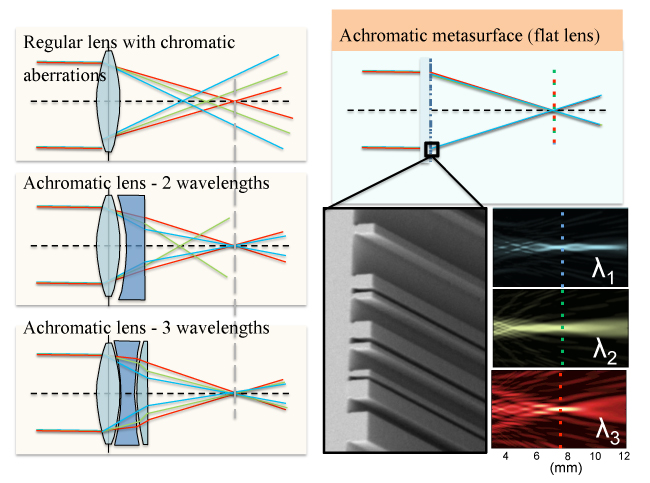
Well, we'll always have The Dark Side of the Moon.

Thursday, January 03, 2013
Forty years before The Mechanical Universe
The Mechanical Universe is no spring chicken. It was born in the mid-1980s.
I recently stumbled across this old gem on YouTube. As a fan of Atomic Café, I've got a soft spot for post-WWII-era animation. It's not a vision of gender equity, and the scientific models aren't flawless, but it's tasty nostalgia, tinged with that proud, declarative optimism for "Tomorrow's World." And Mr. Electron is as cute as Casper.
Principles of Electricity part 1 (1945)
Principles of Electricity part 2 (1945)
I recently stumbled across this old gem on YouTube. As a fan of Atomic Café, I've got a soft spot for post-WWII-era animation. It's not a vision of gender equity, and the scientific models aren't flawless, but it's tasty nostalgia, tinged with that proud, declarative optimism for "Tomorrow's World." And Mr. Electron is as cute as Casper.
Principles of Electricity part 1 (1945)
Principles of Electricity part 2 (1945)
Monday, October 25, 2010
O Jennifer and Michael, where art thou?

Analysis of the list revealed that the most frequent male and female first names to pass through my classroom were Michael and Jennifer. I don't recall the exact number of Michaels, but I do recall there had been more than 70 Jennifers. Over three Jennifers per year, on average.
I recall once having four Jennifers in a single class. One went by Jennifer, another by Jen; one preferred Jenny and the other was Nif. (And yes, Nif was as charmingly quirky as her chosen moniker would suggest.)
Anyway, this year I am teaching neither a Jennifer nor a Michael. A blip in the continuum, I presume. But I could be wrong. Only time will tell.
Sunday, October 17, 2010
My funny AP students
I'm really not that teacher. The favorite teacher that all the kids love. The one who knows all the students' names on the first day of school. Who's considered "cool" for being relaxed and understanding about homework, tests, labs, and exams.
I'm not an inflexible British schoolmaster from the 1950s, either. Or a high priest who accepts only the schools top 10% into his demanding, rigorous physics course.
I try to make my physics course the most challenging class students want to come to. Not easy to balance the "challenging" with "want to come to." And I don't presume to get it right.
But there are many teachers at my own school who do a better job of connecting with students on an interpersonal level. So I don't usually get anything like a student-delivered cake on my birthday.
But there was apparently some instigation for such a thing this year. And the work looks to have been inspired by the difficult FBD test they took on my birthday. I was out that day. The cake was brought in the following day.

A wonderful treat, and highly unexpected! ("Old Man Baird" is what my buddy, Rick, imagined my students called me about 15 years ago. I've incorporated it into my own classroom schtick. So now my students may well call me that. D-oh!)
I'm not an inflexible British schoolmaster from the 1950s, either. Or a high priest who accepts only the schools top 10% into his demanding, rigorous physics course.
I try to make my physics course the most challenging class students want to come to. Not easy to balance the "challenging" with "want to come to." And I don't presume to get it right.
But there are many teachers at my own school who do a better job of connecting with students on an interpersonal level. So I don't usually get anything like a student-delivered cake on my birthday.
But there was apparently some instigation for such a thing this year. And the work looks to have been inspired by the difficult FBD test they took on my birthday. I was out that day. The cake was brought in the following day.

A wonderful treat, and highly unexpected! ("Old Man Baird" is what my buddy, Rick, imagined my students called me about 15 years ago. I've incorporated it into my own classroom schtick. So now my students may well call me that. D-oh!)
Wednesday, September 23, 2009
Back-to-School Night #24
Back-to-School Night is tonight at Rio Americano. Parents get a chance to see what their son's/daughter's teacher look like as they enjoy a trip down memory lane, sitting in a variety of high school classrooms once again.
Though my classroom started out quite Spartan and plain, it is now rather visually noisy. The wall of ego is in full bloom, and my landscape shots are all about.
Each year, it seems, I tweak the handout I give to parents. We have but 10 minutes together, so I try to load the handout with things they might want to know and spend the 10 minutes going over what their child needs to do to be successful in my class. Of course I could just say, "do homework and study for tests," but people want details.
Here's this year's handout, such as it is.
Though I might not recall in vivid detail all 23 BTSNs that I've experienced over the years, I do remember the first one well enough. I was fairly terrified because it was my first BTSN. It didn't help that I had yet to see twenty-two candles on my birthday cake. I was enduring a mild case of "homesickness." During my first month of teaching, my only credit card was taken (and not returned) by an ATM and the lights in my classroom burst into flames. I was still "finding my voice" as a teacher, and my Ann Arbor pace and intensity was proving too much for my California students.
Back-to-School Nigh '86 went better than I'd hoped. The parents seemed delighted with me. I even joined my colleagues at a local watering hole after the event. I didn't stay long, since I don't drink and it was a school night. But while I was inside, someone broke into my car and stole my "transportable" Macintosh 512Ke. They tried to steal the '76 Buick Century, itself, but I guess I didn't give them enough time. September, 1986 was not the best month of my life.
But I digress. I'm sure BTSN09 will go swimmingly. I always hope for a high turnout, and sometimes I get it. I may not get to a watering hole, but I will get a good night's sleep afterward.
Though my classroom started out quite Spartan and plain, it is now rather visually noisy. The wall of ego is in full bloom, and my landscape shots are all about.
Each year, it seems, I tweak the handout I give to parents. We have but 10 minutes together, so I try to load the handout with things they might want to know and spend the 10 minutes going over what their child needs to do to be successful in my class. Of course I could just say, "do homework and study for tests," but people want details.
Here's this year's handout, such as it is.
Though I might not recall in vivid detail all 23 BTSNs that I've experienced over the years, I do remember the first one well enough. I was fairly terrified because it was my first BTSN. It didn't help that I had yet to see twenty-two candles on my birthday cake. I was enduring a mild case of "homesickness." During my first month of teaching, my only credit card was taken (and not returned) by an ATM and the lights in my classroom burst into flames. I was still "finding my voice" as a teacher, and my Ann Arbor pace and intensity was proving too much for my California students.
Back-to-School Nigh '86 went better than I'd hoped. The parents seemed delighted with me. I even joined my colleagues at a local watering hole after the event. I didn't stay long, since I don't drink and it was a school night. But while I was inside, someone broke into my car and stole my "transportable" Macintosh 512Ke. They tried to steal the '76 Buick Century, itself, but I guess I didn't give them enough time. September, 1986 was not the best month of my life.
But I digress. I'm sure BTSN09 will go swimmingly. I always hope for a high turnout, and sometimes I get it. I may not get to a watering hole, but I will get a good night's sleep afterward.
Tuesday, February 19, 2008
Fooling our elders...
really isn't that hard to do. Nevertheless, the kids never seem to tire of it.
An email was forwarded to the staff of my school last week by a well-meaning colleague. She was amazed by a videoclip and corresponding story and thought it should be shared with the school's music and physics students. Here's the story and the clip.
Turn your sound on for this.
This is almost unbelievable. See how all of the balls wind up in catcher cones.
This incredible machine was built as a collaborative effort between the Robert M. Trammell Music Conservatory and the Sharon Wick School of Engineering at the University of Iowa. Amazingly, 97% of the machines Components came from John Deere Industries and Irrigation Equipment of Bancroft, Iowa, yes farm equipment!
It took the team a combined 13,029 hours of set-up, alignment, calibration, and tuning before filming this video but as you can see it was WELL worth the effort.
It is now on display in the Matthew Gerhard Alumni Hall at the University and is already slated to be donated to the Smithsonian. ENJOY
My colleague was so enthused, she added the claim that "this is not computer-generated" to her forwarding note.
But of course, I'm the jerk on your distribution list who assumes such thing are not what they are claimed to be. It turns out, sometimes things sent through "teh intertubes" are hoaxes. And this was, of course, one of them.
Having discovered the truth of the story and the clip with minimal google-fu, I copied and pasted the Snopes link into a "Reply to All," cringed a little bit, and sent it out.
Since I've done this before, the deluge of admonishing replies has abated somewhat. For the uninitiated, the way these episodes go is as follows: The person who sends the hoax is regarded as a happy-go-lucky victim with a positive outlook on life, but the person who responds with the truth is regarded as a curmudgeonly killjoy. It works like that every time. One respondent this time pleaded, "Please don't tell my children about the tooth fairy." (The only correct response to which is to feign total belief in the reality of the tooth fairy.)
I ran it by my AP students and they told me the clip's source just a few seconds into play. They dialed up the Snopes page in a few seconds more. To the eyes of those familiar with computer-generated images (CGI), the clip was clearly the work of microprocessors.
We had a little post-debunking discussion in which they agreed that the people who forward such messages have at least one thing in common. They are of a certain age. My students don't forward such things and don't get them from peers. They always come from an elder: an aunt, uncle, grandmother, grandfather, etc.
There's a thesis in there somewhere for an aspiring Ph.D candidate. My take? Few people under 30 would be fooled by this hoax, but many people over 60 would be. Between 30 and 60, it's a toss-up. But I could be wrong.
Postscript
The hoaxters laid it on thick with all the proper names in their email message. Other than The University of Iowa and The Smithsonian, all other institutions mentioned are non-existent. Google "The Sharon Wick School of Engineering" or any of the others and you'll be directed to some version of this hoax. And for the record, the Hawkeyes are not amused. No word on what the creators of Animusic think of it.
An email was forwarded to the staff of my school last week by a well-meaning colleague. She was amazed by a videoclip and corresponding story and thought it should be shared with the school's music and physics students. Here's the story and the clip.
Turn your sound on for this.
This is almost unbelievable. See how all of the balls wind up in catcher cones.
This incredible machine was built as a collaborative effort between the Robert M. Trammell Music Conservatory and the Sharon Wick School of Engineering at the University of Iowa. Amazingly, 97% of the machines Components came from John Deere Industries and Irrigation Equipment of Bancroft, Iowa, yes farm equipment!
It took the team a combined 13,029 hours of set-up, alignment, calibration, and tuning before filming this video but as you can see it was WELL worth the effort.
It is now on display in the Matthew Gerhard Alumni Hall at the University and is already slated to be donated to the Smithsonian. ENJOY
My colleague was so enthused, she added the claim that "this is not computer-generated" to her forwarding note.
But of course, I'm the jerk on your distribution list who assumes such thing are not what they are claimed to be. It turns out, sometimes things sent through "teh intertubes" are hoaxes. And this was, of course, one of them.
Having discovered the truth of the story and the clip with minimal google-fu, I copied and pasted the Snopes link into a "Reply to All," cringed a little bit, and sent it out.
Since I've done this before, the deluge of admonishing replies has abated somewhat. For the uninitiated, the way these episodes go is as follows: The person who sends the hoax is regarded as a happy-go-lucky victim with a positive outlook on life, but the person who responds with the truth is regarded as a curmudgeonly killjoy. It works like that every time. One respondent this time pleaded, "Please don't tell my children about the tooth fairy." (The only correct response to which is to feign total belief in the reality of the tooth fairy.)
I ran it by my AP students and they told me the clip's source just a few seconds into play. They dialed up the Snopes page in a few seconds more. To the eyes of those familiar with computer-generated images (CGI), the clip was clearly the work of microprocessors.
We had a little post-debunking discussion in which they agreed that the people who forward such messages have at least one thing in common. They are of a certain age. My students don't forward such things and don't get them from peers. They always come from an elder: an aunt, uncle, grandmother, grandfather, etc.
There's a thesis in there somewhere for an aspiring Ph.D candidate. My take? Few people under 30 would be fooled by this hoax, but many people over 60 would be. Between 30 and 60, it's a toss-up. But I could be wrong.
Postscript
The hoaxters laid it on thick with all the proper names in their email message. Other than The University of Iowa and The Smithsonian, all other institutions mentioned are non-existent. Google "The Sharon Wick School of Engineering" or any of the others and you'll be directed to some version of this hoax. And for the record, the Hawkeyes are not amused. No word on what the creators of Animusic think of it.
Sunday, January 06, 2008
Cut the clutter and leave the tangents to me
 I am getting old. No doubt about it. My school district is going through the adoption process for physics textbooks, and I can rattle off several titles I've adopted in years past. For this post, I'll stick to titles adopted for AP Physics.
In 1989 it was Physics by Arthur Beiser. Great book, well written, and it included sample multiple choice items as part of the end-of-chapter questions and problems.
In 1994 it was Physics by Eugene Hecht. The book was huge but stunning. I decided Hecht had to be among the most knowledgeable people to author a textbook. It was rich and colorful. Well beyond complete. When I showed a copy to a few of my AP students during the pre-adoption preview, they wanted to know how to buy a copy for themselves.
In 2001 it was College Physics by Serway and Faughn. The Hecht book was brilliant but too rich. I needed something more direct and to the point. Serway & Faughn fit the bill quite nicely. Compared to much of the competition, it's straight-ahead physics without an agenda: it's not aimed at pre-meds or engineers.
In 2008 my early favorite is Essentials of College Physics by Serway and Vuille. While other titles are tipping the scales at 1000+ pages and problem sets than number in the triple digits, Essentials slims the elephant.
Other titles seem dedicated to squeezing in everybody's favorite application and sidebar topic. And to do so, the type shrinks to well below 10-point, the paper thins, and still the books are big. Essentials bucks these trends. It's only in its first edition, but benefits from being based on Serway and Faughn's excellent College Physics (soon to be in its eighth edition).
Essentials cuts the clutter and leaves the tangents and applications to me. And that's just what I needed.
Saturday, November 10, 2007
The end of concertgoing
 I see a lot of live concerts every year. Hey, everyone's got a hobby; seeing favorite musicians practice their craft is one of mine.
If I ever stop seeing concerts, it won't be because there aren't shows I'd like to see.
It will be because I can no longer take sharing the space with thousands of other people, many of whom don't know how to attend a concert. Going to see a big performance of live music is not rocket science, mind you. But it's far too complex for many to grasp.
More and more people seem to want to pay $100 to sit with someone they know and gab for 2+ hours while music plays around them. Of course the music is so darned loud at these shows that they have to yell at one another to keep the conversation going, They are dumbfounded by the rude people around them who stare and shush.
My first recollection of this being a significant problem was at Lilith Fair. I thought perhaps it was a "girl-thing." It seemed I was surrounded by women who weren't there to see or hear The Indigo Girls, Natalie Merchant, Sarah McLachlan, etc. They were there to sit and chat. Apparently Lilith Fair was the only time/place they could engage in such behavior, so they had to make the most of it.
But the two loud, chatty 20-something men next to me at James Taylor the other night put the lie to that theory. And they weren't the worst offenders in the audience that night.
No, the hands-down winner of the Audience Idiot award was the woman who paid her hundred dollars for the right to tell James Taylor to "Shut up and sing!" Taylor was introducing "Line 'em Up" with his typical wandering back-story. Several seconds into the story, idiot-woman decided she'd had enough. Though she was booed by audience members blessed with more than two neurons to rub together, Taylor stopped the story and launched into the song.
That was probably his only winning option. He later worked the line into his ad-libbed lyrics to "Steamroller Blues" to the delight of the otherwise mortified audience. Nevertheless, I'll go out on a limb and say JT will never burden Sacramento with his wandering stories or a live concert again.
It was also a Sacramento audience at the Genesis show who seemed transfixed by the cacophonous "Mama" (featuring Phil Collins' evil laugh as "lyrics") but headed for the bathrooms and concessions during "Ripples." No accounting for taste in this town! I could be wrong; perhaps "Mama" has an undocumented diuretic effect.
I don't recall the last time I attended a concert of any type anywhere in which the artist was allowed to fill the space with a quiet moment. No, any reduction of decibels from the stage is apparently a universally-understood invitation for screams and shouts from the audience. Everybody knows that! How do I not get that?
I don't see the trend reversing; I don't see concertgoers becoming more civilized in the future. Some people thought that the terrorist attacks of 9/11 had a sobering effect on the population. Casual Fridays were gone and everything was more serious.
The effect on concertgoers? More than three years after 9/11, I was at a big show in Reno. The artist was British pop legend Elton John. There were certainly audience members who brought to mind the Johnny Cash line, "I shot a man in Reno just to watch him die." They were composing flash photos of themselves at the show with the band performing in their background. But the crowning moment came in the audience's call for an encore. For reasons that elude me to this day, a chant of "U-S-A! U-S-A!" rose through the rafters.
Maybe they just need to stop selling booze at these shows.
Sunday, September 09, 2007
It happened
It was really just a matter of time. It happens to a lot of teachers. I'm not the first and I won't be the last. But at Back-to-School Night this past week, I got official word.
I am now teaching the child of one of my former students. I am officially an old campus fixture at Rio Americano.
One of our chemistry teachers and one of our social studies teachers were students of mine. Those are no big deal. A matter of a few years is all that kind of thing takes.
But teaching the child of a former student takes some time to develop. Roughly twenty years, give or take a few. So as I begin my twenty-second year at Rio, I suppose I was--if anything--overdue.
Oh well, getting old is the best thing that can happen to you. Which reminds me I have a birthday coming up in less than a month. D-oh!
I am now teaching the child of one of my former students. I am officially an old campus fixture at Rio Americano.
One of our chemistry teachers and one of our social studies teachers were students of mine. Those are no big deal. A matter of a few years is all that kind of thing takes.
But teaching the child of a former student takes some time to develop. Roughly twenty years, give or take a few. So as I begin my twenty-second year at Rio, I suppose I was--if anything--overdue.
Oh well, getting old is the best thing that can happen to you. Which reminds me I have a birthday coming up in less than a month. D-oh!
Subscribe to:
Posts (Atom)