I should probably ad a subject tag of "better late than never". Maybe later.
Somehow this article got past me last year. My absentminded/aloof game is apparently too strong sometimes. So I apologize if you already knew about this item from Neuroscience News ages ago, but...
In the event you've severed all your social media ties, you might have missed this week's viral video. So allow me to present Mark Rober's "magnum opus" as a public service.
The notion of delivering a modicum of justice to porch pirates strikes a chord in most of us. I'm confident that simpler solutions cannot be far away. With luck, this project will soon be an amusing tale of "back in the olden days".
Some viewers were skeptical of some of the reactions. Rober confessed to being too aggressive in seeking glitter bomb reaction footage and pulled a few of the clips after determining they were not genuine. I saw one YouTube "skeptic" who seemed a few marbles short of a full deck ranting that the whole enterprise was paid for by Amazon. This guy seemed to be hoping that making a vile video would generate viral video revenue. And no, I'm not going to link to it here.
Of course, one takes some risk slapping back at porch pirates. They cast themselves as sociopaths by their criminal conduct to begin with. And having their poor judgment highlighted to them may not set them on the right path.
Still though, a nice story of using STEM skills to deal with a common, real-world problem. STEM coursework isn't the easiest, but mastery of some of it can make you powerful, indeed.
It seems we have at last moved away from the physical kilogram standard, Le Grand K, near Paris (and it's many replicas around the world). The new kilogram is based on electric current, which seems counter-intuitive at first.
First and most importantly, a third season of Cosmos is in production for a Spring, 2019 release. I believe the appropriate term of art here is "Squee!"My Close, Personal Friend, Neil deGrasse Tyson will once again be hosting. The complete title is Cosmos: Possible Worlds. Cosmos aficionados may refer to it as Cosmos 2019 or Cosmos: PW. I look forward to its addition alongside Cosmos: A Spacetime Odyssey (2014) and Carl Sagan's Cosmos: A Personal Voyage (1980).
In other Cosmos news, I have created video questions sets: student sheets and answer keys to accompany Cosmos: A Spacetime Odyssey. Each of the 13 episodes gets a two-sided sheet of questions that students can answer while the episode plays. Question types vary, but are intended for quick, short responses.
Some video question companions launch into deep, probing questions that take students out of the presentation. Not these. The goal of these questions is to help students maintain focus on the episode while it plays. I leave the deep questions to classroom instructors.
I've added this set to my Teachers Pay Teachers Store: The Lessons of Phyz. My question sets for the now-extinct high school adaptation of The Mechanical Universe are already posted there. Who knows what will be next.
In any case, here's a direct link to the Cosmos set:
I have used these sets in my AP Physics 2 course and in my Conceptual Physics course. We watch approximately one episode per unit as part of the ongoing skepticism and critical thinking component of the course curriculum.
Derek Muller goes deep into the explanation of the newly redefined kilogram. The task is not trivial. I may need to rewatch this robust explainer a couple of times before it all sinks in. Have a seat and prepare to get your geek on: there will be mathematics!
[Click any image to embiggen.] The forecast for the day called for rain, and left little room for doubt. I packed a rain jacket and rain pants (in the event of sideways-driven torrents). I packed an umbrella in case the rain remained vertical. I also covered exposed skin with sunscreen and packed a floppy hat in case the forecast was defied by reality. I wore heavy-weather shoes and thick wool socks. I packed a fleece as the forecast high was in the upper 50s. I knew I was going to be in the elements for the day. I wasn't go to bail no matter what. And I didn't want to be too uncomfortable.
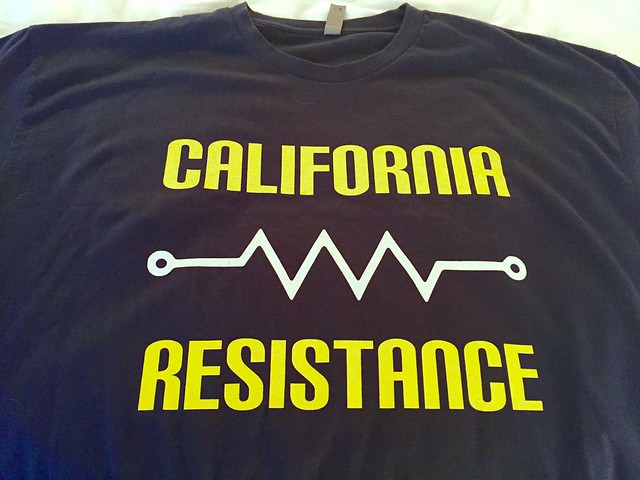
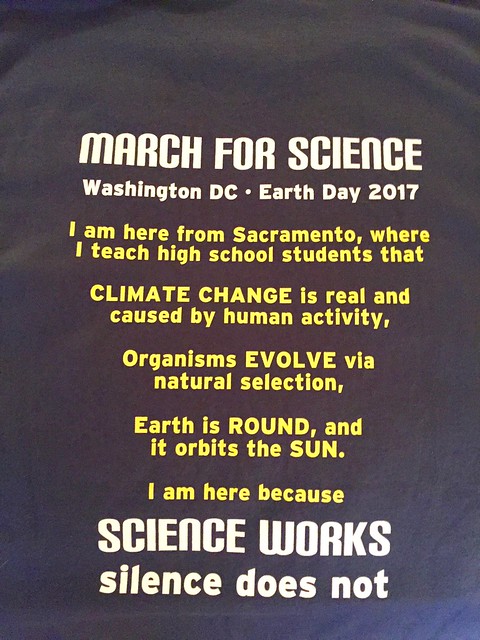
But in the morning, the weather was still fairly mellow, so I was able to expose my custom T-shirt.
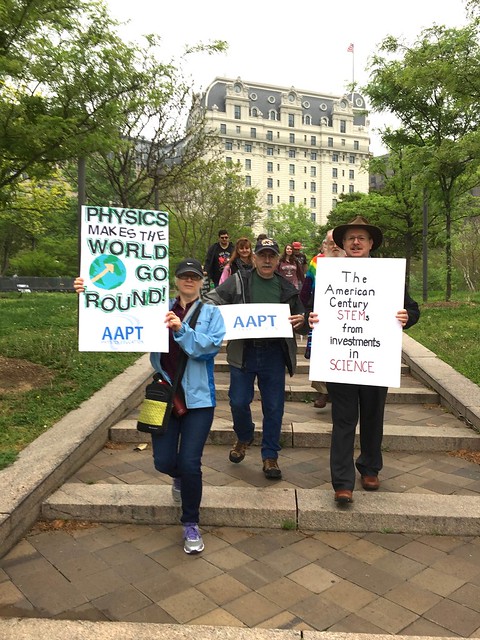
I walked the mile and a half from my hotel to Pershing Park, where I was told representatives of the AAPT would be found. DC bustles on weekdays, but can be a ghost town early on a Saturday morning. I grabbed some breakfast at a bakery/cafe that was doing a brisk business with science marchers.
I found some familiar faces (Dan Brown and Rebecca Vierra) at Pershing Park; AAPT Director, Beth Cunningham quickly joined, as did some Society of Physics Students (SPS) enthusiasts. A retired chemistry instructor showed up in his rainbow tie-dyed lab coat, so I hauled mine out of my pack and matched his look. We socialized and snapped pics for a while before making our way to the rally at the Washington Monument.
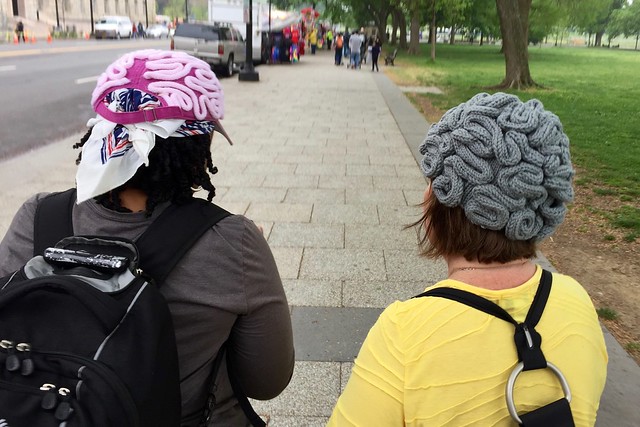
We knew we were headed in the right direction as we followed these two brainiacs.
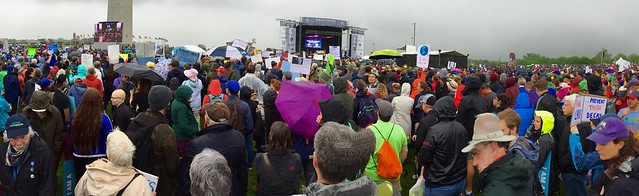
We settled in some distance from the main stage, but with a nice view of a massive screen (atop a truck).
At 10 o'clock, the program began. Veritasium's Derek Muller, Cara Santa Maria, and The Roots' Questlove acted as masters of ceremony. A precipitous mist turned into sprinkles as the program continued. The rainbow lab coat was stowed, and my rain jacket was deployed.
Speakers, music performances, and short films ensued. The rain picked up. It continued in waves. When it got heavy enough, my maize & blue Michigan umbrella was raised. Umbrellas were ubiquitous throughout the crowd. But you feel bad when packed this tight while using one. It blocks views and sheds water on your neighbors.
Four hours of rallying would have to pass before the march was to proceed. Scientists were celebrated, a call and response of "I say 'public' you say 'health'" was launched.
The rain never really stopped. When the wind reached a certain persistence, I undertook a pit-crew donning of my fleece between my t-shirt and the rain jacket. Had it not been such a tight pack where I was, I would have tried to put on my rain pants over the quick-drying trail pants I was wearing.
Near the end, we got a call to action from Bill Nye, himself.
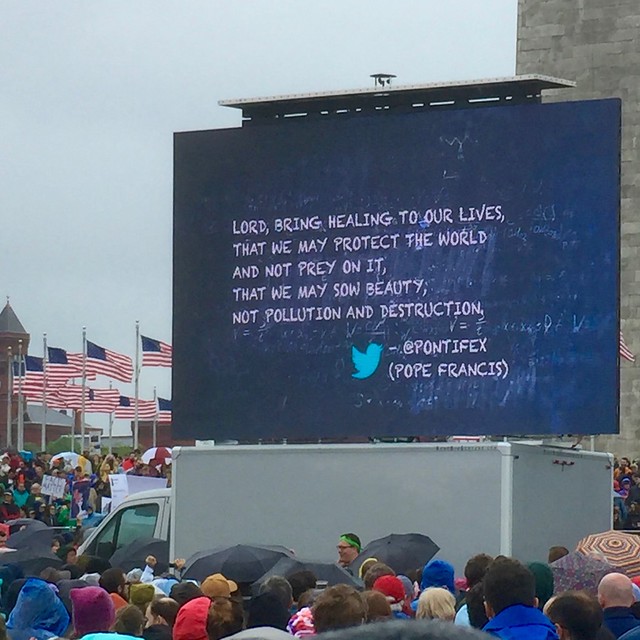
And an Earth Day tweet from... not Donald J. Trump, but from Pope Francis.
Then it was off to the march. We slowly cattle-herded our way out of the secured Washington Monument grounds to Constitution Avenue and marched to the US Capitol.
From time to time, an enthusiastic roar would make its way through the marchers. And there were chants.
"Show me what a scientist looks like : THIS IS WHAT A SCIENTIST LOOKS LIKE!"
"Science--not hate--makes America great!"
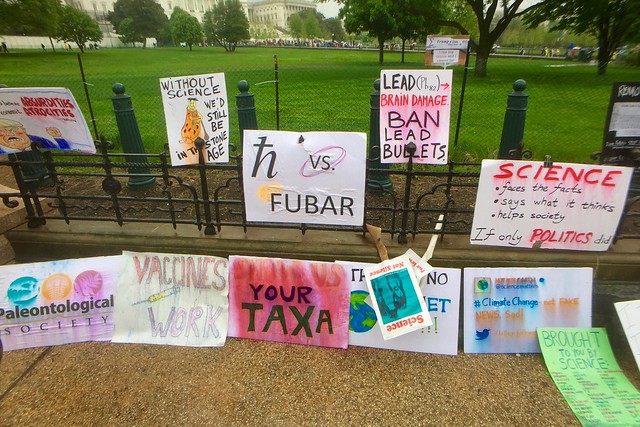
The sprit was great and the energy was positive. The signs were very clever and were all spelled correctly. Hbar vs. FUBAR, Show us your taxa!"
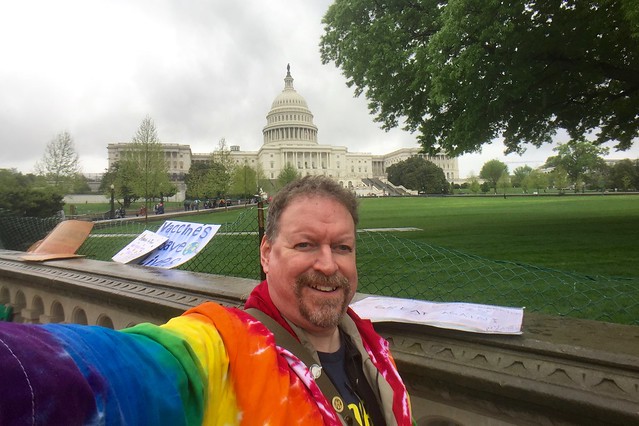
I stopped for a requisite US Capitol selfie.
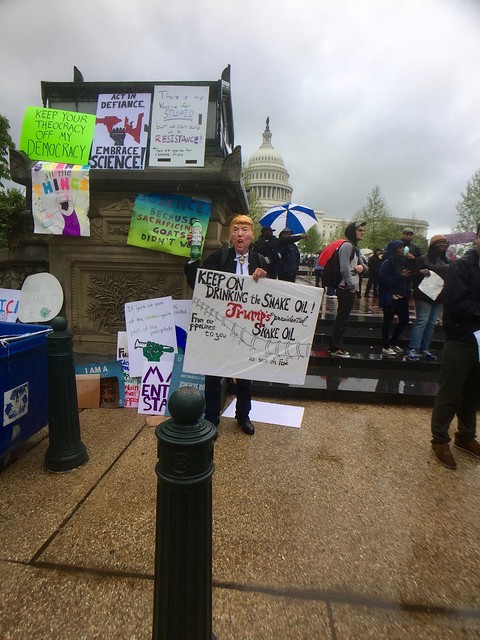
At march's end, marchers laid down their signs along the walkway and fence leading to the Capitol: the impromptu sign graveyard blossomed and grew as more and more marchers finish the route. The rain had taken a toll on most of the signs, and the wind added entropy to the otherwise carefully placed placards.
Snake Oil Trump will haunt my dreams for nights to come.
At the end of the day, there was no way to navigate around the reality that science is under attack in the US from the Republicans who hold the presidency and majorities in the Senate and House of Representatives. It is likely that they will do significant damage to science and the environment as rapidly as they can. It is unlikely that they will change. We cannot nourish a hope that the attack will relent while the GOP maintains unbridled governmental power.
If scientist hope to get work done in the lab, they will need to get work done at the ballot box first.
I'm glad I was able to be in DC for the March on Science. I have more photos in my Flickr album and more videos on my YouTube channel.
When murmurs of The March for Science began circulating, I raised my antennae. When the date was announced, I booked a hotel room in DC and burned a bushel of frequent flyer miles to reserve round trip flights on Southwest.
I harbored a strongly-held personal opinion that I needed to be part of it. In the early days of planning, it wasn't obvious that there would be satellite marches. The groundswell of support made satellites a reasonable speculation. Still though, I wanted to be at ground zero.
As the days and weeks passed, others have been eloquent about why this march needed to be held. Why a fist needed to be raised. Why voices needed to be heard.
There were also the predictable backlashes to this backlash. Every call to action--real or virtual--is guaranteed to produce axe-grinding finger-waggers. "You need to not do that thing you intend to do; instead, you need to take up arms for my cause. If my cause wins, the world will be free of all problems—this one included!" This is the internet-generation's version of "Follow me; I'll make your crops grow!" I cast those aside and pressed on.
Another flavor of marginalization that often arises among the complacent comes in the form of the innocently dismissive question, "What do you hope to accomplish?" No matter how insightful the answer, the follow-up will be to suggest that you could accomplish those goals without a high-profile march/protest. Valid responses to the question vary, and bear a modicum of uncertainty. The question is intended to put participants on the defensive. The hoped-for change will not materialize immediately at the conclusion of the march, so the march was pointless.
As a seasoned debater, I never take such obvious bait. Instead, I prefer to turn the question around. I know—with absolute certainty—exactly what would be accomplished by not marching. Acceptance of an Administration that has made an enemy of science. Sweeping budget cuts for research. Denial of settled science. Ceding leadership in science and technology to China and India. Tacit approval for going full bore in the destruction of the environment in the US and around the world.
The Exploratorium Museum of San Francisco currently has a large exhibit called Strandbeest: The Dream Machines of Theo Jansen. The exhibit has consisted of several of these large machines on display, daily demonstrations of several machines and special events including an After Dark (adults only night) with Adam Savage of Mythbusters fame.
Savage spent three days making a strandbeest of his own live at the Exploratorium in front of whoever would like to watch. He unveiled his creation at yesterday's After Dark event. I was unable to go (those darn kids) but watched video today.
I was so happy to see Savage admit failure and his own limitations. He had designed his machine wrong at first, adjusted it and it worked but not the way he wanted. Even at his unveiling he admitted it wasn't quite the way he wanted, and then he just hopped up on the machine in a "Well I wonder if..." way. He surprised himself and the audience when the machine worked as he had hoped.
His enthusiasm is contagious and his honest answers to audience questions is very reflective. This is a great video to show students that even their media heroes have failures, and grow through embracing them. He even jokes that he fully expected to see headlines the next day saying he had failed "...and that's okay!" It will make a great addition to an engineering project introduction.
Hearing Savage discussing "The Imposter Complex" that many new and veteran teachers experience is uplifting; "He struggles with it just like I do!"
The Exploratorium has a lot of resources online, links to the demos of the Tinspider walking, and more. I was able to see the machines in passing during the Summer Institute for Teachers and I do hope to get out to the museum this summer and really seeing the machines in detail. If you're in the area I highly recommend it.
"They've all said: [climate change is] happening, and it's being caused by human activity. Add to that the fact that most of the published literature that you see in the big journals, like Science and Nature and Geophysical Research Letters, is all showing a consensus. It's overwhelming."
But many classroom science teacher are getting climate science wrong. How so?
Well, roughly 30 percent tell students that humans are only partly to blame for climate change, along with natural causes. The problem with that, Plutzer says, is that it sends mixed messages, suggesting that the causes of climate change are still up for debate — when there is no debate among the vast majority of climate scientists. As for the rest ...
"About one in 10 [teachers] seem to be denying a human role altogether," while the remaining 5 percent don't talk about causes at all.
It's likely we came up in a time when the debate over global warming was robust, and consensus did not yet exist. And we may be accustomed to basic tenets of science not evolving so quickly. So we're comfortable teaching climate science as we learned it 20 years ago or so.
But the needle has moved on this one. Fairly dramatically. If we hope to convey contemporary reality to contemporary students, we need to move out narrative accordingly.
Professional email listservs are treasure troves of good ideas and pedagogical sharing. I love them, and have been greeted by people I have never met before with "Oh you're that Bree! You're always commenting / replying / asking questions on [insert listserv name here]."
This link to a Bloomberg Business graphic called "What's Really Warming The World" recently came through one such listserv and I wanted to forward it to everyone I know. The Blog of Phyz seemed like a faster route.
The graphic and accompanying article discuss each of the most common suspected causes of our global climate change and general increase in global temperature. The data is based on the findings from NASA's Goddard Center for Space Studies.
The 1.4 degree temperature increase in our global temperature is plotted from 1880-2005. Each of the potential contributors is discussed in turn and their influence on the global temperature plotted. "Natural Factors" (orbital changes, the sun, and volcanoes) are discussed first followed by "Human Factors" (land use, ozone depletion, aerosol use and green house gases). I found the visual powerful and scientifically intriguing and that doesn't happen too often.
Click the link to the article: the graphs are large and animated. And compelling.
I've updated the "Cosmos in the Classroom" page to include question sets for episodes 1–12 of the Neil deGrasse Tyson-hosted Cosmos: A Spacetime Odyssey.
The Cosmos page still has all the question sets for Carl Sagan's Cosmos: A Personal Voyage. Those pages have been updated to include name, period, date info in their headers.
So now there are sets for episodes I-XII of Sagan's Cosmos and episodes 1-12 of Tyson's Cosmos. Each series has 13 episodes, but my intent is for students to watch those final episodes without question sets.
My own classroom practice is to follow each unit with an episode of Cosmos. (Sagan's in Physics and Tyson's in AP Physics 2.)
I'm disappointed that Sagan's Cosmos was been removed from streaming video at Netflix and Hulu in September, 2013. That prohibits me from using these lessons as "flipped classroom" assignments.
I own the DVD version of both "seasons" of Cosmos. But I've noticed differences in the episodes on DVD compared to the episodes that stream on Netflix. Some are trivial and insignificant. But one invalidated a question I wrote in an early draft of the Episode 4 question set.
I hope someone out there is cataloguing all the "disc vs. streaming" differences. I'm not even sure why they exist at all. But I haven't delved deeply into the issue, as so many other projects beckon.
As ever, my Cosmos in the Classroom curriculum materials are available to all. I'm using them this year in Physics as I have in the past for AP Physics: one episode per unit, sometimes shown in class the day after a unit test, and sometimes assigned as homework.
Last year, Netflix streamed episodes of Cosmos. They don't anymore. Hulu's Cosmos page anticipates the Neil deGrasse Tyson "reboot". (They did, anyway; the title graphic had been Cosmos: A Space-Time Odyssey, Tyson's title. Looks like they've now gone back to a "Cosmos: Carl Sagan" motif. The full title of Sagan's series was Cosmos: A Personal Journey.)
I've been showing Michael Shermer's 15-minute Baloney Detection Kit video to students in my physics classes for years. It's a great little gem about the methods of science that's much, much better than the tired old, fabricated "Scientific Method" lessons and posters that still seem to proliferate in science classrooms at schools.
But inspiration for a question set for the Baloney Detection Kit video eluded me. Until now. The information is delivered at a pretty rapid pace: to rapid for students to contemplate and write much while the video is in progress.
So I went with a "matching" theme for the bulk of the content. A graphic interpretation for one, and a multi-correct for the third. I'm happy with how it turned out.
As with nearly all the video question sheets I produce for my own classroom use, the name-perdiod-date box appears as a strip of old-fashioned film (with sprocket holes). The video's YouTube video identification is also listed (hJmRbSX8Rqo). If you google that ID, the video is the first hit. And yes, I dressed up the title area to mimic a YouTube look and feel. If you've got substance, it's OK to flash a bit of style.
The point of all video question sets is to prevent the use of the video in the classroom from becoming a passive experience for students. Sometimes adults scoff at this notion and assume the children will sit quietly and reflect contemplatively—the way adults might—during a video presentation. I'm here to tell you that that is simply not the case.
For more quick, classroom-ready mini-lessons relating to skepticism, see my Skepticism in the Classroom page.
In any case, today we learn that the rate of global temperature rise over the past century is unlike anything seen since the last Ice Age.
The research appears in the journal, Science. A nice summary appeared this morning on NPR.
Climate science deniers prefer to announce their "findings" (usually bloated misinterpretations of cherry-picked research) in such distinguished scientific journals as The Daily Mail, Forbes, Fox News, and The Wall Street Journal.
Here is some info I've scraped together on the Russian meteor.
I'm sure that the numbers will be revised but this will give you a start
Russian Meteor
Latest data
The meteor will probably be named Chebarkul after the lake where the largest fragment is believed to have landed.
The rock was 55 feet across, 17 m in diameter
mass 10,000 tons = 10^7 Kg (given the accuracy of this estimate it doesn't matter if we use english or metric tons)
energy release 500 Kilotons TNT about 30 Hiroshima bombs
entry speed 44,000 mph about 20,000 m/s
breakup at 20 km elevation, or 80,000 feet.
The biggest meteorite found so far is 7 mm across less than 1/4 inch, it was a chondrite meteorite
Scientists made great progress understanding stony meteoroid impacts with the earth's atmosphere tat the time when comet shoemaker Levy hit Jupiter. Stony meteoroids that are the size of the one in Russia or the even larger Tunguska event very quickly encounter thickening air at high mach number. The physical stress of the atmospheric pressure due to high velocity of the meteoroid causes the meteoroid to fracture. The multiple smaller fragments decellerate more quickly than the entire original object object with accompanying surface heating and continued fracturing into smaller pieces. (These small fragments remain cool in the center while the surface is incandescent.) The breakup deposits a great deal of kinetic energy into a shock wave.
The good people at the National Center for Science Education (NCSE) have been promoting and defending the teaching of evolution in science classes for years. Despite a river of court rulings that favor the unfettered instruction of evolution in science classes, the practice remains under attack (usually by misguided boards of education), so NCSE is always busy.
As climate change debate has grown during recent years, the people at NCSE noticed parallels between evolution denialism (a.k.a. "creationism" or "intelligent design") and climate change denialism. Deniers reject mainstream scientific community consensus is favor of strongly-held personal opinions, and they actively seek to impose their positions on public school science instruction, among other things. Deniers demand that science curricula teach "both sides" of the issue at hand. They want the fact-based, scientific lessons to be balanced with fringe group, political/religious doctrine.
Science teachers generally prefer to stick to science. But in doing so, they may find themselves embroiled in controversy. This is where NCSE comes in. They marshall resources in defense on science-based science curriculum, arming teachers are parents everywhere with the latest information on how best to fend off attacks from deniers.
NCSE Executive Director, Dr. Eugenie Scott, is an intelligent, battle-tested expert in the evolution/creationism debate. Mark McCaffrey is NCSE's point man on climate science.
Heck no! There's still "debate" about the fact and theory of evolution.
But here are two long-form video presentations that add perspective to the overwhelming chorus of scientific findings confirming the reality of global warming.
Richard Muller: A Reexamination of the Global Warming
Muller is an independent-minded iconoclast who became a darling of the global warming deniers when he criticized Al Gore's An Inconvenient Truth and expressed doubt about surface temperature data. Muller is smart, and he's not without an ego (not that there's anything wrong with that). His Koch-brothers'-funded research group was named Berkeley Earth Surface Temperature so that everyone would know that his findings were the BEST results.
Still though, Muller is a scientist, and his fidelity to the methods of science take precedence over his hunches or biases. He assembled a top-notch group and they did thorough work on surface temperature data. Their results confirmed the existing surface temperature data. But Muller's presentation is informative and entertaining, nevertheless.
Barry Bickmore: How to Avoid the Truth About Global Warming
"Barry Bickmore is Associate Professor of Geological Sciences at Brigham Young University. His research specialties are low-temperature geochemistry and geoscience education. In this presentation, he discusses how he moved from being a climate change "skeptic" to being an outspoken advocate of mainstream climate science. He then discusses how it is that people like him can so effectively avoid the truth about climate change." (Hat tip: NCSE.)