Showing posts with label vendors. Show all posts

Wednesday, February 01, 2017

How many magnetic poles?

Last weekend I presented at the Exploratorium's 4th Annual NGSS STEM Conference "Making Science Count: Integrating Math into an NGSS Classroom." I presented a few inverse and inverse square relationships participants explored using hands on experiments. One of them was to investigate the relationship between the strength of a magnetic field and the distance to the object.

Thanks to sponsors, participants were able to go home with their own "cow magnet" (if you don't know why they are called that read about Hardware Disease). While preparing for the workshop that morning senior scientist and staff physicist Paul Doherty cautioned me that while I would expect cow magnets to be dipoles they could be tripoles. After he check with magnetic viewing film it turned out they were quadpoles. And that can complicate an experiment.

Workshop participants either borrowed my Vernier Magnetic Field Sensor or used the magnetometer on the Physics Toolbox app during the workshop. When I was preparing for the workshop I found that this could be an inverse square or an inverse cubed relationship depending on the physical dimensions of the magnet. Given the orientation of these quadpole magnets if you rotated the cow magnet at all as it approached the sensor the polarity could change.
1. Asking questions (for science) and defining problems (for engineering)
Below is a video using a dipole donut magnet, a dipole cow magnet and a quadpole cow magnet that models what I would expect students to see.

I investigated further using my Vernier Magnetic Field Sensor once I got back to school. Below is a graph made by starting the sensor perpendicular to one end of the cow magnet and then moving up the length of the cow magnet to the other end. I put a pencil in between the cow magnet and the sensor to maintain the same distance between them.

On the left, the red line was made using a dipole cow magnet and the blue by the quadpole magnet. In this case they are similar and one might conclude that they are both dipoles. (Differences in slope are due to the sensor's speed.) On the right, the red line is the same, made with the dipole magnet. The orange and green were both made with the quadpole magnet. When the green line was made the magnet must not have had a pole directly facing the magnetic field sensor.

I also pointed the sensor at the end of the cow magnet and rolled it along the table, keeping the sensor from rolling and at the same distance away. I tried it twice with the quadpole magnet, creating the green and purple lines in the middle. This was harder to keep steady but you can see the polarity switch as the lines pass the time axis. Repeating the experiment with the dipole created the brown line at the top of the graph. For the dipole rolling it made no difference in the polarity strength or direction. 
So what can you do with a pesky quadpole cow magnet? Why, confuse your students of course! I plan to hand groups of students one dipole and one quadpole cow magnet and ask them to determine the number of poles on each. If they are lucky they will get a compass and/ or viewing film. Otherwise having two magnets should be interesting enough. If you're keeping track of the NGSS Science & Engineering Practices, such an investigation could lead to quite a few of them in one lesson:

2. Developing and using models [of thinking]
3. Planning and carrying out investigations
4. Analyzing and interpreting data
5. Using mathematics and computational thinking
6. Constructing explanations (for science) and designing solutions (for engineering)
7. Engaging in argument from evidence
8. Obtaining, evaluating, and communicating information


Sunday, January 29, 2017

Analyzing a simple Crash Cushion design

When my students make their crash cushions many of them create paper tubes. This can lead to a successful design or a horrible one. I saved one such simple design and tested it in three different orientations. Depending on the level of your students you could show them this to aid with their own design development.

Sunday, October 12, 2014

Circuit Scribe

Sometimes something floats up through the Facebook feed that is fairly groovy, and I ponder, "Why didn't I already know about this?"

For example, Circuit Scribe. I've seen conductive-ink pens before, but it seems you needed special pepper. Circuit Scribe needs proprietary components, but still appears promising.


And it looks like they met their Kickstarter goal so I hope to see these things in the world sometime soon.

Monday, April 07, 2014

Some high-speed video from NSTA 2014 Boston

The 2014 NSTA conference was held last week in Boston. A few clips of high-speed video were made available to us, so we present them here.

Frisbee Dogs
There was a session on using Frisbee-catching dogs in the physics curriculum. Some ask "Why?" The answer is that there are people out there who love physics and love dogs, so they brought their passions together. In any case, they also brought a dog to the Boston Event and Convention Center.

Frisbee Dog (HD at 120 fps)


---
Pasco's Annual "Just Physics" NSTA Demo Show
The good people at Pasco once again staged their "Just Physics" demonstration show. David Maiullo assembled his blue-ribbon crew: Sam Sampere, David Sturm and Borislaw Bilash II. "Just Physics" always draws a big crowd, and serves as a welcome refuge for any physics teacher overwhelmed with all the non-physics going on at the conference. Pasco provides food, T-shirts, and resources for a first-rate show.

There were too many demos in the 90-minute show for anyone to capture them all. And not all of them lent themselves to high-speed video.

Ping Pong Bazooka
We'll begin with a clip that reveals challenges to the demonstrators and to the videographer. The Ping pong bazooka is now well-known among high-end physics demonstration professionals. But it can be finicky, and it doesn't always perform well under, uhm, pressure. The camera being used is a Panasonic Lumix DMC FZ200. It's capable of high-speed capture at 240 fps (VGA) and 120 fps (HD). The camera also sports a telezoom lens whose focal length can be extended to the equivalent of a 600 mm lens with an aperture of f/2.8. While the lens features image stabilization, going to full zoom challenges the IS system.

Ping Pong Bazooka (VGA at 240 fps)


---
Ping Pong Explosion
We move on to the Ping Pong Explosion. A plastic waste can has a bit of water at its bottom. A small, empty, plastic soda bottle is partially filled with some liquid nitrogen then capped tight. The bottle is tossed into the can and immediately covered in hundreds of Ping Pong balls. This part needs to be executed with some haste. The liquid nitrogen boils as the liquid turns to gas. But the gas requires much more volume. And that volume is not available in the small soda bottle. So this happens:

Ping Pong Explosion (VGA at 240 fps)


---
Liquid Nitrogen Cloudburst
In out final high-speed clip, we see what happens when a cooler of liquid nitrogen is doused with a bucket of water.

Just Add Water (VGA at 120 fps)

Friday, November 30, 2012

Ball and Ring Caper: did it fail or was it abused?

You make the call!

I tried the Shinco Ring and Ball set recently and found the product to be wanting. But did I push the product beyond reasonable use?

Here's a video of the product failing. It you don't have the Zen to watch all of this, skip ahead to 4:10 on the video's time code (3:30ish on the iPad display).


For comparison, check these snoozefests:

Old Model Win (10 minutes in the flame). This one was at the school when I arrived in 1986.


Late Model Win (10 minutes of abuse in the Bunsen burner flame). Ordered circa 2004, to the best of my recollection.


Shinco's ball and ring appear to be plated, which is worrisome to me. Why plate solid brass with... brass plating?

The good folks at Arbor Scientific were unable (so far) to reproduce my results with their supply. They heated the product using a micro burner. Their copy did not melt after 10 minutes of such heating. (Mine didn't last 4 minutes in the Bunsen burner flame.) They also cut into their ring and found it to be solid brass. I don't sense that mine is. I appreciate them taking the time to test things at their end, but I wonder if they're being kinder to Shinco than Shinco is being to them.

Here are a few more pics of the situation.


What do you think? Maybe Shinco sent a bad batch? Arbor's going to send me another set, and I'll put it to the test. I gave some of these out at last year's PTSOS2.

One PTSOSer reports reports his ring went out of round after heating, causing the ball to not fit through at any temperature. Also that the ball fell off its stem upon heating (the threads do appear more "delicate" than "robust".) Mind you, a fallen red-hot metal ball is capable of doing permanent damage to your classroom. Proceed with caution!

In 27 years of teaching high school physics, I've never had a ball or ring melt on me.

The melting point of brass is greater than the temperature of the gas flame. As a matter of classroom practice, both ball and ring need to be able to withstand extended periods of time in the flame. This is a demonstration, and the flow of the lesson requires that the instructor engages the class in discussion while the object is warmed in the flame. Discussions can be shorter or longer. I like to wait until there is a nice orange glow to either ball or ring before proceeding with the various tests involved in the demo.

By the way, here's a PDF of the demo lesson I do with this apparatus. As always, I try to maximize the value of the apparatus through a thoughtful set of questions.

Ball and Ring Student Worksheet

Here's the presentation I use in conjunction with the demo. It's an Interactive QuickTime file (originally designed in Apple's Keynote). QuickTime is free from Apple for Mac OS and Windows.

Ball and Ring Preso (Interactive QuickTime)

UPDATE: The replacement Arbor sent out survived 10 minutes in the flame (without melting), so a bad batch may have been the case.

Saturday, July 09, 2011

Apple investigating "physics metaphors" for iOS interfacing

As multitouch gesturing matures on smartphones and tablets (well, iPhones and iPads anyway), computer manufacturers are running out of simple options. Click, drag, tap, double-tap, two-finger drag, expand, pinch, rotate... the low-hanging fruit is fairly well picked.

Apple is filing patents on gestures like flicking and pouring--gestures based on physics metaphors--as multitouch devices move forward.

Full details and diagrams at AppleInsider.

Thursday, July 07, 2011

Hall of fame and Phyz photo albums

Dean Baird's Phyz Home Page was designed in the late 1990's when I was taking my first baby steps into Hyper Text Markup Language. It was not intuitively obvious that a domain's home page needed to have a filename of "index.html."

The home page has not been changed much since those early days. Simple. Low bandwidth. Intended as a launch point to content. The day may come when a redesign is warranted. But that day is not today!

I made a couple changes to the site today. The Hall of Fame has been updated to reflect this year's new inductees. The Phyz Photo Album link now directs to the appropriate collection of my Flickr photo empire. I also added a link to Pearson's Conceptual Physics Lab Manual (Hewitt/Baird). And I added links to Arbor Scientific's Laser Beam Viewing Tank and Conceptual Physics Alive! Video Question Sets. Because if I can't flog my own stuff on my own home page, what's the point?

Saturday, June 05, 2010

PhET T-shirts

I designed and posted a couple of T-shirts via Zazzle. I designed them to show my love for PhET. Yes, I am a geek. (Further evidence of my geeky PhET affection was provided previously on The Blog of Phyz.)

PhET is The University of Colorado's Physics Education Technology program. They design, produce, maintain, and promote high-quality interactive science simulations. And they give the simulations away for free!

I bought a black tee to wear during our PhET days (between the last of the new content lessons and the beginning of final exams). The black PhET tee looks better than Zazzle's "model display" of it. (Click the shirt to get to its product page, then click the design tab to see a better rendering.)

I've got a copy of the Matrix design ordered.

Zazzle incorporates a royalties structure so product designers can share in the revenues. I'm donating anything the PhET products generate to PhET. Seems fair.

So go buy yourself a PhET shirt! You know you love PhET, you'll be the only one in your neighborhood with one, and it supports the PhET program.

Sunday, April 04, 2010

The Fountain of Fizz

Addison Wesley's forthcoming Conceptual Physics Laboratory Manual: Activities · Experiments · Demonstrations · Tech Labs by Paul G. Hewitt and Dean Baird will include a demonstration lab write-up for the ever-popular soda pop geyser.

Here's some slow-motion video focused on the soda bottle. The clips are QuickTime, so you can download them to your own device (iPad?).

A write-up will appear in the upcoming lab manual. This copy is a PDF for your convenience. Oh, and the instructor's notes!

The Geyser Tube is a helpful device in this demo. It restricts the fluid flow for some Venturi fun. And it increases the likelihood you'll stay dry during the show.

Sunday, October 18, 2009

Fall harvest of new & improved UCM & Gravity stuff

I was deep in the midst of lab manual authoring this time last year. So this year, I got the chance to write new material or update old material for the Uniform Circular Motion and Gravity unit in Physics 1.

The full page of curriculum materials is here. The new or improved items have asterisks bracketing their numbers.

I'm happy with the way the "Forced to Go in Circles" presentation came out. Sight, sound, and motion! Use it with the Springboard and I think you'll agree it's worth the time to download.

The two new "Will It Go 'Round In Circles" demos make use of a rotating platform (Arbor and Pasco have 'em) and Pasco's Visual Accelerometer. And, oh yes, the mechanics use for the Skinny Fish Tank (Arbor's Laser Viewing System) is exploited.

The TechLab uses PhET's excellent My Solar System orbital mechanics simulator.

Saturday, September 26, 2009

Help the planet with ULSD NiMH

As I've mentioned before, I'm a fan of not burning through single-use batteries. And we have plenty of need for batteries in the physics lab.

I've been using nickel-metal hydride (NiMH) rechargeable batteries for my AA needs for several years now. More recently, I switched to NiMH AAAs, too.

The trouble with NiMH batteries is that they discharge when not in use; they don't have much shelf life when charged. And the first thing you do with new NiMH batteries is to charge them.

Upon a recent visit to www.greenbatteries.com, I noticed something new. (New to me, anyway.) Ultra-Low Self-Discharge (ULSD) rechargeables. They're NiMH batteries that ship charged because they retain their charge when not in use. Rechargeables with shelf life. The compromise is that ULSD batteries have lower charge capacity: 2000 mAh rather than 2400-2700 mAh, the current state-of-the-art for high-capacity NiMH AAs.

With the assistance of our Rio Americano Science Boosters, I've been able to outfit my lab with AAs and AAAs. I also got a set of high-capacity NiMH C-cell batteries for our constant-velocity buggies and circuit labs.

As far as I know, my only need for single-use batteries is the occasional button battery or 9-V. Thank you, Science Boosters!

In other rechargeable battery news: nickel-zinc (NiZn) batteries are coming online. While NiMH batteries operate on a 1.2-volt reaction, the nickel-zinc reaction provides 1.6 volts. (Single-use alkaline cells yield 1.5 volts.)

Saturday, May 09, 2009

Sargent Welch: where are you?

UPDATE 5/11/09: See comments for the detailed explanation from Sargent Welch. The short version: Technical difficulties--please stand by. (Whew!)
UPDATE: Lee T sends word that the site is back up. Gave me a palpitation for a moment there.

Can't tell / Don't know if this is a temporary outage or something worse.

But current attempts to connect to the Sargent Welch website are redirecting to a Network Solutions "domain-holder" page. (By the way, are such pages among the most annoying things you see on teh interwebs?)

Anyone know what's up at Sargent Welch?

Monday, February 16, 2009

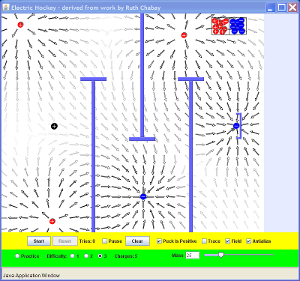
Electric Field Hockey

When Rio received its first year of the Digital High School (DHS) grant in 2001, I was ready to go. It seemed that the rest of the world had moved into the Computer Age and my classroom had been left behind.

One of the software titles I got through DHS was Electric Field Hockey 3. But even in 2001, EFH was long in the tooth and, it seemed, abandoned by its publisher. The program came on an old-style floppy disk. I worked around that and installed it on our new iBooks. EFH was a port from another computing platform, and it showed. Apple's interface guidelines were not adhered to. Still though, the program was so much fun that the idiosyncrasies could be overlooked.

In 2006, our long-obsolete iBooks were due for replacement. With the transition to Intel-based MacBooks came the loss of all so-called "Classic" applications, programs that were designed for Apple's Mac OS 9 and earlier. We actually kept the iBooks around so we could play Electric Field Hockey.

One of the many reasons we needed to replace our 2000-era iBooks with 2006-era MacBooks was that some very groovy apps were coming along that required Apple's modern OS X to run. Such was the case with the PhET simulations.

PhET includes a facsimile of the original Electric Field Hockey. And it's well done! But it lacks the competitive gameplay of the original.

I wrote a student activity to accompany PhET's EFH and restore the competition angle. Teams compete against the clock, not against one another. Students find the activity to be highly engaging, and they do learn a few things along the way.

Here's a link to PhET's Electric Field Hockey.

Here's a link to my corresponding Quest for the Coulomb Cup activity.

Let me know if you find any typos!

Sunday, March 09, 2008

Conceptual Physics labs at Arbor Scientific

Paul Hewitt has posted a comprehensive set of Conceptual Physics labs at Arbor Scientific. The labs are aligned with the upcoming Conceptual Physics: The High School Physics Program (fourth edition/2009).

The labs are in Microsoft Word format. Just download and print for students. Feel free to edit them if you'd like to customize the apparatus list, instructions, or questions for your specific needs. Each lab includes instructor's notes and an answer key. There are also links at ArborSci.com to the required supplies and equipment for each lab.

The Conceptual Physics labs at ArborSci are publication-quality activities, experiments, demonstrations, and TechLabs. Many are currently published in the lab manuals for Conceptual Physical Science, Conceptual Physical Science--Explorations, and Conceptual Integrated Science.

This lab set is also dynamic: New labs will be added as they are developed, and existing labs will be modified when improvements can be found.

Best of all, these labs are free! To start working with these labs, direct your web browser to
http://www.arborsci.com/Labs/CP_Labs_Selection_2.aspx

Wednesday, February 20, 2008

My conflict of interest disenfranchises my students

For the first time in my 22 years of teaching physics in the San Juan Unified School District, I am to have no voice in the decision of which textbook we will adopt for physics.

At our first adoption committee meeting, I disclosed that I knew (and had worked with) the author of one of the titles under consideration. Two meetings later, the district coordinator in charge of the meetings pulled me aside and expressed her concern that I had a conflict of interest. She advised that I should not enter into deliberations over the adoption of the high school physics textbook.

Do I really have a conflict of interest? I did work with Paul Hewitt on Appendix F (Additional Problems) of the previous edition of Conceptual Physics: The High School Program. I was given a one-time, contributor payment. And I am an author on the lab manual for Conceptual Physical Science, Conceptual Physical Science Explorations, and Conceptual Integrated Science. None of those lab manuals are connected to any textbook under consideration for the physics adoption.

I assured the coordinator that if every high school in the country adopted Hewitt's text, my profit would be exactly... zero. And if no one in the country adopted Conceptual Physics, my financial loss we be the same: zero. (Well, for a loss I suppose it would to be negative zero.)

However, the San Juan Unified School District sets a low threshold for "Conflict of Interest." Since I do receive a royalty payment from Pearson Education and Pearson Education does have a title under consideration, I am deemed to have a conflict.

Is the bar set too low? I know a teacher who grades teacher exams for National Education Systems (NES). Prospective teachers seeking certification must pass an NES exam. The exam involves written responses, and those written responses must be scored by readers. My colleague is such a reader. The compensation he receives comes in the form of a check. The check comes from Pearson Education, who acquired NES in 2006.

By SJUSD Board Policy, my colleague would have a conflict of interest in textbook selection if Pearson Education (who owns Prentice Hall and Addison Wesley, among others) offered any titles for consideration. The policy declares conflict for those who are "employed by or receive compensation from any person, firm, organization or any of its subsidiaries or controlling entities submitting instructional materials to the district."

I'd be willing to bet a nickel that my colleague could, in fact, serve on an adoption committee and enjoy input in the process. Completely undetected. The district has no vetting process. (Not unlike the lack of vetting that's common to Homecoming Dance Cleanup Committees.) They would not know of his clear and present conflict. And he wouldn't imagine that he had any such conflict and would not imagine any reason to recuse himself.

Amusingly, I was allowed a voice in our 2001 deliberations. I first and foremost advocated that each teacher be allowed to choose the book of his or her preference. My choice was a book that was, erm, dedicated to me! (Yes, Hewitt's Conceptual Physics.) In my defense, I made full disclosure of that fact to the district science coordinator at the time. But in a case of "no man is a prophet in his own land," she thought that I had simply doctored the dedication page to include my name. LOL!

This adoption is the fourth one I've been involved with and affords me the opportunity to work with my fourth district science coordinator. Just an observation.

Other observation: too bad my physics students will have no voice in the physics adoption process, just because I author a lab manual for courses they will never take.

Monday, January 28, 2008

Horseshoe magnets recalled due to lead paint

Over 150,000 horseshoe magnets sold for use in science classrooms between 1995 and 2007 have been recalled. The red paint used to coat their bodies is unacceptably high in lead content.

The magnets were manufactured in India and imported by United Scientific, Inc. United Scientific is a supplier to independent distributors. No distributors are named in the recall notice from the US Consumer Protection Safety Commission.

See the CPSC notice for full details, including sizes and model numbers.

Please pass this notice on to your colleagues in elementary schools, where most of these magnets probably wound up.

And hey, these lead-coated magnets only been out in classrooms for 13 years. Am I out of line to say, "Way to go, CPSC!" and not be entirely sincere?

Monday, January 07, 2008

D&S Marketing's AP Physics prep book

High school teachers always have goodies awaiting them in their school mailboxes. Many of these treasures are commercial solicitations, and some of them are useful.

One solicitation I can count on year-in and year-out is for D&S Marketing's AP Physics Exam prep book. The book is essentially three practice multiple choice tests. So far, so good. There is a market for such a book, and I'm in it.

One problem D&S faces is copyright infringement. The sad reality of the school market is that teachers will buy a single copy of such a book and blast out "unregistered" copies using the school's photocopying technology. D&S maneuvers around this by selling their book in packs of 10 or more. If you want one copy, you'll have to buy ten. No quibbles there.

I do have quibbles elsewhere.

Probably the least of which is that I already have every product they've ever pitched to me. I have the first and second editions of their AP Physics prep books. I'm not likely to buy any more of the second edition, so the year-in, year-out marketing barrage is wasted on me.

I will probably also pass on future editions. The first edition was fairly good. The trick to these publications is to match the coverage, depth, and difficulty of the actual College Board Advanced Placement Exam in Physics. No mean feat. The first edition came close, though the item writer clearly had some favorite topics that strayed from those of the College Board's syllabus.

The second edition, however, was over the top. Each item was an exam in itself. Much harder than the actual AP Physics Exam. For me, the second edition was of no use. Your mileage may vary.

The best bet is to collect all the released items you can from The College Board/ETS. I've been able to collect released items from the 1984, 1988, 1993, 1998, and 2004 exams in my long and storied career. Those items will always be better than anything offered elsewhere.

Friday, November 23, 2007

Why top-down text adoptions are wrong #417

OK, the 417 might be an exaggeration, but there are many, many reasons that adopting one physics textbook title for use throughout a multi-school district is wrong.

I've listed the others in a "manifesto," but a new one struck me as I was examining the lab manual CD for Holt's Physics by Serway & Faughn. Many of the lab activities in that resource are Calculator-Based Laboratory (CBL) activities.

I'm not a big fan of CBL. For "tech-labs," I prefer the use of laptop computers. Small gizmos like calculators or single-user sensor monitors isolate students during lab work. One laptop shared by a group acts as a focal point and brings students together.

Still though, many teachers do like the CBLs. And teachers who like CBLs might lean toward adopting the Holt text so as to acquire the CBL-rich lab resource. And they should be allowed to do so.

Other teachers within the same district (like me) might be less keen on the CBLs and might be less interested in the Holt textbook. They might prefer a competing title for a variety of reasons.

Should they be forced to adopt a book they don't like and lab resources they won't use?

Better to let each school site decide which title meets the needs of its own program. That's always the best plan, actually.