Showing posts with label heat. Show all posts

Sunday, October 25, 2020

RT;DL Thermoscope

I was reluctant to post this since thermal physics has been so thoroughly abandoned by NGSS (HSPS) and AP Physics. And also because the apparatus that I use appears to be unavailable. And the ones I was able to get most recently are a bit fiddly to use.

But what the heck? Physics teachers teach across a spectrum and not everyone is beholden to NGSS and AP. And physics teachers are a resourceful bunch: There may be other ways to do this without the exact apparatus I'm using here.

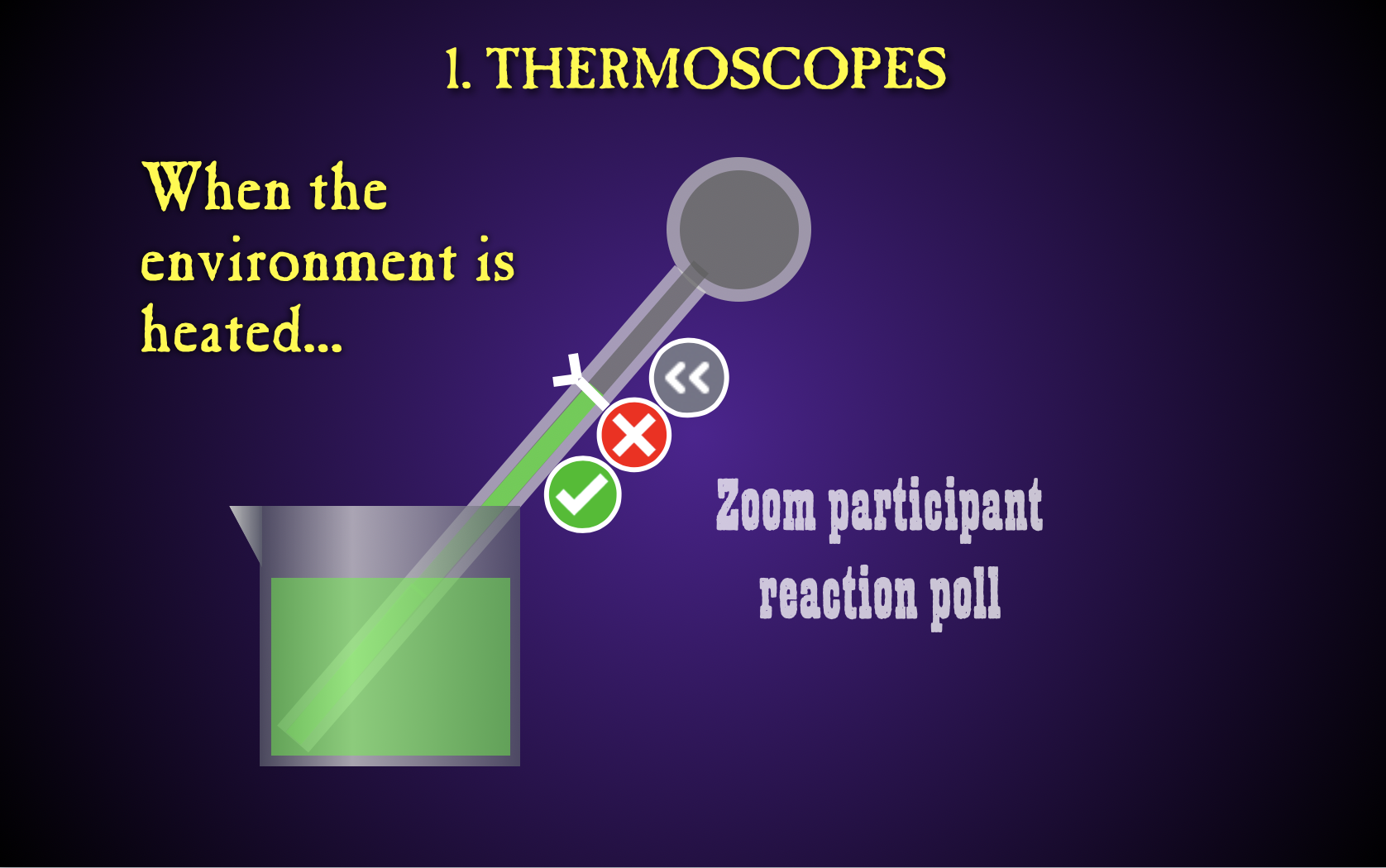
The demonstration revolves around what I've been told is a Galilean thermoscope. A narrow-throated Florence flask is used here, as is a beaker, some food coloring, a twist-tie, a blow drier, a hot plate, and some water.

I like it enough to continue using in in my AP Physics 2 unit on thermal physics which is a pre-cursor to the unit on thermodynamics.

An instant Zoom poll using participant reactions is once again included.

Thermoscope [Virtual Demonstration] at Teachers Pay Teachers

If you have a clever workaround to get past the dearth of what were once sold by Sargent-Welch as "air bulb thermometers," let me know in the comments.

Saturday, October 10, 2020

RT;DL The Tower of Bottle

In the pre-blog, pre-social media days of the mid-1990s, when the World Wide Web was Alien-birthing from nothing (1994) to everything (1995), I was involved with the Southern California Alliance of Mentors for Physics Instruction and its Southern California Area Modern Physics Institute. Yes, two SCAMPIs in one. John Jewett (Cal Poly Pomona) and Roger Nanes (CSU Fullerton) outdid themselves on the acronyms!

Somebody at the California Department of Education liked what SCAMPI was doing, and wanted to get four Northern California teachers involved. I was chosen/selected to be one of them. Jessica Downing, then the Science Department at Esparto High School (now IB coordinator at Inderkum/Natomas) was selected as well. She and I conducted SCAMPI workshops throughout Northern California during those years.

I got this demo idea from her.

The gist is to show that the molecules in a jar of hot water are moving faster than the molecules in a jar of cold water. Just add food color and wait a minute. 

But while we're here, let's add some value. Lay a playing card on top of the hot water and flip the bottle over. The card stays in place and the water doesn't spill. 

Set the bottle mouth down on the cold bottle and remove the card. The result is surprising.

Then re-insert the (a) card and flip the configuration over so that the cold water's on the top. Remove the card. And it's a different outcome.

Last, a few questions of balance or imbalance. If you were nervous that I wouldn't shoehorn a Zoom participant reaction poll in, ease your worried mind.

The Tower of Bottle [Virtual Demonstration] at Teachers Pay Teachers

Single-shot video of the complete demo

Enjoy!

Saturday, November 30, 2019

The Heat Playlist of Phyz

I fear I might be the last high school physics instructor around still teaching heat and temperature. I don't get any sense that NGSS needs me to teach it. AP Physics doesn't need me to teach it. I teach it in AP Physics 2 before delving into the curious realm of thermodynamics. But that's because I think the topics and demonstrations are so groovy.

In any case, here's my playlist.

The Heat Playlist of Phyz
SONGARTISTYEAR
(Love Is Like A) Heat WaveMartha Reeves & the Vandellas1963
Burn Down the MissionElton John1970
Burnin' for YouBlue Öyster Cult1978
Burning Down the HouseTalking Heads1983
Cat People (Putting Out Fire)David Bowie1982
Cold as IceForeigner1977
Cold Cold HeartNorah Jones2002
Dark FireStrunz & Farah1994
Don't Stop Me NowQueen1978
Feels Like FireSantana (feat. Dido)2002
FireSara Bareilles2019
FireIngrid Michaelson2012
Fire And Fury (Fuego Y Furia)Oscar Lopez1997
Fire And RainJames Taylor1970
Fire LakeBob Seger & The Silver Bullet Band1980
FlamethrowerThe J. Geils Band1981
Gypsy FlameArmik1995
Heat of the MomentAsia1982
Heat of the SunStrunz & Farah1994
Heat On the StreetPhil Collins1989
His Latest FlameMary Lou Lord1998
Hot BloodedForeigner1978
I'm On FireBruce Springsteen1982
Ice CreamSarah McLachlan1995
Long Hot SummerStyle Council1983
Paper in FireJohn Cougar Mellencamp1987
Rattle And BurnJesse Cook2005
Set Fire to the RainAdele2010
She's So ColdThe Rolling Stones1980
Some Like It HotThe Power Station1985
SteamPeter Gabriel1992
Still On FireAztec Camera1984
Strange FireIndigo Girls1987
The Fire Down BelowBob Seger & The Silver Bullet Band1976
The Fire InsideBob Seger & The Silver Bullet Band1991
The Rhythm of the HeatPeter Gabriel1982
The Warmth of the SunThe Beach Boys1965
This House Is On FireNatalie Merchant2001
Warm SoundZero72001
Warm WaysFleetwood Mac1975
We Didn't Start The FireBilly Joel1989
World On FireSarah McLachlan2003
You're My FlameZero72006

Monday, February 11, 2019

The Inverse Leidenfrost Effect at Veritasium

Here at The Blog of Phyz, we're big fans of the Leidenfrost effect. If you search "Leidenfrost" here, you'll see exactly how much we love it. I blame Jearl Walker.

As always, Veritasium's Derek Muller gets us.

Inverse Leidenfrost? What can that possibly be about? Take a look:

The Inverse Leidenfrost Effect

Saturday, February 18, 2017

Is there gas in that light bulb?

I'm a fan of topics in thermal physics. Not thermodynamics as much as temperature, heat, and heat transfer. These topics have been largely abandoned by NGSS (HS-PS) and are not included in AP Physics 1. For the moment, I teach AP Physics 2, which has some concern for thermodynamics. That gives me reason enough to teach thermal physics as a precursor.

We cover that content in the fall. We are now into geometric optics. That's how it was that I came to have a 40-W incandescent bulb with a dimmer switch on a gooseneck lamp glowing on a classroom table. I was demonstrating the classic image-formation trope of "What will happen the to the image if half the lens is covered?" (It's right up there with "How would the results of this [mechanics] experiment be different if it were conducted on the moon?" among well-worn item-writing chestnuts.)

But we had a few minutes before the end of the period. So I offered a question: "How could you know whether or not there's gas in this bulb?" If I had planned this inquiry a bit better, I would have  begun with "Why is the filament enclosed in a glass bulb?" If incandescents weren't becoming increasingly rare, we could break the glass on one and see what happens when the filament is exposed to air.

Of course, the immediate solution posed by my thoughtful teenage (mostly male) scholars—after milliseconds of contemplative deliberation—was "break it!". You hardly need a question. The best and most immediate answer is going to be "break it!". It just is.

I asked how breaking the bulb would reveal the answer to the question. Forced into a corner of their own making, they suggested weighing the bulb before and after the break. A difference in weight would reveal the prior existence of the gas. I argued the difficulty of the logistics and the precision required.

To move them off the property destruction solution, I moved the goalposts. How could you know without breaking the bulb? And without any other instruments? Hemming and hawing ensued. The end of the period was approaching.

Is the glass strong enough to hold up under atmospheric pressure if it's evacuated? Maybe. Could there be a gas in there given the rapid burn-out that happens when the filament is exposed to air? Yes: inert gases, noble gases.

I touched the bottom of the bulb and reported that it was warm. I casually kept my fingers on the glass of the bulb. Didn't the transfer of heat from filament to bulb require a conducting medium? No, they insisted. The bulb could have been warmed by thermal radiation.

An inquisitive student got up and touched the top of the bulb. He did not keep his fingers on the bulb very long at all and complained about how hot is was. (I had adjusted the 40-watt bulb down to about 10 watts, so it wasn't as bad as it could have been. I also assured him any burns would heal in a few days.)

At that point, they got it. The bottom was warm but the top was hot. Gas in the bulb is heated by the filament, rises, and deposits heat on the top of the bulb. Convection!

The key to knowing there was gas in there was feeling the top and bottom of the bulb. Having the bulb in a horizontal orientation helps: you have a "top" and "bottom" made of the same glass. The FLIR One thermal camera image was an afterthought, and is not needed to develop a solution.

When the period was over and students were filing out of class, the inquisitive student told me that breaking the bulb could be a simple solution, as long as you broke the bulb underwater.

He had me there.
Sunday, February 12, 2017

Nothing's as cool as seeing the heat

Next week I begin my Thermodynamics unit which includes discussing the 0th, 1st and 2nd Laws of Thermodynamics. When I teach the First Law of Thermodynamics, we discuss how it is basically a restatement of the Conservation of Energy. A favorite demo of this is to use large ball bearings that get slammed together on either side of paper. They are often called "colliding spheres" and are a really simple way to show the heat lost in even a simple collision. When you slam the spheres on either side of the paper a small hole is burned into the paper. When I demonstrate this to students I have a volunteer hold a piece of paper straight up vertically and slam the spheres on either side of them several times. It takes students a moment to realize that holes have been made in the paper and then they notice the smell. Only a few holes in the paper is enough to fill the surrounding area with the smell of burning paper. I talk about how hot the paper must have gotten to literally burn at the contact point and that the thermal energy comes from conserving the energy from the initial collision. Dean Baird uses this as an exhibit in his student run Exploratorio, called "Fire Clap."

Even though it seems obvious to me that the burned hole is an example of thermal energy I wanted to show students the collision as viewed through a thermal imaging camera. I tried looking online but I could not finding any such video. I don't own a FLIR camera (yet) but the Exploratorium Museum of San Francisco does! I was there today to help with a Teacher Institute workshop and headed down to the FLIR exhibit with a set of the colliding spheres. Some other teachers and I got some videos:

Our first attempt showed that there was in fact a bit of heat around where the holes were made. You can see the color change around the edge of the hole over time:


While rearranging for another take we noticed that our hands left residual heat lines on the paper so we drew on the paper that way for awhile. Physics teachers are easily distracted by cool stuff. We found that my fingers didn't work well and when everyone held their hands up we saw why. My fingertips showed up black (cold) while everyone else's were white, the same color as the rest of their hands, apparently I have cold hands.


In this video you can see the experiment take place on the right and the projected FLIR video is on the left. Again the holes produced have a bright white that eventually fades to the color of the paper.


At this point we remembered that we were making holes and therefore we could "see" the heat signatures of things behind the holes. We oriented the paper so that a dark color was behind it so that we did not have contrast behind it. A well timed museum visitor passed behind and we can see that the color changes:


Another experiment commonly done with the colliding spheres is to slam them on either side of a piece of foil. This Educational Innovations post explains both aspects of the experiment. When we tried the foil we found that there was no heat seen through the FLIR camera. We could not heat the foil like we did the paper and see the residual lines from our hands.


According to Zeke Kossover of the Exploratorium it is due to the low emissivity of the foil. This FLIR article explains it a bit but basically the foil is so good at reflecting radiation (visible light and heat) that the FLIR camera does not accurately show its temperature. In the picture above the black rectangle on the right and the two spheres in my hand appear black which translates "cold" through the FLIR camera. They are in fact both room temperature or warmer as they have been held for a moment.

So now I have video to show my students that confirms, in more ways than one that thermal energy is produced when the two spheres are slammed together. There's nothing quite as cool as seeing the heat ... *bad dum ching*.

Saturday, January 07, 2017

Christmas Convection: The Fiery Fairy

I might very well be the last high school physics teacher teaching the topics of temperature, thermal expansion, heat, and heat transfer. Don't worry, I'll eventually retire and that will be that. (As it is, I've relegated those delicious topics to AP Physics 2, and that course is subject to the whims of enrollment.)

In the meantime, here's a tidbit that I'll be adding this sparking gem of black humor to my convection curriculum.


In my assessment, the flying fairy is a sensitive sensor for air currents in a room. And the fireplace sets up a "negative pressure" by sending heated air up the chimney and drawing air in from the living room. The fairy successfully discovered this air current. Great Success!

The video above went viral a few years ago. And some clever folks produced a satirical follow-up: Fiery Fairy Funeral.

Friday, July 22, 2016

Using a laser to pop balloons—with a surprise

AAPT's SM16 included the customary picnic and demo show on its last night (which precedes its last day).

Rutgers' David Maiullo, star of That PHYSICS Show led a capable crew of physics demo artists through a fun-filled demo show.

I caught most of the "balloons popped by a laser" sequence (at 240 fps). But upon further review, I noticed something unexpected. Who doesn't love something unexpected (in this context, anyway)?

Have a look. What surprised me, and what's the explanation?

Laser Balloon Pops

Thursday, July 21, 2016

Shattering Pyrex at 344,000 frames per second

I attended a high-speed video workshop at the AAPT Summer Meeting 2016 in Sacramento. It exposed me to Tracker, which I had not used before.

I've long been a fan of high-speed video, as you can see if click the "high-speed video" label off to the right in the labels section.

While intending to scope out the newly-prized Sony RX10 at my favorite camera gear website, DPReview, I serendipped into a post noting that The Slow Mo Guys had posted footage of shattering Pyrex at various recording rates.

They cranked their camera (a Phantom v2511) up to 11 by dropping the resolution. This allowed them to capture at a ridiculous rate of 343,900 fps. As is their wont, further shenanigans ensued.

Glass Explosion at 343,000FPS! - The Slow Mo Guys

Friday, July 15, 2016

Mounted (but not stuffed) Toaster

I have a ripped apart, non-working toaster and I want to use it to show my students a by product of electricity is heat. Since I took out the controlling circuit board and detached the plug I needed to hook it up to a voltage generator. When I first played with the toaster I was able to get a bit of heat but it was cumbersome to hold the wires and hold the toaster up for students to see.

I mounted the toaster to a piece of wood with two screws and added an angled piece of wood underneath so that it would be easier for the class to see. The toaster is actually on its side; the white plastic piece is the carriage that moves the bread up. I opened one side so that the heating elements were easy access. I soldered two alligator clips to the wires so that it would be easy to connect to the voltage generator.


Since the toaster isn't connected to a standard 120-V outlet the filaments don't get red hot. You can feel the heat near the filaments but the whole point of this demo was to show an entire class how it worked. Taking the time to (and the risk of) students putting their hands near the toaster wasn't going to work.


I hooked up the toaster to a voltage generator and used thermo paper to "show" the heat. Of course a heat vision camera would do the job nicely as well. I have three different temperature ranged pieces of thermo paper from Educational Innovations: 20-25 °C, 25-30 °C and 30-35 °C. The first was too low to be useful but the other two when held near the filaments showed the heat coming off the coils. I held the paper with a binder clip, not because it was hot near the toaster but because I was hot. *badum ching* Seriously, my own body heat would register on the thermo paper (as seen in the upper left of the last part of the clip) and thus would affect the visual. 


Some of you may be worried about mounting an exposed toaster that gives off heat to a piece of wood. Don't worry, I checked and its okay. I left the toaster on for a few minutes then after I turned it off I used the 25-30 °C thermo paper to visualize the heat still coming off the filaments and then below them on the metal that actually touches the wood. No heat registered on the metal against the wood. 


Tuesday, June 14, 2016

Veritasium reminds us: Celsius Didn't Invent Celsius

I'm nearly always a sucker for a good tale of physics history. Especially those regarding the settling of temperature scales. A new offering from Veritasium's Derek Muller details the birth of the Celsius scale.

Celsius Didn't Invent Celsius


For my own part, I do something of dubious merit when teaching about temperature scales. To answer the question of why we have "degrees" when discussing temperatures, I tell a tale which may mix fact and fiction:
Fahrenheit used a salt and ice mixture to establish a zero point. He then used his own body temperature to establish 96. Why 96? Because it has so many factors, and that helps in dividing the scale into usable increments. Halfway between 0 and 96 is 48, half of which is 24, half of which is 12, half of which is 6, half of which is 3. If you start with 100, things get ugly after two halvings. 
Fahrenheit discovered that the freezing point of water was 32 and the boiling point of water was in the neighborhood of 212. He decided to nail down those two points: 32 and 212 for the freezing and boiling of water, and dispensed with the salt-ice/body temperature standards. This moved body temperature closer to 99. 
And therein lies lies the tale of degrees. Freezing and boiling can be interpreted as opposite processes for water. In one, liquid turns to solid; in the other, liquid turns to gas. Opposite processes. The difference between 32 and 212 is ... 180. Why not 180 degrees between opposite processes. It's geometrically perfect.
That's my story, and no one's talked me out of it yet. But I'm open to being brutally corrected.

Monday, April 04, 2016

Ice Scream - a new ExploratoRio Science Snack

When broadcast television was something people watched, networks would pitch their "encore presentations with the line, "If you haven't seen it before, it's new to you!"

Somewhere in the running conveyor belt that is my Facebook feed, I recall seeing a video of a Kennedy half dollar coin being set into a cavity in a chunk of dry ice. The coin and ice produced vibrations and sound.

When two students ran me through the paces of their Bubble Suspension build (for our upcoming ExploratoRio2016 on Wednesday, April 13), they left some dry ice behind in my classroom sink.

So it's me, some sublimating dry ice in a sink, and no one else around. Recipe for serendipity if ever there was one.

After dousing the frozen carbon dioxide and blowing the subsequent cloud out of my sink a few times (that never gets old), I found a nearby electrophorus and pressed it into the sublimating mound.

What happened next is best relayed in the form of a video, which drops the action to 1/8th speed at about 20 seconds in.


So unexpected was the sound that I decided a new ExploratoRio Science Snack was in order. The title of "Ice Scream" wrote itself with little help from me.

The details (as much as I know them or foresee them) are in the recipe linked to below.

Ice Scream - ExploratoRio Science Snack.

Note: Adopting the look and feel of the original Exploratorium Science Snackbookq was not an accident.

Thursday, July 23, 2015

FLIR ONE 2.0 "See the Heat" camera now available*

I'm a fan of photography and imaging. I do a bit of photography, myself. I am a fan of Harold Edgerton's high-speed photography and videography.

I jumped on Casio's EX-F1 when it came out in 2008, and recommended it to physics teachers. My friend and colleague, Dan Burns, got one and came up with a simple rule for what to record in high speed: "If it moves, shoot it!"

When I heard that the heat imaging experts at FLIR were developing a consumer-level product, I looked it up. They were selling FLIR ONE, a camera/case combination for the iPhone 5/5S. I had an iPhone 4S, so I didn't bite. When I upgraded to an iPhone 6, the FLIR ONE was still not an option.

At CES 2015, FLIR announced the next version of FLIR ONE. It wasn't a case, but rather an attachment that connected to the iPhone via the Lightning connector.

As I was beginning my journey to wilds of Alaska, FLIR announced that the new ONE was shipping. By the time I got back to order one, the wait time was up to about six weeks.

Poke around FLIR ONE page.

Check out the marketing video; it's stronger on the funny than it is on the informative.


Or this one. A bit more informative…

Flir One Review


*I don't know how back-ordered they are now, but the sooner you buy, the sooner you'll get.

Tuesday, March 31, 2015

Acoustic extinguisher

Low frequency sound douses a flame. I haven't seen a good explanation. In NGSSpeak, I'd say what we have here is engineering without a full scientific explanation. The explanation that, "it separates the oxygen from the fuel" is not working for me. Moving so much air that the temperature of the reactants is reduced below the combustion temperature seems more plausible.

Here's the article from Sputnik International

Pump Up the Bass to Douse a Blaze: Mason Students' Invention Fights Fires

Monday, February 09, 2015

Conservation of momentum: not always your friend

Make of this what you will, gentle readers. But don't doubt the physics! We've got combustion, fluid flow, conservation of momentum / Newton's 3rd law, and an inclined plane.

Firefighters try to extinguish a car fire when suddenly...


And remember: if you're going to set your car alight on the top of a hill, have the courtesy to set the parking brake!

Sunday, January 11, 2015

FLIR's next generation smartphone thermal camera

The Consumer Electronics Show (CES2015) was recently held, and vendors were pushing their latest and greatest gizmos.

This includes FLIR, whose FLIR One thermal camera case for iPhone 5/5S was discussed in a previous post.

The biggest complaints about FLIR One was that it was limited to the previous-generation iPhone. People with an iPhone 6 or an Android were left out of the thermal imaging party.

FLIR aims to address these concerns with their next generation FLIR One model. It's not a case, but an attachment.

Next Generation FLIR One (CES2015)

New video lesson—The Physics of Tavurvur Volcano

A video similar to this one made it into my Facebook feed, and I saw fit to turn it into a YouTube Physics lesson.


So much physics. How could I resist?

There's the ability to use the sights and sounds to determine distance from the volcano to the camera.

There's the projectile motion of the ejected boulders. Launch speeds, maximum ranges, maximum heights—start with ideal estimates.

Then use PhET's Projectile Motion sim to bring air resistance into the analysis. Huge differences!

Are the spectators at a safe distance? No need to wonder: find out how far those boulders could fly for maximum range. And maximum range with air resistance doesn't happen with a launch angle of 45°.

And don't forget about the adiabatic expansion cloud that appears and disappears at the outset.

Here's the student worksheet that I prepared. The lesson can be done in or out of class. 

YouTube Physics: Tavurvur Erupts! @ TPT 

The answer key is available to classroom teachers who send requests from school email accounts. Ask for the Tavurvur Answer Key.

Here's PhET's "Projectile Motion" sim page.

PhET Projectile Motion 

Sunday, November 16, 2014

FLIR One: A thermal imaging camera for your iPhone 5

The world is lousy with iPhone cases. They're available in all manner of designs to suite a wide variety of tastes and brand loyalties.

FLIR Systems has a $350 case for the iPhone 5/5S. It's a dual-camera thermal imaging system called FLIR One.

FLIR One is a battery case with two cameras whose lenses are in close proximity. One camera is sensitive to visible light, the other is sensitive to infrared light.When actuated, the two cameras collect images simultaneously. The FLIR One app processes the two images into one "thermograph" The app uses the visible light image to create outlines of hard edge boundaries of objects while the IR image is processed into false colors that fills the frame.

FLIR One


If I had an iPhone 5 or 5S, I'd be shooting the world with one of these things. I eagerly await a FLIR One for iPhone 6.

(FLIR is an acronym! Do you know what it stands for? I'll put the answer in the comments.)

Friday, November 30, 2012

Ball and Ring Caper: did it fail or was it abused?

You make the call!

I tried the Shinco Ring and Ball set recently and found the product to be wanting. But did I push the product beyond reasonable use?

Here's a video of the product failing. It you don't have the Zen to watch all of this, skip ahead to 4:10 on the video's time code (3:30ish on the iPad display).


For comparison, check these snoozefests:

Old Model Win (10 minutes in the flame). This one was at the school when I arrived in 1986.


Late Model Win (10 minutes of abuse in the Bunsen burner flame). Ordered circa 2004, to the best of my recollection.


Shinco's ball and ring appear to be plated, which is worrisome to me. Why plate solid brass with... brass plating?

The good folks at Arbor Scientific were unable (so far) to reproduce my results with their supply. They heated the product using a micro burner. Their copy did not melt after 10 minutes of such heating. (Mine didn't last 4 minutes in the Bunsen burner flame.) They also cut into their ring and found it to be solid brass. I don't sense that mine is. I appreciate them taking the time to test things at their end, but I wonder if they're being kinder to Shinco than Shinco is being to them.

Here are a few more pics of the situation.


What do you think? Maybe Shinco sent a bad batch? Arbor's going to send me another set, and I'll put it to the test. I gave some of these out at last year's PTSOS2.

One PTSOSer reports reports his ring went out of round after heating, causing the ball to not fit through at any temperature. Also that the ball fell off its stem upon heating (the threads do appear more "delicate" than "robust".) Mind you, a fallen red-hot metal ball is capable of doing permanent damage to your classroom. Proceed with caution!

In 27 years of teaching high school physics, I've never had a ball or ring melt on me.

The melting point of brass is greater than the temperature of the gas flame. As a matter of classroom practice, both ball and ring need to be able to withstand extended periods of time in the flame. This is a demonstration, and the flow of the lesson requires that the instructor engages the class in discussion while the object is warmed in the flame. Discussions can be shorter or longer. I like to wait until there is a nice orange glow to either ball or ring before proceeding with the various tests involved in the demo.

By the way, here's a PDF of the demo lesson I do with this apparatus. As always, I try to maximize the value of the apparatus through a thoughtful set of questions.

Ball and Ring Student Worksheet

Here's the presentation I use in conjunction with the demo. It's an Interactive QuickTime file (originally designed in Apple's Keynote). QuickTime is free from Apple for Mac OS and Windows.

Ball and Ring Preso (Interactive QuickTime)

UPDATE: The replacement Arbor sent out survived 10 minutes in the flame (without melting), so a bad batch may have been the case.

Sunday, September 16, 2012

Boiling without bubbles?

There was a bit of a flurry of articles, notes, Facebook shares and the like this week surrounding a new application of the Leidenfrost effect. We loves us some Leidenfrost effect here at The Blog of Phyz, so a post is required.

When a very hot metal ball is placed in near-boiling water, an enveloping layer of water vapor surrounds the ball. This insulates the ball, preventing it from cooling down by conduction to the cooler water. The heat transfer is relatively slow. Bubbles peel off from the submerged ball (single file) while the ball cools. Eventually, the ball cools to a point at which it can no longer maintain its vapor "atmosphere."

The new research shows that if the metal ball is coated with nanoparticles, the bubble production from the submerged ball eventually drops to zero.

Here's the video from researchers at Northwestern.


Boiling Water Without Bubbles from Northwestern News on Vimeo.

Full articles are here:
Nature: Stabilization of Leidenfrost vapour layer by textured superhydrophobic surfaces

Scientific American: How to Boil Water without Bubbles

Northwestern: Boiling Water Without Bubbles

Popularizers did their best to popularize this mildly esoteric finding.
New Scientist: Water-repellent balls make liquid boil with no bubbles

Geekosystem seems to have taken things too far.