Showing posts with label standards. Show all posts

Thursday, July 09, 2020

My Flexible Hybrid Learning Plan

Welcome to my debut Blog of Phyz post! I was encouraged by Dean Baird to write a bit about my current flexible hybrid learning plan for the 2020-2021 school year that I posted on Twitter. Great idea! I hope that it can be helpful to others as they try to plan in the face of uncertainty.


The Plan


Let's cut to the chase. Here is the outline for my plan. The rationale follows.


It is currently based on my typical pre-COVID schedule, where I teach a class two 105 minute blocks and one 50 minute class per week. It's likely that I will have to change the times, but I think the philosophy behind it is solid and adaptable.


Guiding Principles


There were three guiding principles in making this schedule: simplicity, consistency, and flexibility.

Simplicity. This structure allows me to make good use of many of the high-quality resources that already exist, such as TIPERS, Ranking Tasks, Flipping Physics videos, Interactive Lecture Demonstrations, and so on.

Consistency. The students will see the same general structure each week, and they will know what to expect if they have to miss class. There should never be any surprises. Hopefully this reduces the "Hey, Mr. Milliano! Did I miss anything? What did I miss?" type questions. They'll know to check the recorded videos and their independent module for the week.

Flexibility. Much of this plan is structured around helping students to self-study and manage their own time. Even if we start the school year in-person, I have a suspicion that we will be online at some point. Students will need to know how to self-study, so we should explicitly prepare them for that while we're together. The teacher-led parts of the plan are things that I'd likely be able to do over video or Zoom, allowing them to work for in-person or online classes.


Independent Modules


Each module would be one week long, starting on Wednesday and ending the following Tuesday.

A module would consist of seven 30-minute tasks, three to be completed in class and four to be completed at home. This could be adjusted to five 30-minute tasks and one 60-minute task, or so on.

These modules would each include at least one of each of the following.
  • An information transfer task. This will often be a student-choice between reading the textbook or watching Flipping Physics videos. For accountability, I will likely have students post pictures of their notes and respond to discussion board prompts in our LMS.
  • A virtual lab or activity. These will come from the usual suspects: PhET, The Physics Classroom, Pivot Interactives, etc.
  • Sense-making tasks. These will include traditional problems, non-traditional problems, making Flipgrid videos explaining a simulation, Google Meets with classmates to collaborate and discuss ideas, posting on discussion boards, writing activities, and more.
Students will be asked to plan their own schedule, with guidance from me and the help of a graphic organizer that I'll make. As an incentive to stick to the plan and as an accountability measure, I'll check in with each student during their independent work time and see if they've stuck to their plan. If so, I'll give them a stamp or a sticker. (I'll never cease to be amazed at how motivating stamps and stickers are to 15-18 year-old students.)

Assessment


The grade will be almost entirely based on weekly quizzes, except for the occasional lab report. This means no long unit tests (to take or to grade)! I will use a version of the 10-8-6-5 flavor of Standards-Based Grading described by Kelly O'Shea on her blog.

The weekly quiz can assess any standard from throughout the whole year, and most standards will be assessed multiple times in class. The most recent standard grade will always replace an older one. Yes, even if it's worse. (Although that rarely happens.)

Student-initiated individual reassessment


Students will have the option to reassess any standard they want throughout the whole year, assuming they have put in the work to understand it better than they did previously. I will have several policies in place to make sure that these reassessments are (a) genuinely reflective for the student and (b) not an administrative nightmare for me.
  • Reassessments will be taken on Fridays in class during the typical self-study time. This gives me a specific time to focus on this reassessments, rather than try to do them in random spurts throughout the week.
  • The student must sign up to take a reassessment by the Tuesday of the week they want to reassess. This tells me that the student has put thought into what they want to reassess.
  • When signing up, the student must provide concrete evidence that they have done extra practice on that standard. This tells me that they have learned from their past mistakes and have put in the work to refine their thinking.
  • The student can only reassess two standards per week, and they must be from the same unit. This helps me write new assessments or find questions quickly and easily.
  • I will only write reassessments for two units and four standards per week. This means I'm not trying to write too many new assessments per week.
  • Only x number of students per class can reassess in a given week. I don't know what the optimal number for x is, but I know there needs to be a limit.
  • There is a definite final date to reassess. For me, that's Friday, December 4, 2020 for the first semester.

Why I like this plan


This plan provides flexibility. There is so much uncertainty surrounding school plans for next fall, and we all know anything could change at the drop of a hat. I believe that this structure could provide the flexibility needed to work fully in-person, fully online, or in a hybrid model. It also allows me to do both online and face-to-face with roughly the same lesson plan.

This plan is not complete. I teach in a St. Louis county school, and all county districts have agreed to release their plans together on July 20. So I don't really know what my schedule will look like yet. With this structure, though, I am confident that I can start working on building some independent study modules.

Some acknowledgements


This plan has been heavily influenced by several conversations that I've had recently with physics teachers on Twitter. I'd like to thank Wesley Morgan for encouraging me to keep things simple this year, Frank Noschese for talking about his plan to make one plan that works in any scenario, and Phillip Easton for sharing how his class has been structured in a similar way in the past.

Saturday, February 23, 2019

CAST Reference Sheet: The Good, the Meh, the Bad, and the Wha?

With the NGSS-based California Science Test (CAST) set for its maiden administration this spring, a reference sheet has been prepared. Students have access to the reference sheet while they take the exam. Here's the reference sheet.

CAST High School Reference Sheet

Reference sheet development can awaken passions that physics instructors didn't know they harbored. So let's go through it. (It might be helpful to print the sheet or have it open on another screen. Blood pressure medication? A preemptive dose might save a life here.)

FORCES AND ENERGY
Good: Newton's Second Law, the weight equation, universal gravitation, Coulomb's law, gravitational potential energy, kinetic energy, work-energy theorem. All good.

Meh: Using w for weight. A little bit non-standard, but the judges will allow it.

MOTION
Good: Ft = mv, the use of ∆v in the equation for acceleration: the ∆ is critical here.

Meh: The use of ∆t rather than t. We never create problems involving isolated clock readings (t); intervals (∆t) are always given. The ∆ in front of the x in the equation for speed? I can take it or leave it.

Meh: The use of J for momentum. That's a rare one. I've seen it, but it is not common. I prefer ∆p, and I don't think I'm alone.

Bad: s for speed. I am reminded of a line from Star Trek: "A Vulcan would not cry out so." In this case, I will turn that phrase to "A physics teacher would never, ever use s to denote speed. Ever." I hope I'm not being ambiguous here. The very use of s for speed makes me wonder if anyone associated with physics instruction was involved in developing this reference sheet. A math teacher might make such a miscue, but not a physics teacher.

Wha?: Using the Greek letter, rho (ρ), for momentum. Why? Lowercase ρ is a symbol used to represent density in high school or college courses. It is also used to represent resistivity. Nobody ever uses ρ to represent momentum. Anywhere, ever! Momentum is represented with the letter p. Extra effort is required to insert the letter ρ. I am dumbfounded.

KEPLER'S LAWS
These are here for the benefit of items addressing Earth Science PE, HS-ESS1-4. I'll let them "Meh" or "Wha?" the notion that e = f/d is among Kepler's Laws.

WAVES
Good: The wave equation and the Planck-Einstein relation. I would have put them in that order, but okay.

Wha?: The reference sheet is set in a sans serif font. In high school, we use lowercase f for frequency. Someone at CAASPP seems to have found the special character, ƒ, which bears a striking resemblance to an italicized, lowercase f. If a pianist sees two of those in a row (ƒƒ), they'll hit the keys hard. The symbol, itself, is called "F with hook," or "florin symbol" and is used to denote the Dutch guilder, for example. This has been Sheldon Cooper's "Fun with Fonts" with your host, Sheldon Cooper.

EXPERIMENTAL DESIGN
Mostly good. It it's me, I'd use a cross (×) rather than a bullet (•) to indicate multiplication. The bullet really isn't a multiplication symbol. The dot (·) is, but the cross is more appropriate here.

At the risk of belaboring a point made in the post critiquing the practice items, I will point out to our gentle readers that no reference to index of refraction appears on the reference sheet. No n = c/v and (thankfully) no Snell's law. Recall that one of the practice items expected students to be familiar with the meaning of index of refraction.

CONSTANTS
If someone at CAASPP sees this, please explore the use of the dot symbol ·. On my Mac, I hold down  the shift and option keys while typing a 9. It's more professional than the big bullet • that you get with option+8. And drop the spaces in unit configurations.

I see N·m as better than N • m for newton-meters.

In all, the reference sheet is more good than meh, bad, or wha? But I wouldn't be keen to print it up and have students use it throughout the year. Replace the speed s with a v and the momentum rho with a p, and I can live with the remaining quirks.

Thursday, February 21, 2019

CAST Practice—An Analysis of the Physics Questions

The California Department of Education's California Assessment of Student Performance and Progress program has released a set of High School Practice Items in connection to the state-mandated exams to be administered this spring.

As detailed in a previous post, six of the 50 released items relate to high school physics topics. Sixteen are from Life Science, 15 from Earth Science, 9 from chemistry, and 4 from Engineering Design.

Remember: chemistry and physics topics have been combined into the more omnibus "Physical Science" realm of the high school science Performance Expectations (PEs). While NGSS's HS-PS1: Matter and Its Interactions is predominantly chemistry, HS-PS2 Motion and Stability: Forces and Interactions, HS-PS3 Energy, and HS-PS4 Waves and Their Applications in Technologies for Information Transfer are predominantly physics PEs.

Nevertheless, 9 of the 15 released HS-PS items assessed HS-PS1 while 6 were shared among PS2, PS3, and PS4. If there is a blueprint available for the composition of the operational exam, I am not aware of it. So the Practice Items may or may not reflect the mix of the operational exams.

UPDATE: I found the blueprint: for the high school test, see page 8 of the CAST Blueprint. Not surprisingly, it appears the operational exam will include physics items in greater proportion than in the released practice items.

Let's take a look at those six. I will state each item's Item-Level Claim Statement (ILCS). Click the ILCS to see the actual item. My analysis will follow each ILCS.


Identify the relationship between mass and acceleration. [Click to see item.]
In general, the item is perfectly reasonable. It speaks to the interpretation of graphed data obtained through a laboratory activity that might be done in a high school setting. The item links solidly with the corresponding PE (HS-PS2-1: Analyze data to support the claim that Newton’s second law of motion describes the mathematical relationship among the net force on a macroscopic object, its mass, and its acceleration.).

But there is a problem. And I say this as someone who had the privilege of sifting through many, many potential exam items offered by ETS for use in state-mandated testing from 2003 to 2013. The problem is the title of the graph.

Classroom teachers come across as dictatorial joy-crushers when they make any attempt to direct their students to conform to established conventions. Titling a graph is but one such challenge. The title of a scientific graph is Dependent Variable vs. Independent Variable.

The graph on this item is correctly constructed as Acceleration vs. Mass: experimenters would have measured the acceleration of a cart while varying the cart's mass. But the graph is titled Mass vs. Acceleration. I have to assume this was an oversight on the part of ETS and anyone (if there was anyone) tasked with content review.


Mathematically determine the properties of the system using the conservation of momentum of objects in the system.
A fair enough item to assess the corresponding PE (HS-PS2.2: Use mathematical representations to support the claim that the total momentum of a system of objects is conserved when there is no net force on the system.).

Some might object that the mathematics is simplified too much in this item. It does leave open the question of how deep the arithmetic might go in operational items. If you make this question about a neutron and a deuteron combining to form a triton, the principle is same, but the numbers are more formidable.

In the event that anyone tries to champion the new assessments as ground-breakingly novel, consider this released test question from the old Academic Content Standards era: Conservation of Momentum RTQ. In fairness, the new one does have color. And kilograms, rather than tons!

But this brings up an ongoing problem suffered by standards exam item-writers. Standards (now PEs) are often important-sounding principles that turn out to be difficult to write a variety of items for.


Select the design solution that best meets the provided criteria about momentum and force during a collision.
This item reveals the challenges associated with writing questions for PEs like HS-PS2-3: Apply scientific and engineering ideas to design, evaluate, and refine a device that minimizes the force on a macroscopic object during a collision. The item has a very long stem leading to the answer choices. And the choices are quite word-heavy, too.

Students with a firm grasp of the fact that increasing impact time reduces impact force will find their way to the correct answer. The item will make them work for it, though. I'm not faulting anyone here: awkwardness is in the nature of writing items aligned to standards (PEs) like this.


Create a correct mathematical representation to determine the components of gravitational potential energy in the Earth-ball system and kinetic energy.
This one requires a written response and is graded with a rubric.

It is linked to HS-PS3-1: Create a computational model to calculate the change in the energy of one component in a system when the change in energy of the other component(s) and energy flows in and out of the system are known.

Might it connect more directly to HS-PS3-2: Develop and use models to illustrate that energy at the macroscopic scale can be accounted for as a combination of energy associated with the motions of particles (objects) and energy associated with the relative position of particles (objects)? The clarifications on PS3-2 say "Examples of phenomena ... could include the conversion of kinetic energy to ... energy stored due to position of an object above the earth. Examples of models could include diagrams, drawings, descriptions, ...]

Aligning items to PEs is sometimes a dark art; I'm inclined to grant CAASPP latitude on this matter.

I have reason to suspect Rhett Allain will not approve of dropping a tennis ball from the top of a building and stating that air resistance is negligible. Neglecting air resistance is a simplifying step. Dropping a tennis ball might be a requirement of item-writing guidelines that prohibit scenarios that might cause significant injury. Dropping a cannon ball would inherently render air resistance more negligible, but would also present a greater potential (!) for damage if carried out in real life.

There's some contrivance at work here: Determining the kinetic energy of a dropped ball in reality would involve measuring its mass and its speed. The speed, alone, allows one to determine the height from which the ball was dropped. But the standard demands items, so here we are.


Describe how wavelength is related to the change in the medium.
The PE being addressed here is HS-PS4-1: Use mathematical representations to support a claim regarding relationships among the frequency, wavelength, and speed of waves traveling in various media. The Disciplinary Core Idea expands this to: The wavelength and frequency of a wave are related to one another by the speed of travel of the wave, which depends on the type of wave and the medium through which it is passing.

One word that doesn't appear anywhere in the HS-PS PEs is "refraction". So we have a judgment call here. Do we assess attainment of this PE by asking about what does or doesn't change at an optical boundary during the process of refraction?

Students must also know what index of refraction refers to and that greater values indicate slower transmission speed in transparent materials. I'm delighted to teach the material; no one gets through my course not knowing how rainbows work. But I might have omitted index of refraction thinking no harm would come to my students based on a strict reading of the PEs and DCIs. I would have been wrong.

There are certainly topics I am skipping based on my reading of NGSS. Which ones will show up in the assessments? Time will tell. I'm not a huge fan of surprises like this.

Minor point: Numerical values were used for the indices of refraction and for the wavelength of the laser. I'm not sure why an infrared wavelength was chosen. When I use lasers in class, I prefer to stick to visible light varieties.


Quantify the change in energy associated with the appropriate change in the relative orientation of the two objects.
The item is a pretty spot-on assessment of the PE here, HS-PS3-5: Develop and use a model of two objects interacting through electric or magnetic fields to illustrate the forces between objects and the changes in energy of the objects due to the interaction.

I like this one because it shows a weakness in my own instruction that will require a bit of patching up.

During classroom instruction, students should be able to examine a number of systems and understand how potential energy changes within them. A rock and the Earth, two opposite charges, two like charges, magnets, springs... Students should know where potential energy is zero and where it is maximized in a given system.

I'll need to work on more explicit instruction of that beyond gravitational systems.


If you made it all the way to the end, pat yourself on the back. This was a long one. I will nourish a hope that we get more released items each year. I was unambiguous about this priority when I served on California's Assessment Review Panel. But panelist's wishes were not always accommodated. I really am trying to be subtle here! In any case, I will try to maintain cautious optimism.

Having said that, I will add that the most fun I had practicing and honing the craft of teaching physics occurred in the years when my students were not assessed with end-of-course exams intended to enforce a measure of accountability. My students in that era did not leave my course with woeful gaps in their physics knowledge. But that's just me shaking my fist at the sky.

Monday, February 18, 2019

Roadmap to the End of Physics

I believe the first time Physics was offered at Rio Americano High School, it was for the 1966-67 school year. My now-retired former colleague, Marion Gribskov taught the course for 19 years until he was called upon to teach Chemistry in 1985-86. I began teaching Physics in 1986. Based on my current reading of the tea leaves, I will teach Rio's final Physics classes in 2020-21.

In 2021-22, I will begin teaching Physics of the Universe (PotU). This will be our school's adaptation to the Next Generation Science Standards and the California Science Framework's digestion of NGSS.

As with most transitions of magnitude, there will be some awkwardness. I have penciled out a roadmap that will take my school from where we are now to where we need to be in 2023.

Here's the roadmap.


Here are the accompanying notes, for what they're worth.

PotU/11-12: Physics of the Universe for Juniors and Seniors. “Algebra 1”-equivalent prerequisite. These juniors and seniors will have had the opportunity to enroll in Biology of the Living Earth and Chemistry in the Earth as freshmen and sophomores.

PotU/11-12 might be a transitional course for use during Rio’s migration to the NGSS Three-Course model. It will be taught in 2021-22 and 2022-23 only. For 2023-24 and beyond, PotU will be a 9-10-level course. PotU/11-12 might be retained to accommodate juniors and seniors who did not enroll in PotU/9-10 but aren’t up to the challenge of AP Physics 1.

PotU/11-12 will omit physics topics not included in the California Framework Physics of the Universe course model, and add earth science topics as needed.

PotU/9-10: Physics of the Universe for Freshmen and Sophomores can omit the math prerequisite but will need to integrate some elements of algebra instruction.

Concurrent offerings of PotU/11-12 and PotU/9-10 in 2021-22 and 2022-23 are to prevent classrooms populated with freshmen through seniors. We put an end to this practice with Earth Science in 2016 with the introduction of Conceptual Physics. Earth Science was restricted to freshmen and sophomores while Conceptual Physics was restricted to juniors and seniors..

Development of Rio’s Physics of the Universe courses will be undertaken during all available collaboration time in 2019-20 and 2020-21 and additional time as needed and approved.

*Beginning in 2022-23, the prerequisite for AP Physics 2 will be “successful completion of AP Physics 1.” [The previous prerequisite had been “successful completion of Physics or AP Physics 1.”]

**Beginning in 2023-24, PotU/11-12 will be discontinued and PotU/9-10 will be the sole non-AP Physics course.

It should be noted that my district has not adopted physics textbooks since 2008. While the district has opted for the three-course model, it doesn't seem any textbook/curriculum program exists for this new course.

It seems there is an assumption among NGSS visionaries that they have provided a grand vision, and now it's up to classroom instructors to develop the curriculum that will implement their vision. That's simply not going to happen. I'm delighted to develop curriculum... to implement my own vision of what high school physics instruction should be. Anyone else who has a vision needs to provide their corresponding curriculum if the hope for implementation.

Between now and then, things may change in terms of the process. This is version 1.0 of how I think it will all go.

Sunday, February 17, 2019

Practice items for California's upcoming NGSS test

The time has come for students of science in California. That's right, CDE's CAASPP's NGSS CAST from ETS goes operational this spring.

That wasn't a cat walking across my keyboard; that was the initialisms and acronyms that spell out the new state-mandated assessment regime in California.

NGSS is, of course, the Next Generation Science Standards. CAASPP is the CAlifornia Assessment of Student Performance and Progress. CAST is CAlifornia Science Test. (I'm suddenly envious of the science tests given in Missouri and Virginia, less so for those in Colorado, Delaware, Georgia, Hawaii, Maine, Nebraska, Rhode Island, Washington, Wisconsin, and lastly, Louisiana. ETA: Looks like I missed Michigan and passed Pennsylvania. I'll be here all weak.)

NGSS has been around for some time now, with its multi-colored documentation of Performance Expectations, Science and Engineering Practices, Disciplinary Core Ideas, and Crosscutting Concepts. California has digested NGSS into its own Science Framework. The Framework and NGSS articulate broad, sweeping visions of science instruction.

CAASPP is the program tasked with testing. The previous iteration of this (in California) was State Testing And Reporting (STAR). This is where the lofty visions presented in the vision documents (NGSS/Framework this time) must be broken down into test questions ("assessment items"). As it was during the STAR era, the California Department of Education (CDE) has contracted the services of Educational Testing Services (ETS) to develop the CAST. (The proliferation of initialisms and acronyms indicate the importance of the enterprise.)

Assessments are where the rubber of the grand visions meet the road of perceived accountability. I say this as someone who served on the Golden State Exam development committee and was appointed by the State Board of Education to serve on CDE's CRP (Content Review Panel, later rebranded as the ARP: Assessment Review Panel).

I am a relentless advocate for released test questions (RTQs). The vision documents are necessary, I suppose. But they never really specify measurable outcomes. The visions boil down to "all students should be knowledgeable in science and capable of performing scientific analysis and related tasks." But vision documents quickly blow up into phonebook sized documents with webs of interrelated objectives that can make tri-level chess seem simple by comparison. But with a sufficient bank of RTQs, I will know exactly what your vision was. Inductive reasoning is really the only way to connect standards and assessments, here.

Until recently, there were just a handful of CAST RTQs available. You can find them on the California Science Test Training Items Scoring Guide: High School (PDF).  The mix of topics (PE/DCIs) left much to be desired.

Life Science: 6 - Earth Science: 1 - Physical Science: 0 - Engineering Design: 0

Remember that in NGSS, high school science opposes three domains: Life Science, Earth Science, and Physical Science. The old subjects known as "chemistry" and "physics" have been combined into Physical Science. But not even one RTQ covered anything in Physical Science.

More recently, a raft of 50 RTQs has been launched. You can find them on the California Science Test Practice Items Scoring Guide: High School (PDF). The mix seems a bit better:

Life Science: 16 - Earth Science: 15 - Physical Science: 15 - Engineering Design: 4

Of the 14 items tagged as Physical Science, 6 related to topics covered in physics. The other 9 were chemistry questions.

Comments and criticism of specific items will be offered in a later post.

Friday, November 16, 2018

You've heard about the new kilogram, but here are the unit changes nobody's talking about

I clearly have no skill in writing clickbait headlines. Anyway...

Let this be our last post about the kilogram. We've had posts on the kilogram

here

here

and here.

It seems we have at last moved away from the physical kilogram standard, Le Grand K, near Paris (and it's many replicas around the world). The new kilogram is based on electric current, which seems counter-intuitive at first.

The new definition of the kilogram will change the way we weigh everything


But wait: there's more. The mainstream media's stories omitted changes to the mole, kelvin, and ampere.

Veritasium has the story.

Monday, August 07, 2017

Where we are with California NGSS state tests

This post is really just a link share. I don't know about you, but I often get so wrapped up in teaching physics that I lose track of where the state is in terms of mandated statewide assessments.

Gone is STAR and its CSTs. In development is the California Science Test (CAST), part of the California Assessment of Student Performance and Progress (CAASPP) [No program is legit unless it has a handy acronym or initialism.] So CAST is the product of CAASPP Science.

The skinny: The CAST is for eligible students in grades five, eight, and once in high school. It's currently in development with pilot tests being run. The test will become operational in the 2018-19 academic year.

Here's the California Department of Education's CAST web page.

Here's a link to released practice test items. When I looked, I was disappointed. Perhaps material for a post to follow. Take a look for yourself at Online Practice and Training Tests Portal.

And here's the promotional video offered on that page.


Sunday, March 22, 2015

Electrophorus Engineering

One of the scariest parts of the Next Generation Science Standards (NGSS) are the Science & Engineering Practices. An easy way to slowly align your curriculum to NGSS is to modify a current demo, lesson or lab so that it is aligned with one of the Science & Engineering Practices. In a (brief) nutshell the Science & Engineering Practices are a skill set students should have in order to explore science phenomenon and engineer solutions to problems or fullfill a human need. Bozeman Science has a nice set of videos on the eight practices. The first one on Asking Questions & Defining Problems is helpful in understanding what NGSS considers the difference between Science & Engineering.

In the past I've created an electrophorus from a styrofoam cup and aluminum pie pan and used it to light a small neon bulb as part of my electrostatics lecture. Among The Exploratorium's many "snacks" is one called Charge and Carry that explains the traditional demonstration. Usually a styrofoam sheet is rubbed vigorously with a cloth to separate charge through friction. The electrophorus is set on the styrofoam and the charges in the aluminum pan polarize; by then touching the top of the aluminum pan you charge it by induction. If you pick it up by the insulating handle, touch one lead of a neon bulb to the aluminum while holding the other you can light a small neon bulb. You form a complete path of conducting material to the ground allowing charges to flow.

This year I did not show my students the electrophorus but asked students to experiment with different materials to explore the best way to light the neon bulb. Specifically students were working on the sixth practice "Constructing Explanations and Designing Solutions." Students had access to the following: plastic cups, plastic plates, paper cups, paper plates, styrofoam cups, styrofoam plates, aluminum plates, aluminum cups (made from rolled aluminum foil).

Students were given this image to understand the arrangement of their materials and instructions on how to charge and ground the electrophorus. Students were told to try different designs to light the neon bulb; each time they changed materials they were to record their results and try something else.

All groups eventually realized they had to use an aluminum plate to conduct the charge to the neon bulb. Most groups used a  styrofoam cup as the handle although some experimented with multiple stacked paper cups and reported a longer and brighter light from the neon bulb. Some groups tried rubbing the aluminum pan directly, skipping the styrofoam sheet, and reported even brighter lights.

After they optimize their design students were asked to write a conclusion paragraph: 
In an age appropriate paragraph explain (1) how the bulb can be lit this way and (2) justify your design choices and how well it worked. Be sure to discuss each of your designs and how their results influences later designs.  

As you might expect, results varied. Some groups really dove into it, referencing their book, asking me clarifying questions and constructed thorough explanations of what they were seeing. From others I could tell that students did not understand how the charge was initially separated, why a conductor was used for one part and an insulator for the other or how the static charge lit the bulb. By discussing their results the next day most students were able to correct their misconceptions. In the end I think they ended up with a much better understanding about the electrophorus and begin to see how current works than if I had just done it as a demo. 

Did it take longer? Yes. Was it worth it? Yes!

Electrophorus Build It Activity (PDF) (Google Doc)

Saturday, January 10, 2015

OK—break's over… kind of

I know it's been a while. And my output was off for 2014 compared to previous years.

The reduced output relates directly to berthing AP Physics 1 and AP Physics 2 at Rio while also retooling Physics from the California Content Standards version that I had polished for the past decade to the Next Generation Science Standards version that is expected to blossom in the next year or so.

So yeah, making this all happen at school to the best of my abilities keeps off the streets (and blogs) at night.

I have no idea when this will be completely sorted. It would be an error to presume that once the year is done, I'll have The Perfect Physics, AP 1, and AP 2 curricula all worked out and ready to repeat until retirement. But I also don't expect things to be as bad for me next year as they are this year.

I do have some groovy posts in the works. They'll be up soon! Neil deGrass Tyson's Cosmos and the Tavurvur volcano are topics.

But I must wave the "My Dear Machine" flag once again. I still love the song, and Leigh Nash's voice is dreamy.

Sixpence None The Richer - My Dear Machine

Saturday, August 02, 2014

Planning the year: NGSS, AP1, and AP2 - Part 1: The broad strokes

My assignment for the 2014-15 academic year includes Physics, AP Physics 1, and AP Physics 2. The Physics course should be aligned to Next Generation Science Standards. Our students are years from facing NGSS assessments; right now school officials of nearly every stripe are focused on Common Core State Standards nearly to the exclusion of any other academic concern.

Last year marked my first attempt to let go of the past decade+ focus on California's now-abandoned academic content standards in physics.

Advanced Placement Physics 1 and Advanced Placement Physics 2 debut this year, and Rio has enrollments in both. Now that AP Physics B is dead and gone, The College Board is laying the AP1 and AP2 cards on the table. My friend, Chicagoland physics teacher extraordinaire, Martha Lietz, pointed me to her AP Physics resource page. And I have been poking around in the links!

This post will give a general direction of how I plan to implement the three courses at my school.

Physics remains a first-year course with an Algebra 1 prerequisite. It needs to fulfill the needs of NGSS as well as provide a suitable foundation for students who might elect to move onto AP Physics 2. It is not feasible to allow Rio's pipeline to AP2 be restricted exclusively to AP1 "alumni".

AP Physics 1 is a first-year course for highly-motivated students who have passed Algebra 2. It must cover the AP Physics 1 syllabus provided by the College Board. But it must also cover the expectations of NGSS.

AP Physics 2 is a second-year course for highly-motivated students who have passed Algebra 2 and a first-year physics course (Physics or AP Physics 1). It must cover the AP Physics 2 syllabus provided by The College Board.

In any case, here's my plan so far. Click to embiggen. Subject to change!


And yes, I'm willing to try the current fashion of energy before momentum. Wide ties/narrow ties. It seems that among the cognizanti, teaching momentum before energy is on par with wearing a wristwatch or typing two spaces after a period as far as age indicators go. I know there are strongly-held beliefs, arguments, and preferences here. Sometimes I think we get too exercised about such things.

Sunday, May 18, 2014

NGSS is a Renaissance, not an Upheaval for Physics Teachers

Your use of the word upheaval is overly sensational. According to Webster's, upheaval means: "a major change or period of change that causes a lot of conflict, confusion, anger, etc.". This characterization would only apply to AP Physics B teachers, a small subset of high school physics teachers (and now a null set!). As for NGSS, I would use something like "freedom", "autonomy", or even "Renaissance". Unlike previous top-down efforts to shackle professionals to a checklist of factoids, this set of standards is more about the process of teaching students how to think and use information to understand the world they live in. There is a large degree of freedom given to teachers to determine how they want to approach achieving the NGSS. NGSS is very similar to the approach outlined in decades-old documents like the Project 2061 "Benchmarks for Scientific Literacy" and the 1991 California Science Framework. It is the pendulum swinging back to a better time in physics teaching. If you rely on your professional judgement as to what constitutes good physics teaching practices, you will not have to worry very much about adapting to NGSS.

Even if you are a teacher that is experiencing "a lot of conflict, confusion, anger, etc." regarding NGSS, I say relax and enjoy the next 2 school years without worrying about preparing your students for state-mandated tests. The earliest these could return would be the 2015/16 school year and the people I work with that are more involved in this process expect them later than that. This is from the FAQ page on NGSS for California:

"When will there be new assessments for the NGSS?
The earliest new science assessments might be available is the 2014–2015 school year. However, due to the short timeline, new science assessments will most likely not be available until the following school year.

Will Smarter Balanced Assessment Consortium (SBAC) have science assessments for NGSS?
At this time, new science assessments will likely be developed much like the assessments of SBAC . However, it is still too early to know exactly how and when new science assessments will be administered.

In SSPI Torlakson’s report Recommendations for Transitioning California to a Future Assessment System, Recommendation 4 encourages the development of new state science assessments consistent with the newly adopted NGSS for California, that include item types consistent with the SBAC assessments (e.g., short and extended constructed-response items and performance tasks)."

The full list or FAQs can be found here:

http://www.cde.ca.gov/pd/ca/sc/ngssfaq.asp

I suggest they dig up the old Golden State Exams for Physics and complete this retro cycle!

Dan Burns
Los Gatos High School

Thursday, September 05, 2013

London skyscraper melts cars

The latest example of architecture that ignores geometric optics brings us to London. The so-called "Walkie-Talkie" building includes mirrored panels arranged on a concave surface.

No doubt the architect thought it looked so cool. But it burns so hot.

It was sure to stand out; no other building in the city has such bold curves. But there's a good reason for that. The building claimed its first victim of note recently.


The contractors blow this problem off, blaming the sun for its current position in the sky (how dare be up there so unexpectedly?) and suggesting the problem will be short-lived (a few weeks).

The US is not immune to such architectural oversight. Las Vegas is home to VDARA Death Ray:


I wondered if no one took physics anymore. But then I remembered that I have not taught geometric optics in my Physics 1 course since before California Academic Content Standards were adopted. Our "Grade A" Physics Standards dropped geometric optics.

But geometric optics do not return with Next Generation Science Standards. And with the AP Physics B redesign, geometric optics is relegated to the second year of AP Physics (AP Physics 2).

So expect to see more of these "death ray" buildings pop up in America and around the world. The increased sunshine from climate change will only add to the trouble.

Friday, August 09, 2013

California Physics: Gem of the state-mandated science tests

The data is in for what appears to be the last round of end-of-course content standards tests.

And in science, Physics finishes on top!

Here are the 2013 Advanced and Proficient percentages:
Biology: 49%
Chemistry: 40%
Earth Science: 37%
Physics: 53%

While CSTs were first administered in 2001, the California Department of Education uses 2003 for its baseline data.

Here are the 2003 numbers for comparison:
Biology: 37%
Chemistry: 31%
Earth Science: 21%
Physics: 29%

Here are the year-by-year numbers with trendlines.


While the other science CSTs were going down, Physics managed to go up!

The award for highest proficiency rate goes to... Physics with 53% in 2013.

The award for most-improved goes to... Physics for posting a 24-point improvement from 2003 to 2013.

Are there other ways to analyze the data? Yes. Even to the point that Physics isn't the science winner? Yes. Am I going to elaborate on those? No.

Congratulations California public school physics teachers: you are—objectively—the best!

To access your school's 2013 STAR results, start at the 2013 STAR Test Results page. From there, select your county, district, and school. Then click the "View Report" button.

To see district, county, or state results, simply leave deeper fields unspecified.

Thursday, August 08, 2013

Rio's 2013 Phyz students are best ever

Rio's 2006 Phyz students held the top spot for six years. They scored as 72% Advanced or Proficient in Physics. With the STAR program's End Of Course (EOC) California Standards Tests (CSTs) winding down, this year's classes rose to the challenge. They will go down as Rio's best physics students ever, as measured by the state of California.

The physics students of 2006 had edged out those from 2001 by  single percentage point.

The physics students of 2013 eclipsed 2006 with a stunning 77%!

Forty-one percent performed at the Advanced level; 36% came in as Proficient. Seventeen percent were rated Basic, 2% Below Basic, and 3% Far Below Basic. (Due to rounding, this does not add to 100%.)

I'll update this post with graphics and more analysis eventually. For now, I'm going to enjoy the buzz.

And congratulate Rio Phyz 2013 as our best physics students ever!

Click here to see if this takes you to schoolwide results.

UPDATE: As promised, here is a breakdown and some longitudinal context for the 2013 data.

We begin with the most detailed breakdown: the number of students at each performance level. Performance levels are Advanced, Proficient, Basic, Below Basic, and Far Below Basic.

Rio Americano/Baird Student Performance, 2008-2013


This analysis leaves something to be desired. There's too much data to see larger, more important trends. A more telling chart compares "good" to "bad". That is, the numbers of proficient (or better) students to the number of basic (or below) students. This chart captures the relative proportions and the overall sample sizes from year to year, and is therefor the most useful chart for analysis.

Rio Americano ADV+PRO vs. BAS+BB+FBB, 2008-2013


Boiling it down too far yields a simple "horse race" result: what percent of the school's test-takers were either advanced or proficient. You lose sample size data here, so things can be somewhat misleading.

Rio Americano %ADV+PRO, 2008-2013


If this chart makes it appear as if 2012 in an anomaly, that's because it was. Rio did not have AP Physics in 2012. We will not have it in 2014, either. But EOC CSTs appear to have run their course, so no worries.

Rio's Physics CST proficiency rate of 77% stands as the highest mark among all the EOC tests. No other CST administered at the school had better results.

Districtwide, our 77% rate places us third among our nine comprehensive high schools. My hat is (again) doffed to Bella Vista and Mira Loma for their physics awesomeness.

Can too much emphasis be placed on the proficiency rate? Absolutely. An arguably better metric is the proficiency number: how many students scored as proficient or better. Rio's biology proficiency rate is always at or near the top for the school. While the physics rate of 77% is better the biology rate of 63%,  biology's proficiency number (63% of 521, which is 328) far outshadows physics' proficiency number (77% of 87, which is 67).

Still though, as a school, we end the Physics CST era on the highest note we've ever played.

Thursday, July 04, 2013

NGSS Fact or Fiction with CSTA's new president

Facts & Myths Regarding Next Generation Science Standards in California

Fact or Myth?
• California adopted the Next Generation Science Standards (NGSS) in April 2013.

• California educators have been involved in reviewing the standards and providing feedback to the author team, the Department of Education and the Superintendent of Public Instruction.

• If adopted, NGSS for California represents the curriculum for science instruction in California.

• If adopted, you will need to implement NGSS for the 2013-2014 school year.

• California will need to write a Science Curriculum Framework based on NGSS for California (assuming the standards are adopted).

• The grade 6-8 standards represent three courses in earth, life and physical sciences, sort of like what we have now.

• The grade 9-12 standards represent the courses that will be offered in high schools.

Tuesday, June 18, 2013

Classroom Skepticism at AAPT Portland 2013

Despite the overlap of TAM2013 and AAPT SM2013, I will be conducting the Skepticism in the Classroom workshop in Portland.

W42: Skepticism in the Classroom - Sunday, July 14 - Portland State University - SRTC 247
(scrolling required)

There will be a variety of lessons, appropriate for the physics classroom, that focus on the skeptical and critical thinking nature of science. Some lessons involve obvious physics content; some bring in examples from the real world. Participants will leave with ready-to-use lessons and resources designed to bring healthy, scientific skepticism to their classrooms—lessons that slip into content-based instruction without disruption. Topics include fire walking, ghosts and angels, balance bracelets, pareidolia, back masking, media credulity, and more.

You'll laugh, you'll wince, and your jaw may fall a time or two. My initial take on NGSS is that there will be room for and demand for lessons like this in the physics (and other sciences) curriculum.

Sunday, June 02, 2013

NGSS high school physical science breakdown: Take 1

The Next Generation Science Standards (NGSS) have now been finalized. I would be surprised if California did anything other than to adopt them without modification.

With the long-standing California Standards Tests now behind us (the EOC tests, anyway), it's time to move on to NGSS. The move will take some time, and there will be some rough patches, kinks and quirks.

If you've seen the full NGSS document, you know it's... robust. It's information-dense, and can be somewhat off-putting at first glance. (Time will tell how it fares at second and third glances.) See for yourself:

NGSS Arranged by Disciplinary Core Ideas
NGSS Arranged by Topic

The high school physics and chemistry Performance Expectations (PEs) are combined into the Physical science set. So last week, my department chair (chemistry teacher) and I sat down to determine boundaries and acceptable overlaps.

Afterward, I produced a document for Chemistry and one for Physics, showing the Performance Expectations appropriate for each course.

I stripped out the red-type clarifying statements and assessment boundaries. I also stripped out the blue, orange, and green foundational pillar boxes. That is, the underlying Scientific and Engineering Practices (Blue), Disciplinary Core Ideas (Orange), and Cross-Cutting Concepts (Green) have all been left to be accessed via further research by interested parties. I probably stripped out other annotations, too.

Here's what we came up with. It may need modifications, especially if there is a need to incorporate Earth Science PEs into Chemistry and Physics. Anyway, it's a start. It will guide what I do next year.

Draft NGSS Chemistry [not my job]
Draft NGSS Physics [my job]

Next year is going to be an experiment. The 1999-2013 California Standards version of Rio Physics is no more. I feel no allegiance to maintain its scope or structure. As a veteran teacher, I have plenty of physics curriculum to draw from. The schedules I've honed carefully throughout the past decade are out the window. Right now, I'm not sure what the finished product will look like. We'll be making the year up as we go along. It's the pre-alpha stage of the NGSS version of Rio Physics development.

Wednesday, February 13, 2013

Changes to the California Physics reference sheet

The reference sheet that accompanies California's statewide end-of-course physics test has been changed. And I'm not happy about it. Why?

In August, 2003, the California Department of Education (CDE) and Educational Testing Service (ETS) sought to settle on a final form of the Physics Reference Sheet to be included in the California Standards Test (CST) in 9-12 Physics. The CSTs were still relatively new, and the reference sheet used for the 2001—2003 administrations had not been completely ironed out. (I think they were using the reference sheet included on the Physics Bowl Exam, but memory is not always to be relied upon.)

A series of drafts and conference calls ensued. I had been newly appointed to the State Board of Education's Content Review Panel (CRP) for Science and volunteered to take part in the collaboration. There was a representative from CDE, one from ETS, and my CRP colleague, Charles Munger, Jr., and perhaps one or two others in on the process. The debate among the parties was more vigorous than a physics reference sheet might seem to merit. But compromise and consensus prevailed; we settled on a document that CDE and ETS implemented. No further work on the document was ever called for or done.

In 2011, ETS changed the reference sheet. A colleague alerted me to these changes and I placed an inquiry to CDE. I got a response from ETS, the contractor in charge of our CSTs. ETS tells me that these changes were needed to accommodate suggestions from the CRP (which is now the ARP: Assessment Review Panel), and to align the 9-12 Physics reference sheet to the Grade 8 reference sheet.

Let's see the changes.

Overview: The Reference Sheet (Click to enlarge)
2004-2011
2012


1. Motion Details
2004-2011
2012


2. Force Details
2004-2011
2012


3. Energy and Momentum Details
2004-2011
2012


You might like the changes; you might dislike the changes. Arguments can easily be made on either side. And those arguments were made in August, 2003!

The details are important, but they're not my primary concern.

I hadn't so much as looked at the reference sheet since 2008, because the matter was settled in 2003. I failed to imagine that while there was no money to continue the Released Test Question process mandated by the STAR test legislation, there was money available to alter the reference sheet. I wouldn't have known about the changes at all if not for an inquiry sent to me by a colleague. (I was incredulous until they included an image.)

As a member of the Assessment Review Panel, I do not recall any suggestion that the reference sheet be modified. I know the ARP never reviewed or approved the modifications.

Having served on the CRP/ARP all these years, I have been made to appreciate the value and importance of the psychometric analysis that is done on the tests and the test items. Psychometric analysis places demands on year-to-year consistency. CRP/ARP suggestions for changes to the test were routinely waved off by ETS/CDE because such changes would break the integrity of the psychometrics.

Altering the reference sheet flies in the face of psychometric integrity. It may be that the CST is so close to sunsetting that psychometrics no longer valued.

So my concern is that changes were made to the CST's Physics Reference Sheet without the involvement of or notice to the Assessment Review Panel. I don't think the reference sheet needed modification in the first place. And given the vigor of the 2003 debate over the original reference sheet, I am troubled that ETS unilaterally modified the sheet based on their perception of implications of ARP feedback on individual test items.

Every change they made was debated and rejected in the August, 2003 reference sheet authoring process. I worry that a new team of individuals came into the process—not knowing the history of contention and consensus that preceded their involvement—and said, "Hey, you know what this thing needs is..."

Amid all those changes, no one could edit the "1 J = 1 N m" to read "1 J = 1 N·m"? With NGSS looming, it's safe to say the CST will run its entire course in anticipation of a notation change that California physics textbooks have yet to make. But I digress.

In sum: Educational Testing Service unilaterally changed a testing document that was originally built through stakeholder consensus. They did so without asking California's Assessment Review Panel for either permission or approval. And they didn't notify the panel or the public that they had done so. So yeah, I'm not happy.

Saturday, November 17, 2012

I am done with Mechanics '12

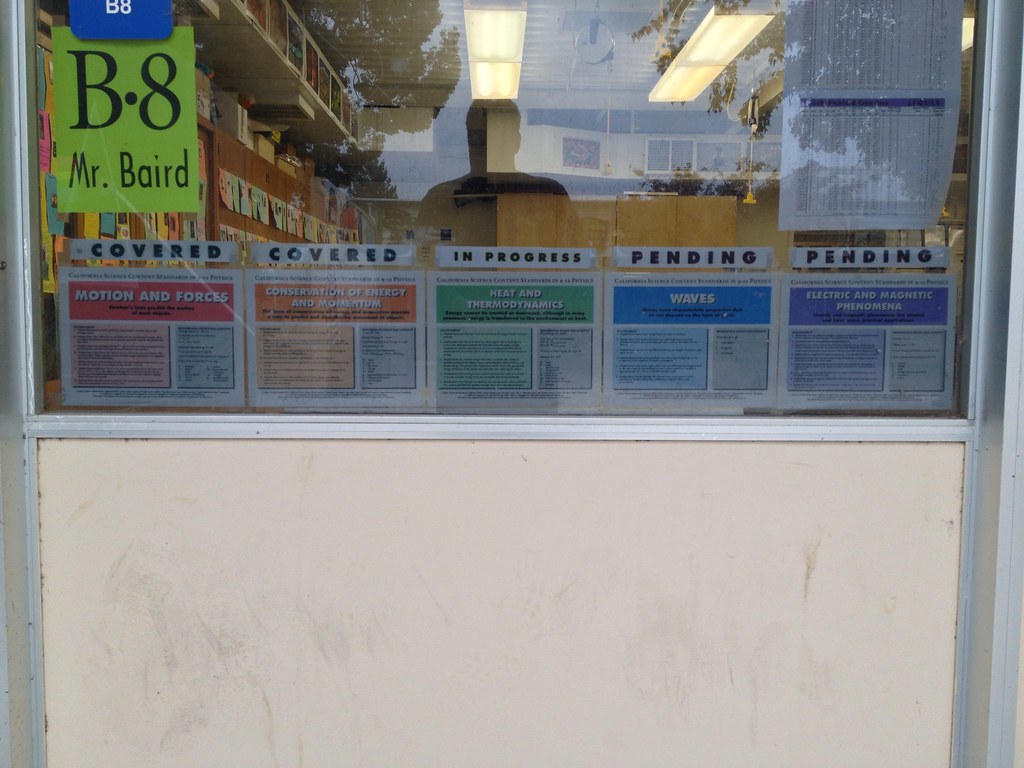
Let this post serve as my annual notice of being done with Mechanics in Physics 1. California 9-12 Physics Standards in Motion & Forces and Conservation of Energy and Momentum are fully covered. We will cover Heat and Thermodynamics before the end of the semester.

PODH, you say? Here ya go: it happened!


I post this because I agree with Paul Hewitt's assessment that we physics teachers tend to linger in topics such as kinematics far too long. Then run out of time at the end of the year before getting to rainbows and why the sky is blue.

California's 9-12 Physics standards are often regarded as onerous and smothering. Some complain that there's too much stuff to cover in a year.

The "onerous and smothering" perception is due, in part, to the end of the era of The Physics Cowboy. The Physics Cowboy was the teacher who, alone, determined every aspect of the 180-day physics curriculum. Nobody told him what to teach, how to teach it, scope, or sequence. The Physics Cowboy ruled his domain, and it was good.

Standards and Assessment drove a dagger into The Physics Cowboy. An external body decided the content. An outrage!

Too much stuff? Perhaps. But I think it's more, "Too much stuff I don't want to teach and not enough of what I do want to teach." If you say there's too much to cover in a year but opt to teach projectiles (not included in the standards), there's a flaw in your logic.

Me? I create a pace that allows me to cover the standards within the school year. Do I cover the standards by the time of STAR test administration? No. STAR tests run about 6 weeks in advance of the end of the school year. And my pace allows for extensive work to be done in Electric and Magnetic Phenomena, the standard set which persists as a low-performance standout with students up and down the state.

To do all that and get to rainbows and blue skies, I must now leave Mechanics behind. We have three weeks of instruction (and one week of final exams) between Thanksgiving Break and Winter Break. In that time we will cover the standards in Heat and Thermodynamics.

Second semester opens with Intro to Electricity. Then it's Circuits, followed by Magnetism. Then it's Waves, Light, and Wave Optics. Covering the grooviest topics at the end of the year maintains student engagement in spite of pressures toward "Senioritis" and "Sun's Out, Brains Off".

Those physics standards mini-posters can be found here:
Dean's California 9-12 Physics Standards Mini-Posters 

Sunday, September 02, 2012

STAR 2012: The What Does This Mean? Edition

Can't resist a HungryBear9562 reference.

The results have been posted from the Spring 2012 administration of the battery of STAR tests. These included the End of Course California Standards Tests in the sciences, including Physics. Which is to say I've got something to talk about.

Statewide: Top-scoring Physics stalls, Biology catches up, and Chemistry sees its biggest jump


Physics has been on top for several years. But this year's 52% Advanced and Proficient rate matches last years best-in-class performance. Biology's steady gains continued this year, and they have matched Physics' 52% ADV+PRO mark. Objectively, Biology's feat is more impressive since there are so many more Biology test-takers. The tie for 1st leaves Chemistry in its long-held third place rank. But Chemistry saw its biggest single-year jump ever: from 38% to 43% ADV+PRO. Although Earth Science remains fourth of 4, it, too enjoyed a nice upward performance bump.

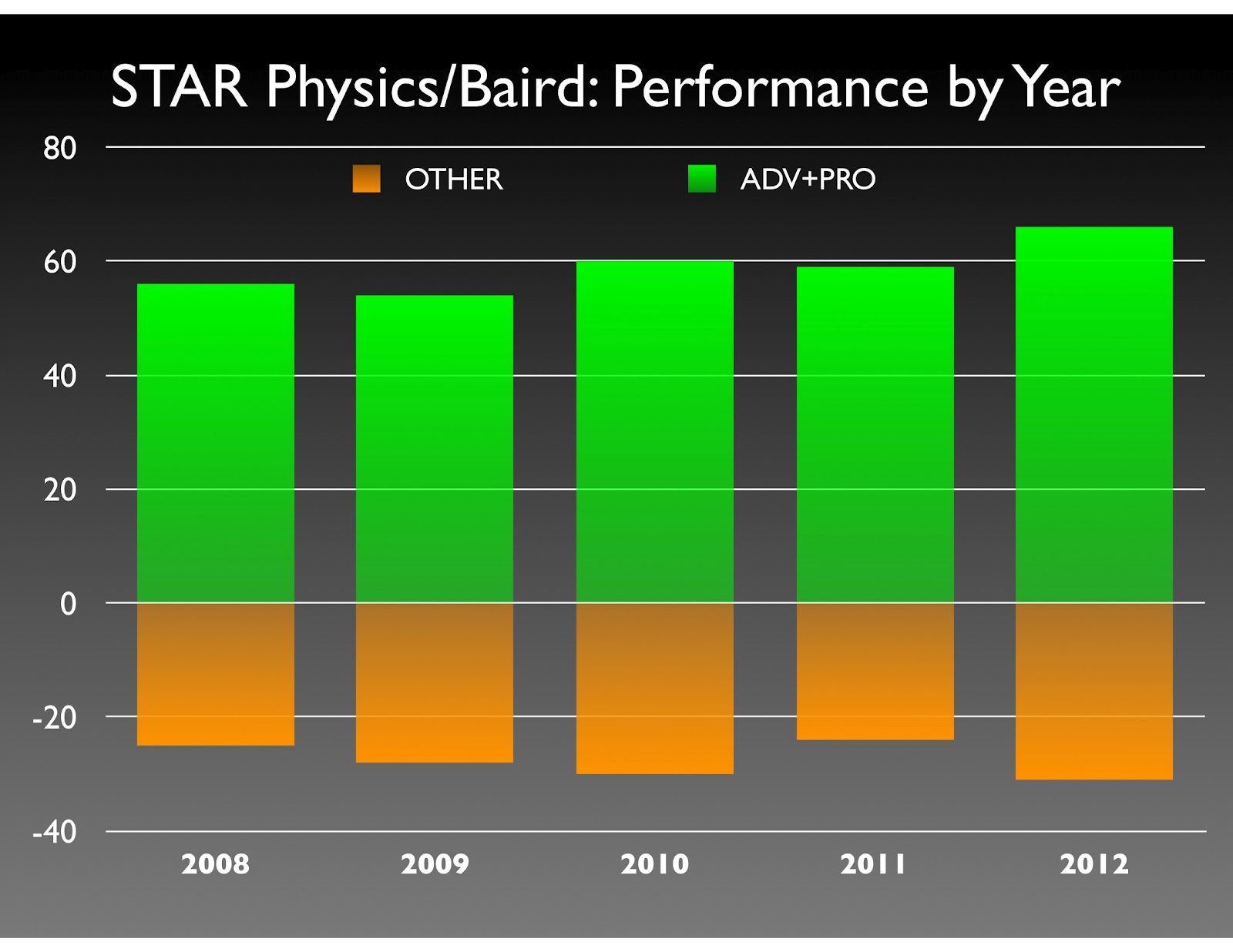
Rio Physics/Baird: My largest ADV+PRO army despite losses in every standard set
My Physics results are mixed, although this seems to be the norm.

1. Good news: 63 of my 96 students performed at the Advanced or Proficient level. 

The school has produced bigger Physics ADV+PRO armies in the past (when we had two physics teachers), but I've never contributed as many as 63 to that army.

2. Bad news: Rio's Physics ADV+PRO rate is down from last year. 

We dropped from 70% to 66%. District schools, Bella Vista and Mira Loma, both posted better rates. But Rio did beat the average district performance, as well we should.

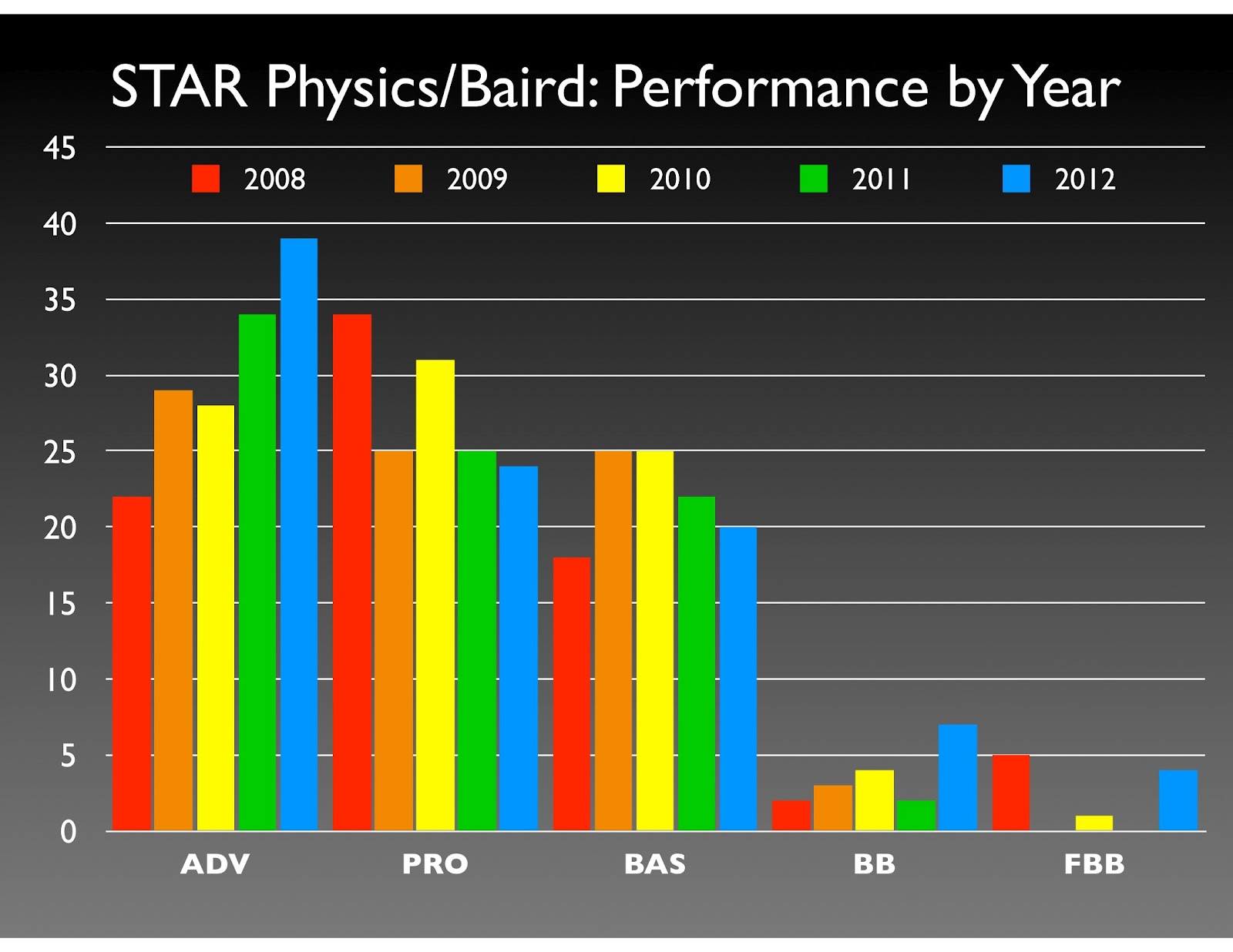
3. Good news: I've never had so many students perform at the Advanced level. 

Thirty-nine is a Baird Phyz Record.Those thirty-nine now reside in my in-class Phyz Hall of Fame on my illustrious Wall of Ego. Unfortunately, 7 in BB represents new records, too.

4 Bad news: We lost ground in nearly every standard set, compared to last year. 

The scene brightens slightly if you compare the 2012 performance to 2010. But why would you do that?