Showing posts with label AAPT. Show all posts

Saturday, August 08, 2020

Phone app Phyphox looks promising

Like many, I've been trying to get a handle on potential distance learning tools over Summer Nocation. It seems there is a vast library of resources and web tools for instruction in general and physics instruction. 

I use PhET already. I'm working with my district to gain access to Pivot Interactives. My district's LMS is Google Classroom, while our SIS is Q (Aequitas).

I have never used Flipgrid, Padlet (or Wakelet), EdPuzzle, Quizizz, Socrative, Screencastify or Screencast-o-matic, Loom, Zoom, Peardeck, Jamboard, Desmos, Edulastic, Flippity, or any other must-have tool that is explained in a video that features a noodling xylophone over a strummed ukulele while a narrator announces, "This ... is <ProductName>. The tool that lets you <do the thing you didn't even know was critical to your instruction program, but is—especially now in distance learning>". If a personal favorite of yours is in that list, you may be tempted to cast me as a luddite. 

There is no shortage of webinars of experts who have been using these tools for years, where importance of Bitmoji is made unambiguous, as is the value of carefully curating of your virtual Zoom background.

At the virtual AAPT Summer Meeting 2020, the phone app, Phyphox, caught my eye (thanks to Susan Johnston's presentation). Like Google's Science Journal app, it leverages a phone's many sensors.


In addition to the activities available from Phyphox, Lawrence Livermore National Laboratory has prepared a series of physics distance learning lessons. I already had the app on my phone, but I was compelled to open it and play around on my own.

As with so many things in the realm of Distance Learning, there is a question as to whether it's appropriate to assume our students have access to a smartphone. 

I'm not going to be able to construct a new and better version of the curriculum I've been honing for over 30 years in the snap of a finger. Or at all. If things work out, we'll be back to face-to-face instruction by ... 2022 is my prognostication. Maybe even Fall, 2021. For now, we're going to do our best with the situation we're in.

Friday, August 10, 2018

#AAPTSM18: Garbage can smoke rings

I will post as many gems as I can from the American Association of Physics Teachers Summer Meeting held in Washington, DC July 28-August 1, 2018. On Twitter, that's #AAPTSM18. The items may be new or classic; simple or complex. Here's one such gem.

Dave Maiullo shows us his smoke ring cannon, adapted to the constraints of the room. Like most things, ring vortices look even better in slow motion.

Maiullo Smoke Rings


Bonus: Maiullo Dragon Voice!

Tuesday, August 07, 2018

#AAPTSM18: Using physics to win a tug-of-war

I will post as many gems as I can from the American Association of Physics Teachers Summer Meeting held in Washington, DC July 28-August 1, 2018. On Twitter, that's #AAPTSM18. The items may be new or classic; simple or complex. Here's one such gem.

At the "30 Demos in 60 Minutes" session, Colorado State's Brian Jones—director of The Little Shop of Physics and author of College Physics by Knight, Jones, and Field—showed us his secret to winning a tug-of-war.

Brian Jones Tug-of-War


I love it: so simple!. Two concerns:

Those once-ubiquitous single-use plastic bags may be an endangered species as voters outlaw them out of concern for the growing plastic islands and gyres in the oceans. It should work equally well with the thicker multiple-use bags that are now coming online.

I wonder if this will work as well on tile as it does on carpet. It clearly works like a charm on carpet. I guess I'll find out soon enough how well it works on tile.

Sunday, August 05, 2018

#AAPTSM18: Google Science Journal

I will post as many gems as I can from the American Association of Physics Teachers Summer Meeting held in Washington, DC July 28-August 1, 2018. On Twitter, that's #AAPTSM18. The items may be new or classic; simple or complex. Here's one such gem.

It is not rare when I spend time with my colleagues at AAPT meetings that I feel like I missed a memo somewhere along the line. If my head is swelling with overconfidence, mixing with my very talented, informed, creative, and knowledgeable colleagues puts me back in my place.

Such was the case when someone casually mentioned the use of Google's Science Journal during AAPTSM18. What? I have a bunch of Google apps, but I hadn't heard of Science Journal. Why not? I don't know. Sometimes I'm just not paying attention.

Anyway, Science Journal accesses sensors built into phones (or as we older folks think of them: smart phones or cell phones) and manages the data for easy use by phone users, such as students. Take a look.

Science Journal

Science Journal, an initiative by Google #ScienceJournal

I don't allow phone use in my class. Strictly and absolutely. Unless I invite exceptions. Phones are never far from students' hands. Given a green light, the phones can be out and about in no time. I'm not sure if I'll find a use for this in class. But at least I know it's there. Hmmm... experiment-based homework?

#AAPTSM18: Color mixing with Ikea's Ledberg

I will post as many gems as I can from the American Association of Physics Teachers Summer Meeting held in Washington, DC July 28-August 1, 2018. On Twitter, that's #AAPTSM18. The items may be new or classic; simple or complex. Here's one such gem.

Rutgers University demonstration specialist, Demo a Day co-author, and That Physics Show star, Dave Maiullo, presented many demonstrations, as he does. With trademark Maiullo panache, of course. One of them was the use of Ikea's Ledberg color-changing LED light strip in conjunction with diffraction ("rainbow") glasses. The LEDs in the strip act as nice point-like sources, a controller allows for variation of the emitted color, and the diffraction gratings produce a nice spectrum that changes in correspondence with the LEDs.

Here's Dave's presentation to a group of physics teachers (Session CM: 30 Demos in 60 Minutes). [Note: this is operationally a family affair as many folks in the room know each other and the demonstrators; so the atmosphere is familiar and casual.] As an attendee, I did my best to capture as much of the session as I could. I did better with some demos than I did with others. My rainbow glasses were secured beyond my ability to deploy them while recording the demo. That didn't stop me from trying!


I managed to make an effort to hold the glasses in front of my big camera during the official demo show. A bit slapdash; I'm delighted it worked as well as it did to show the spectra of the LEDs off to the right.


Tuesday, July 31, 2018

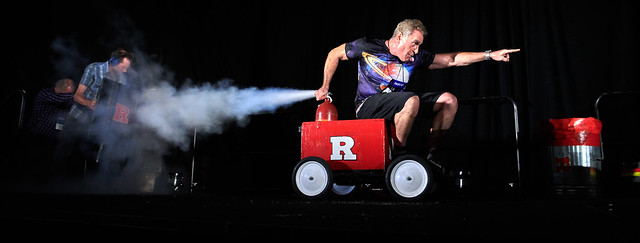
Physics teacher conferees treated to a demo show par excellence

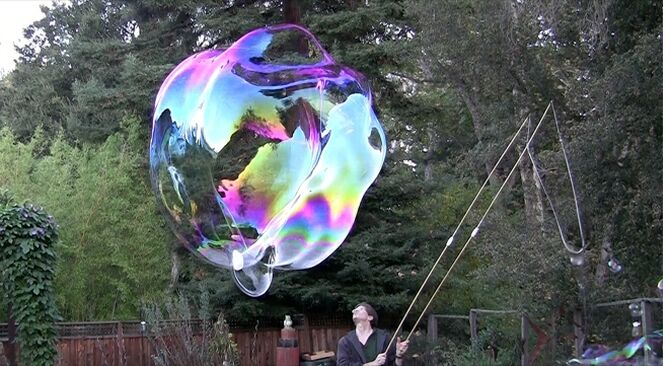
Images from the 2018 Summer Meeting Demo Show, July 31 at the Renaissance Hotel & Conference Center in Washington, DC. Show produced by AAPT's PIRA Team (ft. David Maiullo and Stan Micklavzina) in conjunction with the Bubble Magic of Tom Noddy.

2018 07 AAPTSM18 Demo Show

Saturday, January 13, 2018

Be Direct With Me

I am a huge fan of a CBC podcast called "Under the Influence with Terry O'Reilly". Tales of drunk Canadians engaged in Molson-fueled shenanigans? No. Each half-hour episode tells a carefully woven story connecting some element of advertising or marketing to the world where you live. You will learn things you didn't know about things that you do know with each episode. And each episode is the product of 20-30 hours of research. Subscribe to the podcast right now while you're thinking about it.

In an episode called "When Madison Avenue Met Broadway: The World of Industrial Musicals," O'Reilly played a few seconds of "Be Direct With Me". Just a few-second bite with not much to identify it. But I was transfixed. I deployed my hard-earned blue belt in google-fu and sourced the track. I then saw it was available on iTunes and paid for it immediately (I'm old and from the midwest).

I quickly set the track to a Keynote preso and roughed out a nice delivery. Then I spent several days refining and improving. I simply had to show this gem to my colleagues at the High School Share-a-Thon attached to the American Association of Physics Teachers Winter Meeting 2018 in San Diego.

High School Share-a-Thons can be lively affairs, typically held in the evening on Day 2 of the conference: between the workshops and the invited/contributed talks. For reasons nobody ever explained to me (and I asked), this year's Share-a-Thon was scheduled for 8:30am on Day 2, conflicting with many workshops. And... in the morning!

A few dozen intrepid instructors braved the San Diego rains and made it to the event. Sadly, the session presider did not. A few years ago (I want to say it was the Omaha Summer Meeting), the Share-a-Thon was left without a presider and I stepped up to awkwardly host.

Someone in the room in San Diego remembered that, and promptly ratted me out. So I was once again drafted into service. When the session began, only two of the several dozen attendees signed up to share. We had the room from 8:30am until 10:00am. I made the executive decision to dispense with the five-minute time limit and encouraged my colleagues to not be bashful—we're all friends here!

I showed a couple of things (videos of those things, anyway, as has become the trend among traveling physics sharers). Then I hit them with the video below. I truly didn't want to be up first for this event, but it was what it was.

In any case, the presentation. You will want to be sitting down for this.


I had a few more slides of humor and fun for my live preso; I intend to show it again at the NCNAAPT Spring Meeting.

Eventually more folks came up to share. Questions were asked and answers were given. We ended the session at 9:59:50am.

But industrial musicals? I had no idea. And they were huge in terms of budget, scale, and talent.

UPDATE: GE's Go Fly a Kite—the industrial musical from which this song comes—was written by the composer/lyricist team of Kander and Ebb, who also wrote Cabaret and Chicago. The double-album original soundtrack (souvenir recording) can be had via eBay for $99.99 as of this update. But it has also been posted to YouTube. I found "Be Direct With Me" as the opener for Side 3. The video shows the liner notes and dress rehearsal stills that correlate to the currently-playing track. While Valerie Harper was arguably the biggest enduring star in the cast, she did not sing "Be Direct With Me". Who did? Carole Woodruff. The only other credit I was able to find for her was a musical called Pleasures and Palaces, written by Frank Loesser and choreographed by Bob Fosse. It ran for a month in Detroit and was not reviewed kindly. Woodruff is the last singer listed in the credits. I have found no other relevant information on her.

Thursday, March 02, 2017

Dual purpose dimmer

At the 2017 Summer AAPT meeting in Sacramento Arbor Scientific had a booth in the exhibit hall showing off all their great demos. This Electricity & Magnetism Light Bulb demo caught my eye. It involves an incandescent light bulb with a long loose filament that can be turned on using AC or DC current. While on, a strong neodymium magnet is brought near the bulb with different results depending on the setting. When on DC the filament moves towards one pole of the magnet and away from the other. When on AC the filament vibrates when either pole of the magnet is brought close to it. I wanted one, but the reasonable price was still hard to manage for a once a year demo.

Last year I wanted to show my Conceptual Physics students a working dimmer switch and a simple light bulb. My retired father-in-law made me a self contained box with a dimmer switch and an incandescent bulb:
While shifting equipment around in my room I came across it again while my magnet cabinet was also open. As I recalled the Arbor Scientific demo I thought, "I wonder if...." and grabbed my biggest neodymium magnet. 

With the light bulb on dim so that the filament can be easily seen I moved the magnet close to the bulb. Since my bulb's filament wasn't as long as the one in Arbor Scientific's demo you don't see as much movement but it is vibrating! The second video is easier to see the motion. 


Now I know that my simple demo has a dual purpose and can be used in my current electricity unit and come back in my electromagnetism unit!

Tuesday, January 24, 2017

Crash cushions cont.

Several years ago Dan Burns and I started discussing an engineering project for which students build a crash cushion to investigate momentum and impulse. Using only a few sheets of paper and hot glue student groups design crash cushions (similar to water barrels or guard rails on roadways) to lower the force experienced by a cart rolling down an incline that crashes into them.

Since then we have both completed the project with classes albeit differently. We also presented at the Summer 2016 AAPT meeting in Sacramento, all of the materials discussed there are here. I wanted to share the project here again, with the tweaks my partner Jon Brix and I have made to it since.

My colleague Matt Miller continued the project in Conceptual Physics this year although opted not to use the Vernier sensor that I had last year.  He opted for the resettable Drop N Tells I bought years ago instead as it is more visual for the younger students. He set up a ramp and used a lightweight impact car that had an additional <200 grams of mass added. Miller adjusted the ramp set-up until the 25, 15, 10 and 5-g sensors were consistently tripping. His students were challenged to design the crash barrier that did not trigger all the sensors. I believe he set the grading up this way:
C = triggering the 15, 10 and 5-g sensors
B = triggering the 10 and 5-g sensors
A = triggering only the 5-g sensor
Extra Credit earned for not triggering any sensors.

Dan uses a PASCO Smart Cart while I use Vernier sensors. The first year I tried this I used a low-g accelerometer because it was what I had. Through a Donors Choose grant I was able to purchase the higher 25-g accelerometer, 3-axis accelerometer and a Wireless Dynamic Sensor System (WDSS). The wired sensors require some coordination to prevent the cord from catching but are workable. I found that the wireless WDSS made for easier set-ups but would disconnect occasionally. Both the WDSS and the 3-axis sensors were almost too accurate and the graphs produced were difficult for students to interpret. I opted this year to use the single-axis 25-g accelerometer because even collecting 500 samples per second the peak accelerations were easier for students to determine.

In the past I've used a wood ramp and a big heavy dynamics cart that then travels along the flat lab bench into a wall. The transition from ramp to flat tabletop caused additional acceleration peaks so we opted to have the cart run directly into the wall from an incline. The heavy cart and steep ramp produced a high acceleration that exceeded the accelerometer's limits. We decreased the ramp angle and still occasionally "missed" the hit because the time of impact of the cart against the wall was so short. This year we opted to use a low-friction (not smart) PASCO cart and track from another colleague. The 120 cm long track was raised above the table by one textbook and pushed against the wall. A box of weights (over 30 lbs) was pushed against the higher end of the track to prevent it from moving. In initial tests the conservation of momentum caused the track to move quite a bit when the cart struck the end of the track.

This year student designs proved very successful. Because of the light cart and small incline students were able to reduce the acceleration of the cart at impact fairly easily. Usually the designs that "failed" did so because the cart passed underneath the crash cushion and still struck the wall. I had only one set-up in the classroom so groups took turns testing their barriers and collecting data. We stored a trial of the cart running into a book at the end of the ramp and then printed out graphs for each group with their trial on top of the control data. Here is an example of the data student's received with the control (green) and their trial (blue):
Students were to take measurements of their crash cushion before and after their collision although most cushions did not permanently deform. For some reason students were very pleased when their crash cushion suffers little damage; several cited the fact that it could be reused as a positive attribute. Students were also to calculate the Force with and without their crash cushion based on the mass of the cart.

Using this information students were to write a Claim, Evidence, Reasoning (CER) conclusion to answer the question: "Was your crash cushion effective?" After grading these conclusions we realized a few things:
1. Students did not agree on what made a crash cushion effective. Most students realized that decreasing the force, as shown on their graph as a decrease in acceleration, by increasing the time of impact made for a successful crash cushions. A few more realized that stopping the moving cart without letting it bounce back was also good. Yet many students considered their crash cushions ineffective if there was any acceleration, even if they reduced their force by more than 50% .
2. Students do not know what is fact vs. opinion. This must be going around recently. Students often stated opinions or qualitative observations in place of specific measurable data. "Our crash cushion was good because it stopped the cart slowly."
3. Some students did not understand the graph axis, significance of peaks, etc. Referring to the example above, some students incorrectly described the "time of impact" to be just over 2.5 seconds for the control trial. They did not understand or forgot the fact that the cart had to roll down the ramp before the impact.
4. When in doubt, students are prolific. I expected three, maybe 5, sentences from students yet often received a full page. While grading these conclusions I often crossed out over half of what was written because it was superfluous. They seemed to just keep writing and praying for partial credit.

Before handing back their conclusions I reviewed the CER format with students and showed them a few pictures of correctly written (short) examples of their peers. I showed them a few sample graphs from their trials and reviewed the significance of each peak. In the future this will be done the day after to give students a chance to correct their CER conclusions before turning them in.

Friday, July 22, 2016

Using a laser to pop balloons—with a surprise

AAPT's SM16 included the customary picnic and demo show on its last night (which precedes its last day).

Rutgers' David Maiullo, star of That PHYSICS Show led a capable crew of physics demo artists through a fun-filled demo show.

I caught most of the "balloons popped by a laser" sequence (at 240 fps). But upon further review, I noticed something unexpected. Who doesn't love something unexpected (in this context, anyway)?

Have a look. What surprised me, and what's the explanation?

Laser Balloon Pops

Saturday, August 02, 2014

In good company

The American Association of Physics Teachers formally unveiled its Fellows program at the Awards session of its Summer 2014 meeting at The University of Minnesota in Minneapolis.

Generally speaking, previous AAPT award winners were inducted as the Inaugural Cohort. I was a recipient of their Distinguished Service Citation in 2008. And that's how I came to be included on a list of physics-teaching heavyweights. It's true, I have an ego the size of Montana, but I'm also grounded enough to know I'm dwarfed by the giants on this list.

AAPT's Fellows Announcement Page
A List of the Inaugural Cohort

Thursday, July 31, 2014

AAPT SM14: Physics Force selected moments in high speed

The Physics Force provided the demo show for AAPT's Summer Meeting 2014 at the University of Minnesota in Minneapolis. I caught a few moments at 120 fps in HD and posted the compilation to YouTube.

Physics Force AAPT SM14


Sunday, July 27, 2014

My AAPT SM14 photo album begins

Most images are from Sunday's High School Share-a-thon at The American Association of Physics Teachers Summer Meeting 2014 (AAPT SM14) so far.


Saturday, June 14, 2014

F.AAPT

Jolly? Sometimes. Good? Depends on who you ask.

Fellow. Most indubitably.

At least I will be, as of the American Association of Physics Teachers (AAPT) Summer Meeting 2015.

More details will no doubt emerge at the meeting. But it appears that AAPT is assembling a cadre of honored individuals and bestowing the title of "Fellow" upon them. The AAPT honored me in 2008 with their Distinguished Service Citation. And as I continue to be a member in good standing, I have been included in the first cohort of this cadre.

There will be some manner of shindig exclusive to AAPT Fellows at the Summer Meeting, and we are invited to add the honorific of "F.AAPT" or Fellow, AAPT" after our names on correspondence.

In any case, it's a delightful honor and I am humbled to be in such austere company.

Sincerely,
Dean Baird
F.AAPT


Monday, April 07, 2014

Some high-speed video from NSTA 2014 Boston

The 2014 NSTA conference was held last week in Boston. A few clips of high-speed video were made available to us, so we present them here.

Frisbee Dogs
There was a session on using Frisbee-catching dogs in the physics curriculum. Some ask "Why?" The answer is that there are people out there who love physics and love dogs, so they brought their passions together. In any case, they also brought a dog to the Boston Event and Convention Center.

Frisbee Dog (HD at 120 fps)


---
Pasco's Annual "Just Physics" NSTA Demo Show
The good people at Pasco once again staged their "Just Physics" demonstration show. David Maiullo assembled his blue-ribbon crew: Sam Sampere, David Sturm and Borislaw Bilash II. "Just Physics" always draws a big crowd, and serves as a welcome refuge for any physics teacher overwhelmed with all the non-physics going on at the conference. Pasco provides food, T-shirts, and resources for a first-rate show.

There were too many demos in the 90-minute show for anyone to capture them all. And not all of them lent themselves to high-speed video.

Ping Pong Bazooka
We'll begin with a clip that reveals challenges to the demonstrators and to the videographer. The Ping pong bazooka is now well-known among high-end physics demonstration professionals. But it can be finicky, and it doesn't always perform well under, uhm, pressure. The camera being used is a Panasonic Lumix DMC FZ200. It's capable of high-speed capture at 240 fps (VGA) and 120 fps (HD). The camera also sports a telezoom lens whose focal length can be extended to the equivalent of a 600 mm lens with an aperture of f/2.8. While the lens features image stabilization, going to full zoom challenges the IS system.

Ping Pong Bazooka (VGA at 240 fps)


---
Ping Pong Explosion
We move on to the Ping Pong Explosion. A plastic waste can has a bit of water at its bottom. A small, empty, plastic soda bottle is partially filled with some liquid nitrogen then capped tight. The bottle is tossed into the can and immediately covered in hundreds of Ping Pong balls. This part needs to be executed with some haste. The liquid nitrogen boils as the liquid turns to gas. But the gas requires much more volume. And that volume is not available in the small soda bottle. So this happens:

Ping Pong Explosion (VGA at 240 fps)


---
Liquid Nitrogen Cloudburst
In out final high-speed clip, we see what happens when a cooler of liquid nitrogen is doused with a bucket of water.

Just Add Water (VGA at 120 fps)

Sunday, November 03, 2013

The NCNAAPT Fall 2013 Conference is November 15-16 in Concord

The Northern California and Nevada section of the American Association of Physics Teachers will be gathering for its Fall Conference in Concord, California on Friday and Saturday, November 15 and 16.

The main meeting is on Saturday at Carondelet High School. Friday's social activities center around the Joint Genome Institute in very nearby Walnut Creek.

For the locations map and full program, follow the link below.

NCNAAPT Fall 2013 Conference Details

Wednesday, July 17, 2013

AAPT SM13 Personal Jumblepost

This will be the reservoir for the union of the sets AAPT SM13 and Dean Baird. It will evolve a bit in the near term and will require a bit of patience while I get it all together (hence references with no links). And it may appear to be a wee bit random.

First and foremost: my groupie pic with my former student and current physics teaching "neighbor," Jessica Scheimer. We're showing off my bootleg AAPT SM13 T-shirt design. (Click to embiggen.)

W42 Skepticism in the Classroom went very well indeed, despite the absence of my co-conspirator, Matt Lowry. Dean Baird's SitC Page. Matt Lowry's SitC Page.

Evidence of the High School Share-a-Thon will go here once I am made aware of it.

Bruce Mason prepared a list from the Video Share-a-thon (CKRL05).

There's an App for that Crackerbarrel session info

Demo Show Ballet
Photographs I recorded from the second balcony. (Panasonic Lumix DMC FZ200)


High speed video of the dancers: Vid1 Vid2 Vid3


Other high speed vids from the show

Voodoo Doughnut

Monday, July 08, 2013

AAPT Portland or Bust

I'm saddling up and getting ready to hit the trail for Portland State University and the 2013 AAPT Summer Meeting, July 13-17. I'm taking the scenic route and several days to get there. There will be stops in Yreka, Bandon, and Astoria along the way. Photographs may be taken; a zip line may be zipped.

At AAPT SM13 I'll be attending the W04 AP Physics 1 and 2 workshop led by Martha Lietz on Saturday and I'll be hosting the W42 Skepticism in the Classroom workshop on Sunday.

I've got my preliminary schedule of sessions and activities worked out, but I'm flexible enough to change plans at any time. (That's how I wound up at David Saltzberg's talk in Ann Arbor, and that turned out well.)

I look forward to the High School Share-a-thon and the Tuesday Night Demo Show: perennial favorites. I look forward to seeing PSU's giant barometer. And I very much look forward to reconnecting with friends I only get to see once a year (at these meetings). I'm a wee bit bummed that I'll be missing out on The Amazing Meeting which will be going on in Las Vegas July 11-14. This is the first time these two meetings have conflicted. I hope it's also the last.

Sunday, June 30, 2013

Soap bubble formula


When ExploratoRio rolls around, I worry about the bubble exhibits. The bubble formulas given in the original recipes were developed in the 1990s, before dishwashing detergents were concentrated and who knows what else.

At last year's High School Share-a-thon (AAPT's national meeting Show & Tell), Chicago-area physics teacher shared a link to a site that seems devoted with keeping up with the latest on soap bubble solutions.

Soap Bubble Wiki

What will be shared at this year's share-a-thon? We'll find out at the 2013 AAPT Summer Meeting in Portland. The share-a-thon is scheduled for Sunday, July 14, 6pm-8pm in the Hilton's Broadway III/IV.

Tuesday, June 18, 2013

Classroom Skepticism at AAPT Portland 2013

Despite the overlap of TAM2013 and AAPT SM2013, I will be conducting the Skepticism in the Classroom workshop in Portland.

W42: Skepticism in the Classroom - Sunday, July 14 - Portland State University - SRTC 247
(scrolling required)

There will be a variety of lessons, appropriate for the physics classroom, that focus on the skeptical and critical thinking nature of science. Some lessons involve obvious physics content; some bring in examples from the real world. Participants will leave with ready-to-use lessons and resources designed to bring healthy, scientific skepticism to their classrooms—lessons that slip into content-based instruction without disruption. Topics include fire walking, ghosts and angels, balance bracelets, pareidolia, back masking, media credulity, and more.

You'll laugh, you'll wince, and your jaw may fall a time or two. My initial take on NGSS is that there will be room for and demand for lessons like this in the physics (and other sciences) curriculum.