Showing posts with label rio students. Show all posts

Wednesday, February 17, 2021

Practical masking advice from Professor Marr

Rio Americano alum and Virginia Tech professor, Dr. Linsey Marr, was a guest on NPR's Science Friday. Host Ira Flatow asked her a tight sequence of practical questions, and she handled them all with aplomb. 

In my years of science lectures, colloquia, and conferences, I don't need that many fingers to count academics who communicate as effectively as Linsey Marr. And just because I'm biased, it doesn't mean it isn't true. Am I proud to the point of bursting? Pretty close. 

Judge for yourself:

Two Masks Are Better Than One - Science Friday 2/12/21 - Professor Linsey Marr (16:58)

Oh, and you'll get practical information on how best to handle the pandemic as it stands in February, 2021.

Sunday, July 26, 2020

Getting up to speed on airborne virus transmission

It's natural for us to harbor pride in our former students as they accomplish feats in the world. Of late, Dr. Linsey Marr, professor of environmental engineering at Virginia Tech has been filling my mainstream and social media feeds. Her insights into aerosol virus transmission are sought out by agencies and reporters. She's even smarter now than she was when she burned through my AP Physics B course once upon a time. So I'm beaming already.

When I tuned into this recorded webinar, I went from beaming too bursting. Because now she's the teacher and is doing a great job if it. In reality, she's been an excellent teacher for many years, but I've never managed to sit in on one of her classes.

In any case, it seems we all need to have a fundamental understanding of airborne virus transmission as we contemplate returning to classroom amid the pandemic. As always, knowledge is power. This is knowledge I had never hoped to be conversant in. But here we are.

This is not a brief lesson, but it is worth your time if you're a classroom teacher in the era of COVID-19.

SARS CoV 2 in Indoor Air: Principles and Scenarios

Monday, July 06, 2020

My district's initial plan for 2020-21

My district plans to offer high school students three options as the 2020-21 academic year begins. 

1. On-site, face-to-face instruction (details TBD; may or may not involve physical distancing and a hybrid structure)
2. Distance Learning
3. Independent Study (K-8 students can also be homeschooled)

I sent this to my science department colleagues today:

As we consider returning to face-to-face, physically distanced instruction, let’s consider what has/hasn’t changed since the March 13 shutdown. Or things just worthy of consideration, period.

• There is no vaccine. The most optimistic estimates put vaccine implementation at late 2021. As in ... no vaccine throughout the entire 2020-21 school year. Seems cruel just to think about it, but not thinking about it may lead to poor decision-making.
• Predictions are difficult, especially when the future's involved. Experts seem to be convinced that a second wave will build in the fall. That presumes the first wave will subside prior to the fall. The first wave continues to escalate as of this writing.
• Therapeutics? Remdesivir (for those who can get it) may reduce hospitalization time by four days for those who pull through. That's not really much of a therapeutic. 
• We know transmission likelihood is increased when people congregate indoors.
• No school’s HVAC system was designed / can be easily modified to minimize virus transmission. Our HVAC doesn’t have HEPA filtration. I'd be surprised if we have any filtration at all. Some of us can endeavor to maintain a flow of fresh air by opening doors and window vents, but that’s case by case, and involves air temperatures that may not be conducive to learning, and it subject to day to day meteorological conditions. 
• What do we think about teenager discipline regarding mask-wearing and physical distancing? Every day they are on campus? Every period and during passing periods? Every student? 
• What do we think the consequences will be for students who violate safety protocols?
• The virus remains active in the region. People are infected with it every day. People die from it every day. Sacramento county is on the state’s watch list due its troubling C19 stats. We are in a viral hot spot.
• Parents are tired of providing daycare. They want their kids out of their house. They need day care to get back to their jobs. This factor seems to be trumping all other facts. 

Digging deeper into the ponderables and the realm of speculation ... and logistics that will eventually have concrete answers even if we don't know what they are now...

• Which students are most likely to be sent back to Face-to-Face schooling? And which ones will be kept away from school in Distance Learning? A purely academic / speculative question, but worth thinking about. 
• Will students in Distance Learning be able to maintain the course selections they made in the spring? I have a small AP Physics 2 class. What if half of them want F2F and half want DL? 
• If the DL requests reduce the F2F numbers on campus, will the district really maintain all the sections that were mapped out into the master schedule in the spring?
• Who has our best interests in mind is we navigate into the unknown: elected officials (or their health directors), the district, the union, who? I believe we are on our own here—even more than usual. And we know full well that policy-makers don't always make decisions based on science. 

The science seems clear on the virus: closing down suppresses infection rates and reopening leads to spikes. The virus spreads mainly through respiratory droplets and aerosols emitted when doing things like speaking. Enclosed spaces are conducive to transmission.

But human nature compels us to think we can get away with reopening if we simply engage in what seems like common-sense, general public health precautions: hand-washing, temperature checks, ask people maintain distance, don masks, and dole out copious squirts of hand sanitizer. 

The first schools to open will be the canaries in the coal mine. SJSUD is intent on being an early-opening district in a viral hot spot. 

Who sees this going well? In such a way that we magically dodge the well-established realities of viral transmission? If anyone has a case study to point to, kindly send me a link. 

I find it hard to disagree with this opinion/analysis:


[Parent surveys reportedly include a considerable bloc of advocates for students attending five days/week with no physical distancing or mask requirements: pre-COVID practices.]

We have until July 10 to request a voluntary transfer to Distance Learning for 2020-21. The details would be a post of its own. Not all requests will be honored. 

UPDATE: Concerns about aerosol transmission is emerging. If you want to keep up with the aerosol/virus science, follow Dr. Linsey Marr, Professor of Environmental and Civil Engineering at Virginia Tech on Twitter. She's also a Rio Americano PhyzMaster (1991). I am as proud as can be when I think of the work she's doing and I might "squee!" a little bit when she pops up in news articles and media interviews. I am nothing but confident of her abilities, and she's handling the attention with characteristic aplomb. But I regret the circumstances that have thrust her into the spotlight.

So, what is your district doing and what is your thinking about it?

Sunday, January 26, 2020

Charging Ahead 2020

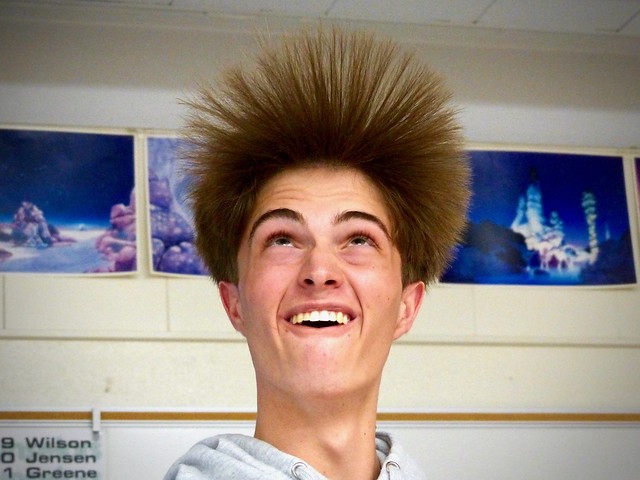
This year's Van de Graaff portrait gallery. Enjoy.


I'm migrating from Flickr to SmugMug. One apparently owns the other, but they continue to operate as separate entities.

Sunday, April 21, 2019

Van de Graaff is the Coiffeur 2019

It was another hair-raising experience when we charged up the Van de Graaff generator this year.

The conditions were often less than ideal. But we charged ahead with our old 1960s-era Cenco Van de Graaff. That old thing can produce a nice charge.

Hair are the results.

2019 Van de Graaff Album
2019 Van de Graaff Rio Phyz

Sunday, February 03, 2019

Torque-Master Challenge 2019

After completing the "Torque Feeler" / "It's All in the Wrist" Conceptual Physics Lab Manual activity, we add the Torque-Master Challenge.

We again repurpose our five-foot aluminum tube from the Pasco Scientific Lenz's Law Demonstration set. Sometimes we use it as a blow gun. Sometimes we use it for examples of resonance. This time, we tie an ordinary 500-mL water bottle to the end. Challengers must hold the arrangement level for ten seconds.

Over the years, I have found that very few of my students can do this. I can, and I am not young, cut, ripped, or chiseled. And I do not lift. I mean, look at me in the video. Honestly!

Torque-Master Challenge 2019


Why I can do this while so few of my students can is a mystery I have no answer to. Now that I think of it, though, very few of them can match my speed when we use this tube as a blow gun. I have no explanation.

When we find students cannot match my blow gun speed, I admonish all of them to quit smoking!

Friday, June 22, 2018

Rio Phyz 2018 media shoebox

There is no history unless you record it. I used to be much more active in getting candids in class of students conducting lab activities.

But I still like to get some from ExploratoRio. So I get students to snap up what they can during the event. I sifted and sorted, then cobbled together a slide show in the Mac OS Photos application. Set it to a bit of music, then uploaded it to YouTube. Turns out, you have to set the video to "private" when you use copyrighted music. So that's what I do. Here's the link.

Fascinated: The ExploratoRio 2018 Slide Show


I still break out the camera for Egg Toss and Van de Graaff generator activities. And class portraits on the day of the final exam, immediately following the issuance of the class's PhyzMaster certificates.

Here's the photo album.

Rio Phyz 2018 Photo Album
2018 00 Rio Phyz

Sunday, January 21, 2018

Kids these days

When I was a new teacher, I was wary of veteran teachers who complained about "kids these days". The gist was that students of a long ago yesteryear were capable of hunkering down and rising to the challenge of rigorous academic coursework, while today's students simply cannot hack it. I didn't see it. My students were rising to the challenges I set before them. What was the problem? I never wanted to age into that seemingly inevitable "get off my lawn" stage.

Back then, a veteran teacher was anyone with ten or more years in the profession. But it was those with more than twenty years in the classroom who were most likely to shake a "kids these days" fist.

I now have more than thirty years of classroom teaching under my belt. And I now see why it happens. The struggle is real. And I don't have a ready solution.

In my own recollection, my Physics students of 1996-97 figured it out better than those of any year I've taught. (I'm referring to my Physics students in this post, not my AP1, AP2, APB, or CP students.) 

In 1996-97, I was entering my second decade of teaching and had settled on some pedagogy and policies that seemed to work for me and my students. A large majority of students in 1996-97 (N=116) essentially agreed to my terms and prospered as a result.

In contrast, my Physics students in 2018 (N=60) have largely opted out of my conditions and suffered predictably. Here's a side-side comparison of the grade distributions.


There were four sections of Physics in 1996-97; there are two sections in 2017-18. (There was one section of AP Physics B in 1996-97; there is one section each of AP Physics 1, AP Physics 2, and Conceptual Physics in 2017-18. These classes are not included in this analysis.) Seventy percent of Physics students earned an A or B in 1997; only 57% did so in 2018.

Why the dramatic difference? In my analysis, it is engagement. Engagement is difficult to quantify for purposes of comparison. My best method for quantifying engagement in 1997 relates to random homework checks. 

By that metric and its built-in tolerances, 29% of Physics students were very engaged in 1997, 45% were somewhat engaged, and 26% were disengaged. 

Since 2014, we have had a Test Correction Journal (TCJ) process by which students can earn back up to half the points they missed on each unit test. "Sweat equity" is required: students spend class time writing "journal" entries for each test item they missed. Completed journals grant students access to a ten-question quiz. A 10/10 gets you half your missed points back; 7/10 gets you 70% of half the points you missed, etc..

So I can now use TCJ performance as a measure of engagement. We have five unit tests in the first semester. Students who participated in all five are rated as "very engaged". Students who participated in four of the five are "somewhat engaged". Students who missed more than two TCJs are "disengaged". 

By that metric and its built-in tolerances, 28% of Physics students were very engaged in 2018, 27% were somewhat engaged, and 45% were disengaged. 

Here is how the Physics grades break down (2014-2018) when classified by levels of engagement. (N=382)


That infographic might take a moment to absorb. The green columns are grades earned by highly engaged students: mostly As, fewer Bs, fewer Cs, two Ds and no Fs. The yellow columns are grades earned by somewhat engaged students: some As, more Bs, some Cs, a few Ds, and two Fs. The red columns are grades earned by disengaged students: one A, more Bs, many Cs, dozens of Ds, and all but two of the Fs.

Excel is happy to make pie charts as well. Here are the grade distributions by engagement level.

Eighty percent of very engaged students earned an A or a B.


Somewhat engaged students were somewhat distributed across letter grades.


Half of disengaged students earned a D or F. One out of 382 earned an A.


My own assessment is that students who engage in the course will get a good grade. There is more to engagement than Test Correction Journals. Homework engagement is crucial. But I have no way to measure that, whatsoever.

Still though, you will most likely earn an A or a B if you are at least engaged in the TCJ process. You will most likely get a C, D, or F if you're disengaged.

Some might argue that in addition to preparing and maintaining quality physics pedagogy and policies, I have an obligation to compel or otherwise force students to engage in the course. I cannot bring myself to agree. 

At some point, students must have the option to engage or not engage. In my own highly biased assessment, I consider my course to be highly engaging as it is. And I believe there is a valuable lesson to be learned about the consequences of choices that we make when approaching an academic course. Physics is a college prep course; many students will be sitting in college courses in less than a year. 

I want my students to succeed. In my class and beyond. I know that no one will chase them down in college to make sure they are duly engaged in their coursework. If they know how to engage on their own, they will be set to succeed to the limits of their abilities.

Full engagement is not a guarantee of an A. An A represents a level of mastery that is demonstrated in various assessment instruments. Engagement puts an A, B, or C in play while virtually precluding a D or an F. Disengagement, on the other hand, operationally precludes a student from earning an A.

Choices and consequences.

Am I at the "kids these days" stage? I don't think so. Engaged students are doing very well in the course. Top grades are well within reach of anyone willing to engage. And AP students (unsurprisingly) remain highly engaged. I am bothered by the increasing number of students who choose to be disengaged in Physics.

One last graphic to convey my disappointment. This is this year's 1st period Physics class's test scores. This was the most disengaged class I've ever had. In the test scores field, red indicates a TCJ that the student missed. Yellow indicates a test that was made up during the make-up period following the administration of the test (usually about 10 school days). Blue represents a test that was missed and not made up in the make-up period. It was made up at the end of the semester. Black is a second test that was missed and not made up in time. It goes down as a zero. The letter grades are shown in the leftmost column. Green shading for very engaged students, yellow for somewhat engaged students, and red for disengaged.


Kids these days? No. Shaking my head? Yes.

Tuesday, January 16, 2018

Egg Toss video because—why not?

The final batch of clips from Grass Omelette XVII at Rio Americano. A nice catch and two spectacular splashes! With no sun, we were able to line up with the geometry of the field. Seems we should have taken a bit of Sharpie to the eggs to increase their contrast with the sky.

Large impact time to reduce impact force


Impact force too large #1


Impact force too large #2


Previous Grass Omelette XVII coverage can be found here:
Splash and Catch: Grass Omelette XVII

More robust coverage of this activity can be found here:
Egg Toss 2013

Tuesday, December 26, 2017

Making engagement visual

At semester's end, it's possible to look back and see how student engagement in the course manifested itself into semester grades.

Students who perform well on tests and labs naturally percolate to the top. But those who don't excel in those objective measures have alternate routes to good grades in my courses.

During the semester, "extra credit" (credit toward the final: CTF) is awarded in dribs and drabs for various tasks and in-class competitions. Completing paperwork associated with the beginning of the school year and team performance in our egg-toss competition are typical first-semester sources. The credit is accumulated through the semester, but only becomes active as an addition to the final exam score. Some teachers add in extra credit as it comes in. That leads to disappointment when final exam scores are low. Adding it to final exam scores at the end of the semester leads to delight similar to finding money under the cushions of the sofa/couch/davenport.

More importantly in my Physics (PHY) and Conceptual Physics (CP) courses, students can earn back points lost on unit tests. The process is called Test Correction Journal. Students write "journal entries" for each item they missed on a unit test and reflect on why they were drawn to a wrong answer over the right answer. Later, a quiz is given consisting of questions from the original test. If they get 10 out 10 on the quiz, they earn back half the points they missed on the test. If they 9/10, they get 90% of half the points they missed, etc.. A 60 can turn into an 80 and 40 into a 70. A 90 can turn into a 95. The more help you need, the more help TCJs provide.

Neither CTF nor TCJs depend on rapid assimilation of course content. But they do depend largely on engagement. Sometimes students who miss many items on a unit test cannot finish the journaling process that we begin during class time. They need to come it at lunch or after school during an approximately two-week window to finish the journal. Only students with completed journals are allowed to take the quiz that will earn their missed test points back.

Students who disengage from TCJs create and expand a gap between themselves and those who are engaged. My engaged students earn only As and Bs. But Cs, Ds, and Fs are given every semester, as many students elect to disengage.

The listings below are actual student data. Each is a period, sorted by points earned. I used Excel's conditional formatting to color the cells in a spectrum from top-score green to bottom-score red, with yellow in between. The next column colors CTF points on a same basis (green good; red bad). Then (for PHY classes), it's the TCJ column with the same color scheme. The last column shows the final exam raw score out of 50. The top number in each column show the maximum value possible.


The pattern is fairly consistent, with anomalies here and there. Nothing to shatter the Earth here. I just wanted to see how well the seemingly nebulous "engagement" tracks to overall class performance. Teachers know this pattern is really the only one that's possible. Students don't always have an intuitive understanding of it. Some will see the evidence and reject it nonetheless.

Those students believe it's possible to get a top score with minimal engagement. It's mathematically possible. It just never happens. They may also fear that investing in full engagement will not be rewarded in a top score. Yet we don't find a red Points value followed by green CTF and TCJ columns. That's actually much less mathematically possible, given what TCJs do.

Monday, November 06, 2017

Catch and Splash: Grass Omelette XVII

After a few year's dalliance with Energy before Momentum, I have switched back to Momentum before Energy. Please don't flame!

One benefit to the return is that our annual egg toss competition, Grass Omelette, has returned to late October/early November. And that increases the likelihood of nice weather.

We conduct the event prior to any discussion on impulse so that we can refer to it during or after our lessons on F∆t = m∆v.

I shoot the catches at 120 fps so that I can pull half-decent still images of "splashes" to give to the individual students who were brave enough to don the plastic ponchos and kilts. I'm currently using a Panasonic Lumix DMC-FZ200. Maybe in the future, I'll shoot normal-speed 4K video to get better stills. At some point, consumer high-speed 4K will be available. I know the Sony RX10 iv can shoot 24 fps at full resolution (as well as 960 fps lower-res high-speed).

In any case...

Egg Toss 2017 Catches

Egg Toss 2017 Splashes

When I had 5 sections of Physics (no AP anything and no Conceptual Physics) in 2013, I had enough to produce an amusing compendium set to Vangelis' Chariots of Fire.

Egg Toss 2013

Saturday, October 31, 2015

An unexpected delight: Working with the Sacramento Speakers Series

I am more likely to get things I don't deserve than I am to be denied things I do deserve. So there I was on a Tuesday night, introducing physics media star, Dr. Michio Kaku to an audience of some 2000 at the Community Center Theater, where he was the second celebrity in this year's Sacramento Speakers Series.

I was given the honor of being the introducer via my connection to Rio's Civitas program chair, Linda Reed. She works with the Series' "Share the Vision" program, which affords local high school students a special pre-show audience with the speakers. They get their own question and answer session with the luminaries. Quite brilliant, really.

Michio Kaku is well-known in the physics community as a prolific author and frequent media science expert. He's carved out a niche in prognosticating the "science of the future". He's very comfortable in front of the camera, and speaks with confidence and authority on the scientific topic of the day. This distinguishes him from most physicists, and it makes him a reliable media darling for journalists.

Kaku's presentations on how things will be in the future are captivating. I confess to not being well-versed in Kaku's expansive oeuvre. I even floated the notion of introducing Kaku to my physics- and skepticism-rich friendosphere on the off chance that Kaku advocated some weirdness that would set him outside the scientific mainstream. I didn't want to be heaping praise on anyone with a "Dr. Oz problem". No objections were raised, so heap praise I did. (The script of my introduction is in the comments.)


Everyone associated with the Sacramento Speakers Series was first-class and professional. They took very good care of me, and it was very groovy to hang out with the principal organizers, manager, Dr. Kaku, and ABC10's Cristina Mendonsa backstage in the green room. She's as personable as she is polished, and did a great job interviewing Kaku and managing the audience question cards. I made a point to personally thank Mitch Ostwald and each of the organizers who worked with me to facilitate my wee role in the evening. They are doing great work and adding to the cosmopolitan nature of Sacramento. [Photos courtesy of The Sacramento Speakers Series]

Saturday, May 31, 2014

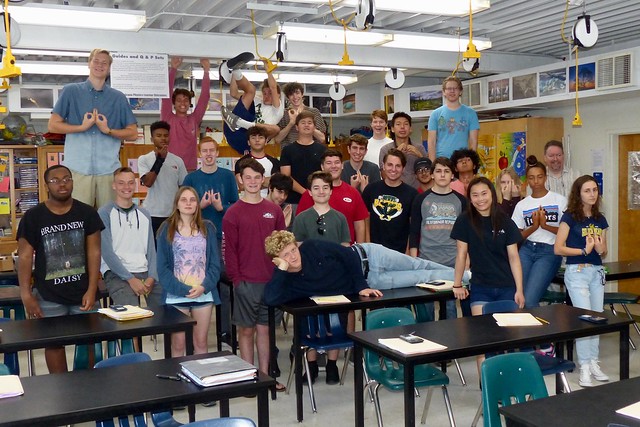
Rio Phyz 2014: Class Portraits

Some with flash; some without. Some with teacher; some without. Some straight; some goofball. The whole set can be accessed via this Flickr Set:

2014 05 Rio Phyz Class Portraits

UPDATE: As per usual, Flickr sent the original album into the æther somehow. I re-uploaded the whole thing. I can't imagine relying on Flickr as a backup of any sort. Photo links often degrade faster than a fine pastry, and albums once loaded can easily disappear for no apparent reason.

Friday, May 16, 2014

Hewitt Fest 2014 at Rio Americano

Conceptual Physics author, Paul Hewitt, was in Sacramento for a day so he could attend Pasco's 50th anniversary. (I was fortunate enough to be able to attend the event, which was great fun in celebration of an excellent company with solid corporate values.)

Hewitt, along with his delightful wife Lillian and ever-clever Evan Jones, was kind enough to drop in on my Physics classes today. He regaled the students with tales of the inverse square law, sunballs, college matriculation, and his path to physics.

After the lessons, the lunch time bell rang and my room became Groupie Shot City (or Selfie Central). My post to Facebook was, "An 82 year old textbook author visited my school today. The students mobbed him like he was a rock star."

Here are some images to prove it.

2014 05 Hewitt Fest at Rio Americano

Some readers might recall that Hewitt paid Rio Americano a visit on the last day of school, June, 2011.

Wednesday, April 16, 2014

AP Physics at Rio update

We didn't have AP Physics B this past year. Enrollment sign-ups were insufficient for the school to run the course.

Recently-revealed evidence suggests that the dearth of sign-ups might have been related to the grading practices followed by colleagues who teach AP Biology, AP Chemistry, and AP Environmental Science. The case was laid out in a previous post.

Students have now signed up for their Fall classes. I have been informed that there is sufficient enrollment for the school to run both new AP Physics courses: AP Physics1 and AP Physics 2, in addition to three sections of Physics.

It's the "nightmare" I hoped for: three different courses to prepare ("three preps" as we say in the faculty lounge). AP Physics 1 and AP Physics 2 are brand-new, never-been-taught courses, so it'll be like seating thread-forming screws. To make matters worse, I intend to redesign our Physics course, aligning it more closely to Next Generation Science Standards and to our adopted textbook.

Here's some information on the new AP Physics 1 and AP Physics 2 courses being launched in 2014-15.

Friday, April 11, 2014

ExploratoRio 2014 Night

Here is the conclusion of this year's ExploratoRio time lapse series. We see the 90-minute exhibition and the 60-minute striking of the set. In the end, the classroom has returned to its original state and is ready to go for the next day.

ExploratoRio 2014 Night

Wednesday, April 09, 2014

ExploratoRio 2014 Daytime

To be a bit different in this year's time lapse, I toured the camera around the room before setting it back on its perch. I also took it outside and into the dark room. A white balance (set to the fluorescent light of the classroom) penalty was exacted.

Earlier, I relearned the lesson that my wide-angle lens is, in fact, a manual focus lens. And easily jarred when the camera is moved, the battery is changed, and the memory card tinkered with. Life goes on.

Here's today's clip. ExploratoRio 2014 had been going for three hours by the time this clip began rolling. So we see things through to the end of the daytime portion.

We had 12 elementary classes come to visit, so that's about 12 x 30 = 360 little ExploratoRions. I hope to see them again as students a few years from now.

ExploratoRio 2014 Daytime

Tuesday, April 08, 2014

ExploratoRio 2014 room prep and exhibit setup

From 3pm to 5pm, we ready the room. From 5pm to 6pm, the exhibits come in. Here's what it looks like, shot at 1 fps, displayed at 30 fps.

ExploratoRio 2014 Room Prep and Exhibit Setup

Saturday, March 08, 2014

ExploratoRio season is in full bloom

Gratuitous time lapse of this year's exhibit adoption. Special thanks to Britknee for being such an excellent bouncer/door guard.

2014 ExploratoRio Exhibit Adoption


The "season" runs from the close of Presidents' ("Ski") Week until ExploratoRio (Open House). Exhibitors bring their exhibits in to show me that they work. Or I show them how to use school equipment to set up their exhibit (so they'll be able to do it on their own on ExploratoRio Eve). We discuss the operation, logistics, physics, perception.

I schedule one or two exhibits after school each day during the season, with the exception of Thursdays and other known blackout days. (Thursdays are out due to district-mandated "collaboration".) The one-on-one time with each set of exhibitors pays dividends on ExploratoRio Eve and Day in terms of operational smoothness and crisis avoidance.

Support staff positions are filling up nicely. Elementary class hosts are bringing in teacher contact information, and I've laid out a visitation schedule. We have three time slots yet unclaimed (two them being 11:30am-12-30pm). There are times when the space we have gets a bit crowded. We want to get as many elementary class students as we can to come in for a visit, but we have school for only a minimum day, so there is a hard time limit. One solution, I suppose, would be moving ExploratoRio off of Open House. But the original vision of ExploratoRio was for it to be the Open House activity.