Saturday, February 09, 2019


Wednesday, February 06, 2019
Which way is north? Not so fast...
It isn't where we left it.
Over the course of geologic time, magnetic north wanders like the oft-maligned "drunken sailor". And it reverses polarity on a not-entirely-stochastic basis. It seems the pole is on the move again—with faster than normal speed—and models will need to be updated to keep pace.
As Magnetic North Pole Zooms Toward Siberia, Scientists Update World Magnetic Model
The North Magnetic Pole Is Shifting East, Fast
Even in the era of GPS, Earth's magnetic field is still an important component in terrestrial navigation.
Over the course of geologic time, magnetic north wanders like the oft-maligned "drunken sailor". And it reverses polarity on a not-entirely-stochastic basis. It seems the pole is on the move again—with faster than normal speed—and models will need to be updated to keep pace.
As Magnetic North Pole Zooms Toward Siberia, Scientists Update World Magnetic Model
The North Magnetic Pole Is Shifting East, Fast
Even in the era of GPS, Earth's magnetic field is still an important component in terrestrial navigation.
Sunday, February 03, 2019
Torque-Master Challenge 2019
After completing the "Torque Feeler" / "It's All in the Wrist" Conceptual Physics Lab Manual activity, we add the Torque-Master Challenge.
We again repurpose our five-foot aluminum tube from the Pasco Scientific Lenz's Law Demonstration set. Sometimes we use it as a blow gun. Sometimes we use it for examples of resonance. This time, we tie an ordinary 500-mL water bottle to the end. Challengers must hold the arrangement level for ten seconds.
Over the years, I have found that very few of my students can do this. I can, and I am not young, cut, ripped, or chiseled. And I do not lift. I mean, look at me in the video. Honestly!
Torque-Master Challenge 2019
Why I can do this while so few of my students can is a mystery I have no answer to. Now that I think of it, though, very few of them can match my speed when we use this tube as a blow gun. I have no explanation.
When we find students cannot match my blow gun speed, I admonish all of them to quit smoking!
We again repurpose our five-foot aluminum tube from the Pasco Scientific Lenz's Law Demonstration set. Sometimes we use it as a blow gun. Sometimes we use it for examples of resonance. This time, we tie an ordinary 500-mL water bottle to the end. Challengers must hold the arrangement level for ten seconds.
Over the years, I have found that very few of my students can do this. I can, and I am not young, cut, ripped, or chiseled. And I do not lift. I mean, look at me in the video. Honestly!
Torque-Master Challenge 2019
Why I can do this while so few of my students can is a mystery I have no answer to. Now that I think of it, though, very few of them can match my speed when we use this tube as a blow gun. I have no explanation.
When we find students cannot match my blow gun speed, I admonish all of them to quit smoking!
Sunday, January 27, 2019
Torsional pendulum
This was another one of those things I wrote on my "To Do" list and figured I should complete before it had been on there a year.
On the day my AP Physics C students learn about torsional (twisting) pendulums I had written myself a note that while they "got it" they were having problems visualizing it. I didn't know how to construct one so I started an internet search and found a lot of problems about them but not a lot of demos. I found one video that looked promising and took a still to help guide my trip to the hardware store. The description called it a chuck nut which didn't seem quite right. After asking for help on Twitter I got a response:

He was nice enough to offer some advice and a link to the part he used. Once I knew what the part was actually called it was much easier to find them. When looking for the right pinch vise I looked for ones sold individually (most are in sets) and checked the range that it could hold. Many can securely hold amazingly small pieces so you have to also check out the max that they can hold. I settled on these, fairly cheap and should be versatile.


I showed students the golfball oscillating with the fishing line, nichrome and steel wire in class. A video of each is below. We did not calculate anything (the wires were really bent) but it worked as a qualitative experiment.
Afterwards I tried making some more with different masses, a small brass mass and a large rubber stopper. The tricky part is attaching the steel cable so that it doesn't twist within the object. I added hot glue to the brass mass but its not as secure as I would like. I added a black line in sharpie to the mass so the oscillation was easier to see. For the rubber stopper I was able to stab the cable through the stopper, although drilling a hole may have been more precise. I added a white pushpin to the side so that we could see the oscillation better. For these last two versions I only needed one pinch vise at the top to hold the cable.
All in all I really liked the way it turned out and it helped students to visualize what was happening with their problems. It can always be improved but at least I have another year until I need it again.
Friday, January 25, 2019
Spring demo set-up
I joke with my classes that the last class of the day gets the best version of me. At least today it only took one period for me to get this worked out.
My AP Physics C are studying simple harmonic motion and the most common type is a block attached to a spring on a horizontal friction less surface. Surprisingly our book does not touch upon springs in series and parallel. Students did a quick activity using PhET's Hooke's Law simulation the other day, leading them to the equations to find the equivalent spring constant if series and parallel pendulums. We ran out of time that day to show it to them live so I set it up for the next day.
I had two identical springs of spring constant 20 N/m +10% that I hung from a horizontal support attached to two large ring stands. I used a pegboard hook to link the two springs when working in parallel which made it easier to hang one mass from it. For the first class of the day I hung a 500 gram mass from a single spring, then the two springs in series and then in parallel so the class could see the difference. The series elongation was very easy to see the difference but the parallel elongation was harder for those in the back. So I added to it between classes.
I used bright post-its and labeled the natural length of one spring, where it stretched to in parallel and in series. I taped a measuring tape in line with the top of the spring so if I wanted to, I could do calculations. It made for a much better visual for the students.

After the fact I realized I wanted to add a marker for the natural length for the two in series since the new length is much larger than twice the stretch of the single spring because of the additional length of the second spring. If I had enough springs of the same spring constant I would want to have all three setups up at the same time. Add that one to the wishlist I guess.
Tuesday, January 22, 2019
The Electricity Playlist of Phyz
Wow. Electricity seems to be very well represented in the world of popular music.
My Blog of Phyz colleague, Dan Burns, has apparently been making music playlists for years. So I'm giving it a go, too. Seems like great fun. With today's seemingly limitless access to music and the magic of search engines, prospects are good that a number of tracks can be identified for any particular topic. The trick is to steer clear of "E" (explicit lyrics songs).
Playlists can be set to shuffle during lab activities in class, if you're inclined to do such. I put out a call on Twitter, and my initial list of 30 sounds more than doubled. Crowd-sourcing!
My Physics classes just worked through a couple of electrostatics labs and several circuits labs are coming up. I fear the music well may run dry when it comes time to assemble a magnetism playlist.
Here is the electricity playlist (as of today):
My Blog of Phyz colleague, Dan Burns, has apparently been making music playlists for years. So I'm giving it a go, too. Seems like great fun. With today's seemingly limitless access to music and the magic of search engines, prospects are good that a number of tracks can be identified for any particular topic. The trick is to steer clear of "E" (explicit lyrics songs).
Playlists can be set to shuffle during lab activities in class, if you're inclined to do such. I put out a call on Twitter, and my initial list of 30 sounds more than doubled. Crowd-sourcing!
My Physics classes just worked through a couple of electrostatics labs and several circuits labs are coming up. I fear the music well may run dry when it comes time to assemble a magnetism playlist.
Here is the electricity playlist (as of today):
| The Electricity Playlist of Phyz | ||
| SONG | ||
If I missed a gem, let me know in the comments.
Sunday, January 20, 2019
Physics Problems Get Tested by Drones
A drone is hovering in an elevator. The elevator goes down. What would happen to the drone? Alternatively, the elevator goes up. What happens to the drone now?
Make your prediction and then watch this video.
Of course, this is a sequel to what happens in a car.
Or the even more famous, problem about truck carrying pigeons on a bridge.
I love when famous physics problems get tested in the real world.
Thursday, January 17, 2019
That's not a pendulum... THIS is a pendulum
As another physics teacher responded after seeing this pendulum:
The original tweet provided a link to this paper describing the motion of the censer: "O Botafumeiro: Parametric pumping in the Middle Ages." While the math is above even my AP Physics C course there are several recognizable parts. I'm debating showing it to my students just to see if they say, "Oh! I recognize that equation!" I worked out a simple energy practice problem about the censer, making some assumptions for simplifications purposes:
 The speed at the bottom of the censer's swing is reported to be 68 km/hr in the paper so that is really close!
I plan on showing the clip to my students in our oscillations unit, although we cannot use it for some sample calculations given it is not a small angle. There were a few suggestions about how to use Pythons and other models but I think I'll have to try that another year.
I had retweeted this short video of an epic censer, Botafumeiro, at the Santiago de Compostela:Just when I think I have great pendulum set ups in my classroom for either my Physics AP-C or Physics 1 kids and feel good about myself as a Physics teacher, someone “one-ups” me and creates this! 😂 And subtly puts me in my place... 😂😂😂— Terry Lambert 🇺🇸 (@CoachTLambVB) January 13, 2019
The video is amazing. There are several on You Tube as well as it is apparently a common stop on religious pilgrimages. The censer, a large metal incense burner, is swung as part of the religious mass. It is over a 1.5 m tall and over 50 kg! The swinging starts off with a push but is increased using a coordinated pumping system by several people holding the other end of the rope. It is similar to pumping your legs while swinging on a swing. Several of the YouTube videos offer glimpses of the people pumping off to the side. Amazingly the censer reaches an angle of 82 degrees with the vertical, almost horizontal and getting close to hitting the ceiling of the cathedral!"O Botafumeiro" is a 120kg censer that reaches speeds of 70km/h at a height of 25m in the transept of the cathedral of Santiago de Compostela. Its motion is due to cyclic pumping by men who pull at the supporting rope. This is the physics behind it https://t.co/xXybkSC2K6 pic.twitter.com/itY4qdfBNN— Massimo (@Rainmaker1973) January 12, 2019
The original tweet provided a link to this paper describing the motion of the censer: "O Botafumeiro: Parametric pumping in the Middle Ages." While the math is above even my AP Physics C course there are several recognizable parts. I'm debating showing it to my students just to see if they say, "Oh! I recognize that equation!" I worked out a simple energy practice problem about the censer, making some assumptions for simplifications purposes:

I plan on showing the clip to my students in our oscillations unit, although we cannot use it for some sample calculations given it is not a small angle. There were a few suggestions about how to use Pythons and other models but I think I'll have to try that another year.
Saturday, January 12, 2019
Want to be ferocious in college? Take physics in high school!
I have been running poster-based ad campaigns to promote physics enrollment since the 1990s. (I tried personalized, direct mail prior to that, but that was troublesome and expensive.)
Previous campaigns were documented in previous blog posts: 2016 and 2012.
But after 30+ years of teaching, some things lose their novelty. Homecoming rallies. Actually, any rally. I could go on, but I digress.
I wanted to use a different campaign for Fall 2019 sign-up season. And that season is coming up soon.
Each of us has our own school community, culture, and instructional styles to work around when designing ads. I did my best to take these into account for this newly-minted campaign.
As with the previous campaigns there is a theme and variations on that theme. Some employ my own photographs. Others use found images, some more classic than others.
These may or may not work for me. Advertising is a fickle alchemy at best. You are certainly welcome to use them if you think they may work for you.
Click to embiggen.



Previous campaigns were documented in previous blog posts: 2016 and 2012.
But after 30+ years of teaching, some things lose their novelty. Homecoming rallies. Actually, any rally. I could go on, but I digress.
I wanted to use a different campaign for Fall 2019 sign-up season. And that season is coming up soon.
Each of us has our own school community, culture, and instructional styles to work around when designing ads. I did my best to take these into account for this newly-minted campaign.
As with the previous campaigns there is a theme and variations on that theme. Some employ my own photographs. Others use found images, some more classic than others.
These may or may not work for me. Advertising is a fickle alchemy at best. You are certainly welcome to use them if you think they may work for you.
Click to embiggen.


Saturday, January 05, 2019
Rotation Props
"Mrs. B, did you make all this?"
In my AP Physics C class we finished our rotation and angular quantities unit before the break. Somehow that means I had a lot of props out. My front counter and support table were filled with spinning things, mostly on the large side because I have 35 kids in one class and they aren't close to the front. Many I've made or assembled myself, and since they were fairly simple to do I thought I would share.
I put one of my bike wheels on a tall ring stand so that I could put it on a lab bench and make it tall enough for everyone to see. Mounting one securely to the ring stand was tricky and only one of my four loose bike wheels did so securely. Unfortunately that was the heavy wheel meant for demonstrating angular momentum so it stops quickly. In the future I'm sure I can rig something up for one of my lighter wheels that would rotate for longer when I have more time.
I wanted students to get a better sense of the angle it was moving through and wanted to mark a radial line on the wheel. At first I thought of a strip of masking or painter's tape but I ended up with a neon straw. I had a jumbo neon straw pack and split them up the length so I could put it on the spoke. It ends up being pretty easy to see so I like the effect. I did the same to a loose bike wheel I was holding and spinning during the lecture.
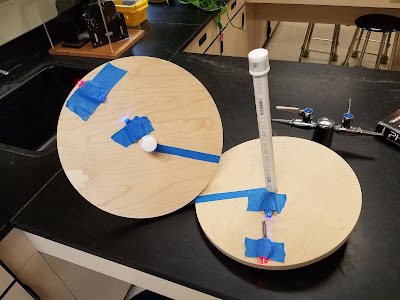 In a previous post I shared how I made these wood and PVC tops. I got these perfectly circular hunks of wood from RAFT and made model tops for students to use for explanations. They could also hold blinkie lights or accelerometers on them. For our first lecture on rotation I added a radial line in painter's tape and two blinkie lights, one top had them on the bottom for facing students and the other on top for being viewed from above.
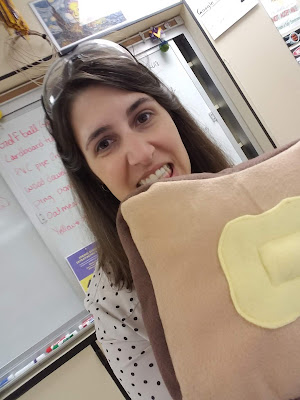 One of the problems students have that week involved a piece of buttered toast falling off a table and rotating. I noticed that when I tried to do the problem the first time I was trying to visualize it by rotating my hands the same way and thought, "This would be so much easier with a piece of bread." So I made an enlarged piece of bread, like a pillow, to model this problem with my students. They get a good laugh out of it but more importantly a lot of them that didn't understand before seem to understand.
Last year I wrote "make giant egg to show non-level translation" on my ever growing "To Do" list. Now the year has come full circle (*ba dum ching*) so I figured I should make it. We recently redid a bathroom and I had a large white oval of 3/4" plywood laying around. I used out bandsaw to cut it roughly into an egg shape and drilled a hole through the center of it. I had another large circle from RAFT that I sanded down and put a hole through its center too. I inserted a dowel into each so that I can hold it from the back and roll it across my front table. For the circle the wheel as it rolls (rotates and translates) the center of the circle remains the same height off the table. When the egg shape rolls the center of the egg raises and lowers relative to the table. If I was able to shove the objects like a wheel and seem them roll by themselves for a while you would see the egg roll at different speeds depending on what portion was in contact with the floor. The whole point of this one is to illustrate our simplification of problems by using spheres or cylinders or disks that have circular cross sections.
I made this inertia demonstrator last year, it kind of looks like a tape dispenser. Students can pass it around and try to rotate it around the three different axis so they can feel the difference in inertia. I use it to describe how we determine inertia for an object and then also to demonstrate the Parallel Axis Theorem.

I saw a gif on Twitter last year showing a Hoberman Sphere used as a conservation angular momentum demonstration. I bought the sphere too late to try it last year but was excited to hook it up this year. There are holes within the plastic joint pieces that you can thread string or in my case fishing line through. You begin with the sphere fully expanded and spinning slowly. As you pull on the string to force it to contract the angular speed increases. I had a colleague help me get this video:
Between all of those and some fifty some odd objects being rolled down boards for our Rotational Derby Lab, it was a very crowded classroom!
In my AP Physics C class we finished our rotation and angular quantities unit before the break. Somehow that means I had a lot of props out. My front counter and support table were filled with spinning things, mostly on the large side because I have 35 kids in one class and they aren't close to the front. Many I've made or assembled myself, and since they were fairly simple to do I thought I would share.
I put one of my bike wheels on a tall ring stand so that I could put it on a lab bench and make it tall enough for everyone to see. Mounting one securely to the ring stand was tricky and only one of my four loose bike wheels did so securely. Unfortunately that was the heavy wheel meant for demonstrating angular momentum so it stops quickly. In the future I'm sure I can rig something up for one of my lighter wheels that would rotate for longer when I have more time.
I wanted students to get a better sense of the angle it was moving through and wanted to mark a radial line on the wheel. At first I thought of a strip of masking or painter's tape but I ended up with a neon straw. I had a jumbo neon straw pack and split them up the length so I could put it on the spoke. It ends up being pretty easy to see so I like the effect. I did the same to a loose bike wheel I was holding and spinning during the lecture.
 In a previous post I shared how I made these wood and PVC tops. I got these perfectly circular hunks of wood from RAFT and made model tops for students to use for explanations. They could also hold blinkie lights or accelerometers on them. For our first lecture on rotation I added a radial line in painter's tape and two blinkie lights, one top had them on the bottom for facing students and the other on top for being viewed from above.
 One of the problems students have that week involved a piece of buttered toast falling off a table and rotating. I noticed that when I tried to do the problem the first time I was trying to visualize it by rotating my hands the same way and thought, "This would be so much easier with a piece of bread." So I made an enlarged piece of bread, like a pillow, to model this problem with my students. They get a good laugh out of it but more importantly a lot of them that didn't understand before seem to understand.
Last year I wrote "make giant egg to show non-level translation" on my ever growing "To Do" list. Now the year has come full circle (*ba dum ching*) so I figured I should make it. We recently redid a bathroom and I had a large white oval of 3/4" plywood laying around. I used out bandsaw to cut it roughly into an egg shape and drilled a hole through the center of it. I had another large circle from RAFT that I sanded down and put a hole through its center too. I inserted a dowel into each so that I can hold it from the back and roll it across my front table. For the circle the wheel as it rolls (rotates and translates) the center of the circle remains the same height off the table. When the egg shape rolls the center of the egg raises and lowers relative to the table. If I was able to shove the objects like a wheel and seem them roll by themselves for a while you would see the egg roll at different speeds depending on what portion was in contact with the floor. The whole point of this one is to illustrate our simplification of problems by using spheres or cylinders or disks that have circular cross sections.
I made this inertia demonstrator last year, it kind of looks like a tape dispenser. Students can pass it around and try to rotate it around the three different axis so they can feel the difference in inertia. I use it to describe how we determine inertia for an object and then also to demonstrate the Parallel Axis Theorem.

I saw a gif on Twitter last year showing a Hoberman Sphere used as a conservation angular momentum demonstration. I bought the sphere too late to try it last year but was excited to hook it up this year. There are holes within the plastic joint pieces that you can thread string or in my case fishing line through. You begin with the sphere fully expanded and spinning slowly. As you pull on the string to force it to contract the angular speed increases. I had a colleague help me get this video:
Between all of those and some fifty some odd objects being rolled down boards for our Rotational Derby Lab, it was a very crowded classroom!
Subscribe to:
Posts (Atom)