Tuesday, May 16, 2017

Lecture replacement fail & success

As part of our NGSSification this year I've tried to put more demonstrations into the hands of students. Before the beginning of each unit I will look at the lectures of previous years and the list of demos I plan to do. If at all possible, I will make miniature versions of the demos that students can do in lab groups. These miniature versions don't usually take long but engage the students. We can then follow up with a few brief notes that explain what they have seen.

At the beginning of our light unit I wanted students to explore the relationship between wavelength and frequency in the electromagnetic spectrum. I made a chart of eight electromagnetic waves, places they are seen or used, a wavelength and frequency (pdf or google doc). I printed the information onto address labels (pdf) and put them on blank cards from RAFT. I passed out a card to each student and asked them to find the three other students that have cards about the same electromagnetic wave. Students were to find their group and then share their information so that they got the "whole picture" for that particular type of electromagnetic wave. I asked students to look at an image of the electromagnetic spectrum on my projector and a different one in their textbook. I thought that between the two images and four students they would be able to match the name to the example to the wavelength to the frequency. I was wrong. Quickly it became apparent they didn't see the connections I did.

Students were looking for the exact frequency on their card to be listed on either the image in their textbook or on the projector screen. Instead images of the electromagnetic spectrum show a range of frequencies for different types of waves. It is very common for sources to have different frequency ranges for the same wave type. This lead to lots of confusion and meant I had to go from one group to another to make sure that each student was sorted correctly.

In the future, I'll only show them one image, the one below. I added red dots representing each frequency and wavelength combination that I had put on the cards. I'll tell students that if they use the wavelength equation they will find someone with a card with the exact frequency they calculated. It was also not obvious to students that they needed to use this equation. I'm hoping this illustrates to students that their specific wavelength is part of a range of wavelengths for that type of wave.
After students were properly sorted I asked them to write the information about their wave onto a whiteboard to share. The whiteboards were held up and shared with the whole class. I helped students organize the information in a more familiar electromagnetic spectrum. To make sure they got the correct information it became more "Write down what I'm saying," and less "Write down what was written down by your peers." By the end of it I feel like they understood the relationship between frequency and wavelength but it was not the clearest way for them to get the information. I don't know if I will continue this activity the same way again.

The second day I wrote an activity I called Light Phenomenon Lab (google doc or pdf with more teacher information) made of eight different demos I used to show as part of a lecture. Each group was given brief instructions about how to create the phenomenon to observe and given some time to play. There were great exclaims of "Oh cool!" and disbelief as students explored and shared their phenomenon from group to group. Some groups were asked to read a page or two out of their textbook that explained the higher level concepts.

Each group was instructed to make a whiteboard with the title of their phenomenon, what they observed, how it worked, etc. Each group had been asked a question that required them to apply what they had seen to a new situation. This question was to be answered on their whiteboard as well. Below are examples from my three classes:

Each student copied down the phenomenon name and the answer to the question posed after each group shared their board. This was much more successful than the previous day. Students took ownership of being the "experts" on their phenomenon and enjoyed wow-ing the rest of the class by showing it off. It lead to more questions, "playing" with the equipment to find out what they could discover. I was able to create a make-up lab (pdf or google doc) for students using YouTube videos of similar phenomenon.

On both days, students were hands-on with something or moving around. We still discussed a few things and I asked them to record some things in their notebook. One I would consider a #fail (or in need of some tweaking) but the phenomenon day I would definitely consider a success. Students still got the important elements of the "lecture" but it was much more engaging.

Soon I'll post more about NGSS Phenomenons ... after Finals Week.

Sunday, May 07, 2017

The Mechanical Universe Is Back

As we noted last year, the Annenberg/CPB college television course series, The Mechanical Universe, had to be removed from Annenberg's video on demand website. At the time, it seemed the series was being banished to oblivion for fear of the expiration of media rights to included (non-original) video [I'm guessing the Kepler-related footage].

In any case, it seems that CalTech has posted the series to YouTube. Start at the link below.

The Mechanical Universe on YouTube

That's good news for those of us who continue to find the series to be a rich instructional resource. Especially those who like to flip a good video lesson from time to time.

Here's CalTech's announcement on the matter.

Pioneering Physics Show The Mechanical Universe Now on YouTube

Monday, May 01, 2017

Chaldni Color

While finding links for the Chladni singing post I found this video as well. 


The description is: "Musician Kenichi Kanazawa creating sand art via vibrations on his special table. The coloured sand takes shape as the vibration frequencies fluctuate." Essentially Kanazawa has made a large Chladni plate that he is resonating. By using different color sand he gets some beautiful images. Using mallets  of different sizes (perhaps different materials?) Kanazawa rubs the mallet along one edge of the table. You can hear the tone produced each time carry until he touches the table again. At some points the video cuts and you can see different shapes in the sand. I don't know if the cleared areas are in fact antinodes or if the sand was manipulated during the film cut. I was not able to find much on this artist so we may never know!

Sunday, April 30, 2017

March for Science: Dean's Day in DC

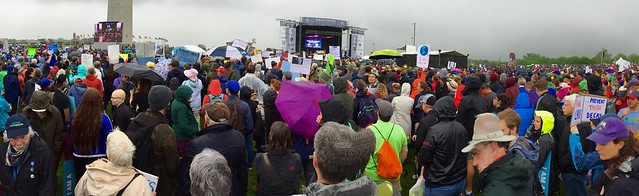
2017 04 March For Science[Click any image to embiggen.] The forecast for the day called for rain, and left little room for doubt. I packed a rain jacket and rain pants (in the event of sideways-driven torrents). I packed an umbrella in case the rain remained vertical. I also covered exposed skin with sunscreen and packed a floppy hat in case the forecast was defied by reality. I wore heavy-weather shoes and thick wool socks. I packed a fleece as the forecast high was in the upper 50s. I knew I was going to be in the elements for the day. I wasn't go to bail no matter what. And I didn't want to be too uncomfortable.
2017 04 March For Science
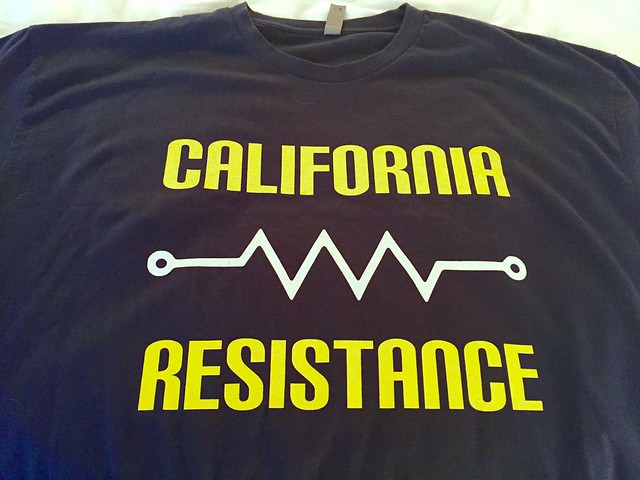
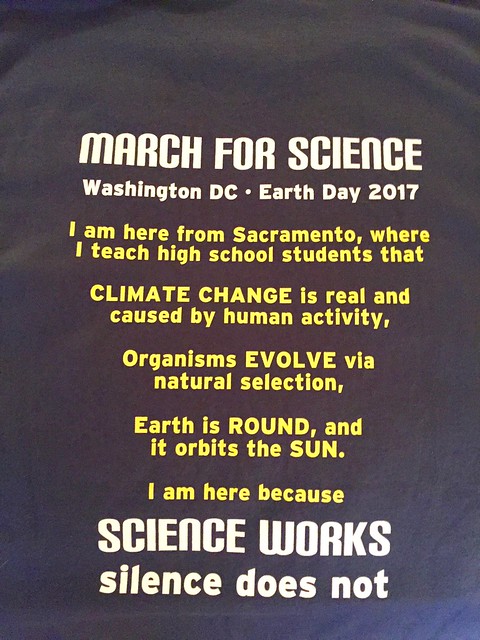
But in the morning, the weather was still fairly mellow, so I was able to expose my custom T-shirt.

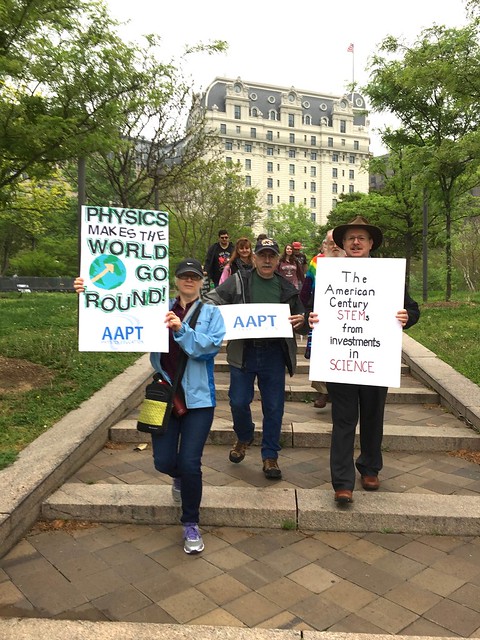
I walked the mile and a half from my hotel to Pershing Park, where I was told representatives of the AAPT would be found. DC bustles on weekdays, but can be a ghost town early on a Saturday morning. I grabbed some breakfast at a bakery/cafe that was doing a brisk business with science marchers.

I found some familiar faces (Dan Brown and Rebecca Vierra) at Pershing Park; AAPT Director, Beth Cunningham quickly joined, as did some Society of Physics Students (SPS) enthusiasts. A retired chemistry instructor showed up in his rainbow tie-dyed lab coat, so I hauled mine out of my pack and matched his look. We socialized and snapped pics for a while before making our way to the rally at the Washington Monument.

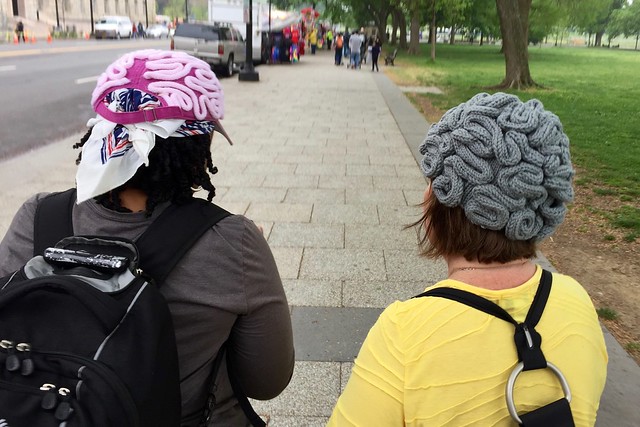
2017 04 March For ScienceWe knew we were headed in the right direction as we followed these two brainiacs.

2017 04 March For Science
We settled in some distance from the main stage, but with a nice view of a massive screen (atop a truck).

At 10 o'clock, the program began. Veritasium's Derek Muller, Cara Santa Maria, and The Roots' Questlove acted as masters of ceremony. A precipitous mist turned into sprinkles as the program continued. The rainbow lab coat was stowed, and my rain jacket was deployed.

Speakers, music performances, and short films ensued. The rain picked up. It continued in waves. When it got heavy enough, my maize & blue Michigan umbrella was raised. Umbrellas were ubiquitous throughout the crowd. But you feel bad when packed this tight while using one. It blocks views and sheds water on your neighbors.

2017 04 March For Science


Four hours of rallying would have to pass before the march was to proceed. Scientists were celebrated, a call and response of "I say 'public' you say 'health'" was launched.

The rain never really stopped. When the wind reached a certain persistence, I undertook a pit-crew donning of my fleece between my t-shirt and the rain jacket. Had it not been such a tight pack where I was, I would have tried to put on my rain pants over the quick-drying trail pants I was wearing.

Near the end, we got a call to action from Bill Nye, himself.


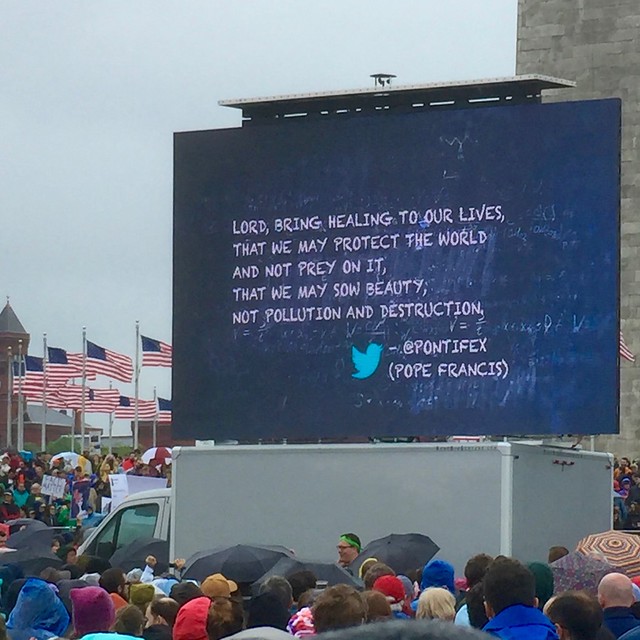
And an Earth Day tweet from... not Donald J. Trump, but from Pope Francis.

2017 04 March For Science
Then it was off to the march. We slowly cattle-herded our way out of the secured Washington Monument grounds to Constitution Avenue and marched to the US Capitol.

From time to time, an enthusiastic roar would make its way through the marchers. And there were chants.

"Show me what a scientist looks like : THIS IS WHAT A SCIENTIST LOOKS LIKE!"

"Science--not hate--makes America great!"


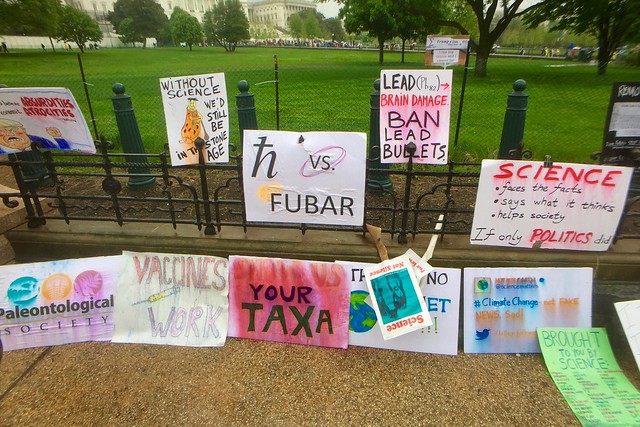
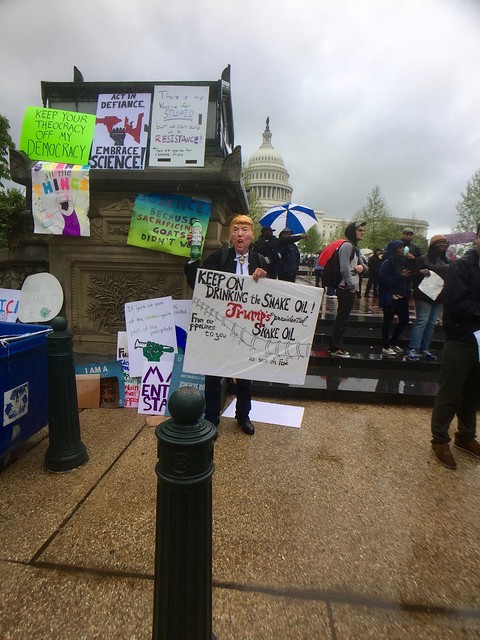
2017 04 March For ScienceThe sprit was great and the energy was positive. The signs were very clever and were all spelled correctly. Hbar vs. FUBAR, Show us your taxa!"

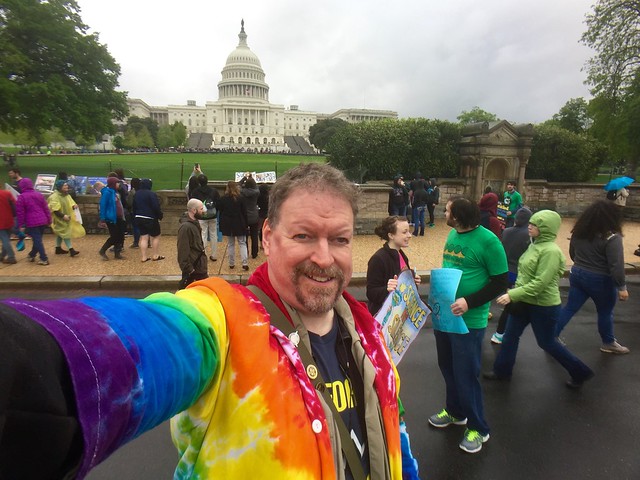
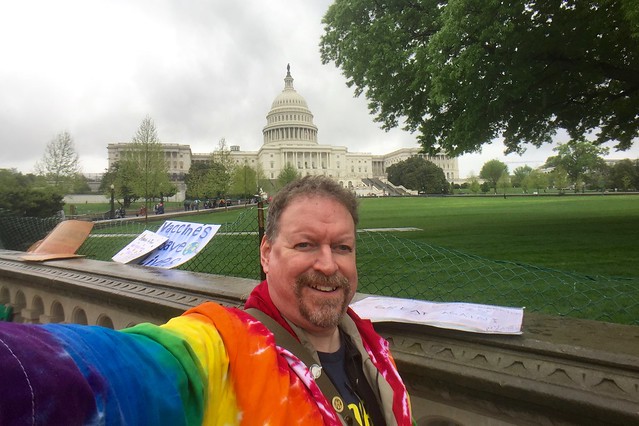
I stopped for a requisite US Capitol selfie.

2017 04 March For ScienceAt march's end, marchers laid down their signs along the walkway and fence leading to the Capitol: the impromptu sign graveyard blossomed and grew as more and more marchers finish the route. The rain had taken a toll on most of the signs, and the wind added entropy to the otherwise carefully placed placards.


Snake Oil Trump will haunt my dreams for nights to come.

2017 04 March For Science
At the end of the day, there was no way to navigate around the reality that science is under attack in the US from the Republicans who hold the presidency and majorities in the Senate and House of Representatives. It is likely that they will do significant damage to science and the environment as rapidly as they can. It is unlikely that they will change. We cannot nourish a hope that the attack will relent while the GOP maintains unbridled governmental power.

If scientist hope to get work done in the lab, they will need to get work done at the ballot box first.

I'm glad I was able to be in DC for the March on Science. I have more photos in my Flickr album and more videos on my YouTube channel.

March for Science Photos:
2017 04 March for Science

Monday, April 24, 2017

March for Science: Dean's Whys and Wherefores

When murmurs of The March for Science began circulating, I raised my antennae. When the date was announced, I booked a hotel room in DC and burned a bushel of frequent flyer miles to reserve round trip flights on Southwest.

I harbored a strongly-held personal opinion that I needed to be part of it. In the early days of planning, it wasn't obvious that there would be satellite marches. The groundswell of support made satellites a reasonable speculation. Still though, I wanted to be at ground zero.

As the days and weeks passed, others have been eloquent about why this march needed to be held. Why a fist needed to be raised. Why voices needed to be heard.

There were also the predictable backlashes to this backlash. Every call to action--real or virtual--is guaranteed to produce axe-grinding finger-waggers. "You need to not do that thing you intend to do; instead, you need to take up arms for my cause. If my cause wins, the world will be free of all problems—this one included!" This is the internet-generation's version of "Follow me; I'll make your crops grow!" I cast those aside and pressed on.

Another flavor of marginalization that often arises among the complacent comes in the form of the innocently dismissive question, "What do you hope to accomplish?" No matter how insightful the answer, the follow-up will be to suggest that you could accomplish those goals without a high-profile march/protest. Valid responses to the question vary, and bear a modicum of uncertainty. The question is intended to put participants on the defensive. The hoped-for change will not materialize immediately at the conclusion of the march, so the march was pointless.

As a seasoned debater, I never take such obvious bait. Instead, I prefer to turn the question around. I know—with absolute certainty—exactly what would be accomplished by not marching. Acceptance of an Administration that has made an enemy of science. Sweeping budget cuts for research. Denial of settled science. Ceding leadership in science and technology to China and India. Tacit approval for going full bore in the destruction of the environment in the US and around the world.

Science is undeniably the single best method that humans have developed to determine the truth of the reality in which they live. It's success is unmatched by any other method ever devised.

Right now, science is under attack. And it's losing. The American voters spoke in November, and the minority elected the anti-Science narcissist actively favored by Vladimir Putin. The Vice-President and the Secretary of Education are Creationists. The President thinks Climate Change is a tactical political concoction of the Chinese. The chief of the EPA has long been an enemy of environmental protection.

So we march to support the principles of science. Principles that helped make the United States a great nation.

A nation makes an enemy of science at its own peril. Some nations have done so. They are not nations many American is eager to migrate to.

My friend, Neil deGrasse Tyson, says it much better than I do.


In my next post, "The Day Of," I'll tell the story of my Earth Day 2017 in Washington, DC: The March for Science.

Tuesday, April 18, 2017

Finding the speed of light with Peeps

I heard a piece on this on NPR. Very cute. Some do this with chocolate, and other materials can be used. But in the event you have leftover Peeps hardening around the house...

Wednesday, April 05, 2017

Brag, teachers, brag!

"I got a promotion!"
     "I got the big sale!"
          "My team won the tournament!"
               "I won my case!"
                    "My thesis was accepted!"
                         "No one failed this semester!"

You can just hear Big Bird singing "One of these things is not like the others...." Generally, teachers have trouble bragging. I think some of it comes from the fact that our victories are not commonly talked about. Our daily successes are measured not in dollar signs, stocks or trophies (usually) but in the personal growth of our many students.

This is not to make the argument that teachers should "make more," although yes, they should. This popular spoken slam poetry "What Teachers Make," by Taylor Mali sets that argument to rest:


If we do brag they fall on the deaf ears of those that just don't understand. Our daily victories are very hard to quantify; often we "succeed" when a student just feels/ seems/ does "better." Depending on your grade level you may be building up students' confidence with verbal positive reinforcement, stamps, smiley faces or high fives. As teachers become more experienced, they can learn which students need more encouragement, which students need a bit more discipline and which need more slack.

Another person we should be encouraging is ourselves. It takes years for new teachers to be proud of themselves regularly. Even experienced teachers that do amazing things for their students everyday don't often share their accomplishments with others. My friends and family have learned not to ask "How is work going?" or be faced with a long tangent into pedagogy: "Well, the no homework experiment is going well but I didn't set up the last unit well and they fell behind in problem solving..." While we may share our students' progress or even their successes, we don't often share our role in their accomplishments. We self-deprecate our good work by mentioning the few mistakes that we make. We focus on the one lesson this week that flopped instead of the four that went well.

Sure, some students can learn without us. And some try not to learn just to spite us. But for most of our students each year, we do make a difference. That is something not only be proud of but to share with others.

I wouldn't share your assessment averages every time, but we all have those "proud teacher" moments when you're reminded "This, this right here is why I teach." Those are the moments to share.

I like this Edutopia post "Why Educators Need To Promote Themselves" by Annie O'Brian that outlines the problem as discussed in">Peggy Klaus' book, "Brag! The Art of Tooting Your Own Horn Without Blowing It." There are also psychology takes on when and when not to brag and  general lists of how to brag without sounding like a jerk if you want to work on the skill. While excessive bragging is seen as conceited, selfish, annoying, [insert bad quality here], etc. sharing your successes honestly is beneficial.

And if you not for you, do it for your country. That may sound grandiose but in a changing political climate believed by many to be anti-science and anti-public education hearing about the good that comes out of our classrooms is very important. Somehow, teachers are seen both as selfless civil servants and corrupt union opportunists at the same time. Sharing the successes for you and your students publicly can help remind everyone that you do good work.

While they are few and far between for our profession, there are awards for teachers. Thinking beyond your district's Teacher Of The Year or your universities Faculty Of The Year awards, look to local or national teaching groups. The American Association of Physics Teachers (AAPT) has a whole list of awards and honors that can be bestowed on its members. So does the National Science Teachers Association (NSTA), the California Association of Science Teachers (CSTA) and the American Physical Society (APS). Want to go bigger? Dean Baird was awarded a Presidential Award for Excellence in Mathematics and Science teaching in 2012; read about his journey here. Our own Northern California/ Nevada section of AAPT (NCNAAPT) will be presenting the first teaching award in our section this spring. Nominate yourself or a colleague here.

Somewhere in all that alphabet soup there is an award for you! If you're still feeling shy about self-promotion, perhaps begin by nominating a colleague. As teachers we should be encouraging the good works of other teachers as much as our own.

You may not be comfortable shouting it from the heavens [yet] but start making it a habit to share just what a good teacher you are!

Monday, March 27, 2017

Chladni Singing

Chladni plates are a beautiful and dynamic example of resonance in two dimensions. Originally a bow was used (as seen in this Harvard demo video) to create two dimensional standing waves in a flat piece of metal in different shapes. More common now is to use a frequency driver to control the frequency of the standing wave. Here is a video that goes through a wide range of frequencies:


Whatever the method, you can demonstrate that higher frequencies produce shorter wavelengths and thus smaller patterns on the plates. You can talk about the fact that the pattern on the plate seems to abruptly change as a resonant frequency is reached. Ask students if the locations where salt gathers are nodes or antinodes of those standing waves. There is a lot to learn from something that is also mesmerizing to watch. If you're not super comfortable with the explanation yourself try showing your students this Physics Girl video that has a good explanation and information on the next steps in modern science.

I thought I'd seen everything about Chladni plates (including this music video they appear in) but then I learned of someone who can sing to a Chladni plate! Meara O'Reilly works at the Exploratorium museum of San Francisco and has enough voice control to sing to Chladni plates to create different patterns. Her website devoted to this phenomenon is here and an example is below. While amplified, this is produced by the human voice and not a frequency generator. It is amazing.

Saturday, March 11, 2017

dB line-up

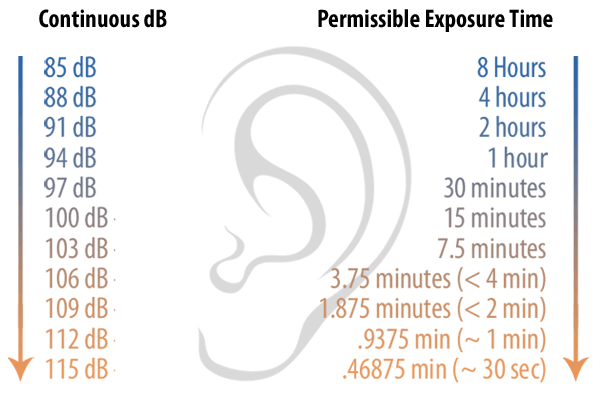
I tend to stand on a soap box during my sound unit and take the opportunity to talk about sound safety. [Other related Blog of Phyz posts: quiet fireworks and firework sound safety.] I discuss decibel scales and show students several graphics with common noises and their values. Some of my favorites are below:
 

But it is sometimes hard for students to understand all the principles at once. I want to discuss allowed time duration, compare sounds they can relate to, talk about decibel reducing measures, and more. I find myself flipping back and forth between graphics during lectures and still not getting it all together.

I found this infographic that details over 60 noises with their decibel level, marked OSHA standards and suggested exposure times. The graphic itself is too large to view all at once but I loved the format. Noises were divided up as occupational or non-occupational noises. I typed up all of the activities with their decibel levels into a word document and selected 40 that I thought provided a range of activities students would relate to. I created another document for printing with the sounds, and OSHA recommendations. I cut out each one, mounted them to thicker bright paper and we were ready to go.

In class I explained the decibel scale to students and showed them a few examples. Then I passed out one sound slip to each student and asked them to arrange themselves into order from 0 dB and up. After they were arranged students took turns reading their sound and decibel rating. As they were sounding off (*ba dum ching*)  I added in the cards describing the sound level (i.e. "comfortable 50 dB" or "Extremely Loud 100 dB") and the cards with suggested exposure times.

Students were surprised to learn the average decibel level of several common noise. They were shocked to see how many of them were past OSHA recommendations like "ear damage can occur here," or "unprotected noise exposure not allowed past this level." It gave them a chance to see all my talking points at once and they got to get up and move.

Space was an issue as 35 students shoulder to shoulder take up some space. I tried in my classroom for students to stand across the front of the room but they ended up in a weird convex arc and couldn't see or hear everyone else. I tried outside as pictured above but being right next to the street (on the other side of that fence) made it even harder to hear. In the future I would have arranged them in a circle around the room so that they could see everyone else. I would also hand students either a pictures of or the actual sound reducing devices where they would be needed to reduce the noises to a safe level. For example, students at 100 decibels would hold your basic foam ear plugs to show that their 20 dB reduction rating could lower those noises to a safe 80 dB. All in all I like the activity and look forward to refining it in the future.

Thursday, March 02, 2017

Dual purpose dimmer

At the 2017 Summer AAPT meeting in Sacramento Arbor Scientific had a booth in the exhibit hall showing off all their great demos. This Electricity & Magnetism Light Bulb demo caught my eye. It involves an incandescent light bulb with a long loose filament that can be turned on using AC or DC current. While on, a strong neodymium magnet is brought near the bulb with different results depending on the setting. When on DC the filament moves towards one pole of the magnet and away from the other. When on AC the filament vibrates when either pole of the magnet is brought close to it. I wanted one, but the reasonable price was still hard to manage for a once a year demo.

Last year I wanted to show my Conceptual Physics students a working dimmer switch and a simple light bulb. My retired father-in-law made me a self contained box with a dimmer switch and an incandescent bulb:
While shifting equipment around in my room I came across it again while my magnet cabinet was also open. As I recalled the Arbor Scientific demo I thought, "I wonder if...." and grabbed my biggest neodymium magnet. 

With the light bulb on dim so that the filament can be easily seen I moved the magnet close to the bulb. Since my bulb's filament wasn't as long as the one in Arbor Scientific's demo you don't see as much movement but it is vibrating! The second video is easier to see the motion. 


Now I know that my simple demo has a dual purpose and can be used in my current electricity unit and come back in my electromagnetism unit!