At the risk of repeating this post, let me tell you where I am as we head into the second semester.
In our first semester at Rio, we cover motion, Newton's laws, UCM & gravity, momentum, energy, and heat. That is, everything that the state of California spell out in the first three of five content standard sets devoted to 9-12 Physics. "Motion and Forces," "Conservation of Energy and Momentum," and "Heat and Thermodynamics" are done.
In second semester, we cover "Electric and Magnetic Phenomena," and "Waves." There's plenty to do in those areas, and we're never done with all of it by the April CST administration.
But I would kindly suggest that if you're still meandering through mechanics when second semester hits, you don't stand a chance of making it through the state's prescribed content. I know at least one or two physics teachers for whom that is not a concern. They express their distaste for statewide standards and assessment by disregarding them completely.That's not a path I would recommend. To each his (or her) own, I suppose.
Saturday, January 31, 2009


Return of the Student Opinion of Teacher Survey
High school teachers in the college town of Ann Arbor were required to undergo anonymous student evaluation at the end of each semester back when I did my student teaching there. The Ann Arbor School District developed a generic Likert scale and open-ended questionnaire that allowed students to rate teacher performance. The front of the questionnaire was devoted to 24 Likert (five-point) scale performance assessments. The back was devoted to open-ended prompts.
Students were not to include their names on the surveys. Completed surveys were collected by a student in the class and delivered to the teacher's evaluating administrator before the teacher could see them. The teacher could not access the completed surveys until semester grades had been turned in.
I brought the form with me to Sacramento. San Juan Unified had no such instrument or program. I was too chicken to use it my first year. In retrospect, I have reason to believe the results would have been much better than I expected. Oh well.
I started using it my second year, 1987-88. I was knocked out by how kind the students were in their assessment of my performance. It might have helped that I was young and they could see that I really was trying. It didn't hurt that Rio's Class of '88 was a truly exceptional group. (I perceived it even then, but my perception was verified by more veteran teachers at the time.)
I continued to administer the survey until 2006. In the early years, I learned a thing or two. And I changed a thing or two about how I conducted the class. But after a while, the annual results started to merge into a certain sameness. My stock would rise or fall within a certain range. The comments--good and bad--changed little from year to year. I lost interest.
I revived the old form this year. To make it somewhat interesting and useful to me, I changed some of the questions.
Here is the survey instrument.
Here are my results. (The graphs will be meaningless without the instrument; the graphs don't show the text of the questions.)
1. Summary Graph by Period (Physics 1 only)
2. Summary Graph (Physics 1 and AP Physics 2)
3. The Data
Students were not to include their names on the surveys. Completed surveys were collected by a student in the class and delivered to the teacher's evaluating administrator before the teacher could see them. The teacher could not access the completed surveys until semester grades had been turned in.
I brought the form with me to Sacramento. San Juan Unified had no such instrument or program. I was too chicken to use it my first year. In retrospect, I have reason to believe the results would have been much better than I expected. Oh well.
I started using it my second year, 1987-88. I was knocked out by how kind the students were in their assessment of my performance. It might have helped that I was young and they could see that I really was trying. It didn't hurt that Rio's Class of '88 was a truly exceptional group. (I perceived it even then, but my perception was verified by more veteran teachers at the time.)
I continued to administer the survey until 2006. In the early years, I learned a thing or two. And I changed a thing or two about how I conducted the class. But after a while, the annual results started to merge into a certain sameness. My stock would rise or fall within a certain range. The comments--good and bad--changed little from year to year. I lost interest.
I revived the old form this year. To make it somewhat interesting and useful to me, I changed some of the questions.
Here is the survey instrument.
Here are my results. (The graphs will be meaningless without the instrument; the graphs don't show the text of the questions.)
1. Summary Graph by Period (Physics 1 only)
2. Summary Graph (Physics 1 and AP Physics 2)
3. The Data
How my students have performed on the physics CST
We get CST results each year. The STAR reports are not always useful or logically organized. I've been on a mission to get results that I could hammer into something meaningful. Each year, I have to volunteer some time, talent, and energy to tease out results that reflect on what's going on in my own classroom.
The state generates some very broad results that they publish August 15-ish each year following the Spring administration. School districts are then charged with providing individualized teacher reports.
With the additional effort I put in, here's a presentation of how my students have performed on the Physics CST over the years. (The file is a zipped QuickTime document.)
Interpreting those results is another matter. Given the data presented in that report, I'm hard-pressed to generate much analysis. My students generally fair well. They've got a number of advantages over the average California physics student. But as far as using the results to decide what to do different next year, the picture is not entirely clear. I've already surrendered a huge portion of the second semester to electricity and magnetism. And electricity and magnetism remains an area of relatively low performance.
The state generates some very broad results that they publish August 15-ish each year following the Spring administration. School districts are then charged with providing individualized teacher reports.
With the additional effort I put in, here's a presentation of how my students have performed on the Physics CST over the years. (The file is a zipped QuickTime document.)
Interpreting those results is another matter. Given the data presented in that report, I'm hard-pressed to generate much analysis. My students generally fair well. They've got a number of advantages over the average California physics student. But as far as using the results to decide what to do different next year, the picture is not entirely clear. I've already surrendered a huge portion of the second semester to electricity and magnetism. And electricity and magnetism remains an area of relatively low performance.
My Dear Machine
There are, generally speaking, two types of casual bloggers: those who have idled their blogs for a spell and those who will.
I honor of my time away from this URL, let me present Sixpence None the Richer's "My Dear Machine." Sixpence disbanded in 2004 and reunited in 2008. They returned with an EP whose title track was "My Dear Machine."
With lyrics like, "My dear machine's been idled so long, now it's time for another drive," it's hard to miss the metaphor. But I really like the track and now I'll be able to access the video easily on my blog. (It says something nice about singer Leigh Nash that she didn't mind the nostril massage making the final cut.)
Oh, you can't get the EP in stores or the iTunes Music Store. I bought it at NoiseTrade. But I don't see it there anymore. I'm not sure where you could buy it if you wanted to. Sorry. If someone knows how to get it, let me know in the comments!
I honor of my time away from this URL, let me present Sixpence None the Richer's "My Dear Machine." Sixpence disbanded in 2004 and reunited in 2008. They returned with an EP whose title track was "My Dear Machine."
With lyrics like, "My dear machine's been idled so long, now it's time for another drive," it's hard to miss the metaphor. But I really like the track and now I'll be able to access the video easily on my blog. (It says something nice about singer Leigh Nash that she didn't mind the nostril massage making the final cut.)
Oh, you can't get the EP in stores or the iTunes Music Store. I bought it at NoiseTrade. But I don't see it there anymore. I'm not sure where you could buy it if you wanted to. Sorry. If someone knows how to get it, let me know in the comments!
Saturday, December 20, 2008
Power Pointlessness at the speed of light
The first experimenters who tried to measure the speed of light concluded that light speed was infinite. Their equipment was unequal to the task of measuring something so very fast. In v = d/t, the t was too small no matter how big they made the d.
Similarly if you were to take the ratio of effective presentations (PowerPoints) you've seen to the total number of presentations you've sen, you would be forgiven if you concluded that "effective PowerPoint" was an oxymoron. (The "effective" number too small and the "total" number total too large.)
Effective presentations do exist. Garr Reynolds hosts a weblog devoted to Presentation Zen. He offers fundamental principles for success that can be found here.
Similarly if you were to take the ratio of effective presentations (PowerPoints) you've seen to the total number of presentations you've sen, you would be forgiven if you concluded that "effective PowerPoint" was an oxymoron. (The "effective" number too small and the "total" number total too large.)
Effective presentations do exist. Garr Reynolds hosts a weblog devoted to Presentation Zen. He offers fundamental principles for success that can be found here.
Sunday, December 14, 2008
Thermal physics in slow motion
 Here's a generous helping of new high-speed video from my trusty Casio EX-F1. We're into thermal physics right now, so it was time to record flame, steam, and the Leidenfrost Effect as Paul Robinson demonstrated at PTSOS.
 As always, these are QuickTime clips (for better playback control and ease of downloading).
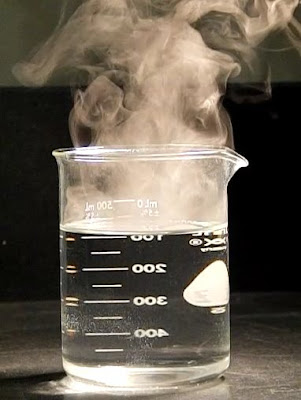 Enjoy the clips here.
Wednesday, November 26, 2008
Never so broke we can't pay the psychic
Oh the humanity! The week off has given me the chance to listen to daytime NPR. The woo seems to permeate the programming.
Here's one from today's Day to Day. Turns out the economic downturn is a bonanza for "psychics." This one tells us that her johns used to be primarily women asking about love, but are now men asking about business. She channels guides and angels from the other side to set her clients straight.
And out of consideration for the economy, she's dropped her fee from $155 to $125 per hour. How will she make ends meet? Makes you weepy, the altruism. Then again, I bet she's not sending any of her profits to the other side.
How could you, Madeleine Brand? Sure, there was a whiff of skepticism in the piece, but it was more of a straw man meant to be blown down. It amounted to a puff pice for woo.
Here's one from today's Day to Day. Turns out the economic downturn is a bonanza for "psychics." This one tells us that her johns used to be primarily women asking about love, but are now men asking about business. She channels guides and angels from the other side to set her clients straight.
And out of consideration for the economy, she's dropped her fee from $155 to $125 per hour. How will she make ends meet? Makes you weepy, the altruism. Then again, I bet she's not sending any of her profits to the other side.
How could you, Madeleine Brand? Sure, there was a whiff of skepticism in the piece, but it was more of a straw man meant to be blown down. It amounted to a puff pice for woo.
Tuesday, November 25, 2008
Scamming Granny using the first rule of cold reading
Listening to daytime NPR on my week off, and the woo jumps out of the radio.
Take this tale of woe from Talk of the Nation. Scam artist from Canada (Oh, Canada!) call numbers in the US. If the person picking up sounds elderly and female, they launch into their scam.
"Hi Grandma, it's me--your favorite grandson," they begin. They tell Granny that there in trouble up in Canada, please wire money ASAP. "And don't tell Mom and Dad; I'll be in so much trouble." Often enough, the money comes through.
You might wonder how the scammers can succeed in such cold calls without knowing so much as the name of the person they're impersonating. That's because you've never worked as a cold-reading "psychic." As is the case with Jonathan Edward and James Van Praagh, the scammers let their marks do their work for them.
"Hi Grandma, it's me--your favorite grandson!"
"I that you, Jimmy?"
"Yes Grandma; it's me, Jimmy..."
It's wrong to blame victims of crimes. But we're such easy marks. If we don't see cold-readers as scam artists, we'll be wiring that money to the Canucks in no time and with no questions asked.
Take this tale of woe from Talk of the Nation. Scam artist from Canada (Oh, Canada!) call numbers in the US. If the person picking up sounds elderly and female, they launch into their scam.
"Hi Grandma, it's me--your favorite grandson," they begin. They tell Granny that there in trouble up in Canada, please wire money ASAP. "And don't tell Mom and Dad; I'll be in so much trouble." Often enough, the money comes through.
You might wonder how the scammers can succeed in such cold calls without knowing so much as the name of the person they're impersonating. That's because you've never worked as a cold-reading "psychic." As is the case with Jonathan Edward and James Van Praagh, the scammers let their marks do their work for them.
"Hi Grandma, it's me--your favorite grandson!"
"I that you, Jimmy?"
"Yes Grandma; it's me, Jimmy..."
It's wrong to blame victims of crimes. But we're such easy marks. If we don't see cold-readers as scam artists, we'll be wiring that money to the Canucks in no time and with no questions asked.
Tuesday, November 18, 2008
High-speed water balloons in zero-g
Thanks to Rick Pam at Stanford for pointing this out to me. Über-groovy!
D-oh! The embedding code failed, so you'll have to click the link.
http://www.sciencefriday.com/videos/watch/10177
D-oh! The embedding code failed, so you'll have to click the link.
http://www.sciencefriday.com/videos/watch/10177
Predictions in review
Ah, the predictions shows. Who doesn't enjoy knowing ahead of time what is to transpire in the following year. Slight downside to the yummy predictions made by the psychics: they're generally wrong. Witness these gems from Sylvia Brown.
Subscribe to:
Posts (Atom)