Tuesday, July 09, 2019

Breakthrough: The Ideas that Changed the World

The Next Generation Science Standards place a new importance on engineering. There will be initiatives and ideas for how to engage students in designing and building things in class.

If we want to enmesh engineering into the fabric of our curriculum, we might want to consider shining a spotlight on the engineering history a few key inventions. The PBS series, Breakthrough: The Ideas the Changed the World shines that light on six such triumphs of engineering. The series played on PBS this past spring It streams on Amazon Prime. And the DVD set of the series, hosted by Patrick Stewart, is now available. Here's a rundown of the episodes.

The Telescope
Episode 1 tells the story of the development of the telescope, from a stone-age observatory to the space-based telescopes of the future.

It entails long-abandoned Stone Age dolmens once used as celestial calendars,
how Venetians made glass transparent, the optics of a medieval Persian camera obscura, a Dutch lens maker’s wartime breakthrough and a Venetian math teacher’s advancement of it, a Parisian invention improved by a spilled bottle of mercury, a team of women known as human computers who were armed with fly spankers, an athlete-turned-astronomer working high above Los Angeles, and telescope in space that will allow us to see as far as physics will allow.

Episode 1 "breakthrough celebrities" include Galileo Galilei, Edwin Hubble, Henrietta Swan Leavitt, Louis Daguerre, Hans Lippershey, and Ibn al-Haytham.

The Airplane
Episode 2 tells the story of the development of the airplane, from early human-powered attempts to the jet concepts of the future.

It involves a ninth-century moorish daredevil’s first attempt at human flight, how we had tails before we had wings, an artist obsessed with anatomy and flight, a whirling arm in the stairwell of a seaside mansion, the rubber band’s role in flight, the curve of a stork's wing, a connection to maritime technology and the gyroscope, the use of a deep-sea diving suit to fly high, why modern pilots are pressure tested, and the surprising efficiency of the jet propulsion gas turbine.

Episode 2 "breakthrough celebrities" include Leonardo da Vinci, Wilbur Wright, Orville Wright, George Cayley, James Doolittle, Wiley Post, Frank Whittle, Elmer Sperry, Lawrence Sperry, Otto Lilienthal, Alphonse Penaud, and Ibn Firnas.

The Robot
In episode 3, Locutus of Borg tells the story of the development of the robot. Well, Patrick Stewart is the series narrator, so... close enough!

It involves the ancient legend of Hephaestus and rudimentary Greek automatons,
a device that could learn a new tune and repeat it exactly, a desire to produce navigation tables by steam, the linguistic contribution of a Slavic cubist painter, the breakthrough of storage for programs, an imitation game, an electronic tortoise, a mission to Mars, a nuclear disaster in Japan, and the challenges of balance and hands.

Episode 3 "breakthrough celebrities" include Alan Turing, Charles Babbage, Ada Lovelace, Hero of Alexandria, William Grey Walter, The Banû Mûsâ brothers.

The Car
Episode 4 tells the story of the development of the car, from ancient sleds powered by primitive dogs to autonomous vehicles powered by graphene batteries. Gary Numan was not available for the narration, so Patrick Stewart handled the voice-over.

It involves ancient arctic sled dogs, the pairing the axle to the wheel, the smelting of metals from rocks, the spreading of a language, the need to pump water out of mines, the boring of naval canons, a stunt carried out by an inventor’s wife, the efficiencies of a slaughterhouse, and the promise of graphene.

Episode 4 "breakthrough celebrities" include Henry Ford, Karl Benz, Bertha Benz, James Watt, Thomas Edison, John Wilkinson, Thomas Newcomen, and Jay Leno.

The Rocket
Episode 5 tells the story of the development of the rocket, from ancient guano-powered fireworks to plasma rockets with magnetic confinement. 

It involves the use of bat guano from Chinese caves to drive off evil spirits, a modern-day celebratory rocket battle in Greece, a work of fiction by a famous astronomer, an imaginative tale about a trip to the moon, a visionary living in rural Russia, a breakthrough in dairy processing technology, a loophole in an international treaty, a repurposing of firefighting equipment, internal Soviet geopolitical subterfuge that stoked the Space Race, and plasma engines that could transport humanity to other worlds.

Episode 5 "breakthrough celebrities" include Robert Goddard,  Werner Von Braun, 
Konstantin Tsiolkovsky,  Jules Verne,  Ti Tian,  Sergei Korolov, Karl Gustav, Thomas Harriot, and Johannes Kepler.

The Smartphone
Episode 6 tells the story of the development of the smartphone, from the fall of Carthage to brain-interfaced apps of the future.

It involves ancient Roman battlefield communications, a painter-turned-inventor who devised a code still in use today, a groundbreaking technology whose rightful inventor had to be settled by the US Supreme Court, an obsessive inventor who found treasure in another scientist’s trash, a quirky keyboard talking machine, a Hollywood starlet who was also a prolific inventor keen to defeat the Nazis, the miniaturization of a circuit invented by an engineer who hadn’t yet earned vacation time, and a father eager to share a photograph of his newborn daughter with friends and family.

Episode 6 "breakthrough celebrities" include Alexander Graham Bell, Samuel Morse, Guglielmo Marconi, Hedy LaMarr, George Antheil, Jack Kilby, Polybius, Philippe Kahn, Homer Dudley, and Elisha Gray.

I produced companion question sets for each episode. They can be found at The Lessons of Phyz at Teachers Pay Teachers: Breakthrough—The Ideas the Changed the World.

Thursday, June 27, 2019

AP Physics C new Manual Part 2

This is a continuation of the original post discussing the changes/tweaks to the AP Physics C Mechanics curriculum by the College Board.

The Electricity & Magnetism curriculum is in the same new format as the Mechanics one. There are the same four Big Ideas that are across all the units:


Unit 1:Electrostatics
Unit 2: Conductors, Capacitors, Dielectrics
Unit 3: Electric Circuits
Unit 4: Magnetic Fields
Unit 5: Electromagnetism
Big Idea 1: Change (CHA)
Interactions produce changes in motion.


X

Big Idea 1: Force Interactions (INT) Forces characterize interactions between objects or systems.
X
X


X
Big Idea 3: Fields (FLD) Fields predict and describe interactions.
X
X
X
Big Idea 4: Conservation (CON) Conservation laws constrain interactions
X
X
X
X
X

With only five units instead of the seven  in Mechanics each unit contains more Leaving Objectives but I found the Essential Knowledge section a bit more sparse. There seemed to be more times that the equation was thrown down and then "using calculus" was meant to explain more of the content. I mean, it does, but I think the content needed under Essential Knowledge is more apparent in Mechanics than in E&M. Unlike in  Mechanics I don't recall seeing any additional equations not on the supplied equation sheet either.

Unit 1: Electrostatics (pdf or Google Doc)
Unit 2: Conductors, Capacitors, Dielectrics (pdf or Google Doc)
Unit 3: Electric Circuits (pdf or Google Doc)
Unit 4: Magnetic Fields (pdf or Google Doc)
Unit 5: Electromagnetism (pdf or Google Doc)

Wednesday, June 19, 2019

The Light Playlist of Phyz

Somewhere in the end-of-the-year rush, I failed to post the ever-important Light Playlist, suitable for background play during light and optics labs. I apologize for my tardiness in this matter.

Previously posted playlists: Waves & Sound, Magnetism, and Electricity. There's a "playlist" topic link below and to the right as well.

The Light Playlist of Phyz
SONGARTISTYEAR
And the LightSupertramp1997
Blinded by the LightManfred Mann's Earth Band1976
Calling AmericaElectric Light Orchestra1986
ColorsAmos Lee2005
Eye in the SkyAlan Parsons Project1982
Green LightLorde2017
LightSan Holo2017
LightSleeping At Last2013
Light (feat. Little Dragon)ODESZA2014
Lights Down Low (feat. gnash)MAX2016
New LightJohn Mayer2018
On the RadioDonna Summer1979
On the RadioThe Concretes2013
On the RadioRegina Spektor2007
RadioSixpence None the Richer2012
Radio CityEilen Jewell2011
Radio GagaQueen1984
Radio SongR.E.M.1991
ShadowAshlee Simpson2004
ShadowBirdy2016
ShadowBleachers2014
ShadowBritney Spears2003
ShadowChromatics2015
ShadowColbie Caillat2011
ShadowJeremy Riddle2017
ShadowSam Tsui2013
ShadowStick Figure2015
ShadowWild Nothing2012
Shadow (feat. Trevor Young)SOJA2014
Sound and ColorAlabama Shakes2015
Spirit of the RadioRush1979
The Lights Go DownElectric Light Orchestra1981
Ultraviolet (Light My Way)U21992
Video Killed the Radio StarThe Buggles1979
Voice on the RadioMaríe Digby2008
WaveJustin Timberlake2018

Tuesday, June 18, 2019

The best laid plans

It's true: I see the world in physics. You might, too. So when I saw a thing at Panera Bread, I spun it into a narrative that's too good to verify. Meaning I could have it a bit wrong, but it feels right. It's 2019, so... good enough.

In any case, here's the observation: an LCD screen in portrait orientation goes dark when viewed through polarized sunglasses. Unless you tilt your head sideways!


My story is that the LCD was manufactured to be used in landscape orientation, as is the case for 99.9% of such displays. In that orientation, the polarization inherent in LCDs was set to be viewable even through polarized sunglasses. But the Panera queue application required portrait mode. Hence the trouble.

And honestly, if you're indoors at Panera, why are you wearing your sunglasses? (Actually, if they're prescription, keeping them on while waiting for your coffee might not be so unreasonable.)

Note that your modern smartphone can be viewed in portrait or landscape through polarized sunglasses. Their displays have been depolarized! Some kind of sorcery is at work here.

Tuesday, June 11, 2019

AP Physics C new manual

The College Board has redesigned (or tweaked?) the AP Physics C Mechanics and Electricity & Magnetism exams for the 2019-2020 school year. The instructors have access to the Course and Exam Description which has been expanded greatly. The 2014 version was 69 pages for both Mechanics and Electricity & Magnetism. The new versions are 174 and 170 pages each, respectively. Going through them is part of my summer plans (exciting I know) and I wanted to share my first impressions, resources, etc.

First of all, the organization is way different. The old version had a few pages on lab and course suggestions (you need money for lab supplies, the class takes lots of time, etc.) and gave a breakdown of the percentage of the exam by topic. Then came several pages of an outline of objectives of the "Students show understand/be able to..." variety. I had retyped these for my students and passed them out at the beginning of each unit. I thought it was important for students to see exactly what could be asked of them on the exam and also what was outside the scope.

Here are the old versions if you're interested:
A. Kinematics
B. Newton's laws of motion
C. Work, Energy, Power
D. Momentum
E. Circular Motion and Rotation
F. Oscillations  & Gravitation

The new version has a lot more information about the logistics of teaching the course. There is suggested pacing, although the range for each unit is large because they recognize that AP Physics C can be taught as a one year or two year course. The course is organized into 7 units, essentially the same topic breakdown as above. Within each unit are subtopics listings with learning objectives under each. Each subtopic has a Enduring Understanding statement which is defined as "long-term takeaways related to the big ideas that leave a lasting impression on students." Each Enduring Understanding comes with Learning Objectives and Essential Knowledge statements. The Learning Objectives have the same purpose as the old ones, the Essential Knowledge is more like a summary or clarification statement. These list the equations that represent the relationships described in the Learning Objectives, some of which are on the equation sheet while some are not. Each unit has a different amount of Topics and Learning Objectives. Some concepts seem to have more emphasis than they used to, for example resistive (drag) forces Under Unit 2 Newton's Laws of motion.

The lab related objectives have also been updated to be Science Practices, a list of skills related to both physical lab skills and also critical thinking and problem solving. There is a whole table that outlines the 7 main practices and the skills required for each. I plan to make a copy of it for my students. The old lab objectives were not as detailed, as a comparison:

Old practices:
3. Analyze data - Students should understand how to analyze data, so they can:
a) Display data in graphical or tabular form.
b) Fit lines and curves to data points in graphs.
c) Perform calculations with data.

d) Make extrapolations and interpolations from data.

New practices:
Practice 4: Data Analysis
Analyze quantitative data represented in graphs.
4.A Identify and describe patterns and trends in data or a graph.
4.B Demonstrate consistency between different graphical representations of the same physical situation.
4.C Linearize data and/or determine a best fit line or curve.
4.D Select relevant features of a graph to describe a physical situation or solve problems.

4.E Explain how the data or graph illustrates a physics principle, process, concept or theory.

Across all 7 units are four "Big Ideas" that remind me of the Cross Cutting Concepts of NGSS. The Learning Objectives for each unit's subtopic fit under one of these Big Ideas. A handy table is included:

Unit 1: Kinematics
Unit 2: Newton's Laws of Motion
Unit 3: Work, energy, power
Unit 4: Systems of particles, linear momentum
Unit 5: Circular motion and rotation
Unit 6: Oscillations
Unit 7: Gravitation
Big Idea 1: Change (CHA)
Interactions produce changes in motion.
X


X
X


Big Idea 1: Force Interactions (INT) Forces characterize interactions between objects or systems.

X
X
X
X
X

Big Idea 3: Fields (FLD) Fields predict and describe interactions.


X
Big Idea 4: Conservation (CON) Conservation laws constrain interactions


X
X
X

X


Overall the unit outlines and supplemental materials looks well designed and flushed out. There are reminders everywhere to view the online materials available for teachers and students. Students will have access to online practice multiple choice and free response questions that are similar in style to the AP exam. It is suggested that you assign these practice problems for homework but specifically states that it should not be graded other than for participation points. There is a page of sample instructional activities, notes space and more. All like the ideal unit outlines we were supposed to learn to make after the credential program. 

All in all I like the addition of information. The layout and new terms will take some getting used to and I'm still deciding what to give my students. I typed up each unit's topic, Enduring Understanding, Learning Objectives and Essential Knowledge for Mechanics. That... took awhile. On one hand I like the Essential Knowledge as background information for my students but I also worry it is too much detail for them and they won't look at it. I typed up the Science Practices (lab skills) and also separated the Learning Objectives into a separate document. And since I typed it up, you won't have to! I'll get to E&M later and I'll be sure to post it here as well. 

All Learning Objects (pdf or Google doc)
Science Practices (pdf or Google doc)
Unit 1: Kinematics (pdf or Google doc)
Unit 2: Newton's Laws of Motion (pdf or Google doc) and Circular Motion (pdf or Google doc)
Unit 3:Work, Energy and Power (pdf or Google doc)
Unit 4: Systems of Particles [aka Center of Mass] (pdf or Google doc) and Linear Momentum (pdf or Google doc)
Unit 5: Rotation (pdf or Google doc)
Unit 6: Oscillations (pdf or Google doc)
Unit 7: Gravitation (pdf or Google doc)

Sunday, April 21, 2019

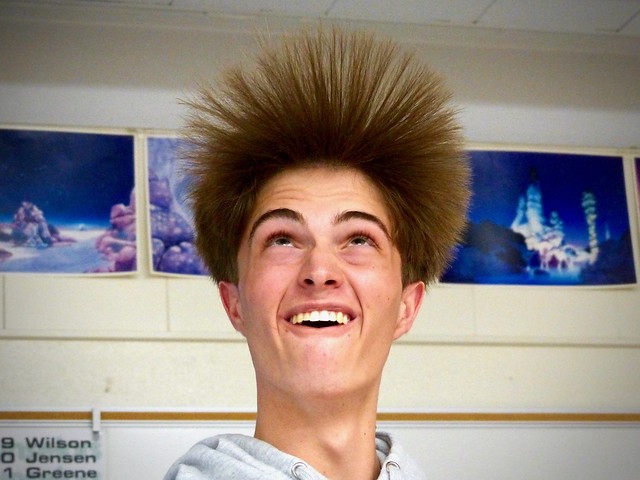
Van de Graaff is the Coiffeur 2019

It was another hair-raising experience when we charged up the Van de Graaff generator this year.

The conditions were often less than ideal. But we charged ahead with our old 1960s-era Cenco Van de Graaff. That old thing can produce a nice charge.

Hair are the results.

2019 Van de Graaff Album
2019 Van de Graaff Rio Phyz

Saturday, April 20, 2019

Our Planet (Netflix series)

Sometimes I go somewhere for spring break. This year I went everywhere on our planet.

Our Planet | Official Trailer [HD] | Netflix


As described by the producers:
Our Planet is a groundbreaking, four-year collaboration between Netflix, Silverback Films and WWF. It explores the rich natural wonders, iconic species and wildlife spectacles that still remain, and reveals the key issues that urgently threaten their existence. Today, we have become the greatest threat to the health of our planet. 
Our joint mission is to inspire people over the world to understand our planet - and the challenges it faces. If we can truly understand why nature matters to us all, and what we can do to save it, then we can create a future where nature and people thrive. 
It is very BBC Planet Earth-esque in many ways: stunning wildlife photography accompanied by a David Attenborough narration. But in it's storytelling, it does describe human impact. There are times when that impact is beneficial, but more often it is detrimental. Appallingly detrimental.

But no part of the series is "pollution porn". No images of filth being pumped into waterways or oil-covered birds struggling amid the sludge.

By and large it is a celebration of nature as it remains and an assurance that, given the opportunity, the extent to which it can recover. And photography tools and techniques have advanced significantly since Planet Earth was made.

There are disturbing vignettes. The fungus that bursts forth from the corpse of an ant whose dying behavior it commandeered, the successful orca hunt of an outmatched penguin, and "the walrus scene". The walrus scene will likely stay with me for a very long time. It should be noted that the entire eight-episode series is rated TV-G.

I may never have need or cause to direct my own students to watch this series. But others might. It seems very much in line with the NGSS three-course model's "The Living Earth". But I know I'm unwilling to use expository video resources without an accompanying set of questions. For long-form videos such as each episode of Our Planet, a sequence of surface-level questions can keep students focused on the narrative.

So I spent a significant portion of spring break preparing video question sets that teachers could use with students while watching any or all episodes of the series. For me, that requires first screening the episode as a passive audience member. Next I go through the process of watching and listening and pausing while I allow the text of the narration to suggest possible questions.

Fill-in-the-blanks are simple and can be effective. Sometimes. But not when the key word or phrase is something like "Rub' al Khali" or name of any exotic place or organism. Multiple choice can be deployed here, but it's key to develop distractors of such quality that even a clever student would be attracted to a wrong answer if they were not paying attention.

There are occasions in which multi-select checklists are appropriate. Rarely, it is even possible to create a matching sequence.

In any case, I came up with Our Planet (Netflix) Video Question Sets and have posted them to The Lessons of Phyz at Teachers Pay Teachers.

Often the producers of such programs will develop deep and expansive curriculum through which an instructor could make a semester or yearlong course based on the documentary series. And the producers of Our Planet have produced a companion book for the series.

For now, my own classroom interests have never risen to that level of ambition. Not even for The Mechanical Universe. I prefer to incorporate the resources rather than to be incorporated by them.

If you know someone who might want to replace their use of Planet Earth with something a little more environmentally conscious, send them this post. Our planet is stunningly gorgeous, as is Our Planet.

Tuesday, April 16, 2019

Let physics change your mind

I should probably ad a subject tag of "better late than never". Maybe later.

Somehow this article got past me last year. My absentminded/aloof game is apparently too strong sometimes. So I apologize if you already knew about this item from Neuroscience News ages ago, but...

New Parts of the Brain Become Active After Students Learn Physics
A neuroimaging study reveals brain areas not commonly associated with science learning become active when people complete physics problems.
It inspired a new Physics Ad. Too late for this year just means super early for next year.


Monday, April 01, 2019

It's a great day to be skeptical!

I've been developing "skepticism in the classroom" resources for quite a while. I've posted a bunch of them to The Lessons off Phyz at Teachers Pay Teachers. I drop them into my curriculum throughput the year, when the moment is right. Sometimes they are assigned as "YouTube Homework".

YouTube Skepticism: Baloney Detection Kit
This activity engages students as they watch a 14-minute video on a so-called "Baloney Detection Kit". It's a structured implementation of Carl Sagan's quote, "Extraordinary claims require extraordinary evidence, and acts as a filter when students are confronted with claims.

YouTube Skepticism: The First Moon Office
This activity compares the science of meteors and apparent weightlessness with how those phenomena are represented in a Federal Express television advertisement.

YouTube Skepticism: Power Balance
Power Balance bracelets burst onto the scene a few years ago and enjoyed explosive success. There were "knock-offs," fakes, and the company gathered so much cash it bough the naming rights to sports and entertainment complex in Sacramento: what had been ARCO Arena became Power Balance Pavilion. The activity brings students through the claims and the tests of those claims. Power Balance has since declared bankruptcy, but similar products (targeted toward baseball players) persist. There will always be such products, I hope my students do not buy them.

YouTube Skepticism: Magnet Boys
This activity allows students to consider several cases of so-called "magnet boys" that swarmed the Internet a few years ago. The cases pose interesting questions, and magician and skeptic, James Randi, has an idea of what might be going on.

YouTube Skepticism: Cell Phone Popcorn
This activity has students observe and investigate a set of viral videos that took YouTube by storm a few years ago: ordinary people were using their cell phones to pop popcorn. The videos leas students into a revealing investigation.

The Secrets of the Psychics
Nova's Secrets of the Psychics. Magician and skeptic, James "The Amazing" Randi, exposes so-called psychics at home and abroad. It's a serious topic, but there are a great many laughs to be had.

Merchants of Doubt
Question set and answer key to accompany Merchants of Doubt (Sony Classic Pictures). This documentary exposes the parallels of the tactics used by the tobacco industry and climate change deniers, among others.

Skepticism Bundle—The Whole Shebang!
All of the above.

More skepticism in the classroom resources can be found at

Skepticism in the Classroom (Dean Baird)

Skepticism in the Classroom (my buddy, Matt Lowry—physics instructor and skeptic extraordinaire)

Saturday, March 23, 2019

Magnetoception: can it happen in humans?

When we study magnetism, we learn that certain animals have awareness of magnetic fields and can use it for navigation. Certain birds are known to have magnetite in their skulls. Here's a nice update of recent findings regarding magnetoception in birds.

Humans do not seem to have this capability. But that doesn't mean our brains are entirely oblivious to magnetic fields.

Veritasium's Derek Muller dons a sensor-laden shower cap of science to test his brain's awareness of the magnetic field it's immersed in. Could it be that the brain senses magnetic fields but doesn't share the information with our consciousness? Take a look.

Can Humans Sense Magnetic Fields?