Sunday, October 24, 2010

Time to flex your poker skills, physicists!

Your physics training was difficult and brain-bending at times. But the payoff extends beyond understanding the universe. Gather some friends and play some poker! For money! You're sure to win!!!

Or so they say in this recent piece from NPR. I, for one, am prepared to believe nearly anything Jennifer Ouellette tells me. (And I even knew how to spell her name without checking.)

So get out there and collect some cash. Daddy needs a new cyclotron!

Skeptical brilliance from xkcd

Sunday, October 17, 2010

My funny AP students

I'm really not that teacher. The favorite teacher that all the kids love. The one who knows all the students' names on the first day of school. Who's considered "cool" for being relaxed and understanding about homework, tests, labs, and exams.

I'm not an inflexible British schoolmaster from the 1950s, either. Or a high priest who accepts only the schools top 10% into his demanding, rigorous physics course.

I try to make my physics course the most challenging class students want to come to. Not easy to balance the "challenging" with "want to come to." And I don't presume to get it right.

But there are many teachers at my own school who do a better job of connecting with students on an interpersonal level. So I don't usually get anything like a student-delivered cake on my birthday.

But there was apparently some instigation for such a thing this year. And the work looks to have been inspired by the difficult FBD test they took on my birthday. I was out that day. The cake was brought in the following day.


A wonderful treat, and highly unexpected! ("Old Man Baird" is what my buddy, Rick, imagined my students called me about 15 years ago. I've incorporated it into my own classroom schtick. So now my students may well call me that. D-oh!)

Tuesday, October 12, 2010

Squirrel vs. Slinky

The squirrel is a simple creature motivated by two all-consuming drives. One of those drives is to eat. So if there's tasty bird food accessible from atop a pole, you climb the pole and get the tasty bird food.


The human male is a slightly more complex creature. His brain has lobes, and his hands have opposable thumbs. His drives include those of the squirrel, but he also hopes to demonstrate mastery over his domain. If the bird feeder he put in his yard is being attacked by a squirrel, he aims to thwart the squirrel to better serve the birds.


So the man engineers an elegant means to "squirrel-proof" his bird feeder using a simple Slinky. Higher thinking skills vs. basic instinct. Who will win? Watch to find out.


Tuesday, September 28, 2010

High school physics teacher: Genius!

How cool is this? California high school physics teacher, Amir Abo-Shaeer, has been named a 2010 MacArthur Fellow. Oh sure, David Simon (creator/writer for Homicide: Life on the Street and The Wire) was named. As was the designer of Verdana and Galliard fonts. Other geniuses were honored as well.

But Abo-Shaeer is the rockstar of the day, as far as I'm concerned. He teaches at Dos Pueblos High School in Santa Barbara. And he has been setting the river on fire.

MacArther Fellows receive $500,000, no strings attached.

Full Abo-Shaeer here.

Monday, September 20, 2010

Neverending updates and upgrades at phyz.org

I am back to being the sole proprietor of physics at Rio Americano. That hasn't been the case since 1995. But biology was up--way up--and physics was down.

The division of labor involved in producing Book of Phyz handouts for students is now undivided and reunited, all on my plate. I can get the district to do most of the printing by sending them PDF-based print orders. (That time spent learning PDFs in 1999-2000 is paying off.)

I always want to print the latest versions of all my curriculum materials. So I need to create PDFs of all my updated documents. The upside is that I can then post them to The Book of Phyz resource at phyz.org. As of this weekend, the whole of the Physics 1 first semester is online.

I'm also upgrading the PowerPoints. Of course, I don't use PowerPoint. My posted presentations are actually interactive QuickTime movies rendered by Apple's Keynote. When I started using Keynote, I went with a resolution of 800x600. Seemed hi-res at the time. Keynote scales when sending presos to the projector. So there was never a problem for me showing my presos in class.

But the rendered QTs did not fare so well. The looked jaggy. So when I can, I'm changing the resolution of the presos to 1650x1050 and re-rendering the QTs. They weigh in with many more megabytes, but they look much, much better. I'm trying to tag the upgraded presos as "HD."

And I just posted a new, Zen-like preso to accompany the Clever Dumbbell demonstration. No words past the title page! If you do the demo on a regular basis, you'll figure out how to leverage the preso. I also posted a simple preso to accompany the Cannonball demo.

Sunday, September 19, 2010

Significant figures, error, and "proofiness"

Professional scientists and engineers have to be skilled in the handling of error and the tracking of significant figures. High school students are not professional scientists or engineers. While I don't exclude any discussion of these issues in my course, neither do I dwell on them. We spend a day on them, and revisit them as needed.


I heard an interesting story on NPR's Weekend All Things Considered that made me think of how significant figures and error work their way into "everyday life." The piece is an interview with Charles Seife, whose latest book, Proofiness: The Dark Arts of Mathematical Deception will arrive on bookshelves this week.

Amazon's description of the book:

"Proofiness," as Charles Seife explains in this eye-opening book, is the art of using pure mathematics for impure ends, and he reminds readers that bad mathematics has a dark side. It is used to bring down beloved government officials and to appoint undeserving ones (both Democratic and Republican), to convict the innocent and acquit the guilty, to ruin our economy, and to fix the outcomes of future elections. This penetrating look at the intersection of math and society will appeal to readers of Freakonomics and the books of Malcolm Gladwell."

Listen to the NPR piece here. If you're not familiar with the story of the 65,000,038 year-old dinosaur, you shouldn't miss it.

The brief time spent on these matters in not for naught. Too much time on them pushes out actual physics out of the school year.

Saturday, September 18, 2010

Galileo was wrong? Oh I don't think so...

We've been exploring inertia in the physics class lately. We've been through some of my favorite demonstrations and will do a lab on Monday. We also watched the Mechanical Universe episode on Inertia, which includes the story of how Galileo used the concept of inertia to "set the world spinning." Spinning away from geocentrism and toward heliocentrism.

Recall that in the early 1600s, the rest of the Enlightened world was growing to accept the idea that Earth was but a planet circling the larger, grander Sun. Galileo was hoping to move Italy in that direction, despite its Church-enforced geocentric predilections. He imagined that his personal connection to the Pope might help him get away with it. And he was wrong.

But according to one Dr. Robert Sungenis, Galileo was wrong about heliocentrism, too.

Sungenis and his followers are modern-day geocentrists! Oxymorons? Perhaps. But they are scheduling a conference to share their beliefs. It's November 6 in South Bend, Indiana (near Notre Dame, they hasten to add).

Galileo was wrong and The Church was right, they claim. Science teachers, our work is never done.

The "Teach the Controversy" spoof T-shirts might sell well there. I hope actual scientists (especially well-spoken astronomers) attend. I'd pay for Phil Plait's registration out of my own pocket to get him there.

Thanks to Michael Shermer for spotting the conference.

Wednesday, September 08, 2010

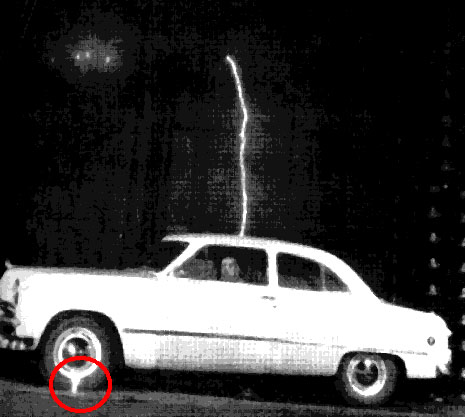
Who knew lightning could be so annoying?

I'm somewhat torn here.

On one hand, it's a very kinetic presentation. Sight, sound, and motion. Nearly all of it could have been done in Keynote. (Do I need to add that nearly all of it couldn't be done in PowerPoint?) So yes, it's very flashy. And it beats traditional content-delivery presentations by a mile.

But for my tastes, it's too much. Too much information (mostly trivial), too fast. Too many wind-whoosh sounds to emphasize how quickly the information is whipping by.

Maybe I'm missing the point. Maybe this series is all about a big clusterdump of trivia presented as infotainment. If that's what it's trying to do, it does it well.

See for yourself.


OK, now let's get at the errors.
1. The "90% of people who are struck survive" line is terrible. The stat may be true, but the vast majority of those survivors suffer permanent, debilitating injuries.
2. With so many stock photos of cars, why did they have to choose a ragtop Cadillac? A convertible may not be so safe if struck by lightning. Better to have metal over your head. Canvas makes a lousy Faraday cage.

Tuesday, September 07, 2010

You CAN take the sky from me

A few years ago, I took a stubborn (er, "principled") stand against CompUSA. I wanted to buy a simple item from them, but the clerk would not complete the transaction unless I supplied personal information. Legal tender was insufficient. I bid her "good day" and walked out of CompUSA for my very last time. I purchased the same item across the street at Best Buy. I gave them money; they gave me the item. So old-fashioned.

Months later, CompUSA declared bankruptcy.

Tonight I tried to buy air at Target. A simple can of compressed air to clean the filter in the LCD projector I use at school. "I need to swipe your ID," the clerk demanded. "Why?" I asked. "Kids get high on the compressed air." "And you can see I'm not a kid; but here, here's my driver's license." I flashed her the ID. "No, I need to swipe it." "If you can't see than I'm not a kid looking to get high, I'm afraid I won't be able to do business with you. So why don't you go ahead and keep all these items?" I had some other stuff to buy, but nothing was such a crisis that I needed it at that moment.

I'm not a fan of surrendering more than money in exchange for goods at stores. I have no idea what they do or don't do with swiped driver's license data. But I do hear about identity thefts involving crooks who abscond with hard drives/data collected by merchants.

The merchants always apologize profusely for letting someone steal your personal information. But there are never legal/monetary consequences for them. So they don't feel compelled to protect the data as best they could.

If I decide to stay away from Target, I'm pretty sure they'll be OK without me. And if I can't buy air anywhere else without an ident card swipe, I'll be back to Target in no time. Otherwise, I simply can't do business with a merchant as paranoid as they are are stupid: a dumb nannystore.

A quick local news story on the swipe. Warning: it's a local news story...

But my immediate concern? How am I gonna get my buzz on without a can of air?