I'm now done teaching all the standards in Standard Set 1: Motion and Forces. Constant "and" average speed, Newton's laws, circular motion, and gravity--all covered. I might have even snuck in some topics that went beyond the standards.
Me being done teaching motion and forces doesn't mean my students are done learning motion and forces. My unit tests and semester final exam are designed to encourage retention of the academic content. Future unit tests will include questions on motion and forces. The drum beats until the semester comes to a close.
We're now moving on to Standard Set 2: Conservation of Energy and Momentum. That set will be finished well before Winter Break. Heat and Thermodynamics will close out the first semester.
With five standard sets to cover and the exam administered in April, you need to cover three of the five before the end of the first semester. That is, if you aim to cover most of the tested content before the test.
Sunday, October 22, 2006


Saturday, October 21, 2006
My district *can* do it right!
My last two posts about the uselessness of the STAR result reports given to teachers by my district got me all worked up. So I wrote a frank missive to my school's STAR administrator, who passed it up/across the food chain to the district person who prepares the reports. She was able to generate exactly the reports I wanted!
Report 1: Standards Performance
Report 2: Student Performance Levels
These reports, especially Report 1, can be used to inform instructional decisions.
My administrator put in an order for reports in these formats for the other teachers at my school.
I'll score it as good news. It knocked a chip off the boulder that is my cynicism.
Report 1: Standards Performance
Report 2: Student Performance Levels
These reports, especially Report 1, can be used to inform instructional decisions.
My administrator put in an order for reports in these formats for the other teachers at my school.
I'll score it as good news. It knocked a chip off the boulder that is my cynicism.
Saturday, October 14, 2006
STAR data in a useful format
In the previous post (below), I listed the problems with the STAR reports that my district generates for me. Extraordinarily useless. Here's a link that will take you to what I turn that data into. Mind you, it takes time and energy to do this. Anyone with a life wouldn't do it.
STAR Physics/Baird
Notes:
1. It's a big file, an interactive Quicktime slideshow.
2. The results are pretty good. But me being on third base doesn't mean I hit a triple. I teach at a good school in a good neighborhood. The students generally know why they go to school. And their parents are quick to remind them should they forget. Anyway, the specific numbers aren't the issue here. It's the format of the data and how it's given teachers.
So what do I want from my district? I want to know how the whole group ("cluster") of my physics students performed in each of the six tested standard sets. That's the information that is most useful to me as a classroom teacher. I'd also like to know how many of my physics students performed at the Advanced, Proficient, Basic, Below Basic, and Far Below Basic levels. That info is interesting but not essential. The whole report would require about half a sheet of paper.
STAR Physics/Baird
Notes:
1. It's a big file, an interactive Quicktime slideshow.
2. The results are pretty good. But me being on third base doesn't mean I hit a triple. I teach at a good school in a good neighborhood. The students generally know why they go to school. And their parents are quick to remind them should they forget. Anyway, the specific numbers aren't the issue here. It's the format of the data and how it's given teachers.
So what do I want from my district? I want to know how the whole group ("cluster") of my physics students performed in each of the six tested standard sets. That's the information that is most useful to me as a classroom teacher. I'd also like to know how many of my physics students performed at the Advanced, Proficient, Basic, Below Basic, and Far Below Basic levels. That info is interesting but not essential. The whole report would require about half a sheet of paper.
School district STAR reports for teachers
Each spring, California public high school students sit for a battery of state-mandated exams. The results are machine-scored and tabulated. Performance levels are set and imposed. Schoolwide reports are generated by the California Department of Education (CDE) and posted on their website by August 15.
The CDE passes then passes districtwide data on to each school district. Each district is charged with generating a report for each teacher, showing how that teacher's students performed on the exams corresponding to the teacher's course. For example, I am to be given a report showing how my students performed on the physics exam. I confess that I am genuinely curious about how my students performed on the exam. I hope that they do well.
The most valuable aspect of the report is that is gives some detail regarding the specific areas of strength and weakness among my students. There are six areas of the physics test for which data is collected: Motion and Force, Energy and Momentum, Heat and Thermodynamics, Waves, Electric and Magnetic Phenomena, and Investigation and Experimentation.
In theory, I could see how my students performed in each of these areas and modify my instruction so as to fortify any areas of relative weakness. Indeed, I interpreted an early report as an indication that I needed to beef up my treatment of electricity and magnetism. In subsequent years, my students have performed better on the exam's electricity and magnetism questions.
The problem is that the teacher report generated by my school district is amazingly useless. It was designed by someone who thought I would find utility in knowing how the 10th-graders in my 1st period class performed on the test, then how the 11th-graders in my 1st period class did, then how the 10th-graders in 2nd period, etc.
To me, such reports are mind-bogglingly useless. Who would want to know any of that? How could it possibly useful to a classroom teacher. "Next year I'm going to strengthen the treatment of heat and thermodynamics for my 4th period sophomores."
I spend a nontrivial amount of time and Excel energy melting down the data provided and reshaping it into a useful report. I'm pretty sure that I'm *the one* who does this at my school. Other teachers have lives.
What I want to know is how my students--all of them--did in the various areas of the test. Not how the 1st period sophomores did and how the 2nd period juniors did and the 3rd period sophomes and 4th period juniors, etc., did. I want all my students pooled together. Maybe I'm just lazy, but I don't differentiate instruction between grade levels or periods.
The report that I want would be much simpler and would require less than one tenth the paper to print.
Is it just me? Does anyone else out there even care? Bueller?
The CDE passes then passes districtwide data on to each school district. Each district is charged with generating a report for each teacher, showing how that teacher's students performed on the exams corresponding to the teacher's course. For example, I am to be given a report showing how my students performed on the physics exam. I confess that I am genuinely curious about how my students performed on the exam. I hope that they do well.
The most valuable aspect of the report is that is gives some detail regarding the specific areas of strength and weakness among my students. There are six areas of the physics test for which data is collected: Motion and Force, Energy and Momentum, Heat and Thermodynamics, Waves, Electric and Magnetic Phenomena, and Investigation and Experimentation.
In theory, I could see how my students performed in each of these areas and modify my instruction so as to fortify any areas of relative weakness. Indeed, I interpreted an early report as an indication that I needed to beef up my treatment of electricity and magnetism. In subsequent years, my students have performed better on the exam's electricity and magnetism questions.
The problem is that the teacher report generated by my school district is amazingly useless. It was designed by someone who thought I would find utility in knowing how the 10th-graders in my 1st period class performed on the test, then how the 11th-graders in my 1st period class did, then how the 10th-graders in 2nd period, etc.
To me, such reports are mind-bogglingly useless. Who would want to know any of that? How could it possibly useful to a classroom teacher. "Next year I'm going to strengthen the treatment of heat and thermodynamics for my 4th period sophomores."
I spend a nontrivial amount of time and Excel energy melting down the data provided and reshaping it into a useful report. I'm pretty sure that I'm *the one* who does this at my school. Other teachers have lives.
What I want to know is how my students--all of them--did in the various areas of the test. Not how the 1st period sophomores did and how the 2nd period juniors did and the 3rd period sophomes and 4th period juniors, etc., did. I want all my students pooled together. Maybe I'm just lazy, but I don't differentiate instruction between grade levels or periods.
The report that I want would be much simpler and would require less than one tenth the paper to print.
Is it just me? Does anyone else out there even care? Bueller?
Saturn, backlit
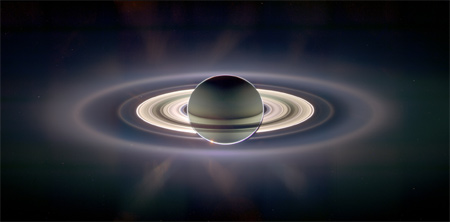
The Bad Astronomer had a post about this image. When I saw it, I stayed up way past my bedtime to fiddle and fuss and made a 13"x19" photo inkjet print of it. Absolutely gwarjiss!
See The Bad Astronomer's post for details of how the photograph was taken. It's not a Photoshop illustration or a manifestation of CGI. But it is evocative of space explosions as envisioned by artists at Industrial Light and Magic. Think Star Trek VI opening scene or Star Wars IV ("Special Edition") Death Star explosion. There is something visually appealing (if not necessarily physics-ly appropriate) about an equatorial ring being thrown radially outward.
Sunday, October 01, 2006
The first law before Sir Isaac
Sorry about the absence. Between moving, a PhyzVan failure, a workshop, moving, a wedding, and moving, the blog had to simmer.
When teaching the concepts and subtleties of inertia and Newton's first law, I like to include some information on the understanding of the first law before the time of Newton. So I include a few relevant historical references.
1. "The cessation of motion is due to the opposing force…. If there is no opposing force…the motion will never stop."
2. "It is impossible to say why a body that has been set in motion in a vacuum should ever come to rest; why, indeed, should it come to rest at one place rather than at another. As a consequence, it will either necessarily stay at rest or, if in motion, will move indefinitely unless some obstacle comes into collision with it."
Both references precede Newton's Principia by about 2000 years.
Reference 1 comes from the Mo Ching, published in China approximately 2400 years ago. The source of reference 2 is a little more shocking.
When posed to groups of physics education professionals, I've never had anyone correctly identify the source. Some guess Newton, others guess Galileo. And these are smart people--many of them much, much smarter than I'll ever be. I'm pretty sure many of them don't believe me when I tell them the source.
The point of the lesson is a fundamental truth stated eloquently by Alfred North Whitehead: "Everything of importance has been said before by someone who did not discover it."
When teaching the concepts and subtleties of inertia and Newton's first law, I like to include some information on the understanding of the first law before the time of Newton. So I include a few relevant historical references.
1. "The cessation of motion is due to the opposing force…. If there is no opposing force…the motion will never stop."
2. "It is impossible to say why a body that has been set in motion in a vacuum should ever come to rest; why, indeed, should it come to rest at one place rather than at another. As a consequence, it will either necessarily stay at rest or, if in motion, will move indefinitely unless some obstacle comes into collision with it."
Both references precede Newton's Principia by about 2000 years.
Reference 1 comes from the Mo Ching, published in China approximately 2400 years ago. The source of reference 2 is a little more shocking.
When posed to groups of physics education professionals, I've never had anyone correctly identify the source. Some guess Newton, others guess Galileo. And these are smart people--many of them much, much smarter than I'll ever be. I'm pretty sure many of them don't believe me when I tell them the source.
The point of the lesson is a fundamental truth stated eloquently by Alfred North Whitehead: "Everything of importance has been said before by someone who did not discover it."
Wednesday, September 13, 2006
I'm done with kinematics
When I started teaching high school physics (during the Reagan Administration), I felt an obligation to "reinvent the wheel." I didn't blindly follow the sequence of chapters laid out by whatever textbook the school had. I was in charge of the curriculum! I wrote my own handouts, homework, tests, etc.
But what I turned out was a pretty true reflection of the introductory college courses I had most recently finished. Mostly the same topics. Mostly the same sequence. It wasn't so different from the textbook's sequence.
I had a whole unit on vectors. It followed my robust unit on "preliminaries" (scientific notation and so on). After vectors was the Month of Kinematics. One-dimensional, two-dimensional; graphical and algebraic. Ticker-tapes, falling bodies, the monkey gun... what's not to love.
The trees were losing their leaves before any mention of Newton was made in my class.
But I noticed a few things. My students never thrilled to the lessons of kinematics as I did. It's difficult, abstract material if you go into deeply. It took the human intellect about 2000 years to figure this stuff out. And we start the year in physics with it. And the year usually ran out before we got to how rainbows work or why the sky is blue.
I was thinking about slimming down my kinematics coverage when I saw Paul Hewitt refer to kinematics as a "black hole" in a Physics Teacher editorial.
Now I speed through motion. I cover it as much as I think it needs to be covered, then move on. (Sorry about the puns, but I'm a physics teacher; we breathe puns the way most people breathe air.) Newton's name will be uttered into air that could be 100F here in Sacramento. The leaves are still green in New England.
There are other ways to handle the problem of not getting to rainbows. The original PSSC program started the year with optics, an approach that galvanized a following even after PSSC abandoned it.
My point is to go easy on kinematics in particular and mechanics in general. First-year high school physics students don't need it to that depth.
The first year I went with the slimmed down kinematics, I held my breath and wondered which part of the sky would fall down. When June rolled around, I noticed that the whole sky was still up. And my students knew why it was blue.
But what I turned out was a pretty true reflection of the introductory college courses I had most recently finished. Mostly the same topics. Mostly the same sequence. It wasn't so different from the textbook's sequence.
I had a whole unit on vectors. It followed my robust unit on "preliminaries" (scientific notation and so on). After vectors was the Month of Kinematics. One-dimensional, two-dimensional; graphical and algebraic. Ticker-tapes, falling bodies, the monkey gun... what's not to love.
The trees were losing their leaves before any mention of Newton was made in my class.
But I noticed a few things. My students never thrilled to the lessons of kinematics as I did. It's difficult, abstract material if you go into deeply. It took the human intellect about 2000 years to figure this stuff out. And we start the year in physics with it. And the year usually ran out before we got to how rainbows work or why the sky is blue.
I was thinking about slimming down my kinematics coverage when I saw Paul Hewitt refer to kinematics as a "black hole" in a Physics Teacher editorial.
Now I speed through motion. I cover it as much as I think it needs to be covered, then move on. (Sorry about the puns, but I'm a physics teacher; we breathe puns the way most people breathe air.) Newton's name will be uttered into air that could be 100F here in Sacramento. The leaves are still green in New England.
There are other ways to handle the problem of not getting to rainbows. The original PSSC program started the year with optics, an approach that galvanized a following even after PSSC abandoned it.
My point is to go easy on kinematics in particular and mechanics in general. First-year high school physics students don't need it to that depth.
The first year I went with the slimmed down kinematics, I held my breath and wondered which part of the sky would fall down. When June rolled around, I noticed that the whole sky was still up. And my students knew why it was blue.
Monday, September 11, 2006
Where were the psychics on 9/10?
I know I appear to harp on the poor psychics more than they merit. But do I really? They continue to get thoroughly credulous coverage in the popular press. On Oprah. On Montell. On Larry King. On the Eleven O'Clock News. On The Medium! And so on. It seems to me that science teachers have an obligation to cast a little light into the demon-haunted world whenever they can. (If my students know KE=1/2mv^2 but call up the Psychic Friends to inquire about the future, have I done my job?)
So where were the psychics, clairvoyants, etc., on 9/10/01? Did the events of the next day not register on their radars? Was the attack not significant enough to carry psychic energy (or whatever) through the temporal aether to them?
With their vast abilities to "see" and "feel," how did they miss something so huge?
Are fabricated Nostradamus quatrains the best they can do? (After-the-fact, as is always the case with Notradamus.)
I'll pose the question--simply as a question to be pondered by anyone who doesn't see that "real psychic" is an oxymoron. I'll pose it in class. Not on 9/11. That day is reserved for other things. But it's a fair question on 9/12.
Where were the psychics on 9/10?
So where were the psychics, clairvoyants, etc., on 9/10/01? Did the events of the next day not register on their radars? Was the attack not significant enough to carry psychic energy (or whatever) through the temporal aether to them?
With their vast abilities to "see" and "feel," how did they miss something so huge?
Are fabricated Nostradamus quatrains the best they can do? (After-the-fact, as is always the case with Notradamus.)
I'll pose the question--simply as a question to be pondered by anyone who doesn't see that "real psychic" is an oxymoron. I'll pose it in class. Not on 9/11. That day is reserved for other things. But it's a fair question on 9/12.
Where were the psychics on 9/10?
Saturday, September 09, 2006
Quick Preso on the "Psychic Sketch"
The link below will take you to an interactive QuickTime presentation (export from Apple Keynote). It's slimmed down from the one I used in class to make it a quick download. The original included groovier transitions and build animations, and full audio for Gary Numan's "Cars."
Th!nk About It: Psychic Sketch
The presentation is done in the minimalist style that I prefer. It's all about the images. You can make up your own script based on the images. Mine went something like this
[Begin]
Title Page >
1. Who's this? >
Does this help? >
What do you think? >
Actually, it's supposed to be a sketch of him >
Good match? Bad match? >
2. News10 said this >
>
3. Here's a story from Denver >
>
4. And from New York >
5. I think this is a better match >
Gary Numan! >
Answer 3 of these 5 questions >
< > < >
> [End]
Th!nk About It: Psychic Sketch
The presentation is done in the minimalist style that I prefer. It's all about the images. You can make up your own script based on the images. Mine went something like this
[Begin]
Title Page >
1. Who's this? >
Does this help? >
What do you think? >
Actually, it's supposed to be a sketch of him >
Good match? Bad match? >
2. News10 said this >
>
3. Here's a story from Denver >
>
4. And from New York >
5. I think this is a better match >
Gary Numan! >
Answer 3 of these 5 questions >
< > < >
> [End]
Tuesday, September 05, 2006
Physics Begins With an "M"
A friend recently wrote me a kind note about the "First Day of School" post. In my response, I recalled the role that John Jewett's Physics Begins With an "M" played in the formulation of my first-day lesson plan. Jewett's idea is to introduce each new unit/section/topic/chapter with a small set of "M's." The M's are Mysteries, Magic, and Myth. The intent is plant to seeds of curiosity in students' heads. Each of Jewett's entries has a setup statement or question, then a subsequent response/answer.
Mysteries might include "Why is the sky blue" or "How do magnets work" or "How might you survive if your parachute doesn't deploy." Magic might include "Watch a test tube 'disappear' when placed in cooking oil," or "Use ice to start a fire." Myths might include "Astronauts in space are weightless because they are beyond the earth's atmosphere," or "Cats can see in the dark," or "Power is the rate at which work is done," or "Absolute zero is the temperature at which all molecular motion ceases." As a teacher, you cobble a small set of M's relevant to the topic you're about to teach, and present it before launching into the unit. On the first day of school, I present a large set spanning topics for the whole year. All questions. No answers. But with the promise that all will be answered before the year is out.
Another way I've used the book is as a source of extra-credit or lab make-up projects. A student will select an M and take home a photocopy of the text question/statement and the response/answer. They must then translate the text into the language they are studying at school (French or Spanish at Rio Americano). Then the student creates a poster with the translated text, splashy graphics, and a translation of "Take Physics: Understand the Universe" in big letters at the bottom. I get the poster, and give it to the appropriate language teacher to see if the translation is OK, then ask them to hang the poster in their classroom. Instant advertising for the physics program! AND cross-curricular synergy (or paradigm-shift, or whatever the latest buzzword is).
Jewett's original title was published b y a company that did an excellent job of keeping the book a secret. It's now available as World of Physics: Mysteries, Magic, and Myth. Get it! You'll use it all year long.
Since I'm recommending a book and I'll never have a MySpace page, let me make a few recommendations in the area of pop culture.. First, go see Little Miss Sunshine. In a theater populated with other people. Don't wait to rent it. The crowd reactions are part of the fun. As for music, you should all be listening to Zero 7, Corinne Bailey Rae, Los Lonely Boys, and Leigh Nash. Don't let yourself get stuck in the 70s (Rick), 80s (Bryce), or even the 90s (Linsey). C'mon, peeps, move into the 2000s! (/mySpace)

Mysteries might include "Why is the sky blue" or "How do magnets work" or "How might you survive if your parachute doesn't deploy." Magic might include "Watch a test tube 'disappear' when placed in cooking oil," or "Use ice to start a fire." Myths might include "Astronauts in space are weightless because they are beyond the earth's atmosphere," or "Cats can see in the dark," or "Power is the rate at which work is done," or "Absolute zero is the temperature at which all molecular motion ceases." As a teacher, you cobble a small set of M's relevant to the topic you're about to teach, and present it before launching into the unit. On the first day of school, I present a large set spanning topics for the whole year. All questions. No answers. But with the promise that all will be answered before the year is out.
Another way I've used the book is as a source of extra-credit or lab make-up projects. A student will select an M and take home a photocopy of the text question/statement and the response/answer. They must then translate the text into the language they are studying at school (French or Spanish at Rio Americano). Then the student creates a poster with the translated text, splashy graphics, and a translation of "Take Physics: Understand the Universe" in big letters at the bottom. I get the poster, and give it to the appropriate language teacher to see if the translation is OK, then ask them to hang the poster in their classroom. Instant advertising for the physics program! AND cross-curricular synergy (or paradigm-shift, or whatever the latest buzzword is).
Jewett's original title was published b y a company that did an excellent job of keeping the book a secret. It's now available as World of Physics: Mysteries, Magic, and Myth. Get it! You'll use it all year long.
Since I'm recommending a book and I'll never have a MySpace page, let me make a few recommendations in the area of pop culture.. First, go see Little Miss Sunshine. In a theater populated with other people. Don't wait to rent it. The crowd reactions are part of the fun. As for music, you should all be listening to Zero 7, Corinne Bailey Rae, Los Lonely Boys, and Leigh Nash. Don't let yourself get stuck in the 70s (Rick), 80s (Bryce), or even the 90s (Linsey). C'mon, peeps, move into the 2000s! (/mySpace)
Subscribe to:
Posts (Atom)