Fun stuff from Earth Unplugged via NPR's Science Friday's Facebook page.
Amazing bead chain experiment in slow motion - Slo Mo #19 - Earth Unplugged
I'm not sure what meaningful high school physics pedagogy is here. For now it's mainly "gee whiz" cool.
Not that there's anything wrong with that.
UPDATE: Bead chain seems to be more commonly referred to as ball chain. If you look for it, it will be listed with a size. The sizing regimen is one of direct proportionalities (unlike wire gauge). Here's a handy guide page: Ball Chain Sizes. The chain in the video looks to be about size 10, but that's a mere guess on my part. And I'm not always the best guesser.
UPDATE 2: Further research shows my size guess was correct. More ball chain goodness can be found at The Kids Should See This. Empirical Zeal's robust analysis merits a link!
Sunday, June 30, 2013


Soap bubble formula
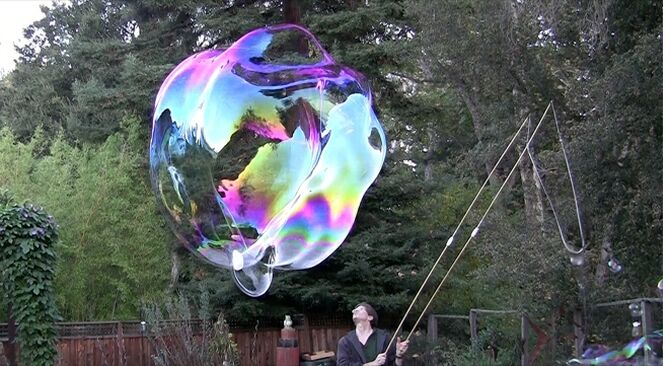
When ExploratoRio rolls around, I worry about the bubble exhibits. The bubble formulas given in the original recipes were developed in the 1990s, before dishwashing detergents were concentrated and who knows what else.
At last year's High School Share-a-thon (AAPT's national meeting Show & Tell), Chicago-area physics teacher shared a link to a site that seems devoted with keeping up with the latest on soap bubble solutions.
Soap Bubble Wiki
What will be shared at this year's share-a-thon? We'll find out at the 2013 AAPT Summer Meeting in Portland. The share-a-thon is scheduled for Sunday, July 14, 6pm-8pm in the Hilton's Broadway III/IV.
Saturday, June 29, 2013
Standing. Water. Waves.
My students, Andrew Stephens, Joey Cozza, and Jeric Rocamora are highly accomplished musicians. They were inspired to blend physics, music, waves, and optics by something they saw on the Internet.
Here's the video record of their inspired work.
Physics - Waves Water Experiment
Pretty groovy, right?
Of course, you don't see these structures when watching with the naked eye. You only see them when they are captured in frame-rate-specific video.
The iPhone app they were using is the free FreqGen.
Here is the video that inspired them.
Amazing Water & Sound Experiment #2
I think this one benefits from brighter ambient light. This allows a faster shutter speed. Filming at 24 fps doesn't mean the shutter is set to 1/24th of a second. And a faster shutter (1/500 s) allows for a sharper capture.
When I first saw this, it wasn't clear to me what was going on. And it's not unhealthy to assume anything that looks supernaturally groovy on YouTube is likely a fake. Captain Disillusion debunks video fakery all the time.
But what we're seeing in these videos is artfully captured stroboscopic effect. The classic example is the wagon-wheel effect. Here's a nice video of an "impossible helicopter." The wagon wheel effect is not the same thing as the rolling shutter artifact.
Here's a thorough explanation of the difference between the classic wagon wheel effect and the newer rolling shutter artifact.
I'm pretty sure I promised them a post on The Blog of Phyz. Consider yourselves famous, guys! You even scored the highly-coveted "groovy" tag.
Here's the video record of their inspired work.
Physics - Waves Water Experiment
Pretty groovy, right?
Of course, you don't see these structures when watching with the naked eye. You only see them when they are captured in frame-rate-specific video.
The iPhone app they were using is the free FreqGen.
Here is the video that inspired them.
Amazing Water & Sound Experiment #2
I think this one benefits from brighter ambient light. This allows a faster shutter speed. Filming at 24 fps doesn't mean the shutter is set to 1/24th of a second. And a faster shutter (1/500 s) allows for a sharper capture.
When I first saw this, it wasn't clear to me what was going on. And it's not unhealthy to assume anything that looks supernaturally groovy on YouTube is likely a fake. Captain Disillusion debunks video fakery all the time.
But what we're seeing in these videos is artfully captured stroboscopic effect. The classic example is the wagon-wheel effect. Here's a nice video of an "impossible helicopter." The wagon wheel effect is not the same thing as the rolling shutter artifact.
Here's a thorough explanation of the difference between the classic wagon wheel effect and the newer rolling shutter artifact.
I'm pretty sure I promised them a post on The Blog of Phyz. Consider yourselves famous, guys! You even scored the highly-coveted "groovy" tag.
Tuesday, June 18, 2013
Classroom Skepticism at AAPT Portland 2013

W42: Skepticism in the Classroom - Sunday, July 14 - Portland State University - SRTC 247
(scrolling required)
There will be a variety of lessons, appropriate for the physics classroom, that focus on the skeptical and critical thinking nature of science. Some lessons involve obvious physics content; some bring in examples from the real world. Participants will leave with ready-to-use lessons and resources designed to bring healthy, scientific skepticism to their classrooms—lessons that slip into content-based instruction without disruption. Topics include fire walking, ghosts and angels, balance bracelets, pareidolia, back masking, media credulity, and more.
You'll laugh, you'll wince, and your jaw may fall a time or two. My initial take on NGSS is that there will be room for and demand for lessons like this in the physics (and other sciences) curriculum.
Monday, June 17, 2013
PhyzFlop: My errant T-shirt design
AAPT is holding a T-shirt design contest for the Summer Meeting in Portland. So I thought I'd give it a go. The simple requirements were that the design must include
1) Some thing related to physics (literal or abstract)
2) The words "2013 AAPT Summer Meeting July 13-17, 2013"
3) BONUS: Something Portland, Oregon-related

Fair enough. I came up with something I liked, then checked the detailed requirements. They included that the design include no more than three colors. Ouch. Disqualified!
But I kinda like what I came up with and decided I'd make one for myself at Zazzle. I also departed from the requirement to double-down on references to "2013".
I posted it to my Zazzle store and will give you $5 if you find me at AAPT Portland while wearing a shirt with this design that you bought from my store at Zazzle. And I will add your name to this post! Yeah, I'm pretty sure crispy Abes are safe and sound.
Update: D-oh! Zazzle won't let me offer the shirt at my Zazzle store. I've offended their sensibilities somehow.
1) Some thing related to physics (literal or abstract)
2) The words "2013 AAPT Summer Meeting July 13-17, 2013"
3) BONUS: Something Portland, Oregon-related

Fair enough. I came up with something I liked, then checked the detailed requirements. They included that the design include no more than three colors. Ouch. Disqualified!
But I kinda like what I came up with and decided I'd make one for myself at Zazzle. I also departed from the requirement to double-down on references to "2013".
I posted it to my Zazzle store and will give you $5 if you find me at AAPT Portland while wearing a shirt with this design that you bought from my store at Zazzle. And I will add your name to this post! Yeah, I'm pretty sure crispy Abes are safe and sound.
Update: D-oh! Zazzle won't let me offer the shirt at my Zazzle store. I've offended their sensibilities somehow.
Wednesday, June 12, 2013
Baker Street: El Camino physics teacher honored by AMTA

The American Modeling Teachers Association (AMTA) recognized the El Camino High School teacher as winner of its April Apparatus competition.
El Camino teacher earns nod for innovative "street sled" lessons
Design and instructional details are posted at the AMTA's site.
Congratulations, Bob!
Groovy video tricks: Motion amplification
Exaggerating color changes at the pixel level reveals "microscopic" motion. It's all explained in the video! Hat tip to Laura Nickerson.
They say that some things once seen cannot be unseen. Now some things unseen can be seen.
They say that some things once seen cannot be unseen. Now some things unseen can be seen.
Canvas to Keynote conversions: Year One
Among the cornucopia of benefits that flow from hosting a blog is the production of a post that is certain to mean nothing to anyone but you. You do it because the subject matter is so central to your life that you cannot fathom how devoid of meaning it is to everyone not currently wearing your underwear.
It is in that spirit that I offer an update on the progress I'm making in the process of converting my curriculum materials from Canvas documents to Keynote documents. The history of this issue was discussed in a previous post. In short, I'm converting the onerously voluminous collection of instructional pages from ACD Canvas to Apple Keynote. Each document requires considerable time and energy to convert. The work is painstaking and tedious. But it also keeps each document alive and editable.
I teach two courses: Physics and AP Physics. Each has 12 units. Each unit has three general components of instructional materials: Guides, Jobs, and Labs.
Two courses x 12 x 3 components = 72 folders of documents. Thirty-six for each course. Some folders hold more documents than others.
At the outset, I faced a sea of red. Red indicating a folder with more than three documents remaining to be converted.

After a year of converting documents whenever possible, I've made some headway. More in Physics than in AP Physics. But progress nonetheless.

In Physics 23 of 36 folders are converted: nearly 2/3rds. In AP, only eight of 36 (less than 1/4) folders are done. Completed folders are shown in green. (Orange is "close" and yellow is "really close".)
When it's nothing but green, my work here will be done. At this point, there are miles to go before I sleep.
UPDATE 6/22/13: Progress (Physics: 26/36 done)

UPDATE 7/4/13: The glacier advances (Physics 29/36 complete; first semester clear). Document count added for additional amusement.

It is in that spirit that I offer an update on the progress I'm making in the process of converting my curriculum materials from Canvas documents to Keynote documents. The history of this issue was discussed in a previous post. In short, I'm converting the onerously voluminous collection of instructional pages from ACD Canvas to Apple Keynote. Each document requires considerable time and energy to convert. The work is painstaking and tedious. But it also keeps each document alive and editable.
I teach two courses: Physics and AP Physics. Each has 12 units. Each unit has three general components of instructional materials: Guides, Jobs, and Labs.
Two courses x 12 x 3 components = 72 folders of documents. Thirty-six for each course. Some folders hold more documents than others.
At the outset, I faced a sea of red. Red indicating a folder with more than three documents remaining to be converted.

After a year of converting documents whenever possible, I've made some headway. More in Physics than in AP Physics. But progress nonetheless.

In Physics 23 of 36 folders are converted: nearly 2/3rds. In AP, only eight of 36 (less than 1/4) folders are done. Completed folders are shown in green. (Orange is "close" and yellow is "really close".)
When it's nothing but green, my work here will be done. At this point, there are miles to go before I sleep.
UPDATE 6/22/13: Progress (Physics: 26/36 done)

UPDATE 7/4/13: The glacier advances (Physics 29/36 complete; first semester clear). Document count added for additional amusement.

Tuesday, June 11, 2013
This Saturday: SkeptiCal in Berkeley

But I can still get my "skepticon" on at SkeptiCal13. It's happening this Saturday, June 15, at the Berkeley Marina Doubletree.
Great speakers, including Eugenie Scott, D.J. Grothe, Julia Galef, and James Randi (via Skype).
A busy day is planned. Check this schedule.
I am registered and raring to go.
Friday, June 07, 2013
Motors cardboard balls motion noise light space ART
The Festival of the Arts opens in my home town of Grand Rapids today. With a hat tip to College of Curiosity's Jeff Wagg, I share this in the spirit of physics and art. The lens work is also praise-worthy. To me, it brings to mind Koyaanisqatsi and Baraka.
Subscribe to:
Comments (Atom)