Sunday, October 30, 2011


Silent upgrades: The SVGA to WXSGA+ edition
When I began authoring Keynote presentations in the early 2000's, I went with the slide resolution/size of 800x600 pixels. VGA was 640x480, and who would ever need more resolution than could be shown on a TV screen? I figured I was future-proofing by dialing the resolution up a notch to SVGA, knowing full well that the resulting documents would have larger file sizes.
As fortune would have it, things change. I noticed that the interactive QuickTime files I created from my Keynote presos looked a little chunky when projected digitally. Keynote uprezzes presos to match the projector's capabilities pretty well, but QuickTime isn't as clever. (Neither was I for not knowing that.)
Last year, I began transforming my 800x600 presos to 1680x1050 (WXSGA+). The new aspect is a better match to the MacBook Pro's own display (no black bars). Keynote does its best to scale everything up. But with animations and grouped objects, it doesn't always work out. So tweaking has to be done. Sometimes, the tweaking is nontrivial.
I launched a raft of updates into the momentum unit. And into the UCM/gravity unit before that, and into the Newton's laws and motion units, too. I tag the links with an "HD" when I remember to. If you've been using the old presos, feel free to grab the new versions. The files are bigger, but the added resolution is worth the wait!
As fortune would have it, things change. I noticed that the interactive QuickTime files I created from my Keynote presos looked a little chunky when projected digitally. Keynote uprezzes presos to match the projector's capabilities pretty well, but QuickTime isn't as clever. (Neither was I for not knowing that.)
Last year, I began transforming my 800x600 presos to 1680x1050 (WXSGA+). The new aspect is a better match to the MacBook Pro's own display (no black bars). Keynote does its best to scale everything up. But with animations and grouped objects, it doesn't always work out. So tweaking has to be done. Sometimes, the tweaking is nontrivial.
I launched a raft of updates into the momentum unit. And into the UCM/gravity unit before that, and into the Newton's laws and motion units, too. I tag the links with an "HD" when I remember to. If you've been using the old presos, feel free to grab the new versions. The files are bigger, but the added resolution is worth the wait!
Fall NCNAAPT Conference @ UCB this Friday and Saturday!
Complete details can be found at the NCNAAPT website.
Some quick highlights:
· UC Berkeley Physics demo show Friday night.
· Noted "climate skeptic," Richard Muller, speaks Saturday morning on his course/book, "Physics For Future Presidents."
Check out the rest of the program on this PDF, and schedule your travel plans accordingly.
Quadruple rainbow observed and shot
I am late to this post, but within the calendar month of the news. I'm slow! But many of these items I post so I can easily find them later.
In any event, here's the fairly undramatic photo:

MSNBC's story at the end of this link explains why the photo doesn't knock your socks off. The BBC's take is here.
One thing to notice, the camera is aimed sunward.
I give a fairly robust lesson in the physics and geometry of rainbows. You should be able to find the materials at these links:
1. "Understanding Rainbows" Springboard (student worksheet)
2. "Understanding Rainbows" Springboard (answers)
3. "Understanding Rainbows" Presentation (interactive QuickTime)
Among the things we learn: the primary rainbow shows up at about 40°-42° around the anti-solar direction, and the secondary is out at 51°-53°. We look away from the sun to see such rainbows.
The geometry of the tertiary rainbow places it 38°-43° from the solar direction. The quaternary rainbow is similarly sunward.
Images of the tertiary and quaternary rainbows are reminiscent of the discovery of the outermost planets. Photographers aim their cameras to where the faint rainbows should be, Without seeing the rainbows with their own eyes, they shoot the images nonetheless. They then post-process the hell out of the images, beefing up contrast and saturation. And voila! Third/fourth order rainbows are revealed.
In any event, here's the fairly undramatic photo:

MSNBC's story at the end of this link explains why the photo doesn't knock your socks off. The BBC's take is here.
One thing to notice, the camera is aimed sunward.
I give a fairly robust lesson in the physics and geometry of rainbows. You should be able to find the materials at these links:
1. "Understanding Rainbows" Springboard (student worksheet)
2. "Understanding Rainbows" Springboard (answers)
3. "Understanding Rainbows" Presentation (interactive QuickTime)
Among the things we learn: the primary rainbow shows up at about 40°-42° around the anti-solar direction, and the secondary is out at 51°-53°. We look away from the sun to see such rainbows.
The geometry of the tertiary rainbow places it 38°-43° from the solar direction. The quaternary rainbow is similarly sunward.
Images of the tertiary and quaternary rainbows are reminiscent of the discovery of the outermost planets. Photographers aim their cameras to where the faint rainbows should be, Without seeing the rainbows with their own eyes, they shoot the images nonetheless. They then post-process the hell out of the images, beefing up contrast and saturation. And voila! Third/fourth order rainbows are revealed.
Saturday, October 15, 2011
I'm done with Motion and Forces
And I'm already behind.
California's Standard Set 1 is "Motion and Forces." It covers basic kinematics, Newton's laws, circular motion, and gravity. And it constitutes 20% of the California Standards Test. A case could be made that Motion and Forces should therefore occupy 20% of one's year-long physics schedule. If the school year is 180 days, Motion and Forces should be the topic for 36 days.
We hit 36 days of instruction this week. And we finished our unit on UCM & Gravity this week. It would appear that I'm right on schedule.
But I'm not. I'm behind.
CSTs are not administered following 180 days of instruction. They are given after about 140 days of instruction. For us, that's mid- to late-April.
So only 28 days should have been devoted to Motion and Forces. I should already be deep into Standard Set 2: Conservation of Energy and Momentum.
As it is, I teach California's 9-12 Physics Standards across a 180-day schedule rather than the artificially-imposed 140-day schedule.
Even at my relatively slow pace, I get the sense that I'm out in front of many physics teachers. We tend to be big fans of Motion and Forces. Many choose to plumb Motion and Forces to depths far beyond what the state of California asks for.
I'm willing to let the state provide guidance on which topics to teach. I am employed by the state to teach physics, so I teach the physics the state asks me to teach.
But I can't bring myself to squeeze all that content into 140 days of a 180-day school year. The STAR testing schedule forces testing to be done in April for the convenience of the Department of Education and their testing contractor. The timetable is artificial and pedagogically meaningless, so I don't adhere to it.
California's Standard Set 1 is "Motion and Forces." It covers basic kinematics, Newton's laws, circular motion, and gravity. And it constitutes 20% of the California Standards Test. A case could be made that Motion and Forces should therefore occupy 20% of one's year-long physics schedule. If the school year is 180 days, Motion and Forces should be the topic for 36 days.
We hit 36 days of instruction this week. And we finished our unit on UCM & Gravity this week. It would appear that I'm right on schedule.
But I'm not. I'm behind.
CSTs are not administered following 180 days of instruction. They are given after about 140 days of instruction. For us, that's mid- to late-April.
So only 28 days should have been devoted to Motion and Forces. I should already be deep into Standard Set 2: Conservation of Energy and Momentum.
As it is, I teach California's 9-12 Physics Standards across a 180-day schedule rather than the artificially-imposed 140-day schedule.
Even at my relatively slow pace, I get the sense that I'm out in front of many physics teachers. We tend to be big fans of Motion and Forces. Many choose to plumb Motion and Forces to depths far beyond what the state of California asks for.
I'm willing to let the state provide guidance on which topics to teach. I am employed by the state to teach physics, so I teach the physics the state asks me to teach.
But I can't bring myself to squeeze all that content into 140 days of a 180-day school year. The STAR testing schedule forces testing to be done in April for the convenience of the Department of Education and their testing contractor. The timetable is artificial and pedagogically meaningless, so I don't adhere to it.
Sunday, October 02, 2011
Web Video for the Classroom page updated
One of the many consequences of my undiagnosed OCD is a need to keep a web page holding links to the many videos I like to use in class at just the right moment. As more videos come online, I update the page.
I'm not sure I provided a space for all the treasures I found since last October, but it seems I have a distinct need to update the page following PTSOS1 each year. Since PTSOS1 was yesterday, today I offer the updated web video page!
The oldies are all there for your convenience. "New ones" found since last year have been added and tagged appropriately, I hope. Each entry has a thumbnail embedded video. The subsequent title is linked to the source page. (Yes, I'm hot-sourcing, so links may go dead. I recommend you download copies onto your own storage device.) There is also a link to the corresponding Blog of Phyz entry and/or curriculum materials where available.
If you find yourself with time to kill, check these out.
Web Video for the Classroom
There's also more video fun at my page for
Skepticism in the Classroom.
1. Enjoy and
2. Send me links of groovy videos I should have included!
3. Feel free to remind me what videos I posted to the blog but haven't archived on this page.
I'm not sure I provided a space for all the treasures I found since last October, but it seems I have a distinct need to update the page following PTSOS1 each year. Since PTSOS1 was yesterday, today I offer the updated web video page!
The oldies are all there for your convenience. "New ones" found since last year have been added and tagged appropriately, I hope. Each entry has a thumbnail embedded video. The subsequent title is linked to the source page. (Yes, I'm hot-sourcing, so links may go dead. I recommend you download copies onto your own storage device.) There is also a link to the corresponding Blog of Phyz entry and/or curriculum materials where available.
If you find yourself with time to kill, check these out.
Web Video for the Classroom
There's also more video fun at my page for
Skepticism in the Classroom.
1. Enjoy and
2. Send me links of groovy videos I should have included!
3. Feel free to remind me what videos I posted to the blog but haven't archived on this page.
Saturday, September 24, 2011
Faster-than-light neutrinos
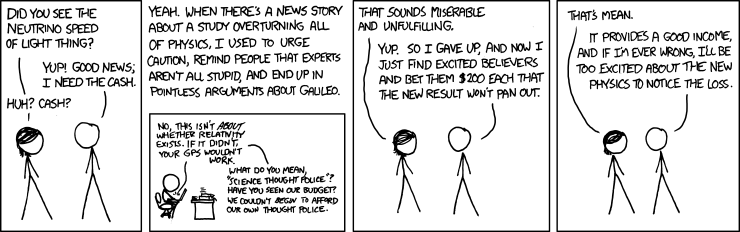
The big science news of the week has been the report of neutrinos traveling faster than light.
The mainstream media has framed the story as the downfall of "Einstein's most trusted theories," a violation of a "cardinal rule of physics" and the like. I suspect some outlets have trained cameras on the 13th floor of science buildings, waiting to capture images of scientists throwing themselves to their deaths over the news.
Physicist had it wrong all this time. How could they lie to us like that? Is ∑F=ma true, or just another lie coming from Big Physics?
It's mostly nonsense, of course. But apparently it's the only way you can run a story about physics research in the mainstream media.
One might reasonably wonder who's behind this physics-shattering research. Is it those pesky chemists with their "central science" braggadocio? Or wore yet: reality-denying economists? Of course not. It's physicists. And they're doing science. And if the science they do leads to a model better than the one we use now, then... well, that's how science works. Just as it did when evolutionists destroyed Piltdown Man. (Creationists could never have destroyed Piltdown Man because they are unfamiliar with the methods of science.)
There are no cardinal rules in science. No immutable laws etched into the stone permanence. There is a process for tentative acceptance or rejection: the process of science. (Not the "scientific method" cleanly described the first chapter of pre-college science textbooks, mind you. That's an unrealistic and simplified distillation not actually practiced by scientists.)
May people think there are laws in science. Permanent, perfect, and absolute truths that explain a whole set of observations. I was recently scolded for this notion by a commenter on a right-wing blog who educated me on the fact that Newtonian Gravity had achieved "law" status, by someone who was clearly not familiar with General Relativity.
We do a disservice to the essence of science when we invoke the term "law." No principle in science is safe from attack, dismemberment, and replacement. And we like it that way. We work to produce the best model we can. But nothing is considered permanent.
If Special Relativity must be discarded into the dustbin of science, it can keep company with the luminiferous aether, phlogiston, and so on. And science will rejoice and be happy in it.
Then again. and I hate to even mention this while the big media ballyhoo still lingers in the air, it might be there was an error somewhere in the faster-than-light neutrino study. If that turns out to be the case, don't look for article in the mainstream media detailing where the research went wrong. There's no sexy there. No collapsing pillars of science imagery to evoke. And how many column-inches is anyone going to devote to "oops" or "never mind"?
As ever, xkcd sums it up nicely (click to embiggen):

The mainstream media has framed the story as the downfall of "Einstein's most trusted theories," a violation of a "cardinal rule of physics" and the like. I suspect some outlets have trained cameras on the 13th floor of science buildings, waiting to capture images of scientists throwing themselves to their deaths over the news.
Physicist had it wrong all this time. How could they lie to us like that? Is ∑F=ma true, or just another lie coming from Big Physics?
It's mostly nonsense, of course. But apparently it's the only way you can run a story about physics research in the mainstream media.
One might reasonably wonder who's behind this physics-shattering research. Is it those pesky chemists with their "central science" braggadocio? Or wore yet: reality-denying economists? Of course not. It's physicists. And they're doing science. And if the science they do leads to a model better than the one we use now, then... well, that's how science works. Just as it did when evolutionists destroyed Piltdown Man. (Creationists could never have destroyed Piltdown Man because they are unfamiliar with the methods of science.)
There are no cardinal rules in science. No immutable laws etched into the stone permanence. There is a process for tentative acceptance or rejection: the process of science. (Not the "scientific method" cleanly described the first chapter of pre-college science textbooks, mind you. That's an unrealistic and simplified distillation not actually practiced by scientists.)
May people think there are laws in science. Permanent, perfect, and absolute truths that explain a whole set of observations. I was recently scolded for this notion by a commenter on a right-wing blog who educated me on the fact that Newtonian Gravity had achieved "law" status, by someone who was clearly not familiar with General Relativity.
We do a disservice to the essence of science when we invoke the term "law." No principle in science is safe from attack, dismemberment, and replacement. And we like it that way. We work to produce the best model we can. But nothing is considered permanent.
If Special Relativity must be discarded into the dustbin of science, it can keep company with the luminiferous aether, phlogiston, and so on. And science will rejoice and be happy in it.
Then again. and I hate to even mention this while the big media ballyhoo still lingers in the air, it might be there was an error somewhere in the faster-than-light neutrino study. If that turns out to be the case, don't look for article in the mainstream media detailing where the research went wrong. There's no sexy there. No collapsing pillars of science imagery to evoke. And how many column-inches is anyone going to devote to "oops" or "never mind"?
As ever, xkcd sums it up nicely (click to embiggen):
Hat tip to Bernard Cleyet.
Tuesday, September 20, 2011
You know school is in full swing when...
To some, it may be the first day of school. For others, it's Back to School Night. What annual milestone is your indication that summer is over and the school year is on "for reals"?
First progress grade reports are due? (When I started teaching, this was at the end of October. They were referred to as "Quarter Grades." This year, it's September 27. You could call them "Eighthly Grades," or "Monthly Grades," or "How did we go from 4 grading interims to 8 grading interims and how much smarter are students as a result?")
The end of the first 20 days of class leveling? (And a slowing of the revolving door.) This is the time of year when teachers announce their newest "adds" in the faculty room like old fighters showing off scars. The real problem lies in the expectation that, four weeks into the year, a teacher has some magical technique that will bring a new student from zero to completely-caught-up in short order and without pain. And without any negative consequence on that first round of eighthly grades.
First parent conference? Haven't had one (yet), but we all know that can't last.
First JB-Weld repair job? This year mine was on a Pasco Visual Accelerometer. I'm not sure how the interior thumbscrew anchor post got fractured, but it did.
In related news, I noticed the milk I bought today will not expire until after paycheck breakfast. Huzzah!
First progress grade reports are due? (When I started teaching, this was at the end of October. They were referred to as "Quarter Grades." This year, it's September 27. You could call them "Eighthly Grades," or "Monthly Grades," or "How did we go from 4 grading interims to 8 grading interims and how much smarter are students as a result?")
The end of the first 20 days of class leveling? (And a slowing of the revolving door.) This is the time of year when teachers announce their newest "adds" in the faculty room like old fighters showing off scars. The real problem lies in the expectation that, four weeks into the year, a teacher has some magical technique that will bring a new student from zero to completely-caught-up in short order and without pain. And without any negative consequence on that first round of eighthly grades.
First parent conference? Haven't had one (yet), but we all know that can't last.
First JB-Weld repair job? This year mine was on a Pasco Visual Accelerometer. I'm not sure how the interior thumbscrew anchor post got fractured, but it did.
In related news, I noticed the milk I bought today will not expire until after paycheck breakfast. Huzzah!
Thursday, September 15, 2011
Der tischdeckentrick - episches ausfallen
Michel and Sven! Will they never learn?
After my classes howled with laughter at this "epic fail," we discussed the clues to the disingenuous nature of the clip. And a good time was had by all.
We'll all remember Michel with great fondness. A student told me the two are young actors in a troupe of some sort; this was a well-choreographed skit. You'll find lesser Michel and Sven tablecloth trick "fails" on YouTube as well. Mostly they dump things onto the floor by pulling the tablecloth too slowly.
Hat tip to Richard Wiseman.
After my classes howled with laughter at this "epic fail," we discussed the clues to the disingenuous nature of the clip. And a good time was had by all.
We'll all remember Michel with great fondness. A student told me the two are young actors in a troupe of some sort; this was a well-choreographed skit. You'll find lesser Michel and Sven tablecloth trick "fails" on YouTube as well. Mostly they dump things onto the floor by pulling the tablecloth too slowly.
Hat tip to Richard Wiseman.
Subscribe to:
Posts (Atom)