The first experimenters who tried to measure the speed of light concluded that light speed was infinite. Their equipment was unequal to the task of measuring something so very fast. In v = d/t, the t was too small no matter how big they made the d.
Similarly if you were to take the ratio of effective presentations (PowerPoints) you've seen to the total number of presentations you've sen, you would be forgiven if you concluded that "effective PowerPoint" was an oxymoron. (The "effective" number too small and the "total" number total too large.)
Effective presentations do exist. Garr Reynolds hosts a weblog devoted to Presentation Zen. He offers fundamental principles for success that can be found here.
Saturday, December 20, 2008


Sunday, December 14, 2008
Thermal physics in slow motion
 Here's a generous helping of new high-speed video from my trusty Casio EX-F1. We're into thermal physics right now, so it was time to record flame, steam, and the Leidenfrost Effect as Paul Robinson demonstrated at PTSOS.
 As always, these are QuickTime clips (for better playback control and ease of downloading).
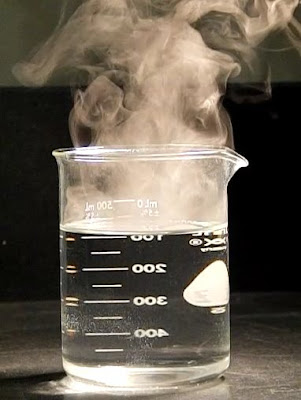 Enjoy the clips here.
Wednesday, November 26, 2008
Never so broke we can't pay the psychic
Oh the humanity! The week off has given me the chance to listen to daytime NPR. The woo seems to permeate the programming.
Here's one from today's Day to Day. Turns out the economic downturn is a bonanza for "psychics." This one tells us that her johns used to be primarily women asking about love, but are now men asking about business. She channels guides and angels from the other side to set her clients straight.
And out of consideration for the economy, she's dropped her fee from $155 to $125 per hour. How will she make ends meet? Makes you weepy, the altruism. Then again, I bet she's not sending any of her profits to the other side.
How could you, Madeleine Brand? Sure, there was a whiff of skepticism in the piece, but it was more of a straw man meant to be blown down. It amounted to a puff pice for woo.
Here's one from today's Day to Day. Turns out the economic downturn is a bonanza for "psychics." This one tells us that her johns used to be primarily women asking about love, but are now men asking about business. She channels guides and angels from the other side to set her clients straight.
And out of consideration for the economy, she's dropped her fee from $155 to $125 per hour. How will she make ends meet? Makes you weepy, the altruism. Then again, I bet she's not sending any of her profits to the other side.
How could you, Madeleine Brand? Sure, there was a whiff of skepticism in the piece, but it was more of a straw man meant to be blown down. It amounted to a puff pice for woo.
Tuesday, November 25, 2008
Scamming Granny using the first rule of cold reading
Listening to daytime NPR on my week off, and the woo jumps out of the radio.
Take this tale of woe from Talk of the Nation. Scam artist from Canada (Oh, Canada!) call numbers in the US. If the person picking up sounds elderly and female, they launch into their scam.
"Hi Grandma, it's me--your favorite grandson," they begin. They tell Granny that there in trouble up in Canada, please wire money ASAP. "And don't tell Mom and Dad; I'll be in so much trouble." Often enough, the money comes through.
You might wonder how the scammers can succeed in such cold calls without knowing so much as the name of the person they're impersonating. That's because you've never worked as a cold-reading "psychic." As is the case with Jonathan Edward and James Van Praagh, the scammers let their marks do their work for them.
"Hi Grandma, it's me--your favorite grandson!"
"I that you, Jimmy?"
"Yes Grandma; it's me, Jimmy..."
It's wrong to blame victims of crimes. But we're such easy marks. If we don't see cold-readers as scam artists, we'll be wiring that money to the Canucks in no time and with no questions asked.
Take this tale of woe from Talk of the Nation. Scam artist from Canada (Oh, Canada!) call numbers in the US. If the person picking up sounds elderly and female, they launch into their scam.
"Hi Grandma, it's me--your favorite grandson," they begin. They tell Granny that there in trouble up in Canada, please wire money ASAP. "And don't tell Mom and Dad; I'll be in so much trouble." Often enough, the money comes through.
You might wonder how the scammers can succeed in such cold calls without knowing so much as the name of the person they're impersonating. That's because you've never worked as a cold-reading "psychic." As is the case with Jonathan Edward and James Van Praagh, the scammers let their marks do their work for them.
"Hi Grandma, it's me--your favorite grandson!"
"I that you, Jimmy?"
"Yes Grandma; it's me, Jimmy..."
It's wrong to blame victims of crimes. But we're such easy marks. If we don't see cold-readers as scam artists, we'll be wiring that money to the Canucks in no time and with no questions asked.
Tuesday, November 18, 2008
High-speed water balloons in zero-g
Thanks to Rick Pam at Stanford for pointing this out to me. Über-groovy!
D-oh! The embedding code failed, so you'll have to click the link.
http://www.sciencefriday.com/videos/watch/10177
D-oh! The embedding code failed, so you'll have to click the link.
http://www.sciencefriday.com/videos/watch/10177
Predictions in review
Ah, the predictions shows. Who doesn't enjoy knowing ahead of time what is to transpire in the following year. Slight downside to the yummy predictions made by the psychics: they're generally wrong. Witness these gems from Sylvia Brown.
Tuesday, November 11, 2008
NCNAAPT Foothills meeting photos are up
 The Fall Meeting of the Northern California and Nevada Section of the American Association of Physics Teachers was held at Foothills College in Los Altos on Saturday, November 8. Here are the photos to prove it.
As is nearly always the case, the photographic conditions were less than ideal. The solution involves patience, and high ISO, noise-reduction software. To get anything worth keeping, it helps to have a zoom with significant reach.
Sunday, November 09, 2008
A body at rest tends to remain at rest
The nice thing about physics is that it's all around us. We live it. Sometimes it leads to consequences we hadn't anticipated.
Submitted for your approval: an object lesson in Newton's first law of motion, the law of inertia.
Submitted for your approval: an object lesson in Newton's first law of motion, the law of inertia.
Sunday, October 19, 2008
PTSOS1 Afterlinks 08
Here are some afterthoughts and links related to the first PTSOS New Teacher Workshop in Sacramento, held at Rio Americano High School Saturday, October 18. Most PTSOSers know about ptsos.org, ncnaapt.org, the PTSOS Yahoo Group, and phyz.org, but we blasted through some other resources as well. We cover a lot of ground at PTSOS New Teacher Workshops, so here's a list of some of the specifics that might have sneaked past you.
Steve Keith demoed Vernier Software's student-friendly Logger Pro for physics data-plotting. Steve's also a fan of Arizona State University's Modeling Workshop. And he gets pretty good mileage out of Interactive Physics. I'm impressed with the potential of IP, but I'm disappointed that they no longer support the Macintosh platform.
I mentioned ripping video from YouTube on the Mac OS X platform. In the ever-changing world of Internet applications, sometimes it's best to simply use your Google-fu. I'm currently using TubeTV (with QuickTime plug-in, Perian, installed). But it looks like there are other things out there, such as YouTube Grabber and TubeSock. If you try them, let us know how it goes.
We looked at some video clips from Physics Cinema Classics. Specifically, the "Cannonball"-related clips. I haven't been able to relocate those on YouTube (they may have been removed per copyright issues), but here's a nice substitute (in keeping with Steve Keith's advice to work cars into the curriculum). With QuickTime (free for Macs and PCs), you can step through the video, frame by frame.
In addition to the Tumble Buggy (with Keith Industries' custom battery slug), Drilled Balls, rare dart guns, and Geyser Tubes included in your Goodie Bags, we saw ideas for using a Newton's Cradle, Visual Accelerometers (and the old-school liquid accelerometer), Introductory Dynamics System, Rotating Platform. Steve demoed Falling Rhythm.
We also talked about skepticism and critical thinking. I've got a page of mini-lessons in this area. Here's a nice resource on spoon bending. It includes video of the world record spoon bending from The Amazing Meeting 6 this past summer in Las Vegas. There's an excellent episode of Nova devoted to this topics as well: James Randi's Secrets of the Psychics.
The existence of Released Test Questions from California's Physics Content Standards Test was news to some. I'll print a set for PTSOS2 participants. By then, there should be 15 more questions in the set.
Oh, and we strongly recommend attending local NCNAAPT meetings and joining the American Association of Physics Teachers (The Physics Teacher, AAPT's journal, is worth the annual dues).
Steve Keith demoed Vernier Software's student-friendly Logger Pro for physics data-plotting. Steve's also a fan of Arizona State University's Modeling Workshop. And he gets pretty good mileage out of Interactive Physics. I'm impressed with the potential of IP, but I'm disappointed that they no longer support the Macintosh platform.
I mentioned ripping video from YouTube on the Mac OS X platform. In the ever-changing world of Internet applications, sometimes it's best to simply use your Google-fu. I'm currently using TubeTV (with QuickTime plug-in, Perian, installed). But it looks like there are other things out there, such as YouTube Grabber and TubeSock. If you try them, let us know how it goes.
We looked at some video clips from Physics Cinema Classics. Specifically, the "Cannonball"-related clips. I haven't been able to relocate those on YouTube (they may have been removed per copyright issues), but here's a nice substitute (in keeping with Steve Keith's advice to work cars into the curriculum). With QuickTime (free for Macs and PCs), you can step through the video, frame by frame.
In addition to the Tumble Buggy (with Keith Industries' custom battery slug), Drilled Balls, rare dart guns, and Geyser Tubes included in your Goodie Bags, we saw ideas for using a Newton's Cradle, Visual Accelerometers (and the old-school liquid accelerometer), Introductory Dynamics System, Rotating Platform. Steve demoed Falling Rhythm.
We also talked about skepticism and critical thinking. I've got a page of mini-lessons in this area. Here's a nice resource on spoon bending. It includes video of the world record spoon bending from The Amazing Meeting 6 this past summer in Las Vegas. There's an excellent episode of Nova devoted to this topics as well: James Randi's Secrets of the Psychics.
The existence of Released Test Questions from California's Physics Content Standards Test was news to some. I'll print a set for PTSOS2 participants. By then, there should be 15 more questions in the set.
Oh, and we strongly recommend attending local NCNAAPT meetings and joining the American Association of Physics Teachers (The Physics Teacher, AAPT's journal, is worth the annual dues).
Sunday, October 12, 2008
Letting go of Newtonian mechanics
I'm finishing my unit on uniform circular motion and gravity. We'll test on that this week and move on to momentum.
In the rearview? Preliminaries, motion and inertia, force and interaction. That is, kinematics and Newton's laws. By week's end, I'll be done with the first of California's 9-12 Physics Standard Sets (Motion and Forces) and started on the second (Conservation of Energy and Momentum).
I say this as someone who will not make it through all California's Physics Standards by the time the Physics CST strikes in April.
And I say it as someone who imagines there are many California high school physics teachers out there not as far into the curriculum in mid-October. I know we all love our mechanics topics and could spend the entire year deeply immersed in them, but that typically requires sacrificing rainbows and blue skies.
It's worth mentioning The Hewitt Doctrine: "Don't Let Kinematics Become a Black Hole of Physics Instruction." Conceptual Physics author, Paul Hewitt worries that we'll spend half the year working with ticker-tape timers and increasingly trickier graphical and algebraic kinematics puzzles, only to run out of time before giving students even the most rudimentary exposure to electricity, magnetism, optics, or many other fascinating topics in introductory physics.
Conscientious physics teachers fear that without a thorough understanding of motion and forces, students will not be able to grasp subsequent topics in physics. This turns out to not be the case. Very little of the sky falls if you move on from mechanics before it's fully fermented.
The deep understanding of kinematics and Newton's laws that most physics teachers obtained on their way out of college should not be expected of high school students in their first exposure to the topics. They don't all really need it.
I recommend letting it go and moving on.
If anything, students need more time with electricity and magnetism. These topics are very abstract, so lab work and slow development of concepts is called for. Of course, the year is finite (180ish days). If you're going to have a chance at E&M, you're going to have to get out of mechanics earlier.
Just a thought. Double your money back if the advice doesn't work for you.
In the rearview? Preliminaries, motion and inertia, force and interaction. That is, kinematics and Newton's laws. By week's end, I'll be done with the first of California's 9-12 Physics Standard Sets (Motion and Forces) and started on the second (Conservation of Energy and Momentum).
I say this as someone who will not make it through all California's Physics Standards by the time the Physics CST strikes in April.
And I say it as someone who imagines there are many California high school physics teachers out there not as far into the curriculum in mid-October. I know we all love our mechanics topics and could spend the entire year deeply immersed in them, but that typically requires sacrificing rainbows and blue skies.
It's worth mentioning The Hewitt Doctrine: "Don't Let Kinematics Become a Black Hole of Physics Instruction." Conceptual Physics author, Paul Hewitt worries that we'll spend half the year working with ticker-tape timers and increasingly trickier graphical and algebraic kinematics puzzles, only to run out of time before giving students even the most rudimentary exposure to electricity, magnetism, optics, or many other fascinating topics in introductory physics.
Conscientious physics teachers fear that without a thorough understanding of motion and forces, students will not be able to grasp subsequent topics in physics. This turns out to not be the case. Very little of the sky falls if you move on from mechanics before it's fully fermented.
The deep understanding of kinematics and Newton's laws that most physics teachers obtained on their way out of college should not be expected of high school students in their first exposure to the topics. They don't all really need it.
I recommend letting it go and moving on.
If anything, students need more time with electricity and magnetism. These topics are very abstract, so lab work and slow development of concepts is called for. Of course, the year is finite (180ish days). If you're going to have a chance at E&M, you're going to have to get out of mechanics earlier.
Just a thought. Double your money back if the advice doesn't work for you.
Subscribe to:
Posts (Atom)