Sacramento's ABC affiliate followed a few other gullible media outlets in the recent frenzy of JonBenet Ramsey/John Mark Karr overcoverage. KXTV's news division found newsworthy this story of how a "psychic's" sketch drawn on the Leeza Gibbons Show in 1998 "bears striking resemblance" to suspect John Mark Karr. Internet forums were abuzz with comments like "spooky," "that makes me a believer."
In various accounts of this story, so-called psychic Dorothy Allison is given credit for having helped authorities with a manhunt for a serial killer in Colorado. The evidence of her help is notably absent, and research on the specifics of that case are notably devoid of any mention of Allison's help.
A sober viewing of the sketch reveals a decided lack of resemblance to Karr. The sketch looks much, much more like this shot of Adolph Hitler (sans mustache). Karr, on the other hand, looks much, much more like this shot of 1980s recording artist Gary Numan, who enjoyed success with the hit single "Cars."
The insidious part of such stories is that they credulously fortify the notion that psychics exist and that they have psychic powers. The sad reality is that much like Santa Claus and the Easter Bunny, "real psychics" don't exist. Nor do psychic powers. James Randi is keen to give anyone with such powers one million dollars. So far, the million dollars is safe and sound.
Now that Karr has been found to have no connection with JonBenet Ramsey (outside of his twisted mind), I'll wait quietly for the media outlets that ran with this bogus story to present their retractions.
But I won't hold my breath.
In the meantime, Joe Nickell has written a more enlightened account of this non-story.
Thursday, August 31, 2006


Thursday, August 24, 2006
"Planet Pluto" bites the dust
Beloit College releases an amusing list of "Things your freshmen don't know" every year. It's an attempt to keep againg teachers aware of the world that is familiar to students now entering college. This year's list includes items like, "Google has always been a verb." A previous list included, "The phrase 'you sound like a broken record' has no meaning to them."
In ten years, one item on the list will be, "Pluto has never been a planet."
http://news.yahoo.com/fc/science/astronomy_and_space
In ten years, one item on the list will be, "Pluto has never been a planet."
http://news.yahoo.com/fc/science/astronomy_and_space
Tuesday, August 22, 2006
The first day of school
It's arguably the hardest day of the school year. You don't know your students and your students don't know you. Eventually, you'll all work your way into a comfortable rapport.
But not on the first day.
I struggled for about seven years before I figured out the first day of school. (And by "figure out," I mean that I came up with something I was happy with.) So here's my advice for the first day of school.
DON'T spend half the period mispronouncing your students' names. It's a time-kill and a first day of school buzz-kill. The students are fairly jazzed about returning to school, and there's a honeymoon going that first day. No need to squander it tripping over all those "tricky" names. You quickly transform yourself into the classroom dunce. It doesn't inspire confidence, doesn't really doesn't serve much of a purpose.
DON'T spend the entire period going over the class rules. What a way to crush the first day. You know those inservice meetings you're required to attend at the beginning of the school year--the ones you have before students show up? You know how they suck the life out of you before you even see your students for the first time. Yeah, it's like that, except now you're doing it to your students.
On the first day, students don't know how your class works. They have no context for your rules. How many classes do you suppose they have where they're NOT expected to be in their seats and ready for class when the tardy bell rings? Do you really need to pound that in on the first day? Let the class operate a little bit, and bring in the rules and policies as they become relevant.
DO cool stuff on the first day of school. Let your students know why your class is the grooviest class on campus. It is! You know that, but they don't know that. Don't keep it a secret. "Tease" them with hints and glimpses of the topics that will be covered during the year. Pose questions that you have no intention of answering until later in the year.
Induce curiosity.
When the end of the first day comes, they should jostle out of your room energetic with anticipation of what your class holds for tomorrow and for the rest of the year. They should be talking to each other about what you presented.
I would hold off on any kind of demo or activity that might intimidate students. That is, hold off on the counter-intuitive stuff. There will be time for that later. You don't need to make them "feel stupid" on the first day. Many are already intimidated being in a class called "physics." Don't scare them off on Day 1.
Have some fun on the first day. Get into your schtick! There will be time to learn the names and discuss the policies. Later. On Day 1, make them eager for Days 2 through 180. It's better for your students and it's better for you.
But not on the first day.
I struggled for about seven years before I figured out the first day of school. (And by "figure out," I mean that I came up with something I was happy with.) So here's my advice for the first day of school.
DON'T spend half the period mispronouncing your students' names. It's a time-kill and a first day of school buzz-kill. The students are fairly jazzed about returning to school, and there's a honeymoon going that first day. No need to squander it tripping over all those "tricky" names. You quickly transform yourself into the classroom dunce. It doesn't inspire confidence, doesn't really doesn't serve much of a purpose.
DON'T spend the entire period going over the class rules. What a way to crush the first day. You know those inservice meetings you're required to attend at the beginning of the school year--the ones you have before students show up? You know how they suck the life out of you before you even see your students for the first time. Yeah, it's like that, except now you're doing it to your students.
On the first day, students don't know how your class works. They have no context for your rules. How many classes do you suppose they have where they're NOT expected to be in their seats and ready for class when the tardy bell rings? Do you really need to pound that in on the first day? Let the class operate a little bit, and bring in the rules and policies as they become relevant.
DO cool stuff on the first day of school. Let your students know why your class is the grooviest class on campus. It is! You know that, but they don't know that. Don't keep it a secret. "Tease" them with hints and glimpses of the topics that will be covered during the year. Pose questions that you have no intention of answering until later in the year.
Induce curiosity.
When the end of the first day comes, they should jostle out of your room energetic with anticipation of what your class holds for tomorrow and for the rest of the year. They should be talking to each other about what you presented.
I would hold off on any kind of demo or activity that might intimidate students. That is, hold off on the counter-intuitive stuff. There will be time for that later. You don't need to make them "feel stupid" on the first day. Many are already intimidated being in a class called "physics." Don't scare them off on Day 1.
Have some fun on the first day. Get into your schtick! There will be time to learn the names and discuss the policies. Later. On Day 1, make them eager for Days 2 through 180. It's better for your students and it's better for you.
Wednesday, August 16, 2006
The Book of Phyz 2006
I have completed a fairly extensive update to The Book of Phyz online. Changes and corrections made during the past school year are reflected. That translates to many new documents and many more corrected (previously available) documents.
The update applies only to Physics 1. I hope to be able to complete a similar update for AP Physics 2 next year.
Many presentations were added as Zipped QuickTime exports of Keynote files. That means you can play them on your computer, but you can't edit them.
The Book of Phyz is an extensive collection of handouts, demonstrations, labs, worksheets, and other documents organized by topic and posted as PDFs.
Physics teachers are free to use Book of Phyz materials in their classes for instructional purposes.
The update applies only to Physics 1. I hope to be able to complete a similar update for AP Physics 2 next year.
Many presentations were added as Zipped QuickTime exports of Keynote files. That means you can play them on your computer, but you can't edit them.
The Book of Phyz is an extensive collection of handouts, demonstrations, labs, worksheets, and other documents organized by topic and posted as PDFs.
Physics teachers are free to use Book of Phyz materials in their classes for instructional purposes.
Sunday, August 06, 2006
What are the odds... [OT]

that I'd meet the brother of an old schoolmate whose children were taught by my best friend's wife at an Applebees in Gillette Wyoming? And all because I endeavored to snap this shot of stringy lightning at Devils Tower (60 mi from Gillette) earlier that same day.
Tuesday, July 25, 2006
What's with the "hairy" lightning?

Look closely at the discharge path of this giant van de Graaff generator. The full image is here. The generator dome is on the right, the discharge sphere is to the left. The primary discharge path is nicely bright. But look at the faint ("darker") blue spray. It follows the direct path where the discharge drops down to make the U-shaped part of the path. But there are other "hairs," too. Is that a clue as to the sign of the charge on the main dome? What do you think?
There are more discharge images here.
Vacuum Gun Still
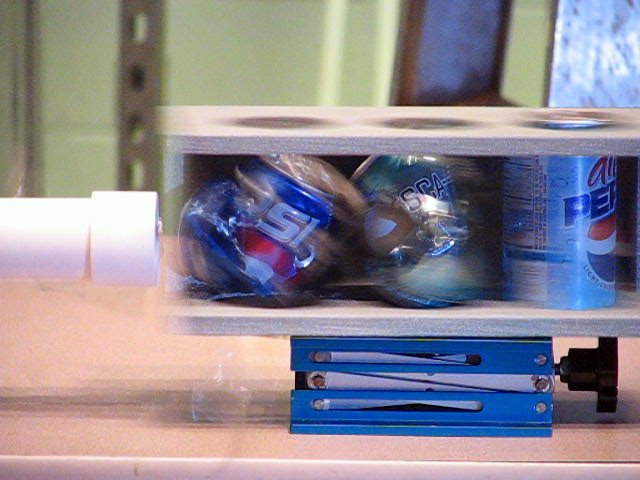
The kids (and by that, I mean physics teachers age 18-108) have yet to tire of the ping pong vacuum gun. Monday evening's AAPT demo show included one. I like this particular still. Look carefully; the ping pong ball emerged from the PVC tube at the far left and has passed through the first can. It is beginning to pass through the second can. The third can is, as yet, unaware.
The full image is here.
Monday, July 24, 2006
Sunday Sunny Syracuse
Sunday may be the best day of the conference.
A workshop in the morning covered a significant portion of cognitive research in physics education.
At lunch, I was able to get Al bartlett's quick review of Al Gore's An Inconvenient Truth. Bartlett was generally pleased with the presentation, but referred to it as An Incomplete Truth. Bartlett was disappointed by the omission of population growth as the most significant ultimate cause of global warming.
An afternoon workshop was a brief immersion into a robust family of physics simulations.
Dinner was a disappointment. Dorm food in all its dorm food splendor. I mean, "wow!" I had allowed myself to repress the memories. The trick is to enjoy a hearty breakfast and a heavy lunch so that dinner is irrelevant.
The High School Share-a-thon was next, and a number of groovy demos were show. There are photos here. The photos do some justice to the demos, but they fail to capture the bad puns and other clever banter. To get that, you had to be there.
I'd write more, but there's stuff going on!
A workshop in the morning covered a significant portion of cognitive research in physics education.
At lunch, I was able to get Al bartlett's quick review of Al Gore's An Inconvenient Truth. Bartlett was generally pleased with the presentation, but referred to it as An Incomplete Truth. Bartlett was disappointed by the omission of population growth as the most significant ultimate cause of global warming.
An afternoon workshop was a brief immersion into a robust family of physics simulations.
Dinner was a disappointment. Dorm food in all its dorm food splendor. I mean, "wow!" I had allowed myself to repress the memories. The trick is to enjoy a hearty breakfast and a heavy lunch so that dinner is irrelevant.
The High School Share-a-thon was next, and a number of groovy demos were show. There are photos here. The photos do some justice to the demos, but they fail to capture the bad puns and other clever banter. To get that, you had to be there.
I'd write more, but there's stuff going on!
Sunday, July 23, 2006
My AAPT Syracuse Photo Album
...is here: http://phyz.smugmug.com/gallery/1699477
Included are photos from Sunday's High School Shar-a-thon and Monday's Demonstration Show.
Included are photos from Sunday's High School Shar-a-thon and Monday's Demonstration Show.
Syracuse Saturday Sans Sunshine
Friday was flyday and in only three flights, I got from Sactown to Syracuse. Saturday was a rain day in Syracuse. Steady, warm, and... steady. Lots of soaked physics teachers around campus and brisk umbrella sales in the bookstore. I thought to bring my raincoat and an umbrella, so I was good to go.
I spent the day with Dewey Dykstra, a physics education rock star. I attended his optics workshop in 1989; to this day I have never seen a better set of inquiry-based labs on reflection, refraction, pinholes, and lenses. Upon completion of the pinholes-lens sequence, you really had an understanding of lenses, rather than a simple ability to draw ray diagrams and "get the right answer" to thin-lens equation problems.
Today's workshop focused on learning theory with an emphasis on elicitation of student conceptions. I'll wait while you savor my clever use of the term "focus." Some of the material was a bit heavy, but the point was how much you can learn as a teacher through sequences of elicitations and discussions. Dewey is a master of this, and he's a genious when it comes to uncovering misconceptions then devising activities that confront those misconceptions. Very groovy stuff.
I also got a kick out the tangents we were able to get him on. Hall's (of The Hall Effect) writings on the nature of the electric fluid, how he groups his students for lab work, etc. I'd pay for a workshop just to hear more of his stories!
Anyway, I didn't miss the 110F that Sacramento was enduring.
I spent the day with Dewey Dykstra, a physics education rock star. I attended his optics workshop in 1989; to this day I have never seen a better set of inquiry-based labs on reflection, refraction, pinholes, and lenses. Upon completion of the pinholes-lens sequence, you really had an understanding of lenses, rather than a simple ability to draw ray diagrams and "get the right answer" to thin-lens equation problems.
Today's workshop focused on learning theory with an emphasis on elicitation of student conceptions. I'll wait while you savor my clever use of the term "focus." Some of the material was a bit heavy, but the point was how much you can learn as a teacher through sequences of elicitations and discussions. Dewey is a master of this, and he's a genious when it comes to uncovering misconceptions then devising activities that confront those misconceptions. Very groovy stuff.
I also got a kick out the tangents we were able to get him on. Hall's (of The Hall Effect) writings on the nature of the electric fluid, how he groups his students for lab work, etc. I'd pay for a workshop just to hear more of his stories!
Anyway, I didn't miss the 110F that Sacramento was enduring.
Subscribe to:
Posts (Atom)