Sunday, January 21, 2018

Kids these days

When I was a new teacher, I was wary of veteran teachers who complained about "kids these days". The gist was that students of a long ago yesteryear were capable of hunkering down and rising to the challenge of rigorous academic coursework, while today's students simply cannot hack it. I didn't see it. My students were rising to the challenges I set before them. What was the problem? I never wanted to age into that seemingly inevitable "get off my lawn" stage.

Back then, a veteran teacher was anyone with ten or more years in the profession. But it was those with more than twenty years in the classroom who were most likely to shake a "kids these days" fist.

I now have more than thirty years of classroom teaching under my belt. And I now see why it happens. The struggle is real. And I don't have a ready solution.

In my own recollection, my Physics students of 1996-97 figured it out better than those of any year I've taught. (I'm referring to my Physics students in this post, not my AP1, AP2, APB, or CP students.) 

In 1996-97, I was entering my second decade of teaching and had settled on some pedagogy and policies that seemed to work for me and my students. A large majority of students in 1996-97 (N=116) essentially agreed to my terms and prospered as a result.

In contrast, my Physics students in 2018 (N=60) have largely opted out of my conditions and suffered predictably. Here's a side-side comparison of the grade distributions.


There were four sections of Physics in 1996-97; there are two sections in 2017-18. (There was one section of AP Physics B in 1996-97; there is one section each of AP Physics 1, AP Physics 2, and Conceptual Physics in 2017-18. These classes are not included in this analysis.) Seventy percent of Physics students earned an A or B in 1997; only 57% did so in 2018.

Why the dramatic difference? In my analysis, it is engagement. Engagement is difficult to quantify for purposes of comparison. My best method for quantifying engagement in 1997 relates to random homework checks. 

By that metric and its built-in tolerances, 29% of Physics students were very engaged in 1997, 45% were somewhat engaged, and 26% were disengaged. 

Since 2014, we have had a Test Correction Journal (TCJ) process by which students can earn back up to half the points they missed on each unit test. "Sweat equity" is required: students spend class time writing "journal" entries for each test item they missed. Completed journals grant students access to a ten-question quiz. A 10/10 gets you half your missed points back; 7/10 gets you 70% of half the points you missed, etc..

So I can now use TCJ performance as a measure of engagement. We have five unit tests in the first semester. Students who participated in all five are rated as "very engaged". Students who participated in four of the five are "somewhat engaged". Students who missed more than two TCJs are "disengaged". 

By that metric and its built-in tolerances, 28% of Physics students were very engaged in 2018, 27% were somewhat engaged, and 45% were disengaged. 

Here is how the Physics grades break down (2014-2018) when classified by levels of engagement. (N=382)


That infographic might take a moment to absorb. The green columns are grades earned by highly engaged students: mostly As, fewer Bs, fewer Cs, two Ds and no Fs. The yellow columns are grades earned by somewhat engaged students: some As, more Bs, some Cs, a few Ds, and two Fs. The red columns are grades earned by disengaged students: one A, more Bs, many Cs, dozens of Ds, and all but two of the Fs.

Excel is happy to make pie charts as well. Here are the grade distributions by engagement level.

Eighty percent of very engaged students earned an A or a B.


Somewhat engaged students were somewhat distributed across letter grades.


Half of disengaged students earned a D or F. One out of 382 earned an A.


My own assessment is that students who engage in the course will get a good grade. There is more to engagement than Test Correction Journals. Homework engagement is crucial. But I have no way to measure that, whatsoever.

Still though, you will most likely earn an A or a B if you are at least engaged in the TCJ process. You will most likely get a C, D, or F if you're disengaged.

Some might argue that in addition to preparing and maintaining quality physics pedagogy and policies, I have an obligation to compel or otherwise force students to engage in the course. I cannot bring myself to agree. 

At some point, students must have the option to engage or not engage. In my own highly biased assessment, I consider my course to be highly engaging as it is. And I believe there is a valuable lesson to be learned about the consequences of choices that we make when approaching an academic course. Physics is a college prep course; many students will be sitting in college courses in less than a year. 

I want my students to succeed. In my class and beyond. I know that no one will chase them down in college to make sure they are duly engaged in their coursework. If they know how to engage on their own, they will be set to succeed to the limits of their abilities.

Full engagement is not a guarantee of an A. An A represents a level of mastery that is demonstrated in various assessment instruments. Engagement puts an A, B, or C in play while virtually precluding a D or an F. Disengagement, on the other hand, operationally precludes a student from earning an A.

Choices and consequences.

Am I at the "kids these days" stage? I don't think so. Engaged students are doing very well in the course. Top grades are well within reach of anyone willing to engage. And AP students (unsurprisingly) remain highly engaged. I am bothered by the increasing number of students who choose to be disengaged in Physics.

One last graphic to convey my disappointment. This is this year's 1st period Physics class's test scores. This was the most disengaged class I've ever had. In the test scores field, red indicates a TCJ that the student missed. Yellow indicates a test that was made up during the make-up period following the administration of the test (usually about 10 school days). Blue represents a test that was missed and not made up in the make-up period. It was made up at the end of the semester. Black is a second test that was missed and not made up in time. It goes down as a zero. The letter grades are shown in the leftmost column. Green shading for very engaged students, yellow for somewhat engaged students, and red for disengaged.


Kids these days? No. Shaking my head? Yes.

Saturday, January 20, 2018

"Magnetic"—a song to add to your physics playlist

There comes an awkward moment in my AP Physics 2 course when we arrive at the topic of electromagnetism. Students enrolled in Physics last year studied magnetism in some depth, with a robust qualitative laboratory component. Students enrolled in AP Physics 1 did not hear the term "magnetic" in class at all: there is no magnetism in AP1.

So I segregate my AP2 charges by which course they had las year. The former AP1s move quickly through the Physics course material while the former Physics students get some enrichment by way of The Mechanical Universe, Conceptual Physics Alive, and Nova. Eventually we reunite and move into deeper issues of electromagnetism and induction, ending up at Faraday's Law.

The Nova episode is S31E07, "Magnetic Storm," concerning the changing nature of Earth's magnetic field. [Warning: do not make a drinking game out of each time a thunderbolt sound effect is deployed—you will not make it to the end.]

Nova - Magnetic Storm


In developing a video question set to accompany the episode, I noticed that a pop song was featured heavily throughout the episode. A bit unusual for Nova in my experience. The end credits included the name of the artist but not much else. It was enough to track down the... track.

It's Judith Edelman's "Magnetic" from the 2009 Thirty One Tigers release, Clear Glass Jar, available on iTunes, Amazon, and wherever fine music is sold. Someone commented that Edelman's "Magnetic" is to electromagnetism what Don McLean's "Vincent" was to the art of van Gogh. You be the judge!

Judith Edelman - "Magnetic"


A comment for the video included the lyrics.

It's the buzz when I'm full
Of your sweet magnetic pull
It's the tug that I crave
It's how opposites behave

Is electricity all there is to you and me?

In the fields, in the fields
Where the static is revealed
If the north isn't true
Will I lose my way to you?

Is electricity all there is to you and me?

What's gonna happen when the magnetism fades?
Will we burn up one bright day?
Will the aurora borealis give us one last show?
You can't leave love to science when you go.

In the deep molten heart
Where these strange attractions start
If we are passionate
Will this rock remember it?

Is electricity all there is to you and me?

What's gonna happen when the magnetism fades?
Will we burn up one bright day?
Will the aurora borealis give us one last show?
You can't leave love to science when you go.

What's gonna happen when the magnetism fades?
Will we burn up one bright day?
Will the aurora borealis give us one last show?
You can't leave love to science when you go.

It's the buzz when I'm full
Of your sweet magnetic pull

Tuesday, January 16, 2018

Egg Toss video because—why not?

The final batch of clips from Grass Omelette XVII at Rio Americano. A nice catch and two spectacular splashes! With no sun, we were able to line up with the geometry of the field. Seems we should have taken a bit of Sharpie to the eggs to increase their contrast with the sky.

Large impact time to reduce impact force


Impact force too large #1


Impact force too large #2


Previous Grass Omelette XVII coverage can be found here:
Splash and Catch: Grass Omelette XVII

More robust coverage of this activity can be found here:
Egg Toss 2013

Saturday, January 13, 2018

Be Direct With Me

I am a huge fan of a CBC podcast called "Under the Influence with Terry O'Reilly". Tales of drunk Canadians engaged in Molson-fueled shenanigans? No. Each half-hour episode tells a carefully woven story connecting some element of advertising or marketing to the world where you live. You will learn things you didn't know about things that you do know with each episode. And each episode is the product of 20-30 hours of research. Subscribe to the podcast right now while you're thinking about it.

In an episode called "When Madison Avenue Met Broadway: The World of Industrial Musicals," O'Reilly played a few seconds of "Be Direct With Me". Just a few-second bite with not much to identify it. But I was transfixed. I deployed my hard-earned blue belt in google-fu and sourced the track. I then saw it was available on iTunes and paid for it immediately (I'm old and from the midwest).

I quickly set the track to a Keynote preso and roughed out a nice delivery. Then I spent several days refining and improving. I simply had to show this gem to my colleagues at the High School Share-a-Thon attached to the American Association of Physics Teachers Winter Meeting 2018 in San Diego.

High School Share-a-Thons can be lively affairs, typically held in the evening on Day 2 of the conference: between the workshops and the invited/contributed talks. For reasons nobody ever explained to me (and I asked), this year's Share-a-Thon was scheduled for 8:30am on Day 2, conflicting with many workshops. And... in the morning!

A few dozen intrepid instructors braved the San Diego rains and made it to the event. Sadly, the session presider did not. A few years ago (I want to say it was the Omaha Summer Meeting), the Share-a-Thon was left without a presider and I stepped up to awkwardly host.

Someone in the room in San Diego remembered that, and promptly ratted me out. So I was once again drafted into service. When the session began, only two of the several dozen attendees signed up to share. We had the room from 8:30am until 10:00am. I made the executive decision to dispense with the five-minute time limit and encouraged my colleagues to not be bashful—we're all friends here!

I showed a couple of things (videos of those things, anyway, as has become the trend among traveling physics sharers). Then I hit them with the video below. I truly didn't want to be up first for this event, but it was what it was.

In any case, the presentation. You will want to be sitting down for this.


I had a few more slides of humor and fun for my live preso; I intend to show it again at the NCNAAPT Spring Meeting.

Eventually more folks came up to share. Questions were asked and answers were given. We ended the session at 9:59:50am.

But industrial musicals? I had no idea. And they were huge in terms of budget, scale, and talent.

UPDATE: GE's Go Fly a Kite—the industrial musical from which this song comes—was written by the composer/lyricist team of Kander and Ebb, who also wrote Cabaret and Chicago. The double-album original soundtrack (souvenir recording) can be had via eBay for $99.99 as of this update. But it has also been posted to YouTube. I found "Be Direct With Me" as the opener for Side 3. The video shows the liner notes and dress rehearsal stills that correlate to the currently-playing track. While Valerie Harper was arguably the biggest enduring star in the cast, she did not sing "Be Direct With Me". Who did? Carole Woodruff. The only other credit I was able to find for her was a musical called Pleasures and Palaces, written by Frank Loesser and choreographed by Bob Fosse. It ran for a month in Detroit and was not reviewed kindly. Woodruff is the last singer listed in the credits. I have found no other relevant information on her.

Thursday, January 11, 2018

You spin me right round, baby, right round ...

Well, my accelerometer anyway.

I'm in the middle of my first year teaching AP Physics C and we ended last semester with rotation. Therefore, I'm looking at any spinning or round thing in a different light. I was at the RAFT San Jose store and saw giant wooden circles with rough edges for cheap. And this is RAFT cheap so I think it was <$4 for 8 of them. I snagged them unsure of what I would do with them and took them home to be inspired.

I ended up sanding down the rough edges to find they were very sturdy and furniture grade plywood. Since they were leftover from some manufacturing process they were perfect circles. I decided to make them into giant tops/ turn tables. I envisioned students playing with them at the onset of this unit to observe changes in rotational quantities, maybe use some slow mo video or accelerometers. Or perhaps we could use them for conservation of angular momentum. The possibilities are endless!

I reviewed some geometry and found how to find the center of the circle. I measured equivalent length chords around the circle and marked halfway across each chord. From this halfway point I drew a line perpendicular to the chord towards the center of the circle. Doing this a few times gave me a point, or at least a small area of the "center" of the circle. Since I was drilling a big hole in the middle I figured close was going to be ok.

We have a drill press in our mini-shop in the Physics prep room. I used a 7/8" drill bit to drill a hole in each disk. This allowed me to fit a 1/2" PVC pipe through the hole with a bit of wiggle room. Going down to a 1/2" bit was too small of a hole for the PVC to fit so the hole had to be a bit bigger. But "wiggle room" meant that if I turned the PVC axle the disk wouldn't rotate at the same speed. Hmm...

I used smooth 1/2" PVC endcaps on the bottom of about a foot of 1/2" PVC for my axle. The endcaps had the manufacturers logo on it so they did not have a perfectly smooth bottom. If it bothers me enough I may go back and file them smooth. I found that wrapping the PVC with a bit of masking tape increased the diameter of the pipe enough to fit in the hole in the disk snugly. Through trial and error I found about 3 times around worked well. Too tight and I was banging the axle against the ground hoping the disk's inertia would drive it down onto the tape, sometimes that worked. I put a second end cap on the other end of the axle for comfort.
In the end I had 8 tops for use. By the time I made them it was towards the end of the rotation unit but they were still helpful. When students were reviewing torque, angular momentum, etc. I left them out with their review sheets. Students would grab them to rotate and discuss vector directions with their partners.

I also played with the Physics Toolbox app's accelerometer by placing it on one of them and giving it a few turns. Next year I'd like students to investigate the acceleration recorded by the phone at different radii as they turn it with the same speed. Below is a quick video of the attempt.

I had considered sharpening down dowels to a point as the axles instead. But, I teach high school and a sharpened dowel through the center of this disk might become a spear with a shield so ... no.


Friday, December 29, 2017

A timely addition to the Hewitt Drew-It collection

With flat-Earthers on the rise, it's a good time to review reality. Paul Hewitt's here to help.

Hewitt-Drew-it! PHYSICS 149. Eratosthenes and the round earth
Hewitt presents an easy explanation on how Eratosthenes measured the diameter and circumference of the earth in about 235 B.C. Only simple geometry is used.


For a complete index of Hewitt Drew-It video lessons, start at
Hewitt Drew-It! PHYSICS Screencast Directory

There are quick lessons on virtually all topics covered in introductory physics, conveniently organized for easy access.

Tuesday, December 26, 2017

Making engagement visual

At semester's end, it's possible to look back and see how student engagement in the course manifested itself into semester grades.

Students who perform well on tests and labs naturally percolate to the top. But those who don't excel in those objective measures have alternate routes to good grades in my courses.

During the semester, "extra credit" (credit toward the final: CTF) is awarded in dribs and drabs for various tasks and in-class competitions. Completing paperwork associated with the beginning of the school year and team performance in our egg-toss competition are typical first-semester sources. The credit is accumulated through the semester, but only becomes active as an addition to the final exam score. Some teachers add in extra credit as it comes in. That leads to disappointment when final exam scores are low. Adding it to final exam scores at the end of the semester leads to delight similar to finding money under the cushions of the sofa/couch/davenport.

More importantly in my Physics (PHY) and Conceptual Physics (CP) courses, students can earn back points lost on unit tests. The process is called Test Correction Journal. Students write "journal entries" for each item they missed on a unit test and reflect on why they were drawn to a wrong answer over the right answer. Later, a quiz is given consisting of questions from the original test. If they get 10 out 10 on the quiz, they earn back half the points they missed on the test. If they 9/10, they get 90% of half the points they missed, etc.. A 60 can turn into an 80 and 40 into a 70. A 90 can turn into a 95. The more help you need, the more help TCJs provide.

Neither CTF nor TCJs depend on rapid assimilation of course content. But they do depend largely on engagement. Sometimes students who miss many items on a unit test cannot finish the journaling process that we begin during class time. They need to come it at lunch or after school during an approximately two-week window to finish the journal. Only students with completed journals are allowed to take the quiz that will earn their missed test points back.

Students who disengage from TCJs create and expand a gap between themselves and those who are engaged. My engaged students earn only As and Bs. But Cs, Ds, and Fs are given every semester, as many students elect to disengage.

The listings below are actual student data. Each is a period, sorted by points earned. I used Excel's conditional formatting to color the cells in a spectrum from top-score green to bottom-score red, with yellow in between. The next column colors CTF points on a same basis (green good; red bad). Then (for PHY classes), it's the TCJ column with the same color scheme. The last column shows the final exam raw score out of 50. The top number in each column show the maximum value possible.


The pattern is fairly consistent, with anomalies here and there. Nothing to shatter the Earth here. I just wanted to see how well the seemingly nebulous "engagement" tracks to overall class performance. Teachers know this pattern is really the only one that's possible. Students don't always have an intuitive understanding of it. Some will see the evidence and reject it nonetheless.

Those students believe it's possible to get a top score with minimal engagement. It's mathematically possible. It just never happens. They may also fear that investing in full engagement will not be rewarded in a top score. Yet we don't find a red Points value followed by green CTF and TCJ columns. That's actually much less mathematically possible, given what TCJs do.

Sunday, December 24, 2017

Fun does not mean unprofessional

I follow some great educators on Twitter, one of the great things about the platform is being able to find people that share interests that I don't know personally. I like to follow inspirational teachers that make me want to do better, that can expand my point of view and remind me that how varied and diverse our national education system is. I get a lot of great ideas from physics teachers and get to chuckle in commiseration with hashtags like #teacherlife and #teacherproblems.

Two days ago a math teacher and author from New York Jose Vilson posted a video of himself dancing in class with a great Christmas sweater. I liked it, not thinking much of it and continued to scroll. Unsurprisingly, Jose's video was retweeted by other people I follow so I got to smile again every time it came up:
I was surprised however, when I started noticing that not only were people retweeting the video but also including remarks of defense and support. I had to follow a few threads to figure out why Jose even needed to be defended. (Hint: he shouldn't have to be) There had been comments about Jose's dance being "unprofessional" but they weren't so nice about it, in fact they were downright racist about it.
On one hand, 2017 can't shock me much more but on the other, he was just dancing! He is a great teacher and activist, published author, etc. but that doesn't mean he's not human. Teachers are human. We are not robots, we are people. The whole thing got me thinking of all the times I've been "unprofessional" in front of my students. Its quite a list:

- Teach students to do the "Superman" yoga pose and worn two back packs at a time while teaching center of mass and stability.
- Literally kicked off my heels to run across my classroom and try to race the stadium wave my students make across the classroom while teaching, duh, waves.
- Spun around like a ballerina/ figure skater to remind them about conservation of angular momentum.
- Spun and leaped in a circle to reinforce the difference between rotation and revolution.
- Stood on lab benches to drop/ throw/ launch a variety of projectiles.
- Channel my inner drill sergeant and lead the class in force exercises; I say "A Force is a what?" and they respond "A push!" I say "And a what?" and they shout back "A pull!"

There are probably more that I've forgotten. As many other teachers have I also frequently share jokes and puns about my curriculum. Students' suspicions are correct, teachers do actually plan some of those jokes. I have a construction hat I've written the formula for work on and I wear it every year. This year I made a giant piece of buttered toast just to illustrate a tough textbook problem

Teachers often use humor to teach and engage their students. We've been known to use comic strips and Dan Burns even dresses up to look like the physics teacher in FoxTrot on occasion.
All of that is acceptable, but dancing is not? You've undoubtedly heard the phrase "Happy Dance," when someone does a little dance for about 10 seconds when they are unexpectedly happy. You may see your students do a happy dance when they got a grade higher than they expected. I've seen full grown adults do a happy dance in a store when they find their favorite wine on sale. The point of the happy dance is spontaneous joy, despite surroundings, in order to celebrate something unexpected or surprising. How is that accepted across our culture but a teacher in a classroom of happy students can't dance? Being fun does not mean you are unprofessional. I say teachers continue the dancing, winging, joking, etc. This job is hard enough without being a sour puss.

Sunday, December 17, 2017

An inclination for serendipity

When I show the Honda Cog ad (flavors of equilibrium, energy transformations), there is always strong skepticism regarding the wheels that roll uphill. So I am always ready to go with the demonstration illustrated in this previous post.

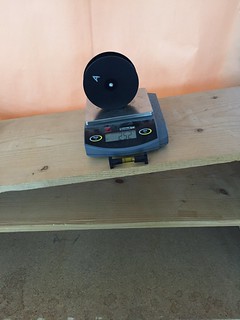
Sometimes I leave the wheel resting comfortably on the inclined plane. That very same inclined plane is also home to my electronic balance.

UntitledSo why not another Physics Mashup?

First, students should be able to explain why the wheel holds fast on the incline before I spill the beans. Or in this case, ball bearings.

Next, I tare the scale and rest the "hill-hugger" atop the scale. A reading is observed.

Finally, students should correctly predict what will happen to the scale reading when the incline is re-leveled. Assure them the wheel will remain atop the scale.

It's not so novel it will shatter the Earth. But it's nice to milk some mileage out apparatus just otherwise lying around.

The answer can be seen via the comments. I leave the solution to the reader.

Monday, December 04, 2017

Advanced Studies in Artistic Lightning

Watch it big; watch it loud. But mostly, watch it.


Transient from Dustin Farrell (www.dfvc.com) on Vimeo.


And remember, deviations from physical realism serve not as disqualifies, but springboards for discussion here.