Tuesday, November 24, 2020

Inertia is how much, not if

Hello Blog of Phyz world! I wrote a piece for the Talkin' Physics column in The Physics Teacher's December 2020 issue. In the interest of sharing it more widely and outside of a paywall, below is the blog-ified version of that article. You can also find a pre-print PDF linked here.

Inertia is an elusive concept in physics, and it is occasionally used to explain similar-seeming yet different concepts. The goal of this article is describe two scenarios which are commonly explained using the word inertia, even though that same word is being used to describe two different phenomena. A discussion clearing up this ambiguity follows the examples.

Consider a block of frictionless ice in the bed of a flatbed truck, as seen in the figure below. If this truck begins to accelerate from rest, the ice will remain stationary with respect to the ground and eventually fall off the back end of the truck. Why does this happen?


Next, consider the two blocks on horizontal frictionless surfaces shown below. Ropes pull them both to the right with 10 N of tension force. Block A mass a mass of 1 kg, while block B has a mass of 5 kg. Which one has a greater acceleration, and why?

Inertia is often invoked to explain both of these examples. In the first, the frictionless ice block maintains its state of rest of because of its inertia. In the second, block B has a smaller acceleration because it has more inertia than block A.

The theme song for Bill Nye the Science Guy famously states that “inertia is a property of matter.” If we accept this Bill Nye maxim, then only the second example is truly a demonstration of the idea of inertia. The frictionless ice of the first example does not remain at rest relative to the ground because of any intrinsic property it has. Rather it stays at rest because of its lack of net interactions with other objects around it. The first example illustrates how matter behaves when interacting or not interacting with other objects, but it does not illustrate any property that matter has. In the second example, Block A accelerates more than Block B because of a property intrinsic to each block.

Similarly, Donald Simanek argues that most so called “inertia demonstrations” would better be classified impulse demonstrations. On the topic of the classic tablecloth pull demonstration, Simanek writes that, after viewing the demonstration, “The audience didn't see anything that showed that objects with different inertia (mass) behaved differently.” Instead, they saw that you could reduce the impulse delivered to plates by reducing the amount of contact time the plates have with the tablecloth. Again, we see a demonstration of matter’s behavior when interacting with other objects and not a demonstration of something intrinsic to matter itself.

In this view, inertia is a property that says “how much” rather than “if.” It does not say whether an acceleration will happen, but rather how much acceleration will happen for a given net force. For example, an object having an inertial mass of 5 kg means that, for every additional 1 m/s/s you want the object to accelerate, you will need to exert an additional 5 N of force. This is what we mean when we say that mass is a measure of inertia. It does not mean that it is five times better at maintaining a constant velocity than a 1 kg object. Both would be equally good at doing that if there is a net zero force acting on those objects, and both would be unable to do so if there were a net force exerted on them.

Perhaps, to bridge the gap between the two demonstrations, we may want to say that the intrinsic property inertia measures how little an object deviates from its inertial path when a given net force is exerted on the object. We could modify our frictionless ice in the truck example to demonstrate this idea. To do so, we would need to replace our frictionless ice with regular, boring ice with friction, so that there is a nonzero net force on it when the truck accelerates forward. We would also need to have two blocks of ice of different masses so that we could compare how much one deviated from its rest position relative to the other for a given friction force. Doing so would allow us to demonstrate than an object with more inertial mass deviates less from its inertial path than object with less inertial mass when the same force is applied to each. Inertia is a comparison of how much, not if.

Similarly, the tablecloth demonstration could be amended to be a true demonstration of inertia. It is not enough to pull a tablecloth out from underneath a ceramic plate to call it an inertia demonstration. If you instead pulled a tablecloth from underneath both ceramic and paper plates and compared the accelerations of each, then you would have a great demonstration of the property inertia. Both plates accelerated, but one acceleration more. Why? Because the plates’ inertias differ. In this example, we are not saying that the ceramic plate remains stationary. Instead, we are saying that its change in velocity is less than the change in velocity of the paper plate. The emphasis is on the amount of change, not on whether or not change occurs.

In the end, it may be time to retire the word inertia altogether. Many physics teachers are comfortable requiring students to refine statements around gravity, asking them to “upgrade” their language from saying gravity alone to saying gravitational force, gravitational field strength, or acceleration due to gravity. Similarly, ambiguity surrounding inertia can be avoiding if we choose language that is more specific.

For example, one could say that Newton’s first law describes an object’s inertial behavior or the inertial path it may follow. These are not intrinsic properties of matter, but rather descriptions of how interactions affect what matter does. Inertia, in this sense, cannot be quantified. Newton’s second law, on the other hand, describes an object’s inertial mass—its resistance to acceleration. The inertial mass described in Newton’s Second Law is an intrinsic property of matter, and it can be quantified.

Like gravity, inertia is a broad and overarching concept. Saying an object has the property inertia is less clear than saying it has inertial mass. Saying an object moves at a constant velocity because of its inertia is less clear than saying it follows its inertial path or it is exhibiting inertial behavior. By improving our language, inertia can be both “how much” and “if.” We simply need to clarify which we are using and acknowledge that they are not the same. 

This article may be downloaded for personal use only. Any other use requires prior permission of the author and AIP Publishing. This article appeared in The Physics Teacher 58, 682 (2020) and may be found at https://doi.org/10.1119/10.0002746

Wednesday, November 18, 2020

RT;DL Things That Go Bump!

Which involves more force: stopping or bouncing? Let's demonstrate.


I inherited a stop/bounce dart when I arrived at my school in 1986. You arrange the dart as a pendulum and swing it into a wood block. Back in those days, you ran the unadorned nail point into the block for the stop, and attached a rubber stopped to the nail point for the bounce.

Since then, the advent of "happy" and "sad" balls improved this demo. And happy/sad pendula/mallets have been commercially available (help me out with a link if you know one).

Arrange the dart so that it barely knocks over the block using the happy ball on the tip. Then switch to the sad ball and allow for predictions and arguments. Then proceed with the reveal.

Sunday, October 25, 2020

A new letter grade for the pandemic: E

It is impossible to characterize everyone's experience with teaching and learning during the COVID-19 pandemic spread throughout the world by the novel coronavirus. 

Many teachers are working with unprecedented intensity to craft synchronous and asynchronous instruction that will cover and deliver academic content in an engaging and suitably rigorous way.

But the products of all this time, talent, and energy are not being universally absorbed by the students in the black Zoom thumbnails with muted microphones. There are stories in each one of those blank frames, covering a broad array of situations.

Many of us seem to have students who are completely disengaged. They are on our rosters, but we never see them, they are not in our Zooms, and they do not turn in assignments or take assessments. They rapidly descend into grades that are in the single digits, perhaps up to about 20%. 

But there are some who seem to be somewhat engaged. But their participation is scattershot. They fall below 60%, but remain north of 40%. I am wondering if an F is the best grade for them while schools are wholly shut down or (worse), engaged in the pure partial daycare service that goes by the name of "hybrid".

So what about a grade of "E" for them? Not an "F" grade of fail. But not really a "D", either. "E" for evidence of engagement.

As a practical matter, the best I can do for now is to expand my range for a "D–".

One thing that a number of us are seeing more and more of in our parent-teacher conferences is parents and students who want to take an F for this semester so that they can repeat the course for a better grade next I'm not a fan of that practice. [Side note: Physics and Conceptual Physics are scheduled to be replaced by Physics of the Universe in my district next year, so that practice will be messy.]

I would let students move on with Es. Otherwise there will be a pandemic of students wanting to repeat courses when schools reopen in a meaningful way.

It's just an idea for now. But I wonder if it's an idea that will make more and more sense the deeper we get into the pandemic.

What do you think?

RT;DL Thermoscope

I was reluctant to post this since thermal physics has been so thoroughly abandoned by NGSS (HSPS) and AP Physics. And also because the apparatus that I use appears to be unavailable. And the ones I was able to get most recently are a bit fiddly to use.

But what the heck? Physics teachers teach across a spectrum and not everyone is beholden to NGSS and AP. And physics teachers are a resourceful bunch: There may be other ways to do this without the exact apparatus I'm using here.

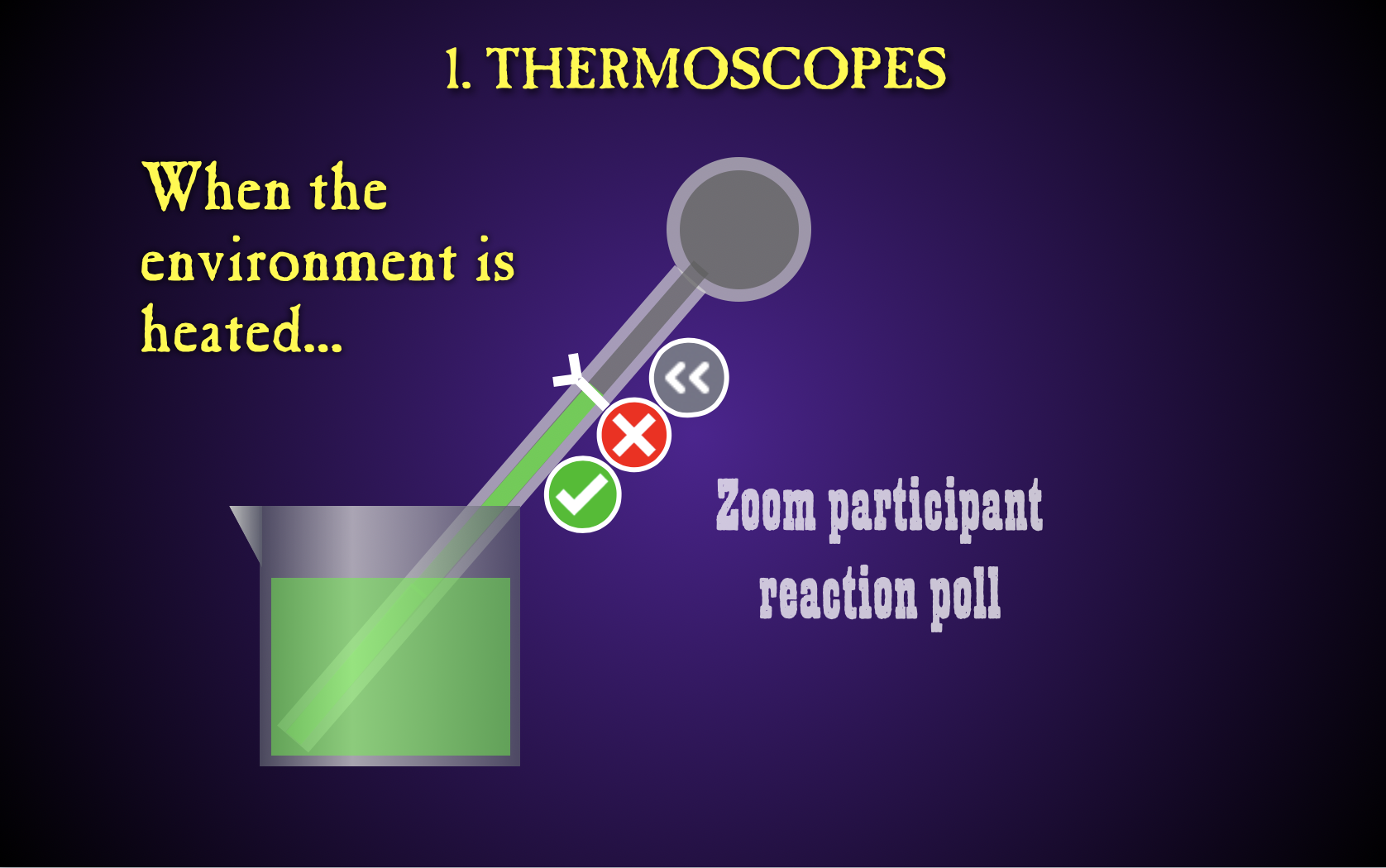
The demonstration revolves around what I've been told is a Galilean thermoscope. A narrow-throated Florence flask is used here, as is a beaker, some food coloring, a twist-tie, a blow drier, a hot plate, and some water.

I like it enough to continue using in in my AP Physics 2 unit on thermal physics which is a pre-cursor to the unit on thermodynamics.

An instant Zoom poll using participant reactions is once again included.

Thermoscope [Virtual Demonstration] at Teachers Pay Teachers

If you have a clever workaround to get past the dearth of what were once sold by Sargent-Welch as "air bulb thermometers," let me know in the comments.

Sunday, October 11, 2020

My district bans a Jewish surname...

...from emails sent to district-managed student accounts. Here's the story:

In COVID-era Distance Learning, I have found Socrative to be a useful platform for administering student assessments. Among its useful features is the ability to send students their own individual scored test, showing which questions they answered correctly and which ones they answered incorrectly. The results can be sent to student email accounts with the push of a button. [You are correct to assume the instructor had to enter those email addresses into Socrative. But it's a one-time investment.]

This is a great feature for when we do Test Correction Journals.

But in my very first attempt to leverage this feature, it failed. I had, of course, tested the feature before using it with students. And it worked. But when I sent my students their test results, students insisted they did not receive them. I tried it using Chrome, I tried it using Firefox. Nothing worked. I had to create a privacy-respecting, individualized way to tell students which specific test items they missed. I created one breakout room per student, joined each one—one at a time, and announced which items they missed. While class time was burning.

I quickly came up with a functional workaround for the next period, but it fell short of what I needed it to do. And why didn't the student email solution work? 

Students suggested that the district blocks third party emails from student accounts. The vendor, Socrative, meets all legal privacy standards. District tech services said they do not block third parties. Further investigation indicated the emails were blocked because they contained objectionable content. That offensive content appeared in the following question. TW: "Objectionable Content."

[Secrets of the Psychics] Psychologist and former palm-reader Ray Hyman found that he had the greatest success with clients when he  

A. gave a straight-up reading in accordance with palm-reading guidelines 

B. told clients the opposite of what he saw in their palms 

C. imagined that he lived in an earlier era 

D. assumed his clients were skeptical of palm-reading and his abilities

There it is: the objectionable content, clear as day. What's that? You didn't see it? Look again. "hymen" is right in there. Prurient anatomical terminology titillation that would offend any community's standards of propriety. High school students must be protected from such filth.

Okay, not "hymen" exactly, but "hyman," a simple misspelling of a highly salacious, practically pornographic word. Okay, not "hymen" or "hyman" exactly, but "Hyman," a not uncommon Jewish surname. I presume my college hall mate's name, Steve Hayman would trigger that comprehensive filter, too, lest bad actors use simple misspellings to skirt content filters. 

Some might judge the content filtering of Jewish surnames (that are not anatomical terms) as anti-semitic. I'm confident the San Juan Unified School District doesn't intend it that way, but here we are. "Ray Hyman" triggered a full and immediate IP ban due to the district's sweeping content blocking protocols. 

I was given no reason to hope that this filter would be removed by my district's tech services, now that they are aware of the embarrassing error. It seemed as if the onus was on me not to include terms that would trigger bans, and I should just know what all those terms are.

The filtering is clearly far too aggressive and highly impractical. Blocking my instructional program (without notification) for the "crime" of including a Jewish scholar's name? That's beyond a bad look.

It's indefensibly paranoid and ignorant, in my assessment.

UPDATE: This is apparently just another instance of The Scunthorpe Problem, or as Tom Scott calls it, The Peniston Problem. 

Saturday, October 10, 2020

RT;DL The Tower of Bottle

In the pre-blog, pre-social media days of the mid-1990s, when the World Wide Web was Alien-birthing from nothing (1994) to everything (1995), I was involved with the Southern California Alliance of Mentors for Physics Instruction and its Southern California Area Modern Physics Institute. Yes, two SCAMPIs in one. John Jewett (Cal Poly Pomona) and Roger Nanes (CSU Fullerton) outdid themselves on the acronyms!

Somebody at the California Department of Education liked what SCAMPI was doing, and wanted to get four Northern California teachers involved. I was chosen/selected to be one of them. Jessica Downing, then the Science Department at Esparto High School (now IB coordinator at Inderkum/Natomas) was selected as well. She and I conducted SCAMPI workshops throughout Northern California during those years.

I got this demo idea from her.

The gist is to show that the molecules in a jar of hot water are moving faster than the molecules in a jar of cold water. Just add food color and wait a minute. 

But while we're here, let's add some value. Lay a playing card on top of the hot water and flip the bottle over. The card stays in place and the water doesn't spill. 

Set the bottle mouth down on the cold bottle and remove the card. The result is surprising.

Then re-insert the (a) card and flip the configuration over so that the cold water's on the top. Remove the card. And it's a different outcome.

Last, a few questions of balance or imbalance. If you were nervous that I wouldn't shoehorn a Zoom participant reaction poll in, ease your worried mind.

The Tower of Bottle [Virtual Demonstration] at Teachers Pay Teachers

Single-shot video of the complete demo

Enjoy!

Thursday, October 08, 2020

RT;DL Blowout—Newton's Laws Edition

My use of Pasco's Lenz's Law demonstrator as a blowgun to explore the equations of motion is discussed in a previous post. That's an activity I don't do in my regular Physics class, because number puzzles aren't a priority there.

In this activity, I introduce the blowgun to Physics, do a quick speed determination, and then detail how Newton's laws of motion apply to the various portions of the Hero's Marker's Journey.

How are Newton's third, first, and second laws relevant to when the marker (bullet) was in the tube (barrel)? Between the barrel and the box? When caught by the catch box?

I do this after all three laws have been taught in class. It's a nice review.

For example, when the marker is in the tube, Newton's third law is relevant in that the air pushes the marker forward while the marker pushes the air backward. 

Newton's first law is relevant in that the marker at rest would have remained at rest, but was acted on by an unbalanced, external force applied by the air. 

And Newton's second law tells us the acceleration of the marker will be proportional to the force that the air applies and inversely proportional to the mass of the marker. 

In the end, we ponder how to make a faster-moving bullet based on Newton's laws. I can't blow any harder. So we modify the bullet. 

Is this demonstration activity really just an excuse to do another blowgun activity in class? I mean... what are you even talking about right now? That's ridiculous! Why would you even suggest such a thing?

It really is a nice review of Newton's laws. 

Blowout Newton [Virtual Demonstration] at Teachers Pay Teachers

Here's the accompanying HTML presentation. As always, the presentation was designed to accompany to the student document rather than to stand on its own.

Monday, October 05, 2020

RT;DL The Newtonian Shot

I'm embarrassed to confess that I don't remember the name of the physics teacher who shared this demo at the January 1986 MSTA Meeting in Lansing. I do recall driving past many cars that had slid into the ditch on the road from Ann Arbor that morning. It was windy and icy. And cold.

But the demo stayed with me, and I worked it into my curriculum early on. It was my first Show & Tell at an NCNAAPT Meeting (Spring 1992, American River College, IIRC). 

I think it's a great demo for the Newton's Law unit. There have been times when securing toy dart guns was a challenge. They can last for many cycles, but they were built as inexpensive toys, not precision science apparatus. Here's one I found online in 2025; use your search engine/AI skills as needed.

I wrote a post about this demo previously, when I recorded some nice high-speed video of it. It includes a few more specifics.

The Newtonian Shot at TPT (Students document, Answer Key, link to presentation)

HTML Preso: Demo - The Newtonian Shot (including convenient Zoom participant reaction instant poll)

As ever, my presos are designed to support my storytelling and do not stand on their own terribly well. (Like a backup band with no lead singer.) And you can see I use aluminum support rods to help with the simultaneous launch. I launch the darts from ceiling-level down to my countertop so students can see the landing point. I protect my concrete countertop with a wood plank.

Monday, September 28, 2020

RT;DL Cannonball - Ball dropped from moving ship

Another classic demo that can elicit excellent classroom discussion. A cannonball is dropped from the mast of a moving boat. Where will the ball land? This nicely confronts our inner Aristotle.

In my version, the premise is laid out, the landing point options are described, and students are asked to produce arguments supporting three of the five possible landing sites: one that they believe, and two they could convince others of (as good attorneys).

A straw poll is conducted (now with Zoom participant reactions), then students are asked to defend their various positions. After the classroom discussion/debate, a final vote is taken. 

I warn them to vote carefully. "Physics is a democracy, and whichever outcome gets the most votes will  be correct. The universe will accede to our wishes. Please vote responsibly!" [Update: at some point Zoom made participant reactions ephemeral, so they lost their value as an instant polling tool.]

Then we see the actual outcome. First in my animation; eventually in the classic Project Physics footage from 1968. In face-to-face instruction, I also carry it out using a discontinued Pasco product (Ballistic Cart Accessory with Ball Drop Attachment). So sad to see that combo go.

Lastly, I ask students how the demo could be altered so that the ball would land at the other locations that were offered in the premise. The 1968 footage shows one such modification. I leave it to students to think of the others.

Cannonball [Virtual Demonstration] free resource at Teachers Pay Teachers

Includes
Student document (Google Docs file on Google Drive)
Presentation link embedded in student document
Answer key

The HTML export from Apple Keynote had a few wee quirks this time. Mostly in that while most of the splash sounds are muted, the audio from the 1968 video (muted in my preso) comes through loud and clear in the export.

Here's the HTML presentation: Cannonball. It's intended for use with the TPT student document.

Further discussion in the comments.

Sunday, September 27, 2020

RT;DL The Clever Dumbbell - Tension & Inertia Demo

A classic and popular demo. I do it in Conceptual Physics, Physics, and AP Physics 1. And I use a 5-lb dumbbell and kite/packaging cotton string. For years, I used a cast-iron dumbbell. But I broke floor tiles on occasion, and there was that one time the wheel-like nature of the dumbbell ends allowed it to roll onto a student's open ... toes. So I found rubberized hexagonal-end dumbbells. And I use a cardboard catch-box with scrap paper to protect the tiles.

After posing the initial question: Which string will break when the bottom string is pulled, I have them work through some leading questions.

Instead of having students predict which string will break, I have them request a string for me to break. Once they understand this paradigm shift, they request the bottom string. And I oblige. Eventually I break the top string, too. This can be navigated in the preso, alone. But I prefer to do the demo in my empty classroom because I can.

The efficacy of this demo lies in the dependence of the outcome on the presenter's technique. If it were a 50-50 coin flip each time, the demo would not have any pedagogical value. Some ponderables are offered post-demo, too.

As is a continuing theme in my RT;DLs, the student sheet is a Google Doc and the preso is an Apple Keynote preso, exported to HTML. These exports work delightfully on computers. Less well on tablets or phones. 

This one takes a bit of practice to navigate. 

Things shown in images but not in words: strings break when they are stretched beyond their limit by tension greater than the sting can withstand. A rapid pull stretches the bottom string through its limit before the dumbbell moves very much, thus keeping the top string from being stretched. A slow pull allows the top string to be at greater tension than the bottom string, allowing it to reach its limit before the bottom string does.


Includes
Student document (Google Docs file on Google Drive)
Observations presentation (linked to on student document)
Answer key