Here are some notes and links relevant to PTSOS Workshop #2. If you're new to teaching physics in Northern California, check out PTSOS.org.
Momentum and Energy
I prefer momentum before energy, but I've run into teachers who consider those to be fightin' words.
Phyz Momentum Curriculum
One highlight here is our Grass Omelette (Egg Toss Competition). In 2013, I had five sections of Physics, so I was able to compile an adequate set of images and video to make a tidy video: Egg Toss 2013
Phyz Energy Curriculum
If you're a fan of ranking items, you might enjoy
Potential Energy Ranking - Answers
Kinetic Energy and Momentum Rankings
Further distinctions between kinetic energy and momentum are explored here.
Kinetic Energy and Momentum Conundrums - Answers
For video resources, there's
The Mechanical Universe High School: Conservation of Momentum, and Conservation of Energy
The Mechanical Universe (College): Conservation of Energy, Potential Energy, and Conservation of Momentum.
Waves and Sound
Phyz Waves Curriculum
One of my favorite lessons is a nice foray into skepticism: Back Masking and EVP (Drop Box Link to Keynote Presentation). I connect it to a lesson that involves Musical Roads and Talkie Tapes.
Demo: Science is Fun!
For video resources, there's
The Mechanical Universe High School: Introduction to Waves
The Mechanical Universe (College): Waves
PBS: The Secret Life of Waves
Showing posts with label PTSOS. Show all posts
Showing posts with label PTSOS. Show all posts
Sunday, January 26, 2020


Tuesday, April 17, 2018
How to teach a class you've never taught before
Short answer: work hard.
Oh you wanted specifics? Keep reading.
One of the intricacies of education is that we can do the same thing year after year but nothing is the same or we can teach a completely different class and everything is still the same. Here are two examples:
I taught Physics every year for ten years. In that time period there have been new national and state standards implemented, two major bell schedule adjustments changing the number of minutes per day and week, furlough days have come and gone, new rallies and school traditions take instructional time, I have changed rooms four times, decided to forgo homework and gotten a new textbook twice. While I have taught "Physics" for ten years the class I would teach now is not the same as when I started.
I have also taught Conceptual Physics seven times in ten years. Several times there was a year in between in which I did not teach it. The population changed from freshmen only to freshmen and English Language Learners to open to all students to freshmen and special education only. The book has not changed but I have also had the same schedule and calendar changes I experienced for Physics. Because the class was meant to sere students that need additional support many of the pedagogical approaches and project based learning remains the same.
It can be hard to teach a course you have taught before with textbook or schedule or population or calendar changes. And then you may have to teach something completely different. Physics teachers often have to teach non-Physics courses because of traditionally lower enrollment in Physics classes compared to say Chemistry. In some schools they are the only Physics teacher and thus teach multiple levels. We tend to have more preps (different classes to teach) and change them up more often than other science disciplines. In your career you will probably at least once have to teach a brand-new-to-you course that makes you feel like a new teacher all over again. That's what happened to me this year with AP Physics C.
While I would love to say I met the challenge gracefully with my years of experience that was not always the case. Sometimes the workload crushed me. It definitely left my family neglected, our house in disorder and our lives chaotic. But as the end of the year approached I found that it got easier, not because the curriculum did but because I had developed a process. I found, through absolute trial and error, what helped me and what did not. I realized I went through the same steps in the same order at the start of each unit and it started to get (incrementally) easier.
And thus I decided to share, not because it is innovative or particularly amazing but because it could be helpful. I know someone out there, experienced or not, will be told in the coming weeks that they will be teaching (gulp) some class brand-new to them. It is daunting, makes you question whatever skills you thought you had and the workload downright sucks. So if some of this process helps you, great. If not, hopefully it helps lead you to your own.
Start with what you are given:
If you are inheriting the course from someone else you may find that you have also inherited a few filing cabinets worth of material. Or binders. Or shelves and shelves of "teacher resources." It is time consuming but worth it to go through this materials and do a first sort of what is and is not useful. Ditch the floppy disc versions of your textbook's teacher materials; ditch multiple copies of supplemental materials (unless there is more than one teacher). Check with your district about district copies of these resources, they may wish to consolidate extras in their warehouse for potential future use. You don't have to read every piece of paper left for you in a file cabinet now, you don't have to decide to adopt everything they left for you but you may want to keep it to give yourself the option.
As I moved into my new room this year there were eight total file cabinet drawers left for me for Physics and AP Physics. In my first sort I kept one copy of everything. I wanted to be able to read the labs he wrote but figured even if I decided to do the same ones I would probably be retyping it. I wanted to be able to see what his tests looked like, but knew I didn't need a class set. I kept a copy of his handwritten lecture notes so I could see how he implemented material, even though I planned to make powerpoints. I kept the manila folders, overheads and single sided paper to reuse as scrap paper. In the end, I filled four full size recycling bins with the paper I discarded, that was just the double-sided stuff. What I kept fit in two 4" binders in page protectors. I separated the stuff by unit, or at least by what I thought was by unit at the time. I was left with no digital files, except for uneditable pdfs I was able to download from his website before the district took it down.
As the year has progressed I started every unit going through what I was left. I looked over and digitized the lecture notes (you can copy it into a tablet or just scan it) to see how the material was presented before. If there was a worksheet that I wanted to use I would retype it as it was at first. I then did the worksheet myself and edited it how I wanted to for my own kids. Basically I took a look at what was done before as a guide, not to follow exactly but just for comparison. It provided a place to start, so I didn't have to start from scratch. There were plenty of worksheets, labs, etc. that I took this second look to and tossed aside. If you are lucky enough to start a new-to-you course that someone else teaches, start with everything they have. You can change things but it is invaluable to see how someone else teaches it, for better or worse.
Textbook resources:
While you may or may not use your textbook, electronic or print, your district has probably adopted one. Looking through it can be helpful if you have to learn or relearn material. I would read and take notes on each chapter, so that I could experience how the material was introduced just like my kids would. Most publishers have digital teacher resources now, either for download or on their website. My publisher has answer keys, lecture powerpoints, test banks, image galleries, simulations and more. So as to not re-invent the wheel, for each unit I started my lecture powerpoints using the textbook ones as a base. As the year progressed less and less of the original remained but it saved me time when I had so little. While using pre-made resources is not ideal, you should personalize your curriculum for yourself and your students, it is not the worst starting place. In later years of teaching the course you will probably use your own materials more and more.
Find reliable resources:
No class should be taught by textbook alone. Finding a few trusted and reliable resources for your class is important. This may be a professional networking site or another teacher's website or even social media. I found helpful materials on a wiki page, PrettyGoodPhysics, that will sadly need to relocate. There were a few YouTube Channels that provided consistently good tutorials by subject for myself and my students. Sometimes it would be for a different course (AP Physics 1, 2 or Honors Physics) but good video lessons are good video lessons regardless. I recommend Flipping Physics, Dan Fullerton's APlusPhysics, Mrs. Twu's video tutorials and AKLectures Physics series. If I needed to review a topic, or more importantly to learn what to emphasize for my students, it was very helpful watching other teachers teach it.
Social media turned out to be one of my greatest resources this year. I was able to find other physics teachers I did not know on Twitter and could follow or use hashtags like #APphysicsC to find resources by course. I was able to share data that didn't make sense and tag the equipment manufacturer who would often very quickly respond with suggestions. I once tagged @VernierST in the middle of a class period about weird looking data and got a response before my students left that period. They would continue to work with me for days as I tried to troubleshoot. Other teachers could jump on the thread and make suggestions or share sample data in the worst case scenario that nothing worked. I could share pictures of student work that made me scratch my head, asking more experienced teachers how I could prevent such incorrect problem solving in the future. As other teachers shared pictures of labs or demos they were doing I could save the picture for future use. I've even reached out to individuals to ask for their lab write-ups, ask follow-up questions or for advice. And they respond! Teachers usually like to help other teachers and many have been amazingly generous, sending me full curriculum guides, sample lecture notes, etc.
And perhaps most importantly, they don't judge much. On Twitter and on the College Board AP Physics C list serve I have posted problems that I cannot solve, or conceptual issues I still have that are preventing me from teaching it to my students. More experienced teachers have been able to respond with suggestions, solutions or alternate ways of approaching the problem. Everyone was patient as I usually started out my requests with "Since it's my first year teaching #APphysicsC..." And since I was putting that question out to anyone who could answer, people that could would and I would crowdsource some great solutions.
I also collected textbooks. Luckily we just adopted new AP textbooks so we had a textbooks from all the big publishers who had sent materials during the adoption process. I currently have six textbooks on my table, and I would often flip through all of them. For each chapter I would look through them to see if the example problems were different, how the material was grouped or arranged and to see what was emphasized. If my adopted textbook emphasized a type of problem that didn't appear in the other textbooks it helped confirm what was outside of the scope of the class.
Ask for help:
You know you should but it may still be difficult to admit that you don't know everything (yet) about your new course and you need help. Sometimes it was about the scope of the course, as my textbook includes a lot more than what is included on the AP Physics C exams. Sometimes the problem I tried to do out of the back of the chapter or on a worksheet I found was coming out wrong or I didn't have the answer to check it. Whatever it was I found that there were a few people I could ask for help. Most I knew personally through NCNAAPT but some I had met through my AP summer training or interactions online. I tried to spread out my questions, rotating through my "will help me" rolodex so that I did not take advantage of those willing to help me. I tried to figure it out by myself and not have to ask unless I was really stuck. My friends seemed to know this and did everything they could to help me when I asked.
Get trained:
I am a firm believer in proper science teaching professional development. Not all PD is good, don't get me wrong, but there are some consistently helpful training opportunities I always enjoy. For new teachers PTSOS and the Exploratorium's New teacher Institute of course. The national AAPT Summer and Winter meetings and your local AAPT meetings are full of the best-of-the-best resources shared among physics teachers. I find that the down-time in between workshops with other teachers can spark the best conversations and lead to lots of good shared ideas.
If the new-to-you course is an College Board Advanced Placement one you can also take a sanctioned AP training. They can be pricey but are often offered throughout the year. I had a hard time finding summer training for AP Physics C last year and had to travel to Texas to attend one. While it was helpful, I did not feel that one was enough to be comfortable teaching the course. I asked my district to send me to another one this summer and I'm crossing my fingers that there is more to learn.
Practice Practice Practice:
I found that, much like my students, I benefited from lots of practice. While I wouldn't do every problem in my textbook, I would probably work through twice as many as my students. I tried to do every conceptual question and did the ones that another AP Physics teacher using my book assigned. I figured that this more experienced teacher had probably already weeded out the problems that were too hard or awkward and these problems would be good for my students. Sometimes these still tripped me up and I decided early on that if I couldn't do the problem, I would not assign it to my students. By doing more problems I was able to see patterns in how the questions were asked or what they were asking for as well as improve my own problem solving technique. This also meant when it came to assessments I had more problems that I could solve then I had given to students to use.
One particularly helpful resource was an online workbook of released AP multiple choice and free response problems arranged by subject. This meant that I could look through the simple harmonic motion section and see all the problems ever asked on the AP exam about SHM. I could pick and choose the problems I wanted, combined with the textbook's test bank, to make my own tests. Sometimes working through all these extra problems seemed time consuming, especially if I wasn't going to assign them all, but overall it really helped my understanding.
Get organized:
This is easier for some than others, and I am not saying that everyone has to be a super clean desk all the time, but, if you are collecting new resources for a new class that doesn't do you any good if you can't find the cool thing your saved when the time comes. The easiest method is to create a folder for each unit and throw it all in there. At the start of the year I made a folder for each section of the AP Physics C objectives so that when I found a few resource I could sort it appropriately. This meant that prior to the start of the unit I would have maybe half a dozen to a dozen files before I really started to build the unit. As the unit progressed I would sort what I was using from the extra resources I wanted to keep from the assessments I would give. Since I tended to save everything I could get my hands on I would end up with a lot of files. For example, I started my magnetic field and forces unit with 5 digital files and two weeks later, before I've even written their test, I have 150.
Take care of you:
At the risk of sounding like a spa commercial, you need to take time out for yourself. Even though I was part time, developing new curriculum this year became my life. It was not unusual for me to work 12 hours a day, as in actual sitting down work, not just being awake for that long. I neglected my hobbies, cleaning, my health, because the work "had to get done." It will be the most work you've done outside of your first year to develop a new curriculum. Apologize to your family up front. However, do not lose yourself to it. Prior to this year I was trying to work on life-work balance and I failed miserably this year. I wish I had taken more breaks, spent more time with my kids, etc. but I didn't know how to get all my work done and do everything else. It got better as I developed this process and that's why I'm sharing. Hopefully having a game plan will help you develop your new-to-you course without drowning in your work. A burnt out teacher is not a helpful teacher.
To summarize:
1. Start with what you are given.
2. Try textbook resources.
3. Find reliable resources
4. Ask for help
5. Get trained
6. Practice Practice Practice
7. Get organized
8. Take care of you.
That's it, just 8 easy steps! (Totally sarcastic by the way)
It will be tough but by trying to focus on what I knew worked for me, I've almost gotten through it. As I can almost see the bright light on the other side believe me when I say you will too. Good luck!
Monday, May 16, 2016
Bowling ball video alternatives
Physics teachers have been using a bowling ball pendulum for a long time. Considered a "classic" it is used to demonstrate conservation of energy and has amazed physics students. Thanks to viral videos of "bowling ball pendulum fails" or "... gone wrong" many of our students have already seen this demo:
Even our own Physics Teachers SOS (PTSOS) workshops have demonstrated this and had mixed results.
For several years I did not have a set up in my classroom that I felt was safe enough for this demo. I found this clip from Brainiacs a suitable replacement for a long time:
I especially like the fact that they try to adjust for the loss of energy (great discussion of work) in a secondary experiment. Of course doing it yourself is always best, but if you can't, this is my favorite replacement.
After I made my new pendulum (more about that here), I was able to make some new videos. My English teacher neighbor was kind enough to assist. Although I should have given him some more initial instructions.
In case they don't think its a big deal, here's a point of view version:
There are many, many more out there if one of these doesn't fit the bill for you!
Sunday, May 15, 2016
The Carousel of Physics

I had this wonderful experience again last week when Kristen (Turner) Ritter sent me an invitation to the Maker Faire Bay Area on May 20-22. Kristen is a Teacher Coach at Dos Pueblos Engineering Academy in Goleta California.
The 80 seniors in the DPEA are presenting their capstone project, the 3D Arcade, at this year's Maker Faire. According to Kristen, "viewers can use tablets to interface with 15 individually unique games. They can manipulate balls and other mechanisms to overcome obstacles and solve problems. All of the arcade games have been created to be fun and engaging while demonstrating various concepts of physics." To back this claim up, she linked to last year's project, the Carousel of Physics:
If you think that was impressive, take a look at this video of the Waves and Oscillations Sector:
After seeing this amazing project I was not surprised to learn that the Director of DPEA, Amir Abo-Shaeer, is a MacArthur Fellow. Amir and his team have created a unique project and design based program at DPEA that I am sure we could all learn from. We have a project-based learning program at Los Gatos High School called New Tech. It is the kind of thing that can get more students to look forward to going to school.
I have been in contact with Kristen since she decided to become a teacher after graduating from UCSB with a physics degree in 2006. When she was given a physics teaching job and needed advice, I was able to help by showing her the many resources that generous physics teachers post online like Dean Baird's Phyz Website. I also sent her a "care package" of items from our PTSOS workshop including a copy of Paul Robinson's Conceptual Physics lab manual. Older editions of this must-have resource can be downloaded for free from the publisher.
It never ceases to amaze me how high school physics teachers are always paying it forward to the next generation. We can all take some pride in seeing what they accomplish like the Carousel of Physics.
I am disappointed that I didn't get to see the Carousel of Physics when it was at the Santa Barbara Museum of Art. I will certainly not miss the chance to see the 3D Arcade and chat with Kristen and her students. I hope to see you there, too.
Wednesday, December 04, 2013
Dan Burns' awesome gravity demo goes viral
Watch this video before it the hit counter tops 1,000,000 views (if it hasn't already)! Apparently it's been topping Reddit (sorry; I'm not a Reddit aficionado) and it merited a Huffington Post.
Gravity Visualized
This is our own Dan Burns at a PTSOS session (PTSOS3, to be exact—hence the comment about returning to electricity and magnetism) from last year.
He's explaining the pedagogy and content of his spandex gravity model to new teachers. It's the kind of thing we've always done at PTSOS. And his little gem hit the Internet's viral funny bone (to mix metaphors). To which I say, "Huzzah!" And now I feel bad that I don't have a groupie shot with Dan.
Tuesday, February 19, 2013
Russian meteor info from Paul Doherty
Exploratorium guru, Paul Doherty, sent this to the PTSOS Yahoo Group this morning. Enjoy!
Here is some info I've scraped together on the Russian meteor.
I'm sure that the numbers will be revised but this will give you a start
Russian Meteor
Latest data
The meteor will probably be named Chebarkul after the lake where the largest fragment is believed to have landed.
The rock was 55 feet across, 17 m in diameter
mass 10,000 tons = 10^7 Kg (given the accuracy of this estimate it doesn't matter if we use english or metric tons)
energy release 500 Kilotons TNT about 30 Hiroshima bombs
entry speed 44,000 mph about 20,000 m/s
breakup at 20 km elevation, or 80,000 feet.
The biggest meteorite found so far is 7 mm across less than 1/4 inch, it was a chondrite meteorite
Scientists made great progress understanding stony meteoroid impacts with the earth's atmosphere tat the time when comet shoemaker Levy hit Jupiter. Stony meteoroids that are the size of the one in Russia or the even larger Tunguska event very quickly encounter thickening air at high mach number. The physical stress of the atmospheric pressure due to high velocity of the meteoroid causes the meteoroid to fracture. The multiple smaller fragments decellerate more quickly than the entire original object object with accompanying surface heating and continued fracturing into smaller pieces. (These small fragments remain cool in the center while the surface is incandescent.) The breakup deposits a great deal of kinetic energy into a shock wave.
Movies of the scientific modelling of the Tunguska event here
https://share.sandia.gov/news/resources/releases/2007/asteroid.html
and now the same researchers are applying their computer code to the Chebarkul meteoroid
http://www.abqjournal.com/main/2013/02/15/abqnewsseeker/sandia-labs-researcher-mark-boslough-to-model-russian-meteor.html
here is the abstract of the Tunguska event article.
http://www.sciencedirect.com/science/article/pii/S0734743X08001784
Here is an article I co-wrote about another recent near collision
http://www.sfsite.com/fsf/2008/pmpd0810.htm
Friday, November 02, 2012
NCNAAPT Fall Conference at Sierra College

Get the full deets at this link:
NCNAAPT Fall Conference at Sierra College November 2-3
Be there or b^2!
Monday, October 01, 2012
Reminder: PTSOS1 Sacramento is Saturday 10/13
The Central Valley version of the PTSOS Workshop 1: Overcoming Inertia is scheduled for Saturday, October 13 at Rio Americano High School.
From 8:30am to 4:30pm, it's a day of physics demos and discussions, food and fun. With awesome goodies and giveaways, and an engaging make-n-take.
If you're a new teacher or interested in honing your physics teaching craft, please contact PTSOS Outreach Coordinator, Stephanie Finander: sfinander@sbcglobal.net. She can register you for this and upcoming workshops in the Sacramento or Los Gatos series.
For ongoing information at any time, visit PTSOS at http://ptsos.org.
Sunday, January 22, 2012
PTSOS2: Don't miss the heat wave this Saturday
 It's not too late to join the PTSOS party in Sacramento this Saturday, 1/28/12. The forecast calls for a heat wave. A physical heat wave.
We'll start with coffee donuts, etc., as we do. Then it's off to heat and thermodynamics. Kinetic Theory will be demonstrated with baby food jars.
The ball and ring will be fully exploited and extended to what we call "Leidenball."

All this and more before we even get to lunch. We'll literally fire up Steve's Ruben's Tube to connect morning and afternoon topics.

After lunch, we'll delve into the wonderful world of waves: mechanical waves and sound, specifically. We'll slow a tuning fork to a crawl (if not a stop), make a plastic tape talk, whirl a singing pipe (and ponder the meaning of its song), and fact-check the tagline from Alien.We'll use high-tech to "see" sound and low-tech to measure its speed.
It's a day of demos and labs and presos. And goodie bags, oh my!
To get in on this extravaganza, send an email to PTSOS Outreach Coordinator, Stephanie Finander, at sfinander@sbcglobal.net. She'll send you the details. One important detail is that PTSOS workshops are free of charge (even the next one, where we discuss electrostatics). Lunch is sponsored by CENCO/Sargent-Welch and other food and "goodies" are provided by the Karl Brown Memorial Scholarship Fund.
PTSOS is sponsored by the Northern California and Nevada section of the American Association of Physics Teachers and made possible by a grant from the Karl Brown Memorial Scholarship Fund.
Monday, September 05, 2011
Are you ready for some PHYSICS?
The season-opening PTSOS Physics Teacher Workshop will be held Saturday, September 17, at Los Gatos High School. That's Dan Burns' high school. (Paul Robinson has retired, so PTSOS workshops will no longer be held at San Mateo High School.)

Sacramento's "home-opener" will be Saturday, October 1, at Rio Americano High School. Dean Baird and Steve Keith are your hosts for the workshop.

The theme for Workshop 1 is mechanics and the beginning of the school year. Motion, forces, energy, momentum, gravity, and rotation, as well as ideas on how to start the year right and communicate to parents at Back-to-School Night. The themes are set, but the workshop paths wander in different directions every year. We specialize in tangents!
If you haven't yet registered, get on over to ptsos.org for more info, and send a note to Stephanie Finander to sign up. Registration is free, but we order serious goodies for participants.
In the meantime, here are some photos from workshops held last year.
PTSOS San Mateo 2010-11
PTSOS Sacramento 2010-11
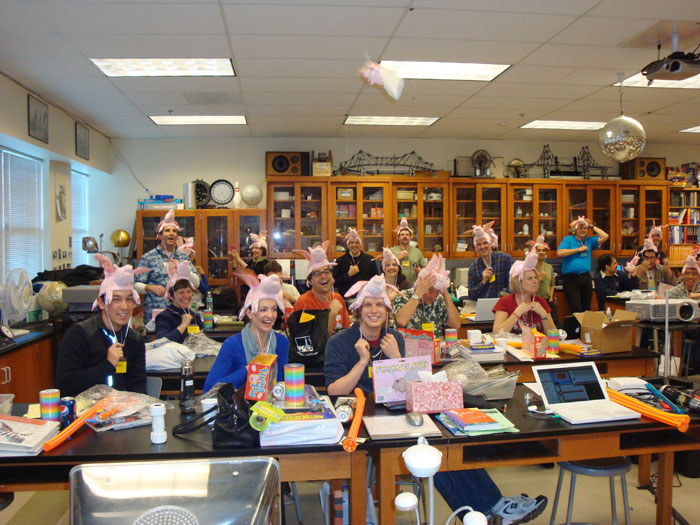
Sacramento's "home-opener" will be Saturday, October 1, at Rio Americano High School. Dean Baird and Steve Keith are your hosts for the workshop.

The theme for Workshop 1 is mechanics and the beginning of the school year. Motion, forces, energy, momentum, gravity, and rotation, as well as ideas on how to start the year right and communicate to parents at Back-to-School Night. The themes are set, but the workshop paths wander in different directions every year. We specialize in tangents!
If you haven't yet registered, get on over to ptsos.org for more info, and send a note to Stephanie Finander to sign up. Registration is free, but we order serious goodies for participants.
In the meantime, here are some photos from workshops held last year.
PTSOS San Mateo 2010-11
PTSOS Sacramento 2010-11
Monday, July 11, 2011
PTSOSers show their mettle on Iron Science Teacher

NorCal physics teachers Bree Barnett and Ty Fredriks recently performed on the Exploratorium's Iron Science Teacher. What is Iron Science Teacher?
"Cheer on the competitors in this zany science cook-off, where teachers compete before a live audience at the Exploratorium for the sought-after title, "Iron Science Teacher." Parodying the cult Japanese TV program, "Iron Chef," the Exploratorium's Iron Science Teacher competition showcases science teachers as they devise classrom activities using a particular ingredient—an everyday item such as a plastic bag, a milk carton, or a nail."
Bree's "secret ingredient" was eggs. Take a look at Bree's Eggsalent Adventure.
Ty's "secret ingredient" was magnets. Take a look at "Tesla Ty" in action (at a distance).
Our colleagues did a great job; they demonstrated grace under pressure in addition to some great science. Well done, Bree and Ty!
Sunday, May 15, 2011
Pixel Peeping - a new PhET activity
PTSOS colleague, Dan Burns, has his students look at pixels through a small, powerful magnifier. Five years after he shared this idea at a PTSOS workshop, I finally figured out a way to make this work for my own students. (I'm kinda slow.)
It involves the use of PhET's Color Vision sim in addition to a magnifier.

Having run a few early drafts in class, I will warn you that you'll hear many involuntary expletives of amazement while students undertake this investigation. They've been looking at displays all their lives. And they never knew what was going on at the microscopic level.
I'm always a fan of activities that get even the most jaded, "been there, done that" high school teenager to revert to the sense of wonder they had in elementary school. Even if only for a few moments. So I can recommend this one without hesitation.
Pixel Peeping at PhET
It involves the use of PhET's Color Vision sim in addition to a magnifier.
Having run a few early drafts in class, I will warn you that you'll hear many involuntary expletives of amazement while students undertake this investigation. They've been looking at displays all their lives. And they never knew what was going on at the microscopic level.
I'm always a fan of activities that get even the most jaded, "been there, done that" high school teenager to revert to the sense of wonder they had in elementary school. Even if only for a few moments. So I can recommend this one without hesitation.
Pixel Peeping at PhET
Tuesday, April 19, 2011
Connecting the Dots
As mentioned in a previous post, a PTSOS participant alerted me to the prospect of constructing a wave machine with Gummy Bears.
I was intrigued enough to give it a shot.
The inertial candies used in the original were the UK-specific Jelly Babies. Sure, we have Gummy Bears (and Gummi Bears) here in the states. But their masses are significantly less than those of the Jelly Babies.
A Jelly Baby packs 6 grams of gelatinous sugar into its plump, opaque body. A Gummy Bear gets by with a mere 2.5 grams of see-through, rubbery gel. It could be eaten by a Swedish Fish for a twist of confectionary irony.
I opted for Dots, a product of the Tootsie corporation. They're nearly 4 grams each. (I didn't know the actual mass of a Jelly Baby until after our in-class project).
My OCD tendencies required that step 1 of the project was to sort the five flavors/colors of Dots. The Wikipedia entry for Dots says that Tootsie claims all flavors are produced in equal amounts. We found that cherry red outnumbered any other flavor by more than 2-to-1.
The rest of the project is represented fairly well in the video I produced and uploaded to YouTube. (Curiously, I produced the video in Apple's Keynote, which allowed me to include some nice construction animations.)
UPDATE 3/26/2022: Connect the Dots [Lab] at Teachers Pay Teachers
Wednesday, February 09, 2011
This snow day swan dive is not normal
Teenagers do the darndest things...
PTSOSer, John Sphar shared this gem with the group.
http://www.wimp.com/swandive
Dan Burns asks his students why the board supports the diver until he jumps.
PTSOSer, John Sphar shared this gem with the group.
http://www.wimp.com/swandive
Dan Burns asks his students why the board supports the diver until he jumps.
Sunday, January 30, 2011
PTSOS: What IS this thing?

A PTSOSer brought this device in hoping to learn what it was and how to use it. Click the pic to access more pics.
It appears to be a transformer whose inner (secondary?) coil is connected to electrodes who come close to one another. The upper arm can be moved to change the space of the gap.
There are no binding/connecting posts above or below. The underside is clean.
Our collective wisdom, such as it was, suggested connecting an AC source to the outer (primary?) coil via alligator clips or equivalent. That outer coils appears capable of handling many amps.
It has a Welch nameplate (before the merger with Sargent).
Have you seen such a thing? Please advise (in the comments) as to its function and proper setup. (I've added a new post tag: Mr. Equipment—it's like the words "mystery" and "equipment" joined together.)
PTSOS: Jelly Baby Wave Machine
Among the many groovy aspects of PTSOS is the sharing among participants. The veterans up front have seen many things, but we haven't seen it all.
While discussing the Bell Labs wave machine, one of the participants at yesterday's PTSOS2 mentioned a Gummi Bear wave machine made with bamboo skewers and tape.
Here's a link to a video of the device. In the UK, they have Jelly Babies rather than Gummi Bears. (They also have G-clamps. Honestly, isn't that a better name than C-clamps?)
Looks like a winner to me!

http://www.nationalstemcentre.org.uk/elibrary/resource/2096/wave-machine
I'm thinking... Dots or Crows might be the way to go on this (in the states).
While discussing the Bell Labs wave machine, one of the participants at yesterday's PTSOS2 mentioned a Gummi Bear wave machine made with bamboo skewers and tape.
Here's a link to a video of the device. In the UK, they have Jelly Babies rather than Gummi Bears. (They also have G-clamps. Honestly, isn't that a better name than C-clamps?)
Looks like a winner to me!
http://www.nationalstemcentre.org.uk/elibrary/resource/2096/wave-machine
I'm thinking... Dots or Crows might be the way to go on this (in the states).
PTSOS2: Heat Waves in Sacramento
Despite the chilly tule fog, a group of physics teachers gathered to discuss the pedagogy of heat and waves at Rio Americano High School yesterday. It was PTSOS2: Give Physics a Whirl.
We ran through kinetic theory, temperature, specific heat, and heat transfer in the morning. Demonstrations were demonstrated, with presentation tips aplenty. Corresponding presos were presented (with my usual admonitions about how bad PowerPoints can be). Lab activities from the Conceptual Physics Lab Manual: Activities · Experiments · Demonstrations · Tech Labs were discussed and summarized.
Specifics included conductometers, radiometers, radiators, Miracle Thaws, and many others. We can never resist the Leidenfrost effect. (A full episode of Jearl Walker's Kinetic Karnival is devoted to this topic.) That led us to busting the paranormal explanation of firewalking.
One highlight was Steve Keith's Rubens' Tube.

During lunch, we were treated to a surprise visit from the Physics Go Girls (Morgan and Riley), who brought treats. With their chartreuse db-T's, they could have been seen from outer space.

Their customized carbohydrate comestibles were enjoyed by participants and workshop leaders alike.

After lunch, we launched into mechanical waves and sound. We discussed the connection of vibrations to waves (without getting bogged down into the robust details of simple harmonic motion). We delved into the Bell Labs wave machine, a Doppler rocket, PhET sims, WavePort, and others. I really like WavePort for creating and analyzing sounds.
A roommful of Talkie Tapes was too silly to not take a video of.
The fact that some users often mishear the word "fun" led us on a tangent of audio pareidolia. Our visit to Jeff Milner's Backmasking website resulted in laughter (wincing, cringing) of varying degrees of propriety.
Steve piped some heavy gas (the eco-friendly freon replacement) through a song flute (recorder) so we could hear the difference that makes. Much like the Mythbusters Fun with Gas clip.
We ended the day with the real make-n-take: Steve Keith's newest and improved-est version of the ever-popular String Thing. (Here's the Exploratorium's version.)

I couldn't resist slowing the finished product down with my compact FH-100.
It was a great day! More photos can be found at my Flickr site.
PTSOS is sponsored by the NCNAAPT and made possible by a grant from the Karl L. Brown Memorial Scholarship fund.
We ran through kinetic theory, temperature, specific heat, and heat transfer in the morning. Demonstrations were demonstrated, with presentation tips aplenty. Corresponding presos were presented (with my usual admonitions about how bad PowerPoints can be). Lab activities from the Conceptual Physics Lab Manual: Activities · Experiments · Demonstrations · Tech Labs were discussed and summarized.
Specifics included conductometers, radiometers, radiators, Miracle Thaws, and many others. We can never resist the Leidenfrost effect. (A full episode of Jearl Walker's Kinetic Karnival is devoted to this topic.) That led us to busting the paranormal explanation of firewalking.
One highlight was Steve Keith's Rubens' Tube.
During lunch, we were treated to a surprise visit from the Physics Go Girls (Morgan and Riley), who brought treats. With their chartreuse db-T's, they could have been seen from outer space.
Their customized carbohydrate comestibles were enjoyed by participants and workshop leaders alike.
After lunch, we launched into mechanical waves and sound. We discussed the connection of vibrations to waves (without getting bogged down into the robust details of simple harmonic motion). We delved into the Bell Labs wave machine, a Doppler rocket, PhET sims, WavePort, and others. I really like WavePort for creating and analyzing sounds.
A roommful of Talkie Tapes was too silly to not take a video of.
The fact that some users often mishear the word "fun" led us on a tangent of audio pareidolia. Our visit to Jeff Milner's Backmasking website resulted in laughter (wincing, cringing) of varying degrees of propriety.
Steve piped some heavy gas (the eco-friendly freon replacement) through a song flute (recorder) so we could hear the difference that makes. Much like the Mythbusters Fun with Gas clip.
We ended the day with the real make-n-take: Steve Keith's newest and improved-est version of the ever-popular String Thing. (Here's the Exploratorium's version.)
I couldn't resist slowing the finished product down with my compact FH-100.
It was a great day! More photos can be found at my Flickr site.
PTSOS is sponsored by the NCNAAPT and made possible by a grant from the Karl L. Brown Memorial Scholarship fund.
Saturday, January 22, 2011
PhyzParty at my place!
PTSOS2/Sacramento is one week from today. Workshop 2, "Give Physics a Whirl" focuses on heat, waves, and sound. We discuss ideas, classroom instruction, labs and demos. Valuable goodies are distributed to participants!
Here's a list of likely topics:
HEAT
Measuring Temperature, Kinetic Theory, Thermal Expansion, Conduction, Convection, Radiation, Leidenfrost Effect, and more.
WAVES
Vibrations, Wave Mechanics, Doppler Effect, Bow/Shock Waves, Interference, Sound, and more.
Critical thinking, paperwork management, dealing with state assessments, and other topics may sneak in during the day. Computer simulations and video clips, too. Resources are "massively shared!" And participants are likely to build a make-n-take before all is said and done.
If you're a new physics teacher in Northern California, sign up! If you're an old physics teacher in Northern California who enjoys talking about the craft, sign up!
The workshop is hosted by Steve Keith and yours truly at Rio Americano High School, Saturday, January 29, 8:30am-4:30pm. Registration includes goodies (apparatus), goodies (treats), and lunch and is attractively priced at FREE! Register with Stephanie Finander at sfinander@sbcglobal.net
PTSOS is sponsored by the Northern California and Nevada section of The American Association of Physics Teachers (NCNAAPT) and made possible by a grant from the Karl L. Brown Memorial Scholarship Fund.
Saturday, January 09, 2010
PTSOS Sacramento: Give Physics a Whirl 1/30/10
The next Physics Teacher SOS (PTSOS) Sacramento workshop will be held at Rio Americano High School on Saturday, January 30.
The focus will be heat, waves, and sound. Topics will include temperature, kinetic theory, heat transfer, phases, the Leidenfrost Effect, mechanical wave characteristics and properties, Doppler Effect, shock waves and sonic booms, interference and beats.
We will address these topics via demonstrations, computer sensors, simulations, and a make-n-take. And we'll discuss how these topics are assessed on the state's Physics CST. In any case, there will be flames!
The goodies are robust and worthwhile. Attendees will leave with treasures of knowledge and the high-quality materials needed to "work the magic" in their own classrooms on Monday (or any time thereafter).
Steve Keith will be leading the workshop with me. And our attendees bring the wisdom, insights, and curiosity that make PTSOS workshops work as well as they do.
We'd love to have all area physics teachers, new and old, along with us for a day of physics fun. If you attended the October workshop, you know the joy of PTSOS. If you missed our October session, you don't want to miss this one!
Register with Stephanie Finander: sfinander@sbcglobal.net. If you're in the San Juan Unified School District, the ERO SRN for this workshop is 1040215072.
Sunday, October 04, 2009
Post-PTSOS1 spotlight: Secrets of the Psychics
The episode of NOVA devoted to the work of James Randi, "Secrets of the Psychics," appears to have gone out of print. Resellers at Amazon.com with VHS tapes to sell are offering it for $999.99.
Thankfully, the episode has been posted to YouTube.
I wrote a question set to accompany presentation of the program.
NOVA: James Randi's Secrets of the Psychics
For the answer key, scroll to the bottom of Skepticism in the Classroom and download the Teacher PDF file.
Thankfully, the episode has been posted to YouTube.
I wrote a question set to accompany presentation of the program.
NOVA: James Randi's Secrets of the Psychics
For the answer key, scroll to the bottom of Skepticism in the Classroom and download the Teacher PDF file.
Subscribe to:
Posts (Atom)