Let me just say at the outset that this post is Reason I'm a Terrible Person #417.
I was scoping out the YouTubes in search of a nice video lesson on the photoelectric effect. Demonstrating the effect can be troublesome and finicky. So why not enjoy the fruits of someone else's labor?
I watched through Adam Micolich's lesson (below) and... found it wanting. Wanting to be used as a lesson in skepticism and critical thinking!
The story/script is nicely straightforward:
1. A negatively charged electroscope is discharged via exposure to ultraviolet light.
2. The UV light is causing the discharge: a glass plate blocks the UV and prevents the discharge.
3. The UV liberates electrons: a positively charged electroscope is not discharged by UV light.
Let's see how it goes. (The actual photoelectric demo begins at about 2:50.)
Each segment seemed to go according to plan and proved the aspect being investigated. The content as spoken is spot-on correct.
And I have no reason to suspect shenanigans. But in my judgment, the demonstration is flawed to the point it would be fraudulent if done intentionally.
Consider it a PhyzMaster Challenge: Can you find the flaws I found?
I offer this challenge in good faith as an exercise in physics-based critical thinking. These principles are ostensibly valued by Common Core, NGSS, and the reimagined AP Physics courses. I mean no disrespect to Mr. Micolich. He was good enough to produce the video lesson; I—someone who didn't bother to create a video lesson of the photoelectric effect—spent a Saturday night finding fault with it. So who is more deserving of harsh judgment? (That was rhetorical.)
Hints and specific allegations in the comments. I might remove these later if I assign a skeptical critique to my students.
Sunday, March 20, 2016


Wednesday, March 09, 2016
Hewitt Drew It screencast index page updated
Conceptual Physics author and good friend, Paul Hewitt, recently spent a few years producing 147 physics screencasts. I was overwhelmed at the sheer volume of these gems, so I organized a set of links to the screencasts in a way that was helpful to me as a classroom teacher.
Since I originally launched my index page, several more screencasts were produced. So today, I updated the index page to reflect the new screencasts. Newly indexed screencasts include several concerning special relativity and a couple on general relativity, as well as "appendix" screencasts on sailing into the wind and another about the exponential function (it's more captivating than you might think).
Hewitt Drew It Screencasts
Since I originally launched my index page, several more screencasts were produced. So today, I updated the index page to reflect the new screencasts. Newly indexed screencasts include several concerning special relativity and a couple on general relativity, as well as "appendix" screencasts on sailing into the wind and another about the exponential function (it's more captivating than you might think).
Hewitt Drew It Screencasts
Monday, March 07, 2016
Take Physics: Course advertising–2016 edition

If you want more students to enroll in physics next year, you might consider advertising your physics course offerings right now.
To that end, I post a series of fliers around campus. Over the years, it's actually become a few series of fliers. I'll post each series below as examples. Some you can probably use as is. One will absolutely not work for you.
In any case, you'll want to click each series to see what it looks like.
Series 1: Physics: You Don't Want to Miss It (The Original Series)
Series 2: Physics: You Don't Want to Miss It (French and Spanish)
I print Series 1 and 2 to fluorescent, coated (not dyed) "neon" paper. It's as optically bright as it is hard to come by. Here's the Amazon link I used last time I bought the stuff.
Series 3: Slogan meets Google Translate [I'm confessing that I went too far with this series.]
Series 4: Dank Memes: Take Physics Edition
Series 5: The Groupie Shots (ft. Bill Nye, Neil deGrasse Tyson, and Adam Savage)

The Groupie Shots? You'll need to get your own. Mine will not work for you: some kind of union contract issue, I think.
If you've got posters that you decorate your school with during course selection season, tell us about them in the comments.
Sunday, March 06, 2016
A variable "tuning fork" with volume
 Tuning forks have one job: to vibrate with a single fundamental frequency. Simple tuning forks are often troubled with some harmonics, but the overtones are typically very small in amplitude. The fundamental frequency produced by each fork is determined by its composition and physical characteristics. Most are made of aluminum, and their tone is fixed by the length of their tines.
Variable tuning forks have weights attached to the tines; the location of the weights can be adjusted. The frequency of the fork depends on the location of the weights. Such forks are okay in a pinch, but they're a bit dull for my tastes and their Q factor leaves something to be desired.

The good folks at Next Generation Science (whose corporate name is harder to find via search engine results in the NGSS era), offered an electronic tuning fork (Sound Generator) that could produce tones at 400 Hz, 600 Hz, and 800 Hz.
But wouldn't it be nice to have a small-scale, full-spectrum variable tuning fork? Perhaps you already do.
 There are frequency generators aplenty available for smartphones. (I have FreqGen, but that one seems to have vanished from the iTunes Store.) What's important is that you can adjust the frequency of the output tone down to the hertz. You can turn your smartphone into a variable tuning fork easily enough. But much like a tuning fork, the smartphone's sound doesn't carry out to much of a volume. The common solution is to set the tuning fork into a resonance box.
But for the smartphone, that's where a portable speaker comes in handy. I have a Bluetooth speaker that is capable of achieving considerable volume. Once the speaker has been paired with the phone, you can unleash whatever frequency you like at volumes that can annoy people and animals for many meters all around.
I don't recommend blasting out 16,000 Hz at full volume simply because it cripples teenagers while leaving you oblivious. That's just cruel. Every time I do it, my students hate me for several minutes.
Use this newfound tool for good, not evil. It could be leveraged in a "speed of sound" type lab. I'll share my primary use for it in another post.
The Bells of Pasco
One of the first things I purchased for my physics program (using other people's money) was Pasco's Lenz's Law Demonstrator. At the time (1988), it was $55. I remember thinking that was a tidy sum, and that I should probably have cobbled together a home-made version of it myself. As my mentor, Steve Keith, often said, "Why buy something for $50 when you can make it yourself for $60?" But there I was, with the "store-bought" version and a bit of guilt.
The apparatus worked great for its intended purpose, but I felt it was important to milk this thing for all its pedagogical potential. I supplemented it with an otherwise identical length of PVC tube to show tubes made of insulating materials produced no effect, and I used an otherwise identical length of EMT to show that iron produced "too much" effect. (Who doesn't love a Goldilocks situation?)
Eventually, I found the aluminum tube did a great job as a blow gun: I was able to shatter whiteboard marker pens that I blew through the tube and toward solid doors or walls, accelerating the pens to speeds unlawful on local highways. The description of this application became my first published article in The Physics Teacher. The inimitable Don Rathjen of the Exploratorium Teacher Institute designed a simpler, safer version of this demo that he called The Marshmallow Puff Tube.
I also found that the tube was capable of producing lovely tones when struck gently at an end with a croquet mallet. The trick there was knowing where to hold the tube (with as light a grip as possible). Serendipitous experimentation shows that different tones can be produced, depending on where along the tube you hold it. The point is amplified if you hold the tube very near the end: acoustically, it's as dead as the proverbial doornail.
The other day I was returning our set of aluminum Pasco Introductory Dynamics System tracks to their storage space when I decided to give them a bonk with the old mallet. I was able to get a nice set of tones out of them. Not as pure and simple as with the Lenz's law tube, but not bad. The Pasco Basic Optics bench, though similar in its extruded aluminum simplicity, was a disappointment as a bell. I blame the permanently attached rubber feet for putting a damper on things.
What exactly one might do with the knowledge that a Pasco track is capable of producing nice tones, I do not know. If you think of something, please share it in the comments. If Bree or I think of something, we'll share it here, too.
And what about that $55 capital outlay in 1988? Considering it's been seen by over 150 students per year for three demos each year for at least 25 years, the expense amortizes out to $55/(150 × 3 × 25) = $0.0049 (less than half a cent) for each student per use in class. There are some things in education that cost more but are worth less. Whatever burden of guilt I attached to the demo purchase has long since been replaced by a buoyant spirit of instructional utility.
The apparatus worked great for its intended purpose, but I felt it was important to milk this thing for all its pedagogical potential. I supplemented it with an otherwise identical length of PVC tube to show tubes made of insulating materials produced no effect, and I used an otherwise identical length of EMT to show that iron produced "too much" effect. (Who doesn't love a Goldilocks situation?)
Eventually, I found the aluminum tube did a great job as a blow gun: I was able to shatter whiteboard marker pens that I blew through the tube and toward solid doors or walls, accelerating the pens to speeds unlawful on local highways. The description of this application became my first published article in The Physics Teacher. The inimitable Don Rathjen of the Exploratorium Teacher Institute designed a simpler, safer version of this demo that he called The Marshmallow Puff Tube.
I also found that the tube was capable of producing lovely tones when struck gently at an end with a croquet mallet. The trick there was knowing where to hold the tube (with as light a grip as possible). Serendipitous experimentation shows that different tones can be produced, depending on where along the tube you hold it. The point is amplified if you hold the tube very near the end: acoustically, it's as dead as the proverbial doornail.
The other day I was returning our set of aluminum Pasco Introductory Dynamics System tracks to their storage space when I decided to give them a bonk with the old mallet. I was able to get a nice set of tones out of them. Not as pure and simple as with the Lenz's law tube, but not bad. The Pasco Basic Optics bench, though similar in its extruded aluminum simplicity, was a disappointment as a bell. I blame the permanently attached rubber feet for putting a damper on things.
What exactly one might do with the knowledge that a Pasco track is capable of producing nice tones, I do not know. If you think of something, please share it in the comments. If Bree or I think of something, we'll share it here, too.
And what about that $55 capital outlay in 1988? Considering it's been seen by over 150 students per year for three demos each year for at least 25 years, the expense amortizes out to $55/(150 × 3 × 25) = $0.0049 (less than half a cent) for each student per use in class. There are some things in education that cost more but are worth less. Whatever burden of guilt I attached to the demo purchase has long since been replaced by a buoyant spirit of instructional utility.
Thursday, March 03, 2016
How far is it EXACTLY?
It is often difficult for students to understand relative distances or speeds of objects. It is even harder to go against their ingrained accepted English system of measurements by making them use *gasp!* the metric system. I've been guilty of it numerous times myself by trying to use round, easy to square root numbers in my problems only to have a student raise their hand and meekly ask, "Wait, wouldn't that be as high as the Empire State Building?" or "Wouldn't that break the sound barrier?" etc. Sometimes we go for realism and sometimes I just want them to be able to do the problem quickly for practice.
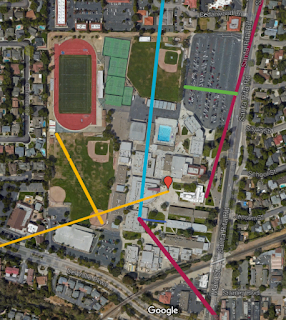 I've found a few times that using Google Maps is helpful to create maps for scale. At the beginning of the year students practice their understanding of scale with this Group Measurement Activity (pdf or ppt here). I've incorporated images from Google Maps before for lectures on measurement but they have not been interactive. I just made this map (at right) of different distances from 50 m to just under 2000 km using our campus as the 0 m mark. You can view the distances in two layers, <5 km and <2000 km.
I just came up with this strategy for my Physical Science class when we studied the layers of the Earth. I gave each student a printed map of the US and showed them this map (below) with different line segments representing the average thicknesses of the different layers of the Earth. Students were able to transfer the lines to their own map.

While the level of students necessitated this format, I would like to try having students find their own lengths for these thicknesses. Using laptops or tablets students would be able to make their own Google maps based on these thicknesses, or any other values I want them to gain an understanding of.
One of my favorite random facts about the electromagnetic spectrum is this quote from a NOVA documentary:
I've also started playing around with a map that compares the distance traveled by sound to the distance traveled by light but I'm quickly finding the difference in scale will be cumbersome. Its hard to compare sound (very fast) with light (faster than you can imagine something moving). What other ways could you use this tool in a science classroom?
 I've found a few times that using Google Maps is helpful to create maps for scale. At the beginning of the year students practice their understanding of scale with this Group Measurement Activity (pdf or ppt here). I've incorporated images from Google Maps before for lectures on measurement but they have not been interactive. I just made this map (at right) of different distances from 50 m to just under 2000 km using our campus as the 0 m mark. You can view the distances in two layers, <5 km and <2000 km.
I just came up with this strategy for my Physical Science class when we studied the layers of the Earth. I gave each student a printed map of the US and showed them this map (below) with different line segments representing the average thicknesses of the different layers of the Earth. Students were able to transfer the lines to their own map.

While the level of students necessitated this format, I would like to try having students find their own lengths for these thicknesses. Using laptops or tablets students would be able to make their own Google maps based on these thicknesses, or any other values I want them to gain an understanding of.
One of my favorite random facts about the electromagnetic spectrum is this quote from a NOVA documentary:
“This understanding of planetary processes is based upon data from satellite instruments spanning a wide range of wavelengths of the electromagnetic spectrum, almost all invisible to the eye. As one scientist explains, if the electromagnetic spectrum were stretched the three thousand miles from New York to California, what we can see in the optical range would take up the space of a dime."
While I have used an animation within Powerpoint to illustrate this in the past it is not to scale. While I was playing around with maps, I created a quick map with only two parts: a line from Los Angeles, California to New York City, New York and a marker in the middle of an intersection in Wichita, Kansas. The distance from LA to NY ended up 2,450 miles but the scale is still impressive. I would show students the whole US and then zoom in on the green circle representing the dime on "main street USA" right in the middle of Kansas. The quote is interesting on its own, engaging as a simple picture but I hope it will be more powerful as an interactive map.
Monday, February 29, 2016
Everything about AP Physics changed except...
My joyless, long-winded assessment of the new AP Physics 1 and AP Physics 2 exams below was long enough as it was. I couldn't suitably fit in all my misgivings and supporting tangents.
As I said, the redesigns is a shining utopia that may well be worthy of pursuing. The old AP Physics B has been torn apart and used for parts in the new, sweepingly grander vision. In very real ways, classroom teachers have been compelled to abandon the old college replacement course and deliver a course that matches what many would describe as the best college courses offered in the nation (if not the world). All in the confines of a high school setting.
The new course represents a rebuilding from the ground up. Everything is different—for the better. To pass AP Audit muster, teachers must attest to conforming to the many layers of the New Vision, and that they've rebuilt their courses from the ground up.
What good fortune it is for the College Board that in spite of the upheaval visited upon classroom teachers far and wide, the exam, itself, required no real structural change!
The old exam consisted of dozens of multiple choice questions and a handful of free-response questions. After the exhaustive overhaul required of AP-approved physics teachers, the corresponding new exam consists of dozens of multiple choice questions and a handful of free-response questions. At the College Board's end, the multiple choice will require machine scoring as it already exists, and the free-response will require readers and table leaders as they have been using since the exam's inception.
So it's not the same old wine in a new bottle. Rather, a completely new wine in an old bottle. As demanded by the bottlers, themselves. Good fortune for the bottlers; tough rows to hoe for the workers in the vineyards.
As I said, the redesigns is a shining utopia that may well be worthy of pursuing. The old AP Physics B has been torn apart and used for parts in the new, sweepingly grander vision. In very real ways, classroom teachers have been compelled to abandon the old college replacement course and deliver a course that matches what many would describe as the best college courses offered in the nation (if not the world). All in the confines of a high school setting.
The new course represents a rebuilding from the ground up. Everything is different—for the better. To pass AP Audit muster, teachers must attest to conforming to the many layers of the New Vision, and that they've rebuilt their courses from the ground up.
What good fortune it is for the College Board that in spite of the upheaval visited upon classroom teachers far and wide, the exam, itself, required no real structural change!
The old exam consisted of dozens of multiple choice questions and a handful of free-response questions. After the exhaustive overhaul required of AP-approved physics teachers, the corresponding new exam consists of dozens of multiple choice questions and a handful of free-response questions. At the College Board's end, the multiple choice will require machine scoring as it already exists, and the free-response will require readers and table leaders as they have been using since the exam's inception.
So it's not the same old wine in a new bottle. Rather, a completely new wine in an old bottle. As demanded by the bottlers, themselves. Good fortune for the bottlers; tough rows to hoe for the workers in the vineyards.
Wednesday, February 24, 2016
물리학에 오신 것을 환영합니다
That's the sign I posted near my classroom door to welcome a group of South Korean visitors today. The city officials were guests of Rio Americano's Civitas program. Their visit coincided with my student teacher's class, so I was free to chat with them. They had great questions and had the foresight to document their visit photographs. My kind of people!
They assured me that my sign was a correct translation of "Welcome to Physics," and I was in no position to argue with them—or with Google Translate. A Korean student (whom I adore) later scolded me for being so formal in my greeting. I gave her the sign and the task of providing a friendlier, more casual greeting for the next time I am visited by a Korean delegation.
If you've never tried the Translate smart phone app, fire it up and try it on this message via its photo analysis feature. Very impressive!
They assured me that my sign was a correct translation of "Welcome to Physics," and I was in no position to argue with them—or with Google Translate. A Korean student (whom I adore) later scolded me for being so formal in my greeting. I gave her the sign and the task of providing a friendlier, more casual greeting for the next time I am visited by a Korean delegation.
If you've never tried the Translate smart phone app, fire it up and try it on this message via its photo analysis feature. Very impressive!
Monday, February 22, 2016
Why I no longer recommend the AP Physics exam
[This post carries the "rant" label, so it is presumed that your mileage may vary. I never presume my own experience is universal. None of this post refers to AP Physics C.]
Since I began teaching Advanced Placement Physics B in 1986, I have strongly encouraged all my AP students to purchase and take the AP Physics exam each May.
For now, I am recommending that they do not.
As we know, AP Physics B has been re-imagined as AP Physics 1 and AP Physics 2. The old vision of AP Physics acting as a college equivalent was dispensed with in the redesign. AP Physics B (as well as content standards prevalent in the 2000s) were seen as too content-focused, and lacked emphasis on process. Not an unfair criticism, to be sure.
The newly redesigned AP Physics 1 and AP Physics 2 are ambitiously constructed, multi-layered visions of physics course utopia. They are Lamborghinis sent in to replace the Camaros that existed until now. College courses, for the most part, remain largely content-driven.
The vision of the AP course being a college equivalent has been abandoned. AP Physics 1 and AP Physics 2 are the best courses time, talent, and energy can buy. Meticulously crafted courses of physics perfection.
But as of now, it's beyond my budget. And beyond the budget of my highly capable students. It is very much in an experimental phase. Version 1.0 of a complex new machine that we have been asked to be the early adopters of.
There is evidence to suggest the nation's AP Physics 1 and 2 teachers and students failed to abruptly snap to The College Board's new vision. Scores between the 2014 AP Physics B administration and the 2015 AP Physics 1 and 2 administrations show a massive shift in the wrong direction.
In 2014, more than 60% of AP Physics B candidates passed the exam with a score of 3 or better. Of those, 34% passed with a 4 or 5 (over 15% were 5s).
In 2015, more than 60% of AP Physics 1 candidates failed to earn a score of 3 or better. Fewer than 20% of the candidates scored a 4 or 5 (only 4% were 5s).
It could be that America's physics students suddenly became less capable. But that's not likely. It's more likely that America's best and brightest physics students weren't prepared for the radically different new exam.
The College Board would argue that they provided extensive information on the newly designed courses. And indeed they have. Exhaustive, really.
But part of The New Vision is that there is no longer a blueprint for exactly what content is to be covered and in which amounts. Physics content mastery is no longer tested, it is now presumed. Instead of distributing questions across a well defined subject-matter topic list, questions are not cast across broadly-defined Big Ideas and Science Practices. Mastery of these can be assessed via questions that merely use physics content as the canvas upon which the Big Ideas and Science Practices are painted.
True mastery of the Big Ideas and Science Practices, via Learning Objectives and bits of Essential Knowledge, painted on the canvas of physics, demands a level of engagement I find to be unreasonable. Don't get me wrong, I'd love for my students to be single-mindedly focused on everything we do in physics: in class and beyond the classroom. But my students have other things going on in their lives that demand attention. Many, many other things, as is typical of highly capable, multi-talented college-bound students.
It is certainly The College Board's prerogative to offer a product for purchase as they see fit. But in my opinion, they got it wrong. My misgivings may well be mine, alone. But that's not the sense that I get when talking candidly to other AP Physics teachers. I assume some folks love the redesign. I trust they'll light me up in the comments because I have not talked to such folks in person.
Speaking only for myself, I would say The College Board did what most august bodies do when undergoing a revisioning process: they spent their time, talent, and energy creating a grand vision. With a multi-dimensional outline and hierarchy. A complex and ornate structure. They then committed that vision to a tome of well over 200 pages.
What would have been more useful to me is for them to have spent more time, talent, and energy developing valid practice items. Practice multiple choice, practice multi-correct, practice free response (all types). I am very much "an assessment guy," having served on AAPT's Editorial Exam board, California's Golden State Exam development team, and California's Content/Assessment Review Panel.
So my process is inductive rather than deductive. If you show me a large sample of assessment items, I can determine what your grand vision was. But if you show me your grand vision, I cannot figure out exactly what your assessment items will look like. Maybe others can deduce better than I can.
But I have yet to see a grand, sweeping process (including you, NGSS) that respects the value of assessment and released items. The spotlight is always shown upon The Vision. Pesky questions about assessment and released items are marginalized with responses such as, "We'll get to that later," "We don't have the budget for that," "The task of item development will be given to other people who are not part of the Blue Ribbon Visioning Panel".
AP Physics redesign advocates encourage teachers to participate in week-long AP training sessions, and I do not doubt that such trainings offer great value (assuming the time and money can be managed). I also know of someone who did the AP training and was left with the impression that rotation was a huge focal point for AP Physics 1. Workshops will always carry the biases of their instructors.
What's more, suppose a student does make a passing score on the redesigned exam. They've shown they can drive that Lamborghini with aplomb. As far as I know, colleges are no more likely to grant credit for the post-redesign exam than they were for the pre-redesign exam.
I'm already past TL;DR territory, so I'll wrap it up. For now, I cannot recommend my students pony up $100 to (most likely) end up on the wrong side of the cut points on an experimental exam. I'll do my very best to prepare them for the exam. But it's fair that they know the extent to which the odds are not in their favor.
With luck, there will be a time in the future by which a sufficient catalog of released items exists so that I feel comfortable that my students will be able to fare well on the AP1 or AP2 exam. But I have no reason to think released item development is a priority for The College Board. So I'll have to wait them out. I do not know how long it will take.
I do know of schools that are switching from AP1 and 2 to AP Physics C, and I know of colleagues who are looking for college credit alternatives to AP1 and AP2. I understand the motivations for these moves completely. To those who are delighted with the redesign, I wish only happiness and good cheer. And the hope that they realize their own experience is not universal.
Since I began teaching Advanced Placement Physics B in 1986, I have strongly encouraged all my AP students to purchase and take the AP Physics exam each May.
For now, I am recommending that they do not.
As we know, AP Physics B has been re-imagined as AP Physics 1 and AP Physics 2. The old vision of AP Physics acting as a college equivalent was dispensed with in the redesign. AP Physics B (as well as content standards prevalent in the 2000s) were seen as too content-focused, and lacked emphasis on process. Not an unfair criticism, to be sure.
The newly redesigned AP Physics 1 and AP Physics 2 are ambitiously constructed, multi-layered visions of physics course utopia. They are Lamborghinis sent in to replace the Camaros that existed until now. College courses, for the most part, remain largely content-driven.
The vision of the AP course being a college equivalent has been abandoned. AP Physics 1 and AP Physics 2 are the best courses time, talent, and energy can buy. Meticulously crafted courses of physics perfection.
But as of now, it's beyond my budget. And beyond the budget of my highly capable students. It is very much in an experimental phase. Version 1.0 of a complex new machine that we have been asked to be the early adopters of.
There is evidence to suggest the nation's AP Physics 1 and 2 teachers and students failed to abruptly snap to The College Board's new vision. Scores between the 2014 AP Physics B administration and the 2015 AP Physics 1 and 2 administrations show a massive shift in the wrong direction.
In 2014, more than 60% of AP Physics B candidates passed the exam with a score of 3 or better. Of those, 34% passed with a 4 or 5 (over 15% were 5s).
In 2015, more than 60% of AP Physics 1 candidates failed to earn a score of 3 or better. Fewer than 20% of the candidates scored a 4 or 5 (only 4% were 5s).
It could be that America's physics students suddenly became less capable. But that's not likely. It's more likely that America's best and brightest physics students weren't prepared for the radically different new exam.
The College Board would argue that they provided extensive information on the newly designed courses. And indeed they have. Exhaustive, really.
But part of The New Vision is that there is no longer a blueprint for exactly what content is to be covered and in which amounts. Physics content mastery is no longer tested, it is now presumed. Instead of distributing questions across a well defined subject-matter topic list, questions are not cast across broadly-defined Big Ideas and Science Practices. Mastery of these can be assessed via questions that merely use physics content as the canvas upon which the Big Ideas and Science Practices are painted.
True mastery of the Big Ideas and Science Practices, via Learning Objectives and bits of Essential Knowledge, painted on the canvas of physics, demands a level of engagement I find to be unreasonable. Don't get me wrong, I'd love for my students to be single-mindedly focused on everything we do in physics: in class and beyond the classroom. But my students have other things going on in their lives that demand attention. Many, many other things, as is typical of highly capable, multi-talented college-bound students.
It is certainly The College Board's prerogative to offer a product for purchase as they see fit. But in my opinion, they got it wrong. My misgivings may well be mine, alone. But that's not the sense that I get when talking candidly to other AP Physics teachers. I assume some folks love the redesign. I trust they'll light me up in the comments because I have not talked to such folks in person.
Speaking only for myself, I would say The College Board did what most august bodies do when undergoing a revisioning process: they spent their time, talent, and energy creating a grand vision. With a multi-dimensional outline and hierarchy. A complex and ornate structure. They then committed that vision to a tome of well over 200 pages.
What would have been more useful to me is for them to have spent more time, talent, and energy developing valid practice items. Practice multiple choice, practice multi-correct, practice free response (all types). I am very much "an assessment guy," having served on AAPT's Editorial Exam board, California's Golden State Exam development team, and California's Content/Assessment Review Panel.
So my process is inductive rather than deductive. If you show me a large sample of assessment items, I can determine what your grand vision was. But if you show me your grand vision, I cannot figure out exactly what your assessment items will look like. Maybe others can deduce better than I can.
But I have yet to see a grand, sweeping process (including you, NGSS) that respects the value of assessment and released items. The spotlight is always shown upon The Vision. Pesky questions about assessment and released items are marginalized with responses such as, "We'll get to that later," "We don't have the budget for that," "The task of item development will be given to other people who are not part of the Blue Ribbon Visioning Panel".
AP Physics redesign advocates encourage teachers to participate in week-long AP training sessions, and I do not doubt that such trainings offer great value (assuming the time and money can be managed). I also know of someone who did the AP training and was left with the impression that rotation was a huge focal point for AP Physics 1. Workshops will always carry the biases of their instructors.
What's more, suppose a student does make a passing score on the redesigned exam. They've shown they can drive that Lamborghini with aplomb. As far as I know, colleges are no more likely to grant credit for the post-redesign exam than they were for the pre-redesign exam.
I'm already past TL;DR territory, so I'll wrap it up. For now, I cannot recommend my students pony up $100 to (most likely) end up on the wrong side of the cut points on an experimental exam. I'll do my very best to prepare them for the exam. But it's fair that they know the extent to which the odds are not in their favor.
With luck, there will be a time in the future by which a sufficient catalog of released items exists so that I feel comfortable that my students will be able to fare well on the AP1 or AP2 exam. But I have no reason to think released item development is a priority for The College Board. So I'll have to wait them out. I do not know how long it will take.
I do know of schools that are switching from AP1 and 2 to AP Physics C, and I know of colleagues who are looking for college credit alternatives to AP1 and AP2. I understand the motivations for these moves completely. To those who are delighted with the redesign, I wish only happiness and good cheer. And the hope that they realize their own experience is not universal.
Sunday, February 21, 2016
New and improved video pages

 Also new, an index page for The Mechanical Universe episodes I use. It links to Annenberg's Learner.org Mechanical Universe page and to my question set worksheets are there for the College Editions. The high school adaptations don't yet stream, so you'll need to pony up to get the short and sweet versions stripped of the calculus. But links to my question sets are there. Is The Mechanical Universe growing long in the tooth? Perhaps. Is there a video series as solid on the fundamentals of physics? None that I know of.
Improved: I've update the burgeoning YouTube Physics page to include this video set, the Mount Tavurvur Volcano Eruption, the Victoria Phyz Falls Baird Bungee Bounce, and Bree's Color Subtraction videos, among others. Worth a visit if you've never been or haven't been in a while.
Classics: The Hewitt Drew It Physics Screencasts remain conveniently catalogued here.
 Full Conceptual Physics Alive! Hewitt lecture videos are available for purchase on DVD or streaming from Arbor Scientific. My video question sets are also available at ArborSci. The videos and questions sets come in very handy for everyday lessons, and become golden in the event of unexpected absences (illness, jury duty, etc.).
Also classic: Cosmos. Cal Sagan's Personal Voyage and Neil deGrasse Tyson's Spacetime Odyssey.
Because there are so many flavors of video I like to have access to, I've created a separate index page (and removed most links from the phyz.org home page).
The Video Index Page of Phyz. Now how silly do you feel for squandering that ski week that's coming to an end?
Got a hot tip for a pedagogy-rich video clip or series? Let us know!
Subscribe to:
Posts (Atom)