We had a pretty heavy downpour of hail at about 5:45 pm on Wednesday, March 23. I grabbed my Casio EX-FH100 and set it to 240 frames per second. From the safety of my eave, I shot a few clips. Pea-sized hail poured down and thunder rolled through. (Always best to go full-screen on these, in my humble opinion.)
I liked the bouncing action apparent near the gutter.
The hail lasted much longer than it usually does (in my experience). So the accumulation was somewhat significant by the end of it all.
These are unedited and may run longer than your patience. If so, skip to the next one or just click pause to stop. Enjoy!
Thursday, March 24, 2011


Sunday, March 20, 2011
XKCD radiation dose chart
You'll find news and comment on the nuclear plant situation else on the interwebs.
All I can do is opine that we will very likely need to increase our reliance on nuclear power generation in the future, so we very much need to get it right and pay particular attention to details. Low-bidding and shoddy construction at a coal plant can have bad consequences. The same at a nuclear plant can be widespread devastation. The consequences are too severe for us to be anything less than brilliant on design and construction.
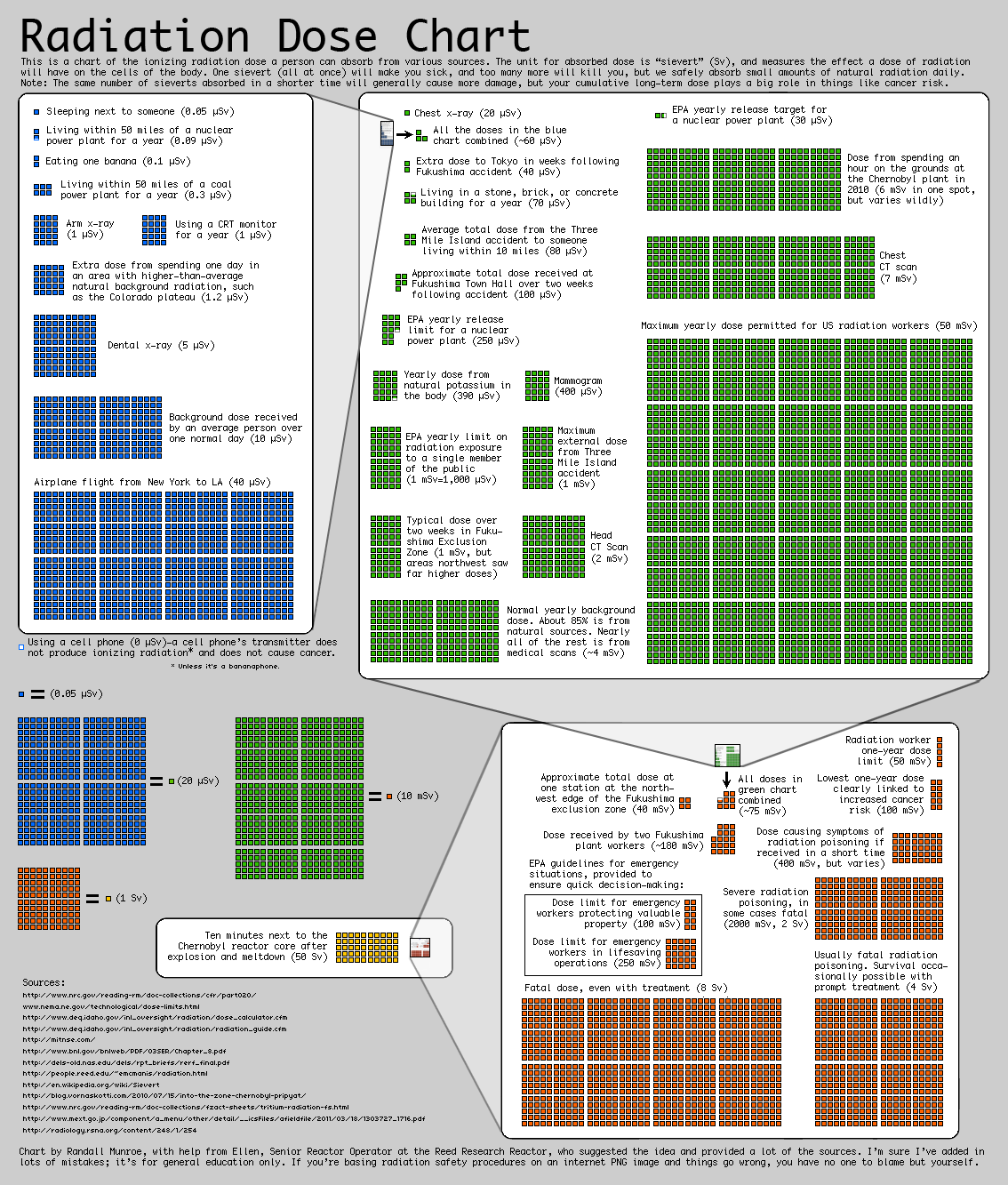
Anyway, in our efforts to Know Nukes, XKCD has prepared a nice chart. Worthy of printing on whatever large-format printer you have access to. It makes a graphical display of radiation doses from natural background up to lethal.

And West-coasters, it's still safe to play outside.
XKCD Radiation Chart
All I can do is opine that we will very likely need to increase our reliance on nuclear power generation in the future, so we very much need to get it right and pay particular attention to details. Low-bidding and shoddy construction at a coal plant can have bad consequences. The same at a nuclear plant can be widespread devastation. The consequences are too severe for us to be anything less than brilliant on design and construction.
Anyway, in our efforts to Know Nukes, XKCD has prepared a nice chart. Worthy of printing on whatever large-format printer you have access to. It makes a graphical display of radiation doses from natural background up to lethal.
And West-coasters, it's still safe to play outside.
XKCD Radiation Chart
Brainiacs electric fence redux
Last year I posted a note about a groovy clip from the now-defunct British science show, Brainiac: Science Abuse (Brainiacs for short). I learnt (I mean learned) that one of the featured circuits was, in essence, an R-2R resistor ladder: a design used in digital to analog conversions.
When I showed the clip to this year's classes, I was compelled to stop the video at specific points and pose questions to encourage predictions and discussions. My inner teacher at work once again.
I've now chopped the original clip up and worked it into a presentation so I could add questions and illustrations where appropriate.
I also developed a brief student worksheet to accompany the video demo. It's what I like to do.
The zipped QuickTime of the preso is kinda hefty (the embedded video bulks it up to nearly 400 MB). And as with all my interactive QuickTimes, it won't stream. You need to download it, unzip it, and run it. But only if you want to!
I think it's worth the time. Your mileage may vary.
Electric Fence zipped interactive QuickTime (huge-normous)
Electric Fence student demo question worksheet (not so big)
When I showed the clip to this year's classes, I was compelled to stop the video at specific points and pose questions to encourage predictions and discussions. My inner teacher at work once again.
I've now chopped the original clip up and worked it into a presentation so I could add questions and illustrations where appropriate.
I also developed a brief student worksheet to accompany the video demo. It's what I like to do.
The zipped QuickTime of the preso is kinda hefty (the embedded video bulks it up to nearly 400 MB). And as with all my interactive QuickTimes, it won't stream. You need to download it, unzip it, and run it. But only if you want to!
I think it's worth the time. Your mileage may vary.
Electric Fence zipped interactive QuickTime (huge-normous)
Electric Fence student demo question worksheet (not so big)
Monday, March 07, 2011
Closed course—professional driver
Barrel-rolling a sports car inside a freeway tunnel isn't everybody's idea of fun. But apparently these Mercedes-Benz guys had nothing better to do.
Thanks to Brad Huff for sharing this gem.
UPDATE: Wired's dot.physics has a nice analysis of the physics.
Thanks to Brad Huff for sharing this gem.
UPDATE: Wired's dot.physics has a nice analysis of the physics.
Saturday, March 05, 2011
More posters to promote physics enrollment
Real estate agents say the three most important characteristics of a property are "location, location, location." Advertisers live by a similar rule, and that is "frequency." Potential customers don't really hear/see your message until the seventh time they've been exposed to it.
So if you're looking to promote enrollment in high school physics, I encourage you to make liberal use of the TAKE PHYSICS posters. Better yet, come up with your own; they'll likely be better than mine. (Unless you live way out on the cutting edge, though, I don't recommend designing a physics version of the old 'Expose Yourself to Art' campaign. Just throwing that out there. But if you do, please send me a copy!)
The American Association of Physics Teachers (AAPT) has designed a couple of nice posters and includes links to them on their Resources page.
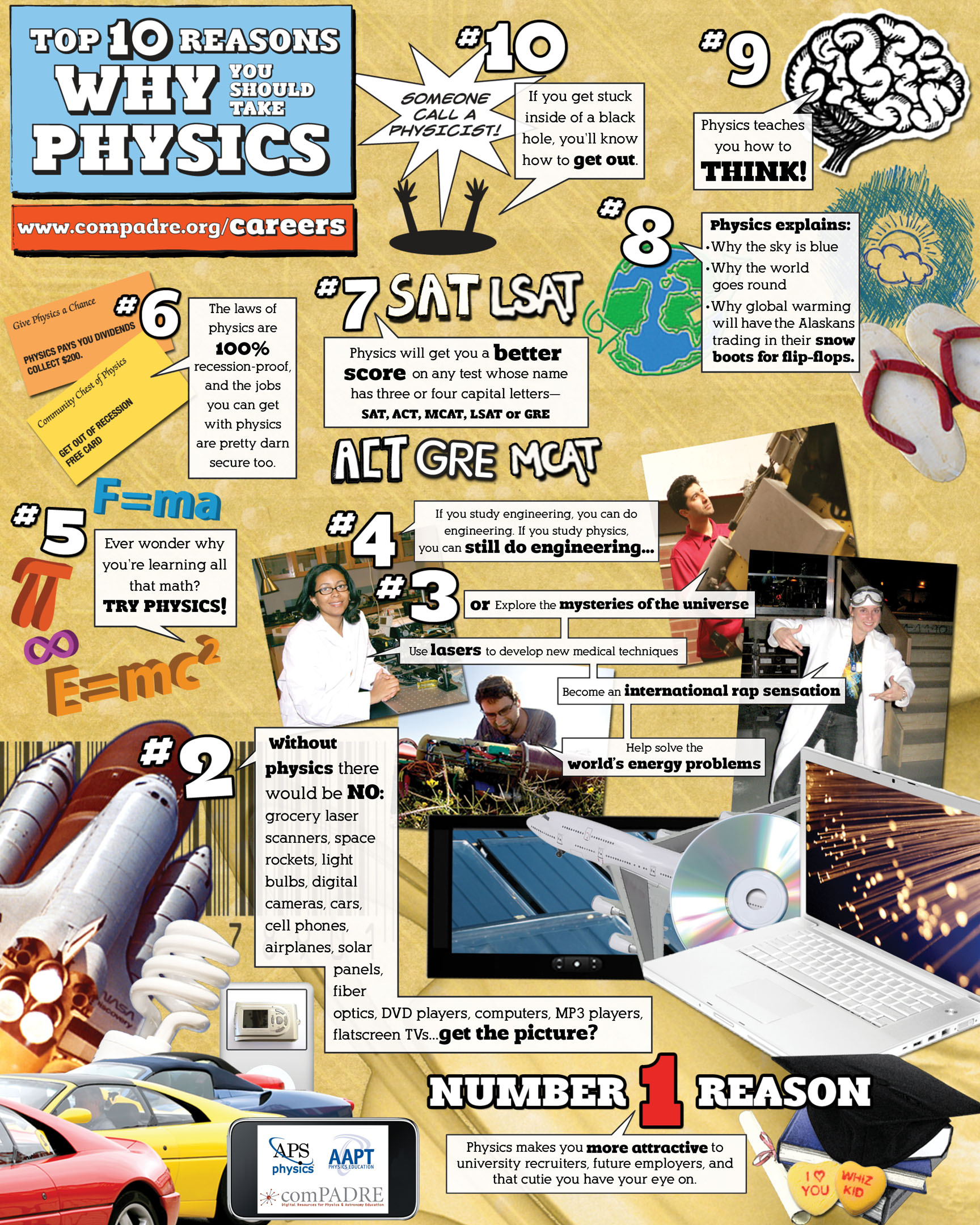
One is "The Top 10 Reasons Why You Should Take Physics."

Another is "Seven Myths About High School Physics." OK, technically, that one is a brochure. But print its two sides big, connect them, and you've got a hugenormous poster.
I recommend downloading high-resolution versions of these and printing them to the biggest paper you can handle. I have an Epson 3880 (because I'm into photography), so I can print to 17" x 22" paper. Your school might have something capable of more than that.
Print them and post them. Be aware of the high-traffic areas at your school. Think like an advertiser! Get them out into locations where they'll be seen. Don't relegate them to the window of your own classroom. That's not where your market is! Be sure to post them in the guidance counselors' office, where students are often waiting around for their appointment. There they are, with nothing to do but sit around and read the posters on the wall.
One might reasonably wonder if advertising is the way to go. Does it make your program appear desperate? No one else is advertising, why are you? (See next article.) If you are happy with your enrollments as they are or are uncomfortable stepping on the toes that might be stepped on by your campaign (again, see the article below), advertising is not for you.
If you know of a better means to higher physics enrollments, please share your ideas in the comments. I will say that my own early efforts—making presentations to the chemistry classes and even mounting a sophisticated, "Ed McMahon-style" personalized direct mail appeal—had nowhere near the efficacy of my much simpler TAKE PHYSICS campaign.
So if you're looking to promote enrollment in high school physics, I encourage you to make liberal use of the TAKE PHYSICS posters. Better yet, come up with your own; they'll likely be better than mine. (Unless you live way out on the cutting edge, though, I don't recommend designing a physics version of the old 'Expose Yourself to Art' campaign. Just throwing that out there. But if you do, please send me a copy!)
The American Association of Physics Teachers (AAPT) has designed a couple of nice posters and includes links to them on their Resources page.
One is "The Top 10 Reasons Why You Should Take Physics."
Another is "Seven Myths About High School Physics." OK, technically, that one is a brochure. But print its two sides big, connect them, and you've got a hugenormous poster.
I recommend downloading high-resolution versions of these and printing them to the biggest paper you can handle. I have an Epson 3880 (because I'm into photography), so I can print to 17" x 22" paper. Your school might have something capable of more than that.
Print them and post them. Be aware of the high-traffic areas at your school. Think like an advertiser! Get them out into locations where they'll be seen. Don't relegate them to the window of your own classroom. That's not where your market is! Be sure to post them in the guidance counselors' office, where students are often waiting around for their appointment. There they are, with nothing to do but sit around and read the posters on the wall.
One might reasonably wonder if advertising is the way to go. Does it make your program appear desperate? No one else is advertising, why are you? (See next article.) If you are happy with your enrollments as they are or are uncomfortable stepping on the toes that might be stepped on by your campaign (again, see the article below), advertising is not for you.
If you know of a better means to higher physics enrollments, please share your ideas in the comments. I will say that my own early efforts—making presentations to the chemistry classes and even mounting a sophisticated, "Ed McMahon-style" personalized direct mail appeal—had nowhere near the efficacy of my much simpler TAKE PHYSICS campaign.
Damn the torpedoes: full speed ahead!
A question about my "TAKE PHYSICS" posters recently came up on the Advanced Placement Physics Electronic Discussion Group (EDG).
(The AP Physics EDG is an old-fashioned messaging system reminiscent of Listservs. Informative and engaging, but a ploddingly slow throwback to the mid-nineties in comparison to modern fora such as those run via vBulletin and the like.)
A physics teacher had posted the TAKE PHYSICS posters on campus but was met with a volley of disapproval from colleagues in his department. To preserve harmony, he took the posters down.
I went through this turmoil years ago; it's something of a birthing process. Presenting the posters without describing potential pitfalls could be seen as reckless or irresponsible on my part. So let me post a FAQ. (If the '90s nostalgia gets any thicker, we'll need to crank up some Toad The Wet Sprocket or Gin Blossoms hits for background music.)
Why Advertise A High School Science Class?
Physics has traditionally been marginalized in the high school science sequence. Everyone takes biology. Half of biology students take chemistry. And whoever's still up for it? They take physics. That's a pipeline to disaster as far as I'm concerned. Many of the students at my school go on to college; it seemed to me that all of them on that path should have a year of physics.
High school counselors are busy enough and have many interests to serve, so I didn't want to saddle them with the responsibility of communicating my belief that all college-bound students should be in physics. If you can get counselors on your side, all the better. But it never hurts to take the message directly to your market.
What About Colleagues Within the Science Department?
The greatest friction I encountered when gearing up was from teachers of chemistry and AP Biology.
My campaign was multi-pronged, and a colleague in chemistry took exception to my changing the course description of physics to include the sentence, "Chemistry is not a prerequisite for physics." At the time, I was encountering difficulty from counselors who had a very traditional sense of the science sequence. I was looking to bypass their predilections. The chemistry colleague, I sense, was hoping to maintain market share despite the fact that honestly, chemistry is not a prerequisite for physics by any objective criterion.
Physics enrollment could reasonably be seen as a threat to AP Biology market share. In the '80s, a statement was issued from the California Community Colleges, California State University, and University of California academic senates. Its primary message for high school students was that they should take one year of biology, one year of chemistry, and one year of physics.
An attempt was made to incorporate this dictum into our own policy for AP science enrollment, but the AP Biology teachers balked. They thought it would be perfectly reasonable for a student in a four-year high school to take biology, chemistry, and AP Biology—and be done with it as far as science was concerned.
So make no mistake: in posting the TAKE PHYSICS flyers around campus during course registration, you will be stepping on some toes. But are the objections of your colleagues reasonable? Or are they meritless attempts to protect turf?
One early memory I have from a collegial scolding on the flyers was my suggestion that they advertise, too. They looked at me as if I had grown a second head. Mounting a campaign takes time and energy, and most of them had guaranteed enrollments. There was no way they were going to advertise. And since they weren't going to advertise, I shouldn't either. Status quo!
I chose to risk some bruised feelings and press ahead. Now my annual campaign is accepted as just another of my myriad quirks. When I initiated the campaign, my enrollment jumped from 4 to 6 sections.
Are There Any Pitfalls To Advertising?
Yes.
Some are obvious. Keep all the slogans and pitches positive and pro-physics. Do not tinge any of them with negativity toward biology or chemistry. Don't turn them into campaigns promoting how cool you are: you're not running for office here. Students will find out how cool you are soon enough.
Some are less obvious. When my enrollment jumped from 4 to 6 sections, there was a problem. I can only teach 5 sections. The administration offered me a 6/5ths position. More students and no prep period. The fact that I'm still alive and teaching physics lets you know I turned that down. Then the counselors asked me to draw names from a hat to determine who'd be turned down. I refused to have any part of that.
An administrator reminded me that I brought this trouble on by advertising. I reminded them that one of the reasons administrators get better chairs (and better compensation) was because they shouldered the burden of solving the problems I created. We hired an additional physics teacher the next year.
For more on this and related topics, see the posts on "recruitment."
Friday, February 25, 2011
SciVals, Take Physics, and Std posters EZ-links added
You'd think that having a week off might result in post after post of pithy pedagogical prose. But you would wrong.
The worst of it is that while my calendar insists it's already Friday, the number of items scratched off my to-do list would argue it's more like Tuesday.
Anyhow, I've added links to the "Sites, Pics, and Docs" sidebar to the right. The added links are for the Scientist Valentines, TAKE PHYSICS flyers, and the California 9-12 Physics Standards. I'd hyperlink the text in this post, but that would defeat adding the links in the sidebar.
I also gathered the links to my own content and moved them to the top because, hey, this is a blog: it's supposed to be about me!
The worst of it is that while my calendar insists it's already Friday, the number of items scratched off my to-do list would argue it's more like Tuesday.
Anyhow, I've added links to the "Sites, Pics, and Docs" sidebar to the right. The added links are for the Scientist Valentines, TAKE PHYSICS flyers, and the California 9-12 Physics Standards. I'd hyperlink the text in this post, but that would defeat adding the links in the sidebar.
I also gathered the links to my own content and moved them to the top because, hey, this is a blog: it's supposed to be about me!
Saturday, February 19, 2011
A "Race to Nowhere" student perspective
The latest edition of The Rio Mirada included a "man on the street" photo/quote piece based on the recent school showings of Race to Nowhere.
Those outside of K-12 education may not have heard of Race to Nowhere. My sense is that its release more or less coincided with Waiting for Superman. And in the marketplace of mainstream cinema, there's only room for one provocative K-12-based documentary at a time. Waiting for Superman is a big-budget, slickly-produced indictment of America's public school system. Race to Nowhere is much more modest in scope and production values. (While Superman enjoyed wide release and a John Legend soundtrack, Nowhere had a one-week theatrical run on two screens and a Weepies* soundtrack.)
Nowhere's real play has come from viewing "parties" organized in school communities. Its real market is America's "Kindergarten-to-Harvard" school communities. The film documents the pressures that mount on high-expectation students.
It turns out that some students who hope to gain admission to America's most exclusive ("elite") colleges and universities find themselves in over their heads with curricular and extra-curricular activities.
The consequences are shown: some students cheat, some drop out, some abuse prescription drugs, many are unhappy and unfulfilled. The film calls for a general "dialing it down a notch."
There are specific recommendations for students, parents, teachers, and administrators.
Although the Mirada piece polled students, it did not ask them if they were taking any of Nowhere's advice for students. Are they speaking to adults about how they feel? Are the getting plenty of sleep? Unplugging and slowing down? Limiting their extra-currilular activities? Seeking colleges that use a comprehensive [rather than objective] approach to looking at applicants? The Mirada asked none of these questions.
The one thing The Mirada did want to know was whether or not the students noticed an immediate reduction in homework assigned by teachers. I'll let readers speculate on what the resounding consensus was.
Don't get me wrong. I'm not trying to be any kind of Thaddeus Bristol here. And if I were a student who had seen Nowhere, that's what I would hope for, too: less homework and more play time.
A few years ago, The Mirada ran an article questioning the whole concept of Advanced Placement. The author wondered why anyone would subject themselves to an academically rigorous class—senior year—that culminated in paying money to take a test! The concept appeared flawed on at least three levels.
Rio's demographics have changed. And the school district has expressed an interest in removing barriers (such as preparedness tests or prerequisites) to Advanced Placement courses.
Taken together, we're hoping that more students (who don't want to take AP courses) will take AP courses, regardless of their preparation or aptitude. Once enrolled, students should not be assigned much homework and should be assessed without so many tests.
Am I a hopeless curmudgeon for not seeing how this plays out successfully? Check the comments for my perspective.
Tuesday, February 15, 2011
55,296 and counting

The Bohr, Celsius, and Curie cards got over 3000 views each. Most cards were somewhere in the 2000-range.
Seems they were pretty well received!
Sunday, February 13, 2011
Do not disturb: Teaching and learning in progress
A teacher at my school co-opted one of those ubiquitous door signs that any high school teacher will recognize. The unadulterated sign is to be placed on the door of any classroom being used for No Child Left Behind-era, state-mandated testing. This particular design was used for the recently administered California High School Exit Exam.

It cracked me up, but it also reminded me of some issues worthy of consideration. Opinions may vary; these are mine.
The presence of the sign during mandated state testing alerts potential classroom "intruders" (students delivering notes and summonses from school offices) that something special is going on behind the door. So special it is not to be interrupted.
That distinguishes it from the human warehousing that must be the usual activity behind that door. It presumes a level of pointlessness of typical classroom activity, a level that welcomes interruptions as breaks to the monotony.
Another colleague is reluctantly resigned to regard regular classroom as holding students in accessible spaces until someone of importance needs them. Nothing could ever be going on in a classroom that's so important a student would suffer from being pulled out of it.
What does the teacher in the classroom behind that sign think of the importance of state testing vs. classroom instruction? I think the sign modifications speak plainly.
What audacity to imagine teaching and learning are so important to merit uninterrupted time. Teaching and learning on the same level of priority as Testing? Sheer madness!

It cracked me up, but it also reminded me of some issues worthy of consideration. Opinions may vary; these are mine.
The presence of the sign during mandated state testing alerts potential classroom "intruders" (students delivering notes and summonses from school offices) that something special is going on behind the door. So special it is not to be interrupted.
That distinguishes it from the human warehousing that must be the usual activity behind that door. It presumes a level of pointlessness of typical classroom activity, a level that welcomes interruptions as breaks to the monotony.
Another colleague is reluctantly resigned to regard regular classroom as holding students in accessible spaces until someone of importance needs them. Nothing could ever be going on in a classroom that's so important a student would suffer from being pulled out of it.
What does the teacher in the classroom behind that sign think of the importance of state testing vs. classroom instruction? I think the sign modifications speak plainly.
What audacity to imagine teaching and learning are so important to merit uninterrupted time. Teaching and learning on the same level of priority as Testing? Sheer madness!
Subscribe to:
Posts (Atom)